Prototyping & Wireframing: Reducing Development Risk Before Code
The most expensive sentence in software development is: “We can just fix it in the next sprint.”
Imagine you are building a custom luxury home in the Hamptons. You wouldn’t let the construction crew pour the concrete foundation based on a conversation you had over coffee. You would demand blueprints, 3D renderings, and a walkthrough of the model before a single shovel hits the dirt. Yet, millions of dollars are wasted in the USA every year by founders who rush into mobile app development without a validated blueprint.
At AtheosTech, we operate on a simple principle of capital efficiency: It costs $1 to fix a problem in the design phase, $10 in the development phase, and $100 after launch.
Prototyping services are not just a “design step.” They are your insurance policy against technical debt, user abandonment, and burned capital. In a market where speed is often confused with progress, we champion precision.
We recently consulted with a promising Fintech startup in New York. They had burned through 60% of their seed round building a robust backend for a feature they assumed users wanted. When they finally launched, the user testing revealed a fatal flaw: the workflow didn’t match how financial controllers actually approved payments.
They didn’t need better code; they needed better logic.
They had skipped the rapid prototyping service phase to “save time.” Instead, they lost four months re-engineering the product. This is the Straight-to-Code Trap. In the rush to bring ideas to life, businesses often mistake activity for progress.
When you bypass prototype design services, you are essentially gambling with your development budget. You are betting that your initial assumption about user behavior is 100% correct. In our experience, that bet rarely pays off.
To mitigate this risk, we must distinguish between the “Skeleton” and the “Simulation.” Many founders conflate wireframes with prototypes, but they serve two distinct, critical functions in the product design lifecycle.
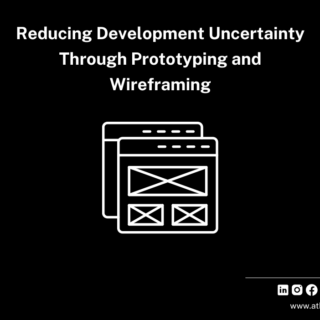
Wireframes are low-fidelity blueprints. They strip away the distraction of color, imagery, and typography to focus purely on layout, hierarchy, and information architecture. This is where we determine if the design elements, like the CTA button or the navigation bar, are logically placed.
Think of wireframing as the floor plan of your house. It tells you where the walls are, where the doors open, and how traffic flows from the kitchen to the living room. It doesn't tell you what color the paint is.
This is where prototyping services transform static images into a digital product that feels alive. High-fidelity prototypes mimic the final application almost perfectly. You can click buttons, open menus, scroll through feeds, and swipe through screens.
It creates a resemblance to the final product experience without writing a single line of production code. It allows ui ux designers and stakeholders to "test drive" the car before building the engine. This is the difference between looking at a picture of a Ferrari and sitting in the driver's seat.
Wireframes are low-fidelity blueprints. They strip away the distraction of color, imagery, and typography to focus purely on layout, hierarchy, and information architecture. This is where we determine if the design elements, like the CTA button or the navigation bar, are logically placed.
Think of wireframing as the floor plan of your house. It tells you where the walls are, where the doors open, and how traffic flows from the kitchen to the living room. It doesn't tell you what color the paint is.
This is where prototyping services transform static images into a digital product that feels alive. High-fidelity prototypes mimic the final application almost perfectly. You can click buttons, open menus, scroll through feeds, and swipe through screens.
It creates a resemblance to the final product experience without writing a single line of production code. It allows ui ux designers and stakeholders to "test drive" the car before building the engine. This is the difference between looking at a picture of a Ferrari and sitting in the driver's seat.
When stakeholders look at a static image (a flat design), they nod their heads. When they hold a clickable prototype in their hands, they start asking the right questions. This is because humans interact with digital products dynamically, not statically.
Without professional prototype development services, businesses face three avoidable disasters:
Without a visualized boundary, features keep getting added during development. "Can we just add a social share button here?" seems like a small request, but in code, it adds days. In a prototype, it takes minutes.
On paper, a three-step checkout looks fine. In practice, users interact with it and find it frustratingly slow. You can’t feel friction on a PDF. You need to touch it to understand the potential issues.
Showing an investor a slide deck is okay. Handing them a phone with a working rapid prototyping service model creates an emotional buy-in that slides can never achieve. It proves you are past the "idea" stage and into the "execution" stage.
When stakeholders look at a static image (a flat design), they nod their heads. When they hold a clickable prototype in their hands, they start asking the right questions. This is because humans interact with digital products dynamically, not statically.
Without professional prototype development services, businesses face three avoidable disasters:
Without a visualized boundary, features keep getting added during development. "Can we just add a social share button here?" seems like a small request, but in code, it adds days. In a prototype, it takes minutes.
On paper, a three-step checkout looks fine. In practice, users interact with it and find it frustratingly slow. You can’t feel friction on a PDF. You need to touch it to understand the potential issues.
Showing an investor a slide deck is okay. Handing them a phone with a working rapid prototyping service model creates an emotional buy-in that slides can never achieve. It proves you are past the "idea" stage and into the "execution" stage.
Data tells you what users might do; psychology tells you why they will do it.
We use prototyping services to validate user intent. When a user interacts with a prototype, we aren’t just looking for bugs; we are looking for hesitation.
This is the psychological layer of the development process. By using rapid prototyping services, we can test the cognitive load of the app. If the interface makes the user “think” too hard, we simplify it.
We test and iterate. We look for the “Thumb Zone”, which is the primary action easily reachable with one hand. We check for “Visual Hierarchy“, does the user know exactly where to look first? We refine the flow until it creates a user-friendly experience that feels intuitive, not learned.
This phase is about gathering feedback on human behavior, not just software function.
“Are you ready to visualize your success before you pay for it?”
The true value of Rapid Prototyping Service & Wireframing is the ability to pivot cheaply. Here are two examples of how we saved clients from costly mistakes.
A logistics client wanted a complex iPad dashboard showing 50+ data points for fleet managers.
The ROI: This decision, made in days, not months, saved an estimated $80,000 in frontend rework. If we had coded the original version, the product would have failed upon launch.
A lifestyle brand wanted a “Tinder-style” swipe interface for shopping.
The ROI: By gathering feedback early, we avoided launching a “cool” app that couldn’t convert sales. We validated the mechanism before the expensive engineering began.
We don’t guess. We engineer certainty. Our complete prototype services follow a rigorous framework designed to protect your ROI and ensure market fit.
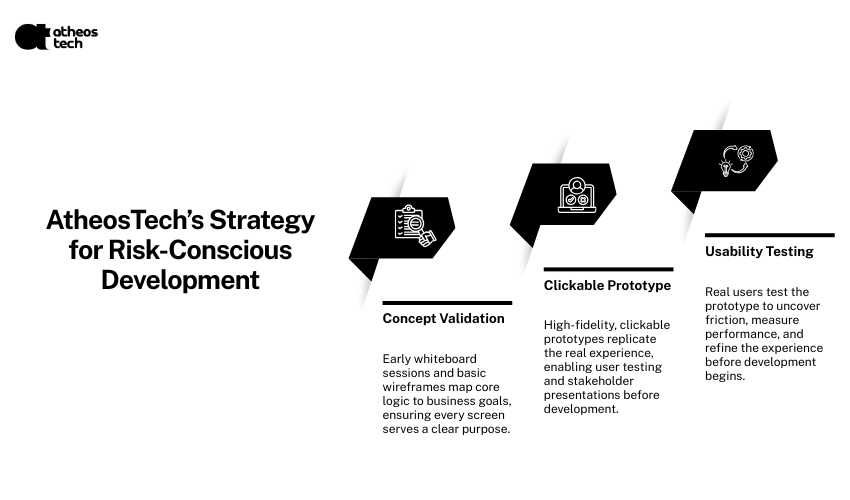
We start with whiteboard sessions and grey-box wireframes. We map the design processes to business goals. Does this screen drive revenue? If not, why is it there? We strip the idea down to its raw logic.
We build high-fidelity prototypes that look and feel like the real deal. We use tools like Figma or Adobe XD to create clickable models that allow users interact with the interface on their actual devices. This is the version you show to your board of directors or use to secure your Series A funding.
We put the prototype in front of real users. We look for potential issues in the flow. We test and iterate. We don’t move to the development process until the prototype converts. We measure time-on-task and error rates. If the user struggles, the design fails, and we fix it instantly.
We start with whiteboard sessions and grey-box wireframes. We map the design processes to business goals. Does this screen drive revenue? If not, why is it there? We strip the idea down to its raw logic.
We build high-fidelity prototypes that look and feel like the real deal. We use tools like Figma or Adobe XD to create clickable models that allow users interact with the interface on their actual devices. This is the version you show to your board of directors or use to secure your Series A funding.
We put the prototype in front of real users. We look for potential issues in the flow. We test and iterate. We don’t move to the development process until the prototype converts. We measure time-on-task and error rates. If the user struggles, the design fails, and we fix it instantly.
Most agencies treat prototyping as a “visual check.” We treat it as a “revenue check.”
Prototyping services allow us to test your Conversion Architecture.
By validating these elements early, we are saving time and ensuring that when the code is finally written, it is being written for a product that is already proven to work. This bridges the gap between early-stage concepts and final designs that actually drive profit.
You cannot afford to find out that your checkout flow is confusing after you have launched. That is a mistake that costs you users who will never return.
In the high-stakes world of digital product launches, hope is not a strategy. Precision is.
You can choose to spend tens of thousands of dollars fixing code six months from now, or you can invest in prototype design services today to validate your vision.
Prototyping services are the ultimate leverage. They allow you to fail fast, fix cheap, and launch with confidence. They buy you time and money, the two most valuable resources a founder has.
AtheosTech is ready to turn your vision into a tangible, testable reality. Don’t build until you know it works.
Skipping prototyping services is often a false economy. While it feels faster to start mobile app development day one, it typically leads to "Scope Creep" and expensive code rewrites later. At AtheosTech, we view rapid prototyping service & wireframing as an insurance policy. It allows you to identify and fix potential issues for pennies on the dollar before they become expensive engineering problems.
Think of a wireframe as the architectural blueprint,it shows the structure, layout, and design elements without the cosmetic details. A high-fidelity prototype, on the other hand, is the 3D walkthrough. It allows users to interact with the interface, click buttons, and experience the flow. It is a digital product simulation that resembles the final product almost perfectly, allowing for deep user testing.
Investors don't fund ideas; they fund execution. Showing a slide deck is standard, but putting a working, clickable model in an investor's hand via our rapid prototyping services creates emotional buy-in. It proves you have validated the user-friendly experience and have a clear vision of the final designs, significantly derisking their investment in your early-stage venture.
Absolutely. A prototype exists to be broken and fixed. We use rapid prototyping services to gather feedback from real users in your target audience. We watch how they navigate, where they hesitate, and what they ignore. We then test and iterate on that data. This ensures that when we finally move to the development process, we are building a product that is already proven to convert.
Prototype development services are designed for speed. While full mobile app development can take months, a rapid prototyping service can deliver a testable model in weeks. This allows you to validate your business logic and product design quickly, saving time and ensuring that your capital is focused on features that actually drive ROI.
Adding {{itemName}} to cart
Added {{itemName}} to cart