- AtheosTech
Understanding Trustless Systems in Blockchain: A Beginner’s Guide
How Blockchain Replaces Human Trust with Code, Consensus, and Cryptography
Key Takeaways
Key Takeaways
- Trustless systems remove reliance on a centralized authority, relying on code, cryptography, and decentralized networks.
- Consensus mechanisms such as proof of work and proof of stake validate transactions and protect the integrity of every previous block.
- Smart contracts enable automated, verifiable actions without intermediaries, minimizing risk and enhancing transparency.
- Blockchain technology allows secure, immutable transactions, improving trust and efficiency in applications such as Blockchain App Development and financial systems.
- Businesses benefit from adopting blockchain consulting services and collaborating with blockchain development companies for secure, scalable solutions.
Defining Trust-Based Systems
Historically, human interactions relied heavily on trust. Banks, trading platforms, and payment apps operate on a trust-based model:
- Depositing funds in a bank requires trust that the bank safeguards and returns the money.
- Initiating trades on platforms like Robinhood depends on the platform executing transactions correctly.
- Sending funds via Venmo requires trust that the payment reaches the intended recipient.
Trust-based systems are prone to failure. Financial crises, corruption, and system manipulation highlight the limits of relying solely on human-controlled institutions.
Blockchain technology introduces an alternative: a trustless system where reliance on intermediaries and human judgment is replaced by transparent, verifiable code.
What Are Trustless Systems?
A trustless system does not eliminate trust entirely. Instead, it transfers trust from individuals or institutions to protocols and algorithms.
In blockchain networks:
- Participants can independently verify transactions.
- Algorithms, cryptography, and consensus mechanisms validate every block.
- Transparency ensures every node in the decentralized network has access to the same information.
This structure allows participants with differing values and backgrounds to transact securely without centralized oversight.
Importance of Blockchain Technology
Trustless systems are foundational for blockchain development services and modern decentralized applications. Key advantages include:
- Eliminating intermediaries: Transactions occur directly between parties, reducing delays and costs.
- Fraud reduction: Every transaction is recorded immutably, making alteration or falsification nearly impossible.
- Automation through smart contracts: Agreements execute automatically according to predefined rules, enabling applications in finance, real estate, and supply chains.
Benefits of Trustless Transactions
Increased Security
Decentralized networks and cryptographic verification protect against hacking and fraud. Each transaction is independently verified, reducing the potential for malicious activity.
Enhanced Transparency
Transactions are publicly accessible on the blockchain. Businesses and individuals can verify data integrity without relying on a central authority. Transparency fosters accountability and trust in the system itself.
Minimizing Risk
Trustless architecture reduces single points of failure. No central authority can alter records, block transactions, or manipulate protocol rules. This design makes blockchain networks inherently resilient.
Increased Security
Decentralized networks and cryptographic verification protect against hacking and fraud. Each transaction is independently verified, reducing the potential for malicious activity.
Enhanced Transparency
Transactions are publicly accessible on the blockchain. Businesses and individuals can verify data integrity without relying on a central authority. Transparency fosters accountability and trust in the system itself.
Minimizing Risk
Trustless architecture reduces single points of failure. No central authority can alter records, block transactions, or manipulate protocol rules. This design makes blockchain networks inherently resilient.
How Smart Contracts Enable Trustless Systems
Smart contracts are self-executing code deployed on the blockchain.
- They verify identities, trigger actions, and enforce agreements.
- Once deployed, contracts are immutable, preventing unauthorized changes.
- Applications include decentralized lending, automated royalties, and Blockchain App Development.
Smart contracts allow safe transactions between unknown parties without intermediaries, embedding trust directly into technology.
Every transaction, contract deployment, and protocol rule is publicly visible.
- Token supply and network activity can be verified directly.
- Platforms demonstrate decentralization through visible node activity.
- Transparency encourages education, participation, and scrutiny, reinforcing trust in the system.
- Code vulnerabilities may exist, requiring careful auditing.
- Communities maintaining protocols must act responsibly.
- Technical complexity and governance mechanisms can introduce challenges.
- Energy consumption may be high in consensus mechanisms like proof of work.
Trustless systems shift trust from individuals to protocols, requiring knowledge and diligence to ensure security and efficiency.
How Smart Contracts Enable Trustless Systems
Smart contracts are self-executing code deployed on the blockchain.
- They verify identities, trigger actions, and enforce agreements.
- Once deployed, contracts are immutable, preventing unauthorized changes.
- Applications include decentralized lending, automated royalties, and Blockchain App Development.
Smart contracts allow safe transactions between unknown parties without intermediaries, embedding trust directly into technology.
Every transaction, contract deployment, and protocol rule is publicly visible.
- Token supply and network activity can be verified directly.
- Platforms demonstrate decentralization through visible node activity.
- Transparency encourages education, participation, and scrutiny, reinforcing trust in the system.
- Code vulnerabilities may exist, requiring careful auditing.
- Communities maintaining protocols must act responsibly.
- Technical complexity and governance mechanisms can introduce challenges.
- Energy consumption may be high in consensus mechanisms like proof of work.
Trustless systems shift trust from individuals to protocols, requiring knowledge and diligence to ensure security and efficiency.
Types of Blockchain Networks
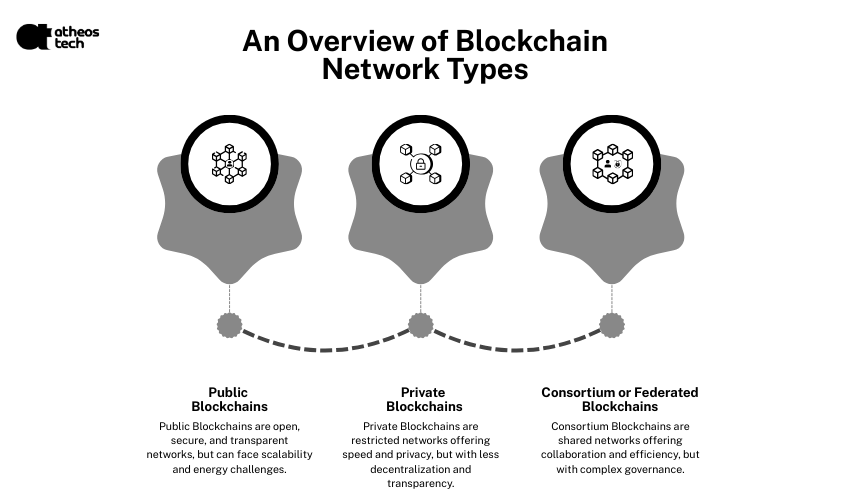
Public Blockchains
Open networks where anyone can participate. Transactions are transparent, decentralized, and secure. Examples: Bitcoin, Ethereum.
Advantages: decentralization, transparency, security
Disadvantages: scalability limits, energy consumption
Private Blockchains
Restricted networks with authorized participants. Faster transactions and privacy advantages are often used in enterprise applications like healthcare or finance.
Advantages: speed, privacy, centralized control
Disadvantages: reduced decentralization, lower transparency
Consortium or Federated Blockchains
Hybrid networks are maintained by a group of organizations. Suitable for industries where multiple parties share data, such as supply chain management..
Advantages: collaboration, efficiency, transparency.
Disadvantages: governance complexity, potential centralization
Public Blockchains
Open networks where anyone can participate. Transactions are transparent, decentralized, and secure. Examples: Bitcoin, Ethereum.
Advantages: decentralization, transparency, security
Disadvantages: scalability limits, energy consumption
Private Blockchains
Restricted networks with authorized participants. Faster transactions and privacy advantages are often used in enterprise applications like healthcare or finance.
Advantages: speed, privacy, centralized control
Disadvantages: reduced decentralization, lower transparency
Consortium or Federated Blockchains
Hybrid networks are maintained by a group of organizations. Suitable for industries where multiple parties share data, such as supply chain management..
Advantages: collaboration, efficiency, transparency.
Disadvantages: governance complexity, potential centralization
Blockchain Applications and Use Cases
- Cryptocurrencies and Digital Assets
- Smart Contracts and Decentralized Applications (dApps)
- Supply Chain Management
- Identity Management
- Other Industries
Blockchain enables secure, transparent, and decentralized financial transactions without intermediaries. Cryptocurrencies like Bitcoin and Ethereum allow instant peer-to-peer transfers, lower transaction fees, and protection against fraud. Beyond payments, digital assets such as tokenized stocks, NFTs, and stablecoins demonstrate how blockchain technology can redefine ownership, investment, and value transfer across global markets.
Smart contracts are self-executing programs stored on the blockchain. They verify identities, enforce agreements, and trigger actions automatically. Decentralized applications leverage these contracts to operate without centralized oversight, providing transparency and reducing risk. Use cases span financial services, insurance, gaming, supply chain logistics, and digital content rights management, where automated, verifiable execution of agreements ensures fairness and reliability.
Blockchain ensures the complete traceability of goods from origin to delivery. Companies can track raw materials, manufacturing stages, and final distribution without relying on a centralized authority. This reduces counterfeit products, improves accountability, and increases operational efficiency. Industries such as food, pharmaceuticals, and luxury goods benefit significantly from enhanced provenance tracking and automated audit trails.
Decentralized identity solutions allow individuals to own, control, and selectively share personal data. Blockchain eliminates reliance on central authorities for verification, reducing the risk of identity theft and data breaches. Secure digital identities facilitate access to banking, healthcare, government services, and online platforms while maintaining privacy and verifiable trust in a trustless system.
Blockchain technology extends beyond finance and identity to transform multiple sectors:
- Healthcare: Secure patient records, medical supply chain tracking, and clinical trial transparency.
- Real Estate: Automated property transactions, title verification, and reduction of fraud.
- Voting: Tamper-proof, transparent, and verifiable electoral systems.
- Energy: Peer-to-peer energy trading, efficient energy market operations, and integration of renewable sources.
- Insurance: Automated claims processing, fraud reduction, and creation of smart-contract-based insurance products.
These applications highlight the flexibility of blockchain technology and the potential for blockchain development services and Blockchain App Development companies to create innovative, secure, and scalable solutions across industries.
- Cryptocurrencies and Digital Assets
- Smart Contracts and Decentralized Applications (dApps)
- Supply Chain Management
- Identity Management
- Other Industries
Blockchain enables secure, transparent, and decentralized financial transactions without intermediaries. Cryptocurrencies like Bitcoin and Ethereum allow instant peer-to-peer transfers, lower transaction fees, and protection against fraud. Beyond payments, digital assets such as tokenized stocks, NFTs, and stablecoins demonstrate how blockchain technology can redefine ownership, investment, and value transfer across global markets.
Smart contracts are self-executing programs stored on the blockchain. They verify identities, enforce agreements, and trigger actions automatically. Decentralized applications leverage these contracts to operate without centralized oversight, providing transparency and reducing risk. Use cases span financial services, insurance, gaming, supply chain logistics, and digital content rights management, where automated, verifiable execution of agreements ensures fairness and reliability.
Blockchain ensures the complete traceability of goods from origin to delivery. Companies can track raw materials, manufacturing stages, and final distribution without relying on a centralized authority. This reduces counterfeit products, improves accountability, and increases operational efficiency. Industries such as food, pharmaceuticals, and luxury goods benefit significantly from enhanced provenance tracking and automated audit trails.
Decentralized identity solutions allow individuals to own, control, and selectively share personal data. Blockchain eliminates reliance on central authorities for verification, reducing the risk of identity theft and data breaches. Secure digital identities facilitate access to banking, healthcare, government services, and online platforms while maintaining privacy and verifiable trust in a trustless system.
Blockchain technology extends beyond finance and identity to transform multiple sectors:
- Healthcare: Secure patient records, medical supply chain tracking, and clinical trial transparency.
- Real Estate: Automated property transactions, title verification, and reduction of fraud.
- Voting: Tamper-proof, transparent, and verifiable electoral systems.
- Energy: Peer-to-peer energy trading, efficient energy market operations, and integration of renewable sources.
- Insurance: Automated claims processing, fraud reduction, and creation of smart-contract-based insurance products.
These applications highlight the flexibility of blockchain technology and the potential for blockchain development services and Blockchain App Development companies to create innovative, secure, and scalable solutions across industries.
Building in a Trustless Environment
Designing and developing applications for a trustless system requires careful planning and adherence to blockchain principles. Every component must ensure security, transparency, and scalability while maintaining decentralization. Key considerations include:
Smart contracts form the backbone of trustless systems. Their code must be precise, thoroughly tested, and continuously monitored. Regular auditing identifies vulnerabilities, ensures smart contracts execute as intended, and prevents exploits that could compromise the network. Maintenance plans must account for updates while preserving immutability and transparency. Blockchain App Development companies play a critical role in creating secure, reliable contracts that enforce agreements autonomously.
Deciding which data is stored on-chain versus off-chain affects security, performance, and scalability. Sensitive information or high-volume data may be stored off-chain with cryptographic proofs linking it to the blockchain. On-chain storage ensures transparency, immutability, and verifiability of essential records. Balancing these considerations is vital for efficient and secure Blockchain Software Development.
Trustless systems require secure handling of identities without relying on a centralized authority. Decentralized identity protocols allow participants to verify themselves while retaining control over personal data. Systems must prevent unauthorized access, fraud, or misuse, while enabling smooth interactions between users and applications.
Even in trustless environments, networks evolve. Establishing transparent governance frameworks ensures decisions about upgrades, protocol changes, and dispute resolution maintain decentralization and community trust. Proper governance structures prevent centralization and protect the integrity of the blockchain network.
Launching a trustless application requires guidance from experienced professionals. Blockchain consulting services provide strategic insights into architecture, security, and compliance, while the Blockchain Software Development Company's expertise ensures technical execution aligns with business goals. Collaboration with these services enables scalable, secure, and future-ready solutions, whether for financial platforms, supply chain management, or decentralized applications.
Building in a Trustless Environment
Designing and developing applications for a trustless system requires careful planning and adherence to blockchain principles. Every component must ensure security, transparency, and scalability while maintaining decentralization. Key considerations include:
Smart contracts form the backbone of trustless systems. Their code must be precise, thoroughly tested, and continuously monitored. Regular auditing identifies vulnerabilities, ensures smart contracts execute as intended, and prevents exploits that could compromise the network. Maintenance plans must account for updates while preserving immutability and transparency. Blockchain App Development companies play a critical role in creating secure, reliable contracts that enforce agreements autonomously.
Deciding which data is stored on-chain versus off-chain affects security, performance, and scalability. Sensitive information or high-volume data may be stored off-chain with cryptographic proofs linking it to the blockchain. On-chain storage ensures transparency, immutability, and verifiability of essential records. Balancing these considerations is vital for efficient and secure Blockchain Software Development.
Trustless systems require secure handling of identities without relying on a centralized authority. Decentralized identity protocols allow participants to verify themselves while retaining control over personal data. Systems must prevent unauthorized access, fraud, or misuse, while enabling smooth interactions between users and applications.
Even in trustless environments, networks evolve. Establishing transparent governance frameworks ensures decisions about upgrades, protocol changes, and dispute resolution maintain decentralization and community trust. Proper governance structures prevent centralization and protect the integrity of the blockchain network.
Launching a trustless application requires guidance from experienced professionals. Blockchain consulting services provide strategic insights into architecture, security, and compliance, while the Blockchain Software Development Company's expertise ensures technical execution aligns with business goals. Collaboration with these services enables scalable, secure, and future-ready solutions, whether for financial platforms, supply chain management, or decentralized applications.
Conclusion
Trustless systems reshape the way digital interactions occur, replacing human-dependent trust with verified protocols. Blockchain technology ensures transparency, security, and fairness across decentralized networks. Applications in blockchain app development, financial services, and identity management demonstrate the potential of these systems.
Expert guidance from blockchain development companies, consulting services, and Web3 Development Companies ensures that trustless systems are implemented effectively, minimizing risks and maximizing scalability.
AtheosTech represents an example of expertise enabling businesses to navigate trustless environments successfully.
FAQ's
A trustless system is a digital environment where participants do not need to rely on a centralized authority or intermediaries. Transactions are verified through algorithms, cryptography, and consensus mechanisms, ensuring transparency, security, and immutability. Trust resides in the technology, not individuals.
Smart contracts are self-executing code deployed on the blockchain. They verify identities, enforce agreements, and trigger actions automatically when predefined conditions are met. Once deployed, smart contracts are immutable, providing reliability without the need for human oversight.
Blockchain stores transactions on a decentralized network, making them publicly accessible and verifiable. Every participant can review ledger entries, smart contracts, and updates, creating accountability without relying on centralized oversight.
Trustless systems reduce reliance on humans and intermediaries but do not entirely eliminate oversight. Developers must write and audit code correctly, communities must maintain protocols responsibly, and users must manage keys securely. The system shifts trust from individuals to technology, protocols, and decentralized networks, ensuring reliability and transparency while minimizing human error.
Successful deployment requires careful consideration of smart contract development, on-chain vs off-chain data management, user identity protocols, and governance structures. Partnering with blockchain consulting services, Blockchain Software Development Company, or a Web3 Development Company ensures applications are secure, scalable, and aligned with industry best practices.
FAQ's
A trustless system is a digital environment where participants do not need to rely on a centralized authority or intermediaries. Transactions are verified through algorithms, cryptography, and consensus mechanisms, ensuring transparency, security, and immutability. Trust resides in the technology, not individuals.
Smart contracts are self-executing code deployed on the blockchain. They verify identities, enforce agreements, and trigger actions automatically when predefined conditions are met. Once deployed, smart contracts are immutable, providing reliability without the need for human oversight.
Blockchain stores transactions on a decentralized network, making them publicly accessible and verifiable. Every participant can review ledger entries, smart contracts, and updates, creating accountability without relying on centralized oversight.
Trustless systems reduce reliance on humans and intermediaries but do not entirely eliminate oversight. Developers must write and audit code correctly, communities must maintain protocols responsibly, and users must manage keys securely. The system shifts trust from individuals to technology, protocols, and decentralized networks, ensuring reliability and transparency while minimizing human error.
Successful deployment requires careful consideration of smart contract development, on-chain vs off-chain data management, user identity protocols, and governance structures. Partnering with blockchain consulting services, Blockchain Software Development Company, or a Web3 Development Company ensures applications are secure, scalable, and aligned with industry best practices.