Prototyping & Wireframing: Reducing Development Risk Before Code
Modern digital marketing frequently prioritizes traffic acquisition and audience reach. Paid campaigns, organic search visibility, and content distribution successfully generate impressions and visits across the top of the funnel.
However, visibility alone does not represent business performance. Large visitor numbers may exist alongside minimal inquiries, weak engagement, and limited revenue contribution. This imbalance indicates that the primary limitation is conversion efficiency rather than marketing reach.
Conversion rate optimization CRO addresses this structural weakness.
CRO examines behavior after arrival, evaluates friction within interaction pathways, and refines the environment so that attention progresses toward meaningful commercial action.
Without CRO, marketing remains activity-driven.
With CRO, marketing becomes outcome-driven.
Increasing marketing investment often creates an expectation of proportional revenue growth.
In practice, expenditure may rise while qualified leads remain stagnant.
Common patterns include:
These conditions demonstrate inefficiency within channel selection, messaging clarity, or buyer journey structure.
CRO provides analytical evaluation that determines whether the investment targets the correct audience and whether the post-click experience supports higher conversion.
This diagnostic function prevents continued spending within non-performing acquisition paths, preserving resources and restoring strategic direction.
Conversion challenges frequently originate from a missing foundational marketing structure.
Execution that begins without strategic clarity produces fragmentation, inconsistency, and reduced commercial impact.

Lack of precise segmentation disperses messaging across broad, low-intent audiences.
Marketing effort fails to concentrate on qualified leads most likely to convert, reducing efficiency and increasing acquisition costs.
Weak articulation of differentiated value prevents meaningful brand positioning.
Prospective buyers cannot easily understand why a solution is superior or relevant.
This uncertainty slows decision-making and restricts revenue growth potential.
When segmentation and value clarity remain undefined, CRO inherits unstable groundwork, limiting optimization effectiveness
These elements establish the necessary base for successful CRO execution.
Conversion challenges frequently originate from a missing foundational marketing structure.
Execution that begins without strategic clarity produces fragmentation, inconsistency, and reduced commercial impact.
Lack of precise segmentation disperses messaging across broad, low-intent audiences.
Marketing effort fails to concentrate on qualified leads most likely to convert, reducing efficiency and increasing acquisition costs.
Weak articulation of differentiated value prevents meaningful brand positioning.
Prospective buyers cannot easily understand why a solution is superior or relevant.
This uncertainty slows decision-making and restricts revenue growth potential.
When segmentation and value clarity remain undefined, CRO inherits unstable groundwork, limiting optimization effectiveness
These elements establish the necessary base for successful CRO execution.
Tactical activity implemented before strategic alignment creates inefficient revenue systems.
Campaigns may operate across multiple channels while lacking unified direction.
Primary consequences include:
Strategic coordination between sales and marketing ensures that each action contributes toward measurable commercial outcomes rather than isolated activity.
Such alignment transforms fragmented execution into cohesive growth infrastructure.

Tactical activity implemented before strategic alignment creates inefficient revenue systems.
Campaigns may operate across multiple channels while lacking unified direction.
Primary consequences include:
Strategic coordination between sales and marketing ensures that each action contributes toward measurable commercial outcomes rather than isolated activity.
Such alignment transforms fragmented execution into cohesive growth infrastructure.
Strong CRO performance depends on well-established marketing fundamentals. When foundational components remain weak, optimization cannot deliver full impact.
Essential foundations include:
Absence of clarity regarding decision stages produces ineffective funnel structure and inconsistent engagement. Prospects may encounter friction, uncertainty, or missing information that interrupts conversion momentum.
Limited credibility reduces trust, slowing purchase decisions and lowering long-term loyalty. Revenue systems remain unstable without recognizable authority. Investment in foundational marketing, therefore, supports sustainable growth and long-term CRO effectiveness.
Strong CRO performance depends on well-established marketing fundamentals. When foundational components remain weak, optimization cannot deliver full impact.
Essential foundations include:
Absence of clarity regarding decision stages produces ineffective funnel structure and inconsistent engagement. Prospects may encounter friction, uncertainty, or missing information that interrupts conversion momentum.
Limited credibility reduces trust, slowing purchase decisions and lowering long-term loyalty. Revenue systems remain unstable without recognizable authority. Investment in foundational marketing, therefore, supports sustainable growth and long-term CRO effectiveness.
Failure of marketing to convert typically occurs within the middle or bottom stages of the funnel.
The root cause often lies beyond traffic generation.
Frequent breakdowns include:
These disruptions interrupt momentum across the sales and marketing relationship, preventing progression toward revenue.
CRO restores continuity by establishing:
This structure converts passive interest into active commercial engagement.
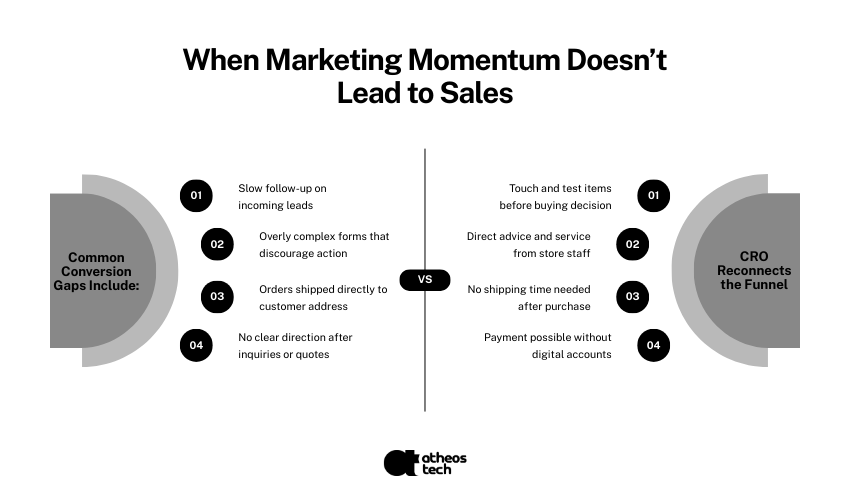
Failure of marketing to convert typically occurs within the middle or bottom stages of the funnel.
The root cause often lies beyond traffic generation.
Frequent breakdowns include:
These disruptions interrupt momentum across the sales and marketing relationship, preventing progression toward revenue.
CRO restores continuity by establishing:
This structure converts passive interest into active commercial engagement.
Conversion rate optimization CRO integrates data-driven analysis, structured experimentation, and continuous refinement of user experience.
This integration produces measurable advantages:
Because CRO maximizes value from existing demand, it represents core operational infrastructure rather than an optional enhancement.
Conversion rate optimization CRO is the decisive mechanism that transforms marketing visibility into confirmed revenue performance.
Strategic foundation, aligned execution, strong marketing fundamentals, and friction-free buyer journey design collectively create higher conversion, operational clarity, and sustainable growth.
Organizations that integrate CRO with professional SEO services establish long-term commercial stability and scalable performance grounded in data-driven precision.
Strategic implementation supported by AtheosTech enables unified alignment between marketing and sales while strengthening measurable revenue outcomes across the entire buyer journey.
Conversion Rate Optimization (CRO) is a structured process that improves the percentage of visitors who complete meaningful business actions such as inquiries, purchases, or registrations. CRO is essential because marketing traffic alone does not guarantee revenue. Higher conversion efficiency directly supports revenue growth, qualified lead generation, and sustainable long-term performance.
Marketing generates awareness and traffic at the top of the funnel, while sales teams focus on closing qualified opportunities. CRO creates alignment between both functions by improving user experience, refining messaging, and removing friction across the buyer journey. This connection transforms traffic into measurable business results and predictable revenue contribution.
CRO relies on behavioral analysis, structured testing, and continuous optimization. Sustainable improvement requires validated data, consistent experimentation, and strategic refinement. Quick wins may appear in early stages, but lasting performance gains emerge from disciplined, long-term optimization guided by measurable insights.
Small business environments often operate with limited marketing budgets, making efficiency critical. CRO increases the value of existing traffic generated through professional SEO services, organic SEO services, and search engine marketing company initiatives. Improved conversion performance reduces acquisition cost and strengthens overall marketing return.
An effective CRO framework includes user experience optimization, clear value communication, trust-building design, fast technical performance, and structured testing methodologies. Alignment with marketing strategy, sales intent, and product-market expectations ensures higher conversion outcomes and consistent revenue growth.
Conversion Rate Optimization (CRO) is a structured process that improves the percentage of visitors who complete meaningful business actions such as inquiries, purchases, or registrations. CRO is essential because marketing traffic alone does not guarantee revenue. Higher conversion efficiency directly supports revenue growth, qualified lead generation, and sustainable long-term performance.
Marketing generates awareness and traffic at the top of the funnel, while sales teams focus on closing qualified opportunities. CRO creates alignment between both functions by improving user experience, refining messaging, and removing friction across the buyer journey. This connection transforms traffic into measurable business results and predictable revenue contribution.
CRO relies on behavioral analysis, structured testing, and continuous optimization. Sustainable improvement requires validated data, consistent experimentation, and strategic refinement. Quick wins may appear in early stages, but lasting performance gains emerge from disciplined, long-term optimization guided by measurable insights.
Small business environments often operate with limited marketing budgets, making efficiency critical. CRO increases the value of existing traffic generated through professional SEO services, organic SEO services, and search engine marketing company initiatives. Improved conversion performance reduces acquisition cost and strengthens overall marketing return.
An effective CRO framework includes user experience optimization, clear value communication, trust-building design, fast technical performance, and structured testing methodologies. Alignment with marketing strategy, sales intent, and product-market expectations ensures higher conversion outcomes and consistent revenue growth.
Adding {{itemName}} to cart
Added {{itemName}} to cart