- AtheosTech
AI Adoption Is a Leadership Problem, Not a Technology One
Why leadership clarity, not tools, determines whether AI transforms or stalls
Artificial intelligence is not failing because the tools are weak.
It’s failing because leadership is unprepared for the responsibility that comes with it.
Across modern technology companies, AI initiatives are launched with ambition, powered by advanced AI tools, supported by data teams, and aligned with broader digital transformation goals. Many of these initiatives even sit alongside Blockchain development services, as organizations attempt to modernize decision-making, security, and trust at the same time. Yet adoption stalls. Employees hesitate. Outcomes remain incremental instead of transformational.
The problem isn’t AI capability.
It’s leadership clarity.
At AtheosTech, a company operating at the intersection of digital technologies, AI, Web3, and Blockchain development services, we consistently see that successfulAIi transformations depend far less on software and far more on how leaders guide people through uncertainty, redefine accountability, and build confidence across teams.
AI adoption is not a technical challenge.
It is a leadership challenge with long-term consequences.
Why Technology Alone Cannot Solve Business Problems
Most organizations start AI initiatives with the same flawed assumption: better technology will automatically fix existing business problems.
So they invest in platforms, automate workflows, and expect outcomes to improve on their own. But technology does not operate in isolation. It operates inside people, processes, and power structures.
Without leadership direction:
- AI insights go unused
- Decisions remain instinct-driven
- Teams hesitate to trust outputs
- Innovation stays trapped in silos
This is equally true in Web3 initiatives. Companies partner with a blockchain development agency or a Web3 Development Company, yet struggle to see returns. The reason is identical: leadership never redesigned how decisions are made, owned, and rewarded.
Technology amplifies leadership behavior.
If leadership is unclear, technology magnifies the confusion.
AI Adoption Is a Human Experience Before It Is a Technical One
For employees, AI adoption does not feel like innovation; it feels like uncertainty.
When leaders introduce AI without context, teams immediately start asking:
- What does this mean for my role?
- Who owns decisions now?
- Will mistakes be punished?
- Is leadership confident, or experimenting?
These unanswered questions create fear. Fear slows adoption.
This is where psychological safety becomes critical. Employees must feel safe to question AI outputs, challenge assumptions, and experiment without reputational risk. Without this safety, AI becomes something people quietly avoid or superficially comply with.
The same dynamic appears in blockchain app development initiatives. Decentralized systems demand trust, transparency, and shared responsibility. Without leadership reinforcing those values, teams resist, even if the technology works perfectly.
Adoption begins where fear ends.
Leadership controls that boundary.
The Leadership Blind Spot: Confusing Access With Adoption
Many leaders assume that giving teams access to AI tools equals adoption.
It does not.
Access creates potential. Adoption requires behavior change.
Organizations often run basic training sessions, distribute tools, and expect usage to rise organically. But without leadership reinforcement, old habits return. Decisions remain centralized. AI insights are ignored. Teams revert to familiar processes.
This mirrors failed blockchain consulting engagements where companies receive technical blueprints but never integrate them into daily operations.
True adoption requires leaders to:
- Use AI insights publicly
- Reference data in decisions
- Reward experimentation
- Accept uncertainty
If senior leaders do not model AI-driven behavior, no one else will.
Start Your Blockchain Journey
Why Senior Leaders Feel Threatened by AI (And Rarely Admit It)
AI challenges something deeply personal for leaders: authority.
For decades, leadership success was built on experience, intuition, and decisive judgment. AI introduces a new dynamic, decisions supported by probabilities, patterns, and models that leaders did not personally create.
This shift can feel destabilizing.
Instead of admitting uncertainty, many leaders subtly slow adoption:
- Endless pilots
- Over-governance
- Delayed approvals
- “Waiting for clarity.”
But clarity never arrives through waiting. It arrives through leadership courage.
This same hesitation appears when organizations explore decentralized business models through blockchain development companies. Leaders hesitate not because they doubt the technology, but because it redistributes control.
AI adoption exposes leadership maturity.
Those comfortable with learning lead faster.
AI Changes How Organizations Think, Not Just What They Do
AI is often positioned as an efficiency tool. That framing is dangerously incomplete.
AI changes how organizations think.
It shifts decision-making from reactive to predictive. It challenges linear logic. It surfaces uncomfortable truths hidden in data. And it forces organizations to confront biases embedded in past decisions.
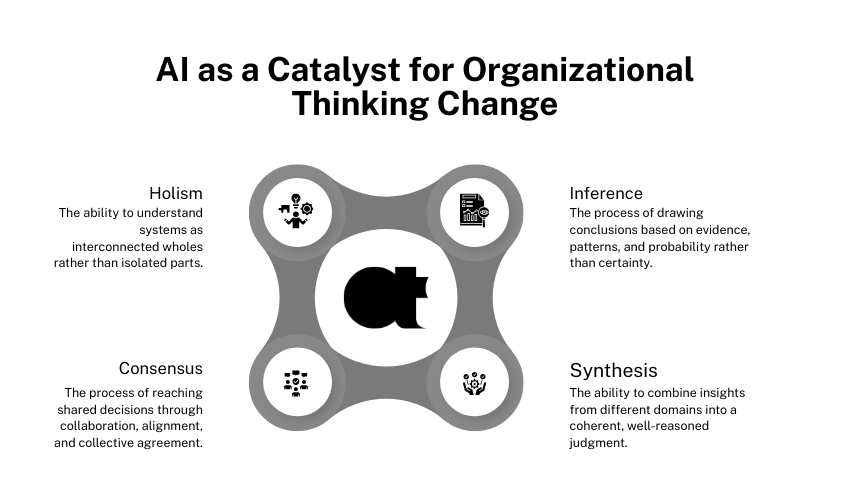
This requires leaders to develop new AI capabilities:
- Systems thinking
- Probabilistic reasoning
- Cross-domain judgment
- Collaborative decision-making
Without these capabilities, AI insights remain unused, even when technically accurate.
The same applies to Web3 initiatives driven by a blockchain software development company or web3 development services provider. Technology introduces new logic. Leadership must evolve to interpret and act on it.
Transformation fails at the thinking layer, not the technical one.
- The Cross-Functional Breakdown That Kills AI Value
- Why AI Adoption Determines Long-Term Competitive Advantage
- How Strong Leadership Turns AI Into Business Transformation
- AI, Blockchain, and the Same Leadership Truth
AI initiatives rarely fail inside one department. They fail at the intersections.
Data teams build models.
Business teams don’t trust them.
Operations teams resist change.
Legal teams’ slow progress.
Leadership stays distant.
Without cross-functional alignment, AI becomes fragmented.
Leadership must act as the integrator, clarifying ownership, aligning incentives, and resolving conflicts. This is not a technical task. It is a leadership responsibility.
We see identical breakdowns in blockchain app development company engagements. Technical teams deliver. Business teams hesitate. Leadership fails to bridge the gap.
When leadership does not orchestrate collaboration, technology stalls.
AI adoption is no longer optional. It is the foundation of future competitive advantage.
Organizations that embed AI into decisions move faster, adapt quicker, and scale smarter. Those who hesitate fall behind, not because they lack tools, but because they lack leadership readiness.
The same long-term divide is emerging between companies that successfully adopt Web3 with the help of a blockchain development company in the USA and those that treat it as an experiment.
Short-term hesitation creates long-term irrelevance.
Leadership determines which side organizations land on.
AI stops being a project and becomes part of how work happens. Teams trust insights. Decisions accelerate. Learning compounds.
Strong leaders:
- Admit uncertainty
- Invite experimentation
- Redesign roles
- Protect learning
- Measure what matters
This mindset transforms AI from a cost center into a driver of business transformation.
We guide organizations through this shift, aligning AI, leadership behavior, and emerging technologies like blockchain into a single strategic direction. Because transformation is not about adopting tools. It is about becoming a different organization.
Both technologies:
- Challenge hierarchy
- Redefine trust
- Require new decision logic
- Expose cultural weaknesses
Whether working with blockchain consulting services, a web3 development agency, or implementing AI internally, success depends on leadership clarity, not technical brilliance. Technology follows leadership. Always.
- The Cross-Functional Breakdown That Kills AI Value
- Why AI Adoption Determines Long-Term Competitive Advantage
- How Strong Leadership Turns AI Into Business Transformation
- AI, Blockchain, and the Same Leadership Truth
AI initiatives rarely fail inside one department. They fail at the intersections.
Data teams build models.
Business teams don’t trust them.
Operations teams resist change.
Legal teams’ slow progress.
Leadership stays distant.
Without cross-functional alignment, AI becomes fragmented.
Leadership must act as the integrator, clarifying ownership, aligning incentives, and resolving conflicts. This is not a technical task. It is a leadership responsibility.
We see identical breakdowns in blockchain app development company engagements. Technical teams deliver. Business teams hesitate. Leadership fails to bridge the gap.
When leadership does not orchestrate collaboration, technology stalls.
AI adoption is no longer optional. It is the foundation of future competitive advantage.
Organizations that embed AI into decisions move faster, adapt quicker, and scale smarter. Those who hesitate fall behind, not because they lack tools, but because they lack leadership readiness.
The same long-term divide is emerging between companies that successfully adopt Web3 with the help of a blockchain development company in the USA and those that treat it as an experiment.
Short-term hesitation creates long-term irrelevance.
Leadership determines which side organizations land on.
When leadership commits fully, everything changes.
AI stops being a project and becomes part of how work happens. Teams trust insights. Decisions accelerate. Learning compounds.
Strong leaders:
- Admit uncertainty
- Invite experimentation
- Redesign roles
- Protect learning
- Measure what matters
This mindset transforms AI from a cost center into a driver of business transformation.
We guide organizations through this shift, aligning AI, leadership behavior, and emerging technologies like blockchain into a single strategic direction.
Because transformation is not about adopting tools.
It is about becoming a different organization.
AI and blockchain appear different on the surface. At their core, they demand the same thing: leadership evolution.
Both technologies:
- Challenge hierarchy
- Redefine trust
- Require new decision logic
- Expose cultural weaknesses
Whether working with blockchain consulting services, a web3 development agency, or implementing AI internally, success depends on leadership clarity, not technical brilliance.
Technology follows leadership. Always.
Final Thought: AI Adoption Is the Ultimate Leadership Mirror
AI does not reveal how advanced your systems are. It reveals how mature your leadership truly is.
Organizations that succeed in AI adoption do not win because they own better tools or larger budgets. They win because their leaders are willing to learn, adapt, and confidently guide teams through uncertainty, especially as AI increasingly intersects with Blockchain development services and other transformative digital technologies.
At AtheosTech, we believe AI adoption is not about replacing human judgment. It is about elevating leadership to operate with greater clarity, responsibility, and foresight in an era shaped by AI and blockchain innovation.
Because in the end, technology does not transform companies.
Leaders do.
FAQ's
AI adoption requires leaders to rethink how decisions are made, shared, and trusted. When leaders rely solely on intuition instead of data-driven insights, adoption slows. This leadership challenge mirrors what organizations face when implementing blockchain consulting or Web3 development services, where cultural readiness matters as much as technical execution.
Psychological safety allows employees to experiment, question AI outputs, and learn without fear of blame. Without it, teams resist adoption. This principle applies equally to AI systems and Blockchain 1App Development, where trust and transparency are essential for sustained use and long-term value.
Yes. AI and Blockchain development services complement each other by combining intelligence with trust, automation with transparency. When aligned under strong leadership, they accelerate digital transformation, strengthen business models, and create measurable competitive advantage.
Leadership-driven organizations embed AI into everyday decision-making instead of treating it as a side project. Leaders actively use AI insights, encourage cross-functional collaboration, and align teams around outcomes. This approach also defines successful partnerships with blockchain development companies and Web3 consulting firms.
AtheosTech helps organizations bridge the gap between technology and leadership. By aligning AI strategies with Blockchain development services, cultural readiness, and clear decision frameworks, we enable businesses to move beyond pilots and achieve scalable, long-term transformation.
FAQ's
AI adoption requires leaders to rethink how decisions are made, shared, and trusted. When leaders rely solely on intuition instead of data-driven insights, adoption slows. This leadership challenge mirrors what organizations face when implementing blockchain consulting or Web3 development services, where cultural readiness matters as much as technical execution.
Psychological safety allows employees to experiment, question AI outputs, and learn without fear of blame. Without it, teams resist adoption. This principle applies equally to AI systems and Blockchain 1App Development, where trust and transparency are essential for sustained use and long-term value.
Yes. AI and Blockchain development services complement each other by combining intelligence with trust, automation with transparency. When aligned under strong leadership, they accelerate digital transformation, strengthen business models, and create measurable competitive advantage.
Leadership-driven organizations embed AI into everyday decision-making instead of treating it as a side project. Leaders actively use AI insights, encourage cross-functional collaboration, and align teams around outcomes. This approach also defines successful partnerships with blockchain development companies and Web3 consulting firms.
AtheosTech helps organizations bridge the gap between technology and leadership. By aligning AI strategies with Blockchain development services, cultural readiness, and clear decision frameworks, we enable businesses to move beyond pilots and achieve scalable, long-term transformation.