


- AtheosTech
Delivering Zero-Defect Civil Engineering Assets Through Automated Infrastructure Project Management

Swiss Tiefbau firms are modernizing by integrating Building Information Modeling (BIM), centralized project data management systems, and compliance automation into their workflows. By aligning with SIA 2051 and ISO 19650, these companies are moving away from legacy construction systems to improve infrastructure project management, ensure regulatory adherence, and maintain a competitive edge in public procurement.
Switzerland’s civil engineering landscape is undergoing its most significant shift in decades. While the quality of our roads, bridges, and tunnels remains world-class, the methods used to build them are changing. The reliance on fragmented legacy construction systems, paper plans, and manual spreadsheet project tracking is no longer just an administrative burden; it is a strategic risk.
As public infrastructure projects increasingly demand digital deliverables, firms that delay digital infrastructure modernization find themselves facing a narrowing path to profitability. In this environment, digital construction in Switzerland is no longer a futuristic concept; it is the current standard for operational excellence and securing the next generation of Swiss infrastructure contracts.
The Cultural Blueprint: Why the If It Isn’t Broken Mindset is Now the Greatest Risk
To truly understand the digital shift in Swiss civil engineering, one must first respect the culture that built the country. The Swiss Tiefbau sector is defined by a multi-generational, “engineering-first” mindset. These are firms where trust is earned on the Baustelle (job site), and decisions are often concentrated in the hands of an owner or a seasoned Bauleiter who has spent decades mastering the physical realities of road construction in Switzerland.
In this world, the phrase “If it isn’t broken, don’t touch it” isn’t just a saying; it is a risk-management strategy. There is a deep-seated and often justified distrust of generic software sold by people who have never stood in a muddy trench or navigated the complexities of a cantonal permit. For many, legacy construction systems and manual processes are seen as reliable because they are tangible. You can see the paper plan; you can talk to the foreman.
However, this loyalty to tradition is now meeting a new reality. The complexity of modern infrastructure project management has outpaced what a human brain and a spreadsheet can track without error. The “old way” worked when projects were simpler, and data was secondary. Today, the data is the project.
The hesitation to adopt digital construction in Switzerland often stems from a fear of losing that human touch or being buried under “administrative overhead” that doesn’t add value. But the most successful firms are realizing that digital infrastructure modernization isn’t about replacing the engineer’s intuition; it’s about clearing the clutter so that intuition can be applied where it matters most.
The cultural challenge isn’t just about technology; it’s about transition. It’s about moving from a culture of “information hoarding” in silos to a single source of truth. In a market where precision is a point of national pride, the firms that will lead the next forty years are those that see digital tools not as a threat to their craftsmanship, but as the only way to protect it against rising costs and shrinking timelines.
The Hidden Leaks: Why Manual Systems are Costing More Than Just Time
In the world of infrastructure project management, what you don’t see is often more dangerous than what you do. For a firm specializing in road construction in Switzerland or complex bridge construction, a single miscalculated elevation or an outdated utility map isn’t just a “software error”; it’s a week of rework, a damaged excavator, or a blown budget.
While the “old way” feels safe, it is quietly leaking capital through several critical pain points that modern digital construction in Switzerland is designed to plug.
At AtheosTech, we see these pain points not as failures of management, but as the natural limits of analog tools in a digital age. The friction you feel in your daily operations is the signal that your business has outgrown its current systems. The question is no longer if these leaks will impact your bottom line, but how much they have already cost you this year alone.
The Digital Foundation: BIM, Integrated Data, and the End of Manual Compliance
When we speak of digital infrastructure modernization, we aren’t talking about a single “magic” app that solves every problem. Instead, we are looking at a three-tiered digital foundation that transforms a firm from a reactive builder into a data-driven powerhouse.
For a Swiss Tiefbau firm, this shift is centered on three core pillars: BIM, centralized data systems, and the automation of Swiss-specific compliance.
1. BIM for Tiefbau: Beyond "Pretty 3D"
In high-rise construction, BIM is often about aesthetics and space. In digital civil engineering, Building Information Modeling is about survival. Whether you are managing bridge construction in Switzerland or laying intricate utility networks, 3D, 4D, and 5D BIM allow you to “build it twice”, once digitally and once physically.
By aligning with SIA 2051 and the ISO 19650 series, firms can perform clash detection long before a shovel hits the ground. Imagine identifying that a new water main will intersect with an existing fiber-optic line during the design phase, rather than discovering it mid-excavation. This level of infrastructure project management doesn’t just save time; it protects your reputation from the public embarrassment of utility strikes and emergency repairs.
2. Common Data Environments (CDE): The Nervous System
The most successful firms are moving away from fragmented folders toward contractor collaboration platforms, often referred to as Common Data Environments. This is the “single source of truth” where drawings, site photos, and RFIs live in a unified project data management system.
The key here is accessibility and Infrastructure dashboard UX. A Polier on a rainy site in the Jura shouldn’t be squinting at a complex PDF that won’t load; they need a mobile-first interface with role-based access control that gives them exactly the data they need for today’s pour. By centralizing this data, firms can implement infrastructure asset management software that tracks the entire lifecycle of a project, from the first survey to the final hand-off to the municipality.
3. Compliance Automation: Removing the Administrative Tax
The Swiss regulatory environment is notoriously rigorous. Between SUVA safety protocols, VSS road standards, and the new Federal Act on Data Protection (nDSG), the manual burden of proof is immense.
Modern systems are now incorporating AI document processing to handle this. Instead of a project manager spending Friday afternoons scanning paper logs, compliance automation consulting allows for the implementation of systems that automatically flag missing safety checks or environmental reports. These tools ensure that when it comes time for an audit or a final payment milestone on public infrastructure projects, the documentation is already complete, verified, and ready for review.
The AtheosTech Approach: Tailored, Not Templated
At AtheosTech, we recognize that no two Tiefbau firms are identical. A firm in Ticino has different regional requirements than one in Basel. We don’t believe in forcing you into rigid, off-the-shelf software clones.
Instead, we focus on custom technology services, building and integrating systems that mirror your actual workflows. From developing custom stakeholder portal UX to ensuring your cloud infrastructure management complies with Swiss data residency laws, our goal is to build a system that works for you, not the other way around.
Beyond the Handshake: The New Era of Digital Authority in Swiss Construction
A generation ago, a reputation in the Swiss Tiefbau sector was built exclusively on handshakes and the literal strength of one’s work. While quality remains the ultimate currency, the way that reputation is discovered, verified, and rewarded has fundamentally shifted. In a world where municipal procurement officers and private developers are increasingly data-literate, having “limited digital visibility” is no longer a sign of a traditional firm; it is a signal of a legacy firm.
The Digital "First Impression" in Public Procurement
When a cantonal authority evaluates a bid for public infrastructure projects, they aren't just looking at your price; they are looking for evidence of your capability. Increasingly, this search begins online. If a competitor’s website showcases their mastery of digital civil engineering through detailed case studies and BIM-readiness, while yours is a static page from 2012, the "credibility gap" opens before the first meeting.
SEO for infrastructure companies isn't about "likes" or viral content. It is about technical SEO that ensures when a decision-maker searches for a "BIM-certified road construction partner in Bern," your firm appears as the authoritative answer. It is about Local SEO, ensuring that your presence in specific cantons is undeniable to the people who live and work there.
Content as a Proxy for Competence
Modern content marketing for a Tiefbau firm is simply "storytelling with data." By documenting the lifecycle of a complex project, from the initial 3D terrain model to the final automated compliance report, you aren't just "marketing"; you are providing proof of work.
A well-structured project portfolio serves several critical business functions:
It proves you can handle the specific complexities of the Swiss landscape (e.g., Alpine terrain or high-density urban utility mapping).
The best young engineers want to work for firms that are leaders in digital infrastructure modernization. Your website is your most powerful recruiting tool.
A professional, high-performance site acts as a 24/7 digital brochure that supports your physical tender documents.
The AtheosTech Advantage: Positioning You as the Modern Standard
At AtheosTech, we understand that digital marketing for construction must feel as sturdy and reliable as the projects you build. We don't use "cookie-cutter" strategies. We focus on building digital authority that reflects your firm’s unique strengths, whether that’s specialized foundation work or massive-scale earthworks.
By integrating your project data management systems with a modern, high-conversion civil engineering website development strategy, we help you turn your internal digital transformation into an external competitive advantage. We ensure that when the next major infrastructure project is announced, the decision-makers already know, trust, and prefer your firm.
From Roadwork to Foundations: How Digitality Redefines Every Niche
The Swiss Tiefbau sector is far from a monolith. It is a mosaic of highly specialized disciplines, each with its own set of risks, margins, and operational rhythms. Whether your firm is centered on Strassenbau (road construction), Kanalisationsbau (sewage and drainage), or Spezialtiefbau (foundation and tunneling), the impact of digital infrastructure modernization is not just an administrative upgrade; it is a fundamental shift in how business models function.
Specialization Meets Data: The Niche Advantage
In the past, specialization was enough of a differentiator. If you were the best at bridge construction in Switzerland or complex utility laying (Leitungsbau), you had a secured place in the market. Today, the niche specialist is expected to be a data specialist as well.
- Road and Utility Construction: For firms managing road construction in Switzerland, the focus is shifting toward infrastructure asset management. It is no longer just about laying the asphalt; it is about providing the municipality with a digital "as-built" record. This data allows for proactive maintenance and long-term planning, turning a one-time construction project into a long-term value partnership.
- Specialized Foundation Work (Spezialtiefbau): In tunneling or complex foundations, the margin for error is razor-thin. Here, AI construction scheduling and real-time sensor data integration are becoming the gold standard. Being able to predict geological shifts or equipment fatigue before they halt a project is the difference between a profitable quarter and a massive insurance claim.
The Shift from "Reactive Bidding" to "Digital-First" Contracts
Traditionally, the business model for Swiss civil engineering has been the "tender-win-build" cycle. You wait for a project, you bid low, and you hope to manage the margins through efficiency. However, a new model is emerging among the most forward-thinking firms: the "Digital-First" Bidder.
These firms don't just bid on price; they bid on certainty. By utilizing infrastructure asset management software during the bidding phase, they can provide more accurate cost estimates and timelines. They offer "Digital Twins" as a standard deliverable, making them the preferred choice for long-term Rahmenvertrag (framework) agreements with cantonal authorities.
Why the Business Model is Evolving
For the business owner, the goal of digitization is to move away from the "race to the bottom" on pricing. When you can prove your efficiency through a project data management system, you aren't just selling labor; you are selling a de-risked outcome. This transition allows firms to:
- Predict Profitability: Use historical data and AI construction scheduling to avoid under-bidding.
- Ensure Continuity: Digital records mean that if a key Bauleiter leaves, the project's institutional knowledge stays with the firm, not in their head.
- Unlock New Revenue: Offering data-driven maintenance and monitoring services beyond the initial build phase.
At AtheosTech, we help firms identify which digital tools will yield the highest ROI for their specific niche. We don't believe in technology for technology’s sake; we believe in technology that reinforces your specific business model. Whether you are looking to dominate a local canton or scale your specialized engineering services across Switzerland, the right technological framework ensures your business model is built on solid ground, both physically and digitally.
The Regulatory Fortress: Navigating SIA 2051, ISO 19650, and the nDSG
In the Swiss construction sector, compliance is not a mere suggestion; it is the boundary between a successful hand-off and a legal entanglement. As public infrastructure projects move toward a “digital-first” mandate, the regulatory landscape has become significantly more complex. Relying on manual compliance tracking in this environment is akin to navigating an Alpine pass in a blizzard without a map; eventually, you will lose your way.
The Swiss Digital Framework: SIA 2051 and Beyond
At the heart of digital construction in Switzerland lies SIA 2051. While technically a code of practice rather than a strict norm, its influence is absolute. It provides the "language" for BIM in Switzerland. However, it is increasingly being augmented by the EN ISO 19650 series, which brings international rigor to how information is managed throughout the lifecycle of an asset.
For a firm, the risk is not just about failing to follow these guides; it’s about the contractual weight they carry. Once these standards are referenced in a cantonal tender, they become legally binding. If your infrastructure project management doesn't produce the required digital artifacts (COBie data, IFC models, or audit trails), you aren't just behind schedule; you are in breach of contract.
Data Sovereignty and the nDSG
One of the most overlooked aspects of digital infrastructure modernization is data residency. With the introduction of the new Federal Act on Data Protection (nDSG/FADP), Swiss firms must be hyper-aware of where their project data lives. Using a generic, US-based cloud service for your contractor collaboration platforms may inadvertently place you in violation of Swiss privacy laws, especially when dealing with sensitive municipal data or landowner information.
This is why cloud infrastructure management must be handled with a "Swiss-first" mindset. At AtheosTech, we ensure that the systems we build or integrate prioritize Swiss data residency and end-to-end encryption, ensuring that your firm remains a "safe pair of hands" for the most sensitive government contracts.
Compliance as a Competitive Moat
The firms that thrive are those that view compliance not as a hurdle, but as a differentiator. By automating the collection of safety logs (SUVA), environmental impact reports, and material certifications, you remove the human error inherent in manual compliance tracking.
When a procurement officer sees a firm that can provide real-time, automated compliance dashboards, they see a firm that is in control. This level of transparency builds a level of trust that no marketing brochure can match. At AtheosTech, our technology consulting focuses on building these automated "compliance engines" directly into your workflow, turning a regulatory burden into a primary reason why clients choose you over the competition.
The Digital Toolkit: Navigating the Landscape of BIM and CDE Platforms
In the transition toward digital construction in Switzerland, the question is rarely if a firm should use digital tools, but which ones will actually stand up to the rigors of a Swiss job site. For a Tiefbau firm, the toolkit must bridge the gap between heavy engineering and high-speed data.
The Industry Standards
When we look at the leaders in infrastructure project management, several key platforms define the current landscape.
- BIM & Design: For the actual modeling of road construction in Switzerland or complex tunneling, Autodesk Civil 3D and Revit remain the dominant forces for 3D modeling and terrain analysis. In the DACH region, Allplan is also a significant player, known for its precision in structural engineering and its alignment with local Swiss standards.
- Common Data Environments (CDE): To manage the “single source of truth,” firms often turn to Autodesk Construction Cloud (ACC) or Procore. These platforms act as the central nervous system for a project, housing everything from BIM models to RFI logs. For massive-scale public infrastructure projects, Oracle Aconex is frequently the choice for its robust audit trails and document control capabilities.
- Swiss-Specific Logic: Many firms also rely on localized ERP and calculation tools like BauBit, which are tailored to the specific accounting and tendering rhythms of the Swiss construction market.
Where AtheosTech Bridges the Gap
While these platforms are powerful, they often remain islands of data. This is where AtheosTech becomes an indispensable partner for the modern civil engineering firm. We don’t just point you toward a piece of software; we build the digital infrastructure that makes these tools work in harmony.
AtheosTech is most useful when:
- Breaking Data Silos: You have Revit for design and an ERP for accounting, but they don’t talk to each other. We specialize in building custom integrations that ensure your project data flows seamlessly from the office to the excavator.
- Transitioning from Legacy Construction Systems: If your firm is still anchored to spreadsheet project tracking, we provide the technology consulting and roadmap needed to migrate to a modern CDE without disrupting your active projects.
- Swiss Compliance Layering: Generic platforms don’t understand SIA 2051 or SUVA requirements out of the box. We build custom “compliance wrappers” and automated reporting layers onto your existing tools to ensure you are always tender-ready.
- Custom Stakeholder Portals: Public projects often require high transparency for cantonal officers. AtheosTech develops bespoke Stakeholder portal UX that allows you to share specific, role-based data with clients without exposing your entire internal database.
- Cloud Infrastructure & Data Sovereignty: For firms concerned about the nDSG (FADP), we provide specialized cloud infrastructure management. We ensure your project data lives in Swiss-based data centers, keeping you compliant with national privacy regulations.
Ultimately, a tool is only as good as the workflow it supports. AtheosTech acts as your “Digital General Contractor”, ensuring that your technology stack is as well-engineered and reliable as the infrastructure you build. By turning fragmented software into a unified project data management system, we move your firm away from the risks of digital civil engineering and toward its rewards.
Is your technology stack a strategic asset or an operational anchor?
The Roadmap to Modernization: A Partnership, Not a "Rip-and-Replace"
For a firm that has spent decades mastering the physical complexities of the Swiss landscape, the idea of a digital transformation can feel like an unnecessary disruption. There is a very real fear that bringing in new systems will lead to “digital paralysis”, where the office is buried in new dashboards while the site teams are left waiting for data.
At AtheosTech, we approach digital construction in Switzerland differently. We don’t believe in the “rip-and-replace” model that forces you to abandon what has made you successful. Instead, we act as your digital engineering partners, ensuring that your transition to high-performance infrastructure project management is incremental, low-risk, and tailored to your actual capacity for change.
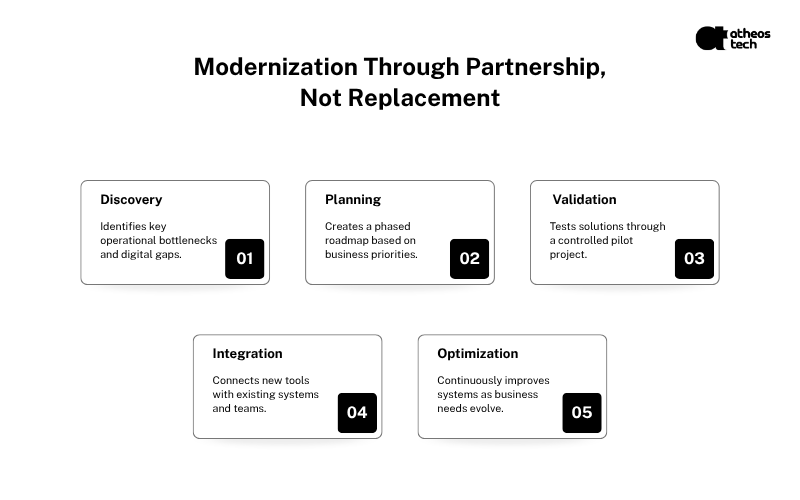
1. The Digital Audit (Discovery)
Our process begins with a look "under the hood" of your current operations. We don't start with a sales pitch; we start with a conversation. We identify where your project data management systems are leaking time and where your team is most frustrated. Whether it’s a bottleneck in cantonal permit approvals or a lack of real-time site reporting, we pinpoint the high-impact areas where technology can provide immediate relief.
2. The Tailored Blueprint (Roadmap)
There is no "standard" path to digital infrastructure modernization. Based on our discovery, we build a phased roadmap that prioritizes your firm’s most urgent needs, be it securing a specific BIM-mandated tender or automating a manual compliance workflow. This plan is designed to be self-funding, where the efficiencies gained in Phase 1 help fuel the growth in Phase 2.
3. The Pilot Project (Mitigated Risk)
We believe in proof, not promises. Instead of a firm-wide rollout that risks operational downtime, we begin by implementing a pilot program on a single, active project. This allows your team to see the benefits of digital civil engineering in a controlled environment. It builds internal buy-in from the Bauleiters and Poliers who will be using these tools every day, ensuring that the software feels like a help, not a hindrance.
4. Integration & The Human Element
Technology is only as effective as the people who operate it. Once the pilot is successful, we handle the technical heavy lifting of integrating new tools with your existing ERP or accounting software. More importantly, we manage the "change management" aspect. We provide training that respects the expertise of your staff, ensuring that your veteran engineers feel empowered,not replaced,by the new systems.
5. Continuous Improvement
The digital landscape is never static. As public procurement regulations evolve and new tools like AI construction scheduling become more sophisticated, AtheosTech remains your ongoing advisor. We don't just "hand over the keys" and disappear. We ensure your systems are continuously optimized to protect your margins and maintain your competitive edge.
The cost of delaying this transition is no longer just an administrative concern; it is an opportunity cost that grows with every missed tender and every hour of rework. By choosing a partnership-based engagement model, you aren’t just buying software; you are investing in a future-proof foundation for your firm.
Built for Precision: Why Swiss Design Matters in Construction Software
In Switzerland, design is never just about aesthetics; it is about functionality, reliability, and precision. For a Tiefbau firm, a digital tool that feels “flimsy” or overly flashy will be met with immediate skepticism. To be adopted on the Baustelle, technology must mirror the rugged, dependable nature of the machinery your teams use every day.
A truly “native” digital experience means moving away from cluttered interfaces toward a refined infrastructure dashboard UX. Whether a Bauleiter is checking a 3D model on a tablet or an administrator is reviewing a stakeholder portal UX, the design should be:
- Functional Under Pressure: High-contrast, easy-to-navigate interfaces that work in the glare of a job site or the haste of a deadline.
- Predictable and Precise: Minimalist layouts that prioritize critical data points, like safety alerts or project milestones, over unnecessary features.
- Culturally Aligned: Reflecting the Swiss business values of understatement and reliability.
At AtheosTech, we believe that software for digital construction in Switzerland should feel as sturdy as a well-engineered bridge. Our UI/UX design process is rooted in the reality of your fieldwork, ensuring that your digital tools feel like a natural extension of your firm’s craftsmanship. When technology feels native, adoption becomes effortless, and the “digital divide” within your team disappears.
From Chaos to Clarity: A Case for Digital Resilience
To see the true impact of digital infrastructure modernization, consider the case of a mid-sized Swiss civil engineering firm managing a complex bridge construction in Switzerland. For years, they relied on legacy construction systems, a combination of paper site diaries and disconnected spreadsheets.
On one particular project, an outdated utility map led to a two-week excavation delay. Because the information was stored in a foreman’s binder, the office wasn’t alerted until the heavy machinery was already idle. The financial hit wasn’t just the downtime; it was the damage to their reputation with the cantonal authorities.
Following this, the firm partnered with AtheosTech to implement a centralized project data management system. By moving to a cloud-based Common Data Environment (CDE), they achieved:
The shift didn’t require a total overhaul of their staff; it simply gave their experienced engineers better tools to succeed. As their portfolio now demonstrates, the “digital version” of their business is not just more efficient; it is more profitable and significantly more competitive.
Building the Digital Foundation: Your Next Strategic Move
The future of Swiss infrastructure is no longer built solely with concrete and steel; it is built with data. While the craftsmanship of our Tiefbau sector remains world-class, the firms leading the next decade will be those that master digital infrastructure modernization.
Continuing to rely on legacy construction systems is no longer a conservative choice; it is a measurable risk to your margins and your ability to win public infrastructure projects. Transitioning to an integrated project data management system isn’t about replacing your team’s expertise; it’s about providing the digital shield that protects it from rework, compliance errors, and competitive pressure.
Don’t wait for a missed tender to modernize your workflow. At AtheosTech, we specialize in bridging the gap between traditional engineering and the digital future.
FAQs
FAQs
BIM (Building Information Modeling) is the digital representation of an infrastructure asset’s physical and functional characteristics. For Tiefbau firms, it enables 3D clash detection for underground utilities and precise volume calculations for earthworks. It is increasingly mandatory for winning public infrastructure projects as cantonal authorities move toward a "digital-as-built" requirement.
SIA 2051 is a code of practice, not a federal law. However, it becomes legally binding as soon as it is referenced in a construction contract or a public tender. For Swiss firms, aligning with SIA 2051 and ISO 19650 is essential to meeting the technical deliverables now expected in modern infrastructure project management.
The cost is not a single flat fee but a phased investment based on your firm’s digital maturity. While there are software and consulting costs, the focus should be on the "opportunity cost" of inaction, such as lost tenders, site rework, and manual administrative errors that drain project margins.
Yes. A major part of digital infrastructure modernization is ensuring that your new Common Data Environment (CDE) "talks" to your existing ERP or accounting tools. AtheosTech specializes in building custom integrations so you can maintain a single source of truth without a total "rip-and-replace" of your current software stack.
Compliance automation streamlines the tracking of safety (SUVA), environmental, and SIA standards. By providing real-time, automated reports, you demonstrate to procurement officers that your firm is organized, transparent, and de-risked. This significantly increases your credibility and reduces the time spent on manual audit preparation.
BIM refers to the data-rich 3D models of the infrastructure project. A Common Data Environment (CDE) is the centralized project data management system where those models,along with drawings, photos, and communications live. The BIM model is the "what," and the CDE is the "where" that allows everyone to access it.
You may also like


