

- AtheosTech
DIY vs. In-House vs. Outsource: Choosing the Right Development Approach
DIY, In-House, and Outsourced Development for Maximum ROI
Your website or mobile app can make or break your business. It’s more than just a digital presence; it’s where customers form first impressions, interact with your brand, and decide whether to trust you – or move on to a competitor.
The challenge is deciding how to build it. Do you go with DIY Web Development, hire a full In-House Development team, or partner with a Mobile & Web Development Company to handle it all through outsourcing?
Each option has its pros and cons, but real-world experience and global trends show one clear winner: outsourcing. It’s faster, more scalable, and more cost-effective – especially for SMBs, startups, and growth-focused businesses.
As a trusted Mobile & Web Development Company, we’ve helped countless businesses make this choice. In this blog, we’ll break down each approach, compare them, and explain why outsourcing is often the smartest long-term move.
What is Website Development Outsourcing?
Outsourcing web development means entrusting your website or application project to external professionals or agencies, rather than building it entirely in-house. These experts may be located anywhere in the world and often provide end-to-end services – from design and coding to content and long-term maintenance.
This approach allows businesses to:
- Save costs by avoiding full-time salaries, benefits, and infrastructure expenses.
- Access specialized expertise across design, mobile app development, web design and development, and emerging technologies like AI and blockchain.
- Scale flexibly, ramping teams up or down as projects demand.
- Accelerate development, reducing time-to-market and gaining a competitive edge.
Outsourcing web development empowers organizations to focus on their core business activities while experts handle the technical execution. However, it does require effective vendor management and clear communication to avoid pitfalls.
Get professional web and mobile solutions without the overhead.
Partner with AtheosTech for outsourcing that scales with your business.
Pros and Cons of Outsourcing Development
Pros:
- Cost Savings – Avoid expenses of hiring, training, and retaining a permanent team.
- Specialized Expertise – Access a global pool of professionals with niche skills.
- Scalability – Easily scale resources up or down to match workload demands.
- Faster Delivery – Experienced teams with established workflows ensure quicker rollouts.
Cons:
- Communication Challenges – Time zones and cultural nuances may cause
delays. - Less Direct Control – You rely on external partners for critical decisions.
- Quality Variability – Choosing the wrong vendor could affect deliverables.
- Security Concerns – Sensitive data must be protected with strict
protocols.
What is In-House Development?
In-house development involves building and maintaining your website or app through a dedicated internal team of developers, designers, and managers. This approach gives businesses complete control over every aspect of the project.
Pros:
- Full oversight and direct communication.
- Strong alignment with brand vision and goals.
- Higher data security as everything stays internal.
- Long-term familiarity with company culture and processes.
Cons:
- Extremely costly (salaries, benefits, infrastructure, training).
- Limited skillsets within one team.
- Slower delivery due to recruitment and onboarding delays.
- Resource-heavy and difficult to scale quickly.
In-house development works well for large enterprises with significant budgets and long-term digital strategies, but often proves unrealistic for smaller organizations.
The Reality of DIY Web Development
DIY website builders like Wix, Squarespace, or Shopify (for eCommerce) and app builders like Glide or Adalo attract many entrepreneurs with their affordability and ease of use. While they work for hobby projects or very small businesses, they fall short as businesses grow.
Pros:
- Low upfront cost.
- Quick launch without coding skills.
- Good for personal projects or simple MVPs.
Cons:
- Cookie-cutter designs with little uniqueness.
- Limited flexibility in customization and scalability.
- Weak SEO, user experience, and long-term performance.
- Time-consuming for busy business owners.
In short, DIY can be a stopgap solution, but serious businesses quickly outgrow it and need professional solutions.
When to Outsource Software Development Instead of DIY
As businesses scale, the limitations of DIY platforms make strategic decisions around outsourcing software development and in-house development increasingly important. Weighing in house vs outsource, outsourced vs. in-house, and broader development outsourcing models helps leaders choose the right balance of control, cost, and scalability. Whether pursuing outsourcing its development, it outsourcing development, or building strong in-house development vs outsourcing frameworks, sustainable growth depends on aligning technical execution with long-term vision, an approach carefully guided by AtheosTech through tailored digital and development strategies.
Cost & Adoption Trends (DIY vs In-House vs Outsourcing)
| Approach | Avg. Cost | Best Fit | Adoption (SMBs/Enterprises) |
|---|---|---|---|
| DIY | $500 – $5,000 | Hobby projects, personal use | 40% SMBs, 10% Enterprises |
| In-House | $120k – $300k/year (team of 3–5) | Large enterprises with continuous dev needs | 20% SMBs, 70% Enterprises |
| Outsourcing | $5,000 – $100k+ (scope-based) | SMBs, startups, growth-focused firms | 65% SMBs, 55% Enterprises |
According to Deloitte, 70% of businesses outsource at least one IT function, and outsourcing cuts operational costs by 30–60% compared to in-house development.
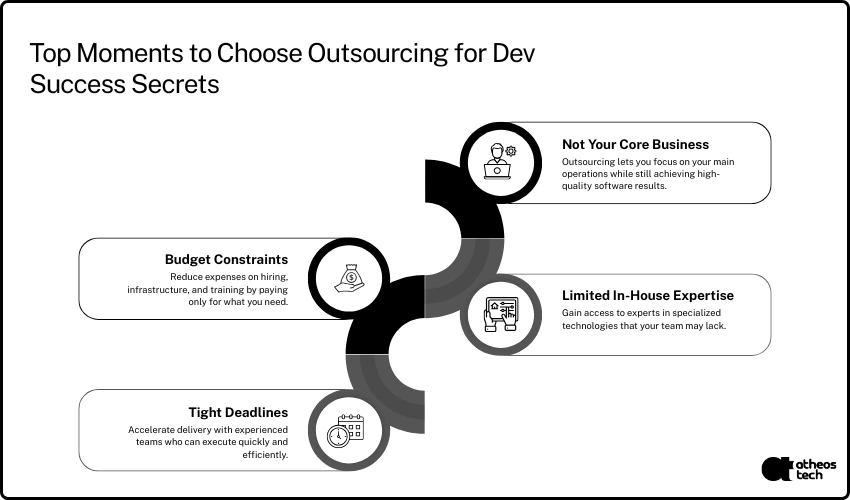
When to Choose Outsourcing Development
You should strongly consider outsourcing if:
- Software development isn’t your core business.
- Your budget is limited, but you need professional results.
- Your team lacks expertise in specific technologies.
- You have strict deadlines and need rapid delivery.
Real-World Scenarios
DIY website builders like Wix, Squarespace, or Shopify (for eCommerce) and app builders like Glide or Adalo attract many entrepreneurs with their affordability and ease of use. While they work for hobby projects or very small businesses, they fall short as businesses grow.
- DIY Example:
A boutique salon uses Wix for bookings but struggles to add loyalty features – forcing a rebuild by professionals.
- In-House Example:
A healthcare provider builds a secure patient management system internally, but at extremely high costs.
- Outsourcing Example:
A fitness startup partners with a Mobile & Web Development Company, launches in 3 months, scales globally, and secures funding – without hiring an internal dev team.
How Top Brands Use DIY, In-House, and Outsourcing Development
DIY website builders like Wix, Squarespace, or Shopify (for eCommerce) and app builders like Glide or Adalo attract many entrepreneurs with their affordability and ease of use. While they work for hobby projects or very small businesses, they fall short as businesses grow.
| Approach | Example Use Case | Results | Limitations |
|---|---|---|---|
| DIY | Small local campaign microsite or seasonal landing page | Fast launch, minimal cost, good for testing ideas | Limited customization, not scalable, cannot handle high traffic or deep integrations |
| In-House | Core Starbucks app, rewards program, online ordering system | Highly tailored, secure, fully integrated with business operations | Expensive to maintain, slower to implement new features, requires ongoing investment in talent |
| Outsourcing | Specialized campaign app, mobile ordering/payment for new international markets | Faster time-to-market, access to global expertise, cost-efficient, scalable | Less direct control, requires vendor management and clear communication |
Hybrid Approaches (But Outsourcing Still Leads)
Some businesses experiment with hybrid models, combining internal strategy with outsourced execution. While effective in some cases, most eventually discover that outsourcing partners – especially a skilled Mobile & Web Development Company – can handle everything from strategy to execution, making hybrids unnecessary.
Outsourcing vs In-House: Which Wins?
Both outsourcing and in-house have their places, but outsourcing consistently offers the best balance of cost, flexibility, expertise, and speed. In-house is best for enterprises with vast budgets and ongoing needs, while DIY only suits individuals or microbusinesses.
For SMBs, startups, and growth-focused enterprises, outsourcing is the clear winner.
Scale your business digitally without breaking the bank.
Outsource your web and mobile development to AtheosTech today
Why Outsourcing is the Smartest Choice
With the right Mobile & Web Development Company, you don’t just outsource work – you gain a long-term partner that scales with your business.
How AtheosTech Helps
At AtheosTech, we’ve helped businesses across industries transform their digital presence through strategic outsourcing. As a Mobile & Web Development Company and trusted Website Development Agency, we offer:
- Custom Web Development aligned with your industry and goals.
- Mobile Application Development for both iOS and Android.
- End-to-end Web Development Services including design, coding, testing, and maintenance.
- Flexible outsourcing models tailored to your needs.
Conclusion
When it comes to DIY Web Development, In-House Development, or Outsourcing Development of a Website, the verdict is clear.
- DIY is limited to hobbyists and very small businesses.
- In-house is expensive, slow, and best suited only for enterprises.
- Outsourcing—with a trusted Mobile & Web Development Company – is the sweet spot. It combines affordability, expertise, scalability, and speed-to-market, making it the smartest choice for SMBs and startups.
If you want Web Development Right for Your Business, outsourcing isn’t just an option – it’s the path forward. Let AtheosTech, your trusted Mobile & Web Development Company, guide you to success.