- AtheosTech
The Dutch Architecture and Design Firm's Digital Playbook: BIM Integration, Client Portals, Sustainability Compliance, and the Online Presence That Wins Projects

A digital playbook for Dutch architecture firms is no longer optional in a market where Building Information Modeling adoption already covers more than half the construction sector, where the Omgevingswet and Wet kwaliteitsborging voor het bouwen (Wkb) have rewritten how permits and quality checks happen, and where clients expect the same transparency from their architect that they get from their bank’s app.
Architecture and design firms across the Netherlands, from Amsterdam to Eindhoven to Rotterdam, are sitting on technically excellent design work that often never gets discovered, never gets trusted at the tender stage, or gets stuck in email threads instead of structured client communication.
This blog breaks down exactly how Dutch architecture and design firms can integrate BIM workflows properly, build client portals that reduce friction, stay compliance-ready under BENG, MPG, NTA 8800, and Wkb, and build an online presence that actually wins projects rather than just looking good. At AtheosTech, we have built this playbook by combining BIM-adjacent software integration, custom client portal development, and Netherlands-focused digital marketing into one connected system for AEC firms.
The Dutch AEC Landscape in 2026: Why Digital Maturity Decides Who Wins Tenders
The Netherlands has consistently ranked among the most BIM-mature construction markets in Europe.
- BIM adoption reached 58.0% of Dutch construction firms in 2023, and BIM use has remained the highest in the Netherlands across Europe because Dutch construction stakeholders are far more advanced in digitalisation than peers in the UK, Spain, Germany, and Italy.
- At the same time, only 19% of construction firms in the Netherlands used cloud project management tools in 2023, which reveals a clear gap: firms have adopted BIM as a modeling discipline but have not yet connected it to cloud-based collaboration, client communication, or marketing systems. (source: www.bimcollab.com )
This gap matters because public and large private clients increasingly treat digital maturity as a tender-stage filter. BIM has solidified its place as a global standard in the AEC industry and is now a compliance requirement in many countries, especially for public infrastructure and large government-funded projects, and the Netherlands has moved aggressively in incorporating BIM into national procurement policies alongside Germany, France, and the Nordic countries. A firm that cannot demonstrate BIM Level 2 collaboration, structured data delivery, and a credible online portfolio is simply filtered out before the design conversation even starts.
Key pointers for this section:
- Dutch construction firms lead Europe in digitalisation, but lag in connecting that data to cloud collaboration and client-facing tools
- BIM is shifting from a design tool to a procurement gatekeeper, particularly for gemeente (municipal) and government-funded tenders
- Firms that pair BIM maturity with strong online discoverability are positioned to win both public tenders and private commissions
There is also a parallel shift happening in how buildings are physically delivered, which feeds directly back into the digital requirement.
The prefabricated construction market in the Netherlands is expected to grow by 6.4% on an annual basis, reaching close to EUR 3.90 billion, after achieving a compound annual growth rate of 7.6% between 2020 and 2024, with that growth forecast to continue at a 5.5% CAGR through 2029. (Source: https://revizto.com/resources/blog/national-bim-programs)
Dutch firms lead Europe in prefabricated construction digitalisation, and robotics such as automated bricklaying are already being tested in facades and structural assembly.
None of this prefabrication and automation works without a digital model that contractors, manufacturers, and architects can all read from the same source, which is exactly why BIM adoption and prefab growth are moving together rather than separately.
This combination of regulatory pressure and industrialized construction methods means a Dutch architecture firm today is being evaluated on three layers at once: design quality, digital workflow maturity, and online credibility. A firm can be exceptional at the first and still lose work because it is weak on the second or invisible on the third.
Pain Points Holding Dutch Architecture Firms Back from Scaling Digitally
Most Dutch architecture and design firms are excellent designers, but under-resourced on the digital operations side. Based on market research and firsthand patterns across the AEC sector, the recurring pain points are:

BIM models live in Revit or ArchiCad, but clients still receive PDFs and email updates, creating version confusion and disputes over what was actually approved
Document approvals, drawings, change orders, and omgevingsvergunning (environment and planning permit) status updates are scattered across email, WhatsApp, and shared drives
Tracking BENG-1, BENG-2, BENG-3, MPG scores, and Wkb quality assurance sign-offs manually increases the risk of late-stage redesigns and missed inspection windows
Many firms rely entirely on referrals and RFPs, leaving them invisible during the early planning phase when developers are actually searching for a design partner
Portfolio sites that show projects but say nothing about specialization, sustainability credentials, or BIM capability, which is exactly what commissioning clients now screen for
Long B2B design-build sales cycles lose momentum because there is no CRM tracking who inquired, what stage they are at, or when to follow up
Common compliance-related problems include inadequate early energy calculations that address BENG or insulation shortfalls late in a project, which drives up costs, along with overlooked structural implications in older buildings and conflicting local versus national requirements that always need separate verification. These are not just technical risks; they are digital workflow failures, because the right software stack would catch BENG shortfalls during the design phase rather than during permit review.
Further Reading
Is Your Firm's Innovation Strategy Actually Digital?
Dutch R&D firms and innovation consultancies face many of the same digital transformation challenges as architecture studios - from fragmented data workflows to weak online discoverability.
BIM Integration: From Compliance Checkbox to Competitive Moat
BIM in the Dutch market has moved well past 3D modeling for internal use. Familiarity with the Building Information Modeling framework, including BIM 1.0, 2.0, and 3.0, is now crucial for effective collaboration among stakeholders, and challenges in the sector include integrating BIM into existing workflows, which often requires real investment in training and technology. The firms winning larger commissions are the ones treating BIM as connected infrastructure, not an isolated design tool.
What effective BIM integration looks like in practice:
- openBIM and IFC-based data exchange so models can be shared with structural engineers, MEP consultants, and contractors without proprietary lock-in
- BIM-to-client-portal sync, where approved model versions, clash detection reports, and 3D walkthroughs are automatically pushed to a client-facing dashboard instead of being emailed as static files
- Digital twin layers for larger commercial and public projects, allowing clients and facility managers to interact with the building model post-handover
- API connections between BIM software and project management or ERP tools, eliminating duplicate data entry between design, scheduling, and billing systems
An organisation’s level of BIM knowledge and experience is the greatest obstacle to BIM adoption, and dissatisfaction tends to occur when strategic partners or BIM projects cannot cope with planned BIM methods or fail to deliver what was promised in advance. This is precisely where a technology partner adds value: not by replacing the architect’s BIM authoring work, but by building the integration layer between the BIM environment and everything the client, contractor, and compliance officer needs to see.
It is worth being specific about what “BIM maturity” actually means in practice, since the term gets used loosely. BIM 1.0 typically refers to firms producing 3D models for internal coordination only. BIM 2.0 introduces structured collaboration, where multiple disciplines work from a shared model with clash detection.
BIM 3.0, the level of public tenders increasingly expected, adds lifecycle data: facility management information, sustainability scoring, and integration with external systems beyond the design team. A firm stuck at BIM 1.0 internally can still present itself at a BIM 3.0 level externally if the integration layer connecting the model to clients, compliance tools, and contractors is built correctly. This is a realistic, achievable shortcut for small and mid-sized firms that cannot justify a full internal BIM department but still need to compete against larger studios on tender documentation.
AtheosTech builds custom BIM integration layers that connect Revit, ArchiCad, and BIMcollab environments to client-facing portals and reporting dashboards, so model updates translate into client trust instead of client confusion.
Client Portals: Turning the Permit-Era Paper Trail into a Transparent Digital Experience
The Dutch permitting and quality assurance environment has become significantly more document-intensive. The Environment and Planning Act, or Omgevingswet, splits construction of a building into a technical part and a spatial part, resulting in two separate activities: the technical building activity and the environment plan activity for construction works, which can mean two separate environment and planning permits are needed.
Buildings in the lowest risk class, known as gevolgklasse 1, must use an independent quality assurer under the Wet kwaliteitsborging voor het bouwen, and before construction starts, this quality assurer assesses the risks associated with the building plan and determines which measures are necessary.
For a client, this means juggling permit submissions through the Omgevingsloket, quality assurance sign-offs, and architectural drawing revisions, often without a single place to check status. A well-built client portal solves this directly:
Real-time permit and quality-assurance status tracking,
pulling structured updates rather than forcing clients to chase email threads
Version-controlled drawing and document repositories,
so there is never ambiguity about which set of drawings was approved
Milestone and change-order approval workflows
with digital sign-off, reducing disputes during construction
Secure, role-based access
so contractors, structural engineers, and clients see only what's relevant to them
Mobile-friendly access,
since site visits and client meetings increasingly happen away from a desktop
This is also where AVG compliance (the Dutch implementation of GDPR) becomes a real consideration, since portals handle personal data, financial documents, and sometimes site photography. AtheosTech’s portal builds are always AVG and GDPR-compliance-ready, with EU-based hosting options and role-based data access controls built in from the architecture stage, not bolted on afterward.
The practical effect of a properly built portal shows up most clearly during disputes. When a change order is questioned six months into construction, the firm with a version-controlled, timestamped approval trail resolves the disagreement in minutes.
The firm relying on scattered email threads spends days reconstructing what was actually agreed, and that delay often costs more than the disputed change itself. For firms managing several concurrent projects, a portal also becomes an internal operations tool, giving project managers a single view across all active commissions instead of toggling between inboxes, shared drives, and spreadsheets.
Sustainability Compliance as a Digital Workflow: BENG, MPG, NTA 8800, and Wkb
Sustainability compliance in Dutch architecture is not a single checkbox; it is a layered set of requirements that must be tracked from concept design through final inspection.
BENG (Bijna EnergieNeutrale Gebouwen / Nearly Energy-Neutral Buildings):
BENG-1 sets a maximum on the building's energy use, BENG-2 governs how efficiently fossil energy is used and generated, and BENG-3 sets the minimum required share of renewable energy. These requirements have been mandatory for new construction in the Netherlands since January 1, 2021, based on the Building Decree 2012 and European EPBD guidelines, and are closely tied to the NTA 8800 calculation standard.
MPG (Milieu Prestatie Gebouwen):
New residential and office buildings over 100 square meters must meet an environmental performance score that limits the lifecycle impact of the materials used.
Wkb and Omgevingswet:
Since its phased rollout, the Wet kwaliteitsborging voor het bouwen has shifted oversight for many projects from municipal pre-checks to independent quality controllers, and builders must demonstrate compliance throughout the process, with final approval from these experts required before occupancy.
BACS and heating systems:
In 2026, larger utility buildings face mandatory Building Automation and Control Systems installation, meaning smart systems that automatically adjust heating, lighting, and ventilation for efficiency.
The digital workflow problem this creates is real: BENG calculations, MPG material scoring, and Wkb sign-off documentation are typically produced in different specialist tools (Uniec, Vabi, DGMR-style software) and then manually compiled for client and municipal submission. Centralizing these outputs into one client-facing compliance dashboard, linked to the BIM model and the client portal, removes the late-stage scramble that causes the redesign costs and inspection delays firms most often complain about.
AtheosTech builds compliance-ready digital infrastructure, meaning client portals and reporting dashboards that are structured to accept BENG, MPG, and Wkb documentation exports and present them clearly to clients, contractors, and quality assurance officers, without us replacing the specialist compliance calculation work itself.
The sequencing matters as much as the documentation itself. Outdated assumptions about permit categories and procedures, a direct consequence of the shift to the Omgevingswet, remain one of the most frequent causes of project delay, alongside inadequate early energy calculations and material choices that fail MPG or sustainability thresholds.
Early consultation with qualified professionals, paired with a digital system that surfaces compliance gaps before they reach the permit stage, prevents most of these problems. A compliance dashboard that flags a BENG-2 shortfall during schematic design is solving a problem that would otherwise surface during the much more expensive construction-document phase.
(Source: https://ensun.io/search/bim-consulting/netherlands )
Niches and Business Models Inside Dutch Architecture: Where the Margins Actually Are
Dutch architecture and design is not one homogeneous market. The niches with distinct digital needs and revenue models include:

Often project-fee based, increasingly competing on BENG/MPG compliance speed and visual presentation for homeowners who research extensively online before contacting a firm
Frequently work on retainer or phased-fee models tied to BREEAM or similar certification milestones, with longer sales cycles driven by developers and asset managers
Operate primarily through tender and RFP processes, where BIM maturity and digital submission capability are direct qualification criteria
Smaller firms positioning around circular materials and energy-neutral design, often value-priced rather than purely fee-based, and highly dependent on content marketing and thought leadership to be discovered
Service other architecture firms rather than end clients, working on project-based or subscription-style retainer models for ongoing modeling support
Wood modules, 2D panels, and 3D volumetric components are becoming more prominent in Dutch prefabricated construction, offering environmental and delivery precision, which is creating an emerging niche of architecture firms specializing specifically in modular and prefab-compatible design, a category that barely existed as a distinct service line a decade ago.
Understanding which niche a firm sits in changes the digital strategy entirely. A residential renovation firm needs strong local SEO and visual portfolio content; a public-tender firm needs BIM credibility signals and case study depth; a circular-design boutique needs content marketing and authority-building more than paid lead generation.
Revenue models follow a similar split. Project-fee models, common in residential and smaller commercial work, reward firms that can move clients from inquiry to signed contract quickly, which puts a premium on a responsive website and a fast-loading portfolio.
Retainer and phased-fee models, common in larger commercial and certification-driven work, reward firms that can demonstrate long-term reliability through case studies and documented compliance track records. Tender-based revenue, dominant in public infrastructure work, rewards firms that can produce structured digital submissions on demand, since the qualification stage is often won or lost on documentation completeness rather than design narrative alone.
Recognizing which of these models a firm is actually operating under, rather than assuming one approach fits every commission, is the first step in building the right digital strategy instead of a generic one.
Ready to Get Your Architecture Firm Found Before the RFP Lands?
AtheosTech builds the SEO foundation, bilingual content strategy, and CRM pipeline that puts your firm in front of the right people before the tender stage even begins.
The Online Presence That Wins Projects: SEO, Content, and Portfolio Platforms
Architecture firms operate in a highly competitive, relationship-driven market where winning new work depends on visibility, reputation, timing, and trust with the right decision-makers, yet many firms struggle to consistently generate new opportunities beyond referrals, RFPs, and existing client networks. By leveraging digital marketing, architects can connect with prospective clients during the early stages of design and build projects, offering their services and portfolios before clients finalize partnerships with other firms.
A strong online presence for a Dutch architecture firm typically includes:
- Technical and local SEO: optimizing websites and content for search rankings to enhance discoverability in search engines, including Dutch-language keyword targeting around terms like "architectenbureau," "duurzaam bouwen," and "BENG advies"
- Portfolio presentation similar to platforms like Archilovers and ArchDaily: AtheosTech builds custom portfolio and case study platforms with the same polish and project storytelling depth as these leading industry platforms, but fully owned by the firm rather than dependent on third-party listings
- Project-stage content marketing: Blog and case study content that addresses BENG compliance, Wkb readiness, and BIM collaboration, positioning the firm as a knowledgeable partner rather than just a portfolio
- Bilingual NL/EN website structure: since international developers and expat homeowners increasingly search in English while local municipal and B2B audiences search in Dutch
- LinkedIn and BNA-network visibility, given that the BNA (Branchevereniging Nederlandse Architectenbureaus) functions as the central network for Dutch architecture firms and is a natural platform for authority-building and referral generation
- CRM-backed inquiry tracking, since long sales cycles make it easy for opportunities to go cold without a system that tracks relationships, manages follow-up, and maintains visibility throughout extended buying cycles
Platform names worth building external links and citations around in this space include BNA (Branchevereniging Nederlandse Architectenbureaus), Archilovers, ArchDaily, Dezeen, RVO (Rijksdienst voor Ondernemend Nederland), Omgevingsloket, and NEN (Nederlands Normalisatie-instituut), all of which are authentic, authoritative sources for the Dutch and international AEC audience. A few additional tactics tend to separate firms that consistently get found from those that don't:
- Publishing project case studies that explicitly mention compliance milestones (BENG achieved, MPG score, Wkb sign-off date), since these terms are searched directly by developers vetting potential partners
- Maintaining a Google Business Profile with accurate categories and regularly updated project photography, which matters disproportionately for residential and local commercial searches
- Building backlinks from BNA member pages, regional business directories, and sustainability-focused publications rather than generic guest posts
- Structuring service pages around specific niches (residential renovation, BENG advisory, modular/prefab design) instead of one generic "services" page, since search intent differs sharply between these audiences
- Tracking which content pieces actually convert into inquiries through CRM-linked analytics, rather than measuring traffic alone
None of these tactics works in isolation. A firm with strong case study content but no CRM follow-up loses leads at the exact moment they convert from anonymous visitor to named inquiry.
Engagement Models: How AtheosTech Works With Dutch Architecture Firms
Based on AtheosTech’s working dynamics, the engagement models best suited to architecture and design firms depend on the specific solution being built:
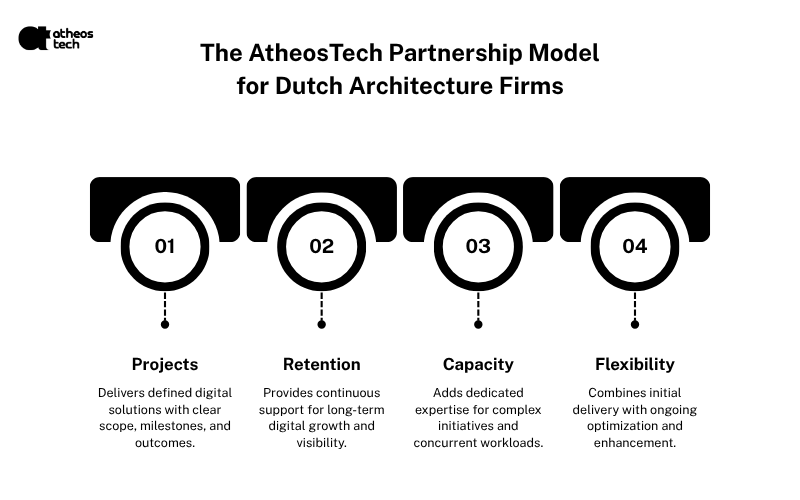
Project-based engagement:
Best suited for one-time builds such as a new client portal, a portfolio website rebuild, or a BIM-to-portal integration, with clearly scoped deliverables and timelines
Retainer-based engagement:
Best suited for ongoing SEO, content marketing, and digital presence management, since AEC marketing results compound over months rather than appearing overnight
Dedicated team/staff augmentation model:
Best suited for larger firms running multiple concurrent BIM integration or compliance dashboard builds who need consistent developer and designer capacity without hiring in-house
Hybrid model:
Common for firms that need an initial project build (portal, website, BIM integration) followed by an ongoing retainer for content, SEO, and feature iteration
The right model depends on whether the firm needs a one-time digital infrastructure build, ongoing visibility and lead generation, or sustained technical capacity across multiple projects. Firms just starting their digital transformation typically begin with a project-based engagement to establish the core infrastructure (portal, BIM integration, or website rebuild), then transition into a retainer once that foundation is in place and the focus shifts to ongoing visibility and content.
Larger firms with multiple active commissions tend to move directly into a dedicated team model, since the volume of compliance documentation, client communication, and reporting across projects requires consistent, embedded technical capacity rather than a series of separate one-off engagements.
AtheosTech Services Relevant to This Niche
For Dutch architecture and design firms specifically, the most relevant AtheosTech service lines are:
- Custom client portal and project extranet development, including document version control and approval workflows
- BIM-to-web integration, connecting Revit/ArchiCad/BIMcollab outputs to client dashboards and reporting tools
- Compliance-ready web infrastructure, structured around AVG/GDPR, BENG, MPG, and Wkb documentation handling
- Digital marketing for AEC firms, covering technical SEO, Dutch-language content strategy, and authority-building content
- Custom CMS and portfolio website development, built with the same storytelling quality as leading platforms like Archilovers and ArchDaily, but fully owned and controlled by the firm
- CRM and pipeline systems for managing long, multi-stakeholder B2B design-build sales cycles
- API and ERP integrations connecting BIM, project management, and billing systems into one operational flow
Digital marketing specifically deserves emphasis here: a Dutch architecture firm with excellent BIM and compliance infrastructure but no discoverability still loses tenders to firms that show up first in search results and LinkedIn feeds. Combining the back-end systems (BIM integration, client portals, compliance dashboards) with front-end visibility (SEO, content, portfolio platforms) is what actually converts design quality into signed contracts
Conclusion
Dutch architecture and design firms already have one real advantage: a market that is more BIM-mature than almost anywhere else in Europe.
The firms that turn that advantage into more signed projects are the ones connecting BIM data to client-facing portals, keeping BENG, MPG, and Wkb compliance documentation organized and visible, and building an online presence credible enough to be shortlisted before the RFP stage even begins.
AtheosTech 360° digital consultancy and IT solutions work with architecture and design firms across the Netherlands to build exactly that connected system, from BIM integration and client portals through to the digital marketing that gets a firm found in the first place. If your firm is ready to move from referral-dependent growth to a structured digital pipeline, AtheosTech can help map out where to start.
Your BIM Is Ready. Your Clients Shouldn't Have to Chase You for Updates.
Whether you need a custom client portal, a BIM-to-web integration, BENG and Wkb compliance dashboards, or a full digital marketing strategy built for the Dutch AEC market - AtheosTech delivers it as one connected system.
FAQ's
FAQ's
BIM integration connects Building Information Models from tools like Revit and ArchiCad to real workflows, including client portals, compliance dashboards, and contractor coordination. Dutch architecture firms need it because BIM Level 2 collaboration is increasingly a qualification requirement for public tenders and government-funded projects in the Netherlands, making it a direct factor in winning or losing commissions.
BENG (Bijna EnergieNeutrale Gebouwen) sets three mandatory energy indicators for new construction in the Netherlands: BENG-1 limits total energy demand, BENG-2 governs fossil energy efficiency, and BENG-3 sets the minimum share of renewable energy. These requirements have been mandatory since January 1, 2021, under the Bouwbesluit 2012 and apply to all new residential and commercial buildings.
The Omgevingswet (Environment and Planning Act) splits building permits into two separate activities: a technical building activity and a spatial environment plan activity, which can now require two separate permits. Firms must also comply with the Wet kwaliteitsborging voor het bouwen (Wkb), which requires an independent quality assurer to review plans before construction starts on most new buildings.
Now includes the academic origin (Etzkowitz/Leydesdorff, University of Amsterdam), the full Brainport governance structure (Brainport Development, 300-organisation network, Brainport Foundation), its recognition as one of three Dutch economic cornerstones, and a detailed breakdown of what multi-party digital collaboration actually requires technically. Four source citations, including an academic journal.
A client portal gives clients real-time access to drawing versions, permit status, change-order approvals, and project milestones in one secure place. It eliminates approval disputes, reduces email-based confusion over which drawings are current, and makes the firm look more professional and organized during long project timelines.
AtheosTech provides technical SEO, Dutch-language content strategy, CRM and lead pipeline systems, custom portfolio website development, and authority-building content marketing specifically for architecture and design firms in the Netherlands. These services are designed to move firms from referral-only growth to a structured, measurable digital lead pipeline.