- AtheosTech
How Swiss Chemical Manufacturers Are Embracing Digital Technology to Optimise Operations, Ensure Compliance, and Drive New Growth

Contributing 40% of national exports, chemical manufacturers define Swiss industrial success. However, many sites in the Chemiestandort Schweiz (Swiss chemical hub) still depend on Handgeschriebene Protokolle (handwritten logs) rather than live data.
This manual production monitoring creates a critical Engpass (bottleneck) for business leaders who require real-time Rückverfolgbarkeit (traceability). To stay competitive, the chemical industry is moving away from legacy spreadsheets toward smart chemical plants.
Through digital transformation in chemical manufacturing, AtheosTech empowers chemical manufacturers to turn these operational hurdles into a lasting, measurable competitive advantage.
THE MINDSET SHIFT: From If It Ain't Broke to Digital-First
For decades, the chemical industry in Switzerland has been defined by the “Swiss Precision” paradox. A cultural focus on reliability and tradition often created a “if it ain’t broke, don’t fix it” mentality, which inadvertently slowed the adoption of new digital tools. Many firms believed their manual processes, honed over generations, were sufficient. However, the hidden cost of this resistance is now impossible to ignore.
The tide is turning due to a generational shift in leadership. Younger CTOs and operations heads are entering the Chefetage (executive suites), recognizing that digital is not a threat to tradition, but the next evolution of Schweizer Qualität (Swiss quality). These leaders understand that to maintain their global standing, they must industrialize their digital backbone the same way they once industrialised their laboratories.
Several “Trigger Events” have shattered the old mindset. Post-COVID supply chain disruptions revealed how brittle manual operations truly are. Simultaneously, regulatory compliance demands have exploded. Navigating the complexities of EU REACH, GHS, and the Swiss ChemRRV (Chemikalien-Risikoreduktions-Verordnung) is no longer feasible with spreadsheets. Furthermore, competition from EU firms embracing Industry 4.0 has placed immense market pressure on local chemical manufacturers.
Customer expectations are also shifting. Buyers in the pharmaceutical and food-grade sectors now demand instant digital audit trails and live data portals. They want a level of Transparenz (transparency) that only integrated systems can provide. Today, business leaders are prioritizing digital transformation in chemical manufacturing as a core growth strategy. At AtheosTech, we help companies navigate this transition, ensuring that modern technology becomes the newest layer of Swiss precision.
THE PAIN POINTS: What's Actually Breaking Down
Many chemical manufacturers in Switzerland find that their traditional operational strengths are being undermined by internal “operational fractures”. When asking”,What are the biggest technology challenges for Swiss chemical manufacturers?” The answer lies in the friction between high-speed market demands and slow, analog processes. Here are the seven most critical pain points currently impacting chemical production across the region:

Compliance Overload: Manually managing REACH, GHS, and the Swiss ChemRRV is an unsustainable Verwaltungsaufwand (administrative burden). The sheer volume of ECHA submissions and dossier updates is now too complex for spreadsheets.
Disconnected Systems: Most firms suffer from silos where the ERP, LIMS, and MES do not communicate. Without a “Single Source of Truth”, data errors multiply at every Schnittstelle (interface), leading to costly production delays.
Batch & Formula Management Gaps: Manual version control on chemical formulations makes audits and potential Rückrufaktionen (recalls) a nightmare. Without digital safeguards, the risk of using an outdated “recipe” is dangerously high.
Traceability Blind Spots: Modern risk management requires knowing exactly where every gram of raw material originated and ended up. For many, this “batch genealogy” still requires hours of manual cross-referencing.
Export Complexity: Navigating the divergence between Swiss, EU, and US regulations, alongside multi-language SDS management, is a massive hurdle for the chemical industry. Automating these workflows is the only way to scale exports efficiently.
Talent & Knowledge Retention: With the current Fachkräftemangel (talent shortage), expert chemists are retiring, and their institutional knowledge is often lost because it was never captured in a digital system.
Reporting & Analytics Debt: Leadership is often “flying blind” because they rely on weekly Excel summaries. These static reports lack the real-time data and analytics and modern manufacturing reporting interfaces needed for agile decision-making.
These fractures represent a massive hidden cost that drains the bottom line. By addressing these gaps, chemical manufacturers can transition from reactive crisis management to a proactive growth strategy. At AtheosTech, we specialize in identifying these fractures and providing the digital glue needed to repair them for chemical manufacturers.
THE SOLUTIONS: Digital Technologies Transforming the Swiss Chemical Floor
To overcome the fractures of the past, Swiss chemical manufacturers are deploying a comprehensive “Digital Stack”. This is not just about installing a single piece of software; it is about creating a seamless flow of data from the laboratory to the production floor and into the boardroom. By integrating digital technologies, firms are evolving into smart chemical plants capable of competing on a global stage.
ERP & Systems Integration: The Digital Nervous System
Modern digital chemical manufacturing requires a unified nervous system. Many firms are replacing siloed legacy tools with modern ERPs like SAP S/4HANA or Microsoft Dynamics, often tailored with custom builds. The goal is real-time integration: when procurement buys a raw material in Basel, the production team in Valais and the finance team in Zurich see the data instantly. This eliminates data silos and ensures that your supply chain remains agile.
Learn how we bridge these gaps: System Integration & Digital Transformation
Compliance & Regulatory Tech (RegTech)
Compliance is no longer a manual task, it is an automated workflow. New digital tools now handle automated SDS generation, GHS labelling, and REACH dossier management. By implementing workflow automation for audits and Korrektur- und Vorbeugemassnahmen (CAPA), manufacturers ensure they are always “audit-ready.” This turns effective compliance from a cost center into a competitive advantage.
Secure your operations: Security & Compliance Consulting
Custom Software & Industry-Specific Platforms
Off-the-shelf software often fails to grasp the nuances of Chargenverwaltung (batch management). Swiss firms are increasingly moving toward a “clone-and-customise” model. This involves taking proven architectures and tailoring them to specific chemical contexts, such as formula version control or specialized quality gates, that generic platforms miss.
Build your roadmap: Product Discovery & Strategy
UI/UX Built for the Plant Floor: The Native Feel
A major reason digital tools fail is poor industrial dashboard UX. In Switzerland, a Benutzerschnittstelle (user interface) must be intuitive for shift workers who speak German, French, or Italian. We focus on a Native Feel, software that uses regional terminology and measurement conventions, not just a translated menu. This ensures high adoption rates from the lab to the loading dock.
Design for your team: UI/UX Design Services
Data, Analytics & AI-Powered Operations
The move toward AI process optimization is where true growth happens. By using AI tools for chemical manufacturing, leaders can implement predictive maintenance on reactors to prevent unscheduled downtime. Real-time dashboards replace static Excel reports, allowing for Vorausschauende Wartung (predictive maintenance) and yield deviation alerts that protect the bottom line.
Optimise your yield: Technology Consulting
Mobile Apps for Field & Lab Teams
In a sprawling chemical plant, connectivity is not always guaranteed. Mobile apps with offline capability allow technicians to record incident reports or waste tracking data on the move. Whether it’s an iOS tablet in the cleanroom or an Android device in the warehouse, mobile access is the final link in the digital chain.
Go mobile: Mobile App Development
By adopting this full digital stack, chemical manufacturers ensure that their operational efficiency finally matches their chemical expertise. At AtheosTech, we specialize in building these integrated environments, helping you move from fragmented spreadsheets to a truly smart chemical plant.
Explore our Digital Transformation Solutions here.
COMPLIANCE DEEP DIVE: Turning Regulation into a Competitive Edge
For chemical manufacturers in Basel, Zurich, Geneva, and Valais, navigating laws and regulations is a core operational challenge. Swiss firms must balance international and domestic frameworks to maintain global export access. Key regulations include:
- EU REACH: Required for all exports to the European Union.
- GHS / CLP: The global standard for hazard classification and labelling.
- Swiss ChemRRV: The Chemikalien-Risikoreduktions-Verordnung (Chemical Risk Reduction Ordinance).
- SECO Controls: Managing Swiss dual-use export regulations.
Digitalizing your compliance program shifts your team from reactive “scrambling” to being “always audit-ready”. With regulatory compliance fines often exceeding CHF 500,000, automation is a financial necessity. Effective compliance ensures that chemical manufacturers can enter new markets faster and with total confidence.
ENGAGEMENT MODELS: How to Work with a Digital Partner
Many chemical manufacturers feel paralyzed by the idea of a massive, multi-year “digital overhaul”. At AtheosTech, we believe the key to successful digital transformation is finding the right entry point that delivers immediate value without disrupting daily operations. We don’t offer generic software; we offer a strategic Zusammenarbeit (collaboration) designed to meet you where you are today.
Our engagement models are massgeschneidert (tailor-made) to fit the specific needs of business leaders in the chemical sector:
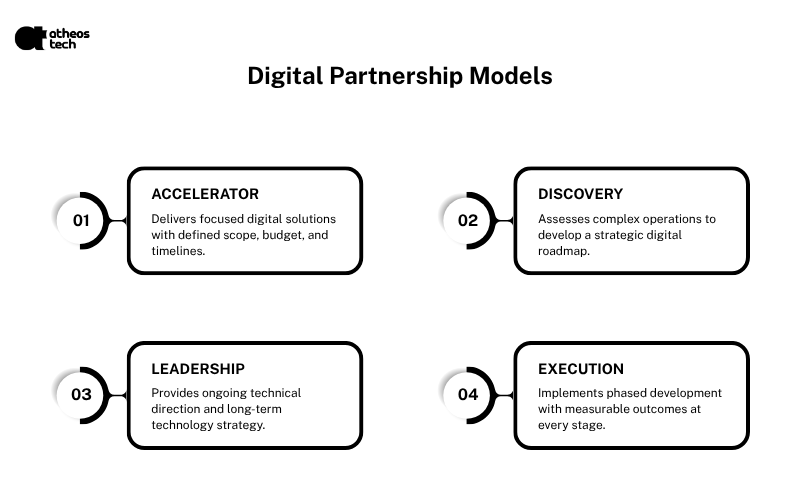
Quick-Start / Fixed Scope:
Ideal for specific tools like compliance portals, SDS management systems, or audit dashboards. We deliver a high-impact solution with a defined timeline and budget.
Discovery-Led / Consulting First:
For firms with complex, interconnected processes, we deep-dive into your operations to create a comprehensive digital Entwicklungs-Roadmap (development roadmap).
Fractional CTO / Strategic Partner:
We become your technical "co-founder", owning the long-term growth strategy and technology architecture while you focus on the chemistry.
Scale-Up / Agile Development:
A phased rollout, starting with QA before scaling to production and compliance, ensuring every Meilenstein (milestone) provides measurable ROI.
We believe that technology should adapt to your business, not the other way around. By choosing a partner that understands the specific regulatory and operational nuances of the industry, chemical manufacturers can achieve a seamless transition to digital maturity that respects their heritage while securing their future.
NICHE, MODELS & CLONES: Why Specialized Software Beats Generic Platforms
Generic ERP systems often fail the chemical industry because they are designed for discrete manufacturing, not the complex realities of Spezialchemie (specialty chemicals). For chemical manufacturers, a “one-size-fits-all” platform usually lacks the depth required for intricate batch genealogy, formula version control, or the automated multi-language output of safety data sheets. Forcing these specialized needs into a generic framework creates friction and forces teams back into manual spreadsheets.
To solve this, AtheosTech utilizes a “clone and elevate” model. By taking proven software architectures from adjacent high-compliance sectors like pharma and food processing, we adapt them specifically for the Swiss chemical context. This innovation process allows us to deploy digital tools that are already familiar with rigorous safety standards while being tailored to your specific Rezepturverwaltung (formula management). This approach not only speeds up implementation but also opens doors to new revenue models, such as subscription-based SDS portals or white-label apps for distribution partners.
The ultimate value of niche specialization is higher adoption on the plant floor. When software reflects the actual workflows of a chemist or technician, the training burden vanishes. These targeted benefits of digital transformation allow for sustainable growth without the “bloat” of unnecessary features. We don’t just deliver software; we provide a domain-specific digital foundation that empowers chemical manufacturers to lead their niche with precision.
LOCAL LANGUAGE & NATIVE FEEL: The Overlooked Key to Adoption
For chemical manufacturers in Switzerland, the country’s four-language reality is not a simple translation challenge, it is a fundamental cultural UX necessity. Whether your facility is in Basel, Sion, or Lugano, shift workers and lab technicians perform high-stakes tasks in their Muttersprache (native language). An English-only interface creates unnecessary friction, increases the risk of data-entry errors, and breeds cultural resistance among the very people meant to use the software.
A true “Native Feel” goes beyond menus and buttons; it requires local industrial dashboard UX that understands Swiss date formats, measurement conventions, and specific Fachterminologie (technical terminology) used in the chemical industry. At AtheosTech, our regional European team builds software that feels like it was made in Switzerland, for Switzerland. We prioritize intuitive workflows that respect the local Betriebsklima (workplace atmosphere), ensuring that your digital tools are embraced rather than abandoned.
The real consequence of ignoring this detail is “shelfware”, expensive software that is discarded by the floor team within six months because it feels foreign and cumbersome. By focusing on language-native solutions, AtheosTech ensures high user adoption and long-term ROI for chemical manufacturers.
GROWTH DRIVERS: Digital as a Revenue Engine
Beyond cost-cutting, digitalization transforms chemical manufacturers into high-value strategic partners. By integrating advanced supply chain traceability, firms can access high-margin sectors like pharma-grade or aerospace production that demand rigorous, real-time Rückverfolgbarkeit (traceability).
Using data and analytics, firms can offer premium services such as live inventory portals, providing a distinct Mehrwert (added value) to global customers. Furthermore, AI process optimization reduces waste and improves yield, freeing up capital for the innovation process and specialized R&D. This transition to a data-driven model is the ultimate engine for sustainable growth, ensuring that chemical manufacturers maintain their competitive edge and long-term Zukunftssicherheit (future-proofing).
FAQ's
FAQ's
Most firms use integrated digital tools for automated Safety Data Sheet (SDS) generation, GHS labelling, and specialized REACH dossier management systems. These platforms ensure real-time alignment with both Swiss ChemRRV and EU regulations.
Costs vary based on plant complexity. However, many chemical manufacturers start with a phased approach (e.g., a specific compliance portal) which can cost between CHF 20k–50k, while full-scale digital transformation in chemical manufacturing is an ongoing investment scaled to ROI.
An ERP (Enterprise Resource Planning) manages business operations like finance and procurement. A LIMS (Laboratory Information Management System) specifically tracks lab data, samples, and chemical formulations. Integrating the two is essential for a "Single Source of Truth".
A targeted module can be deployed in 3-4 months. A full-scale integration typically follows a 6-to-18-month roadmap to ensure zero disruption to production and high employee adoption.
Yes. AtheosTech provides localized expertise and a dedicated European team to help chemical manufacturers implement secure, scalable, and language-native digital solutions that meet the highest Swiss industrial standards.