- AtheosTech
The ROI of XR: Measuring Business Impact and Performance
From Immersive Experiences to Measurable Results That Drive Real Business Growth
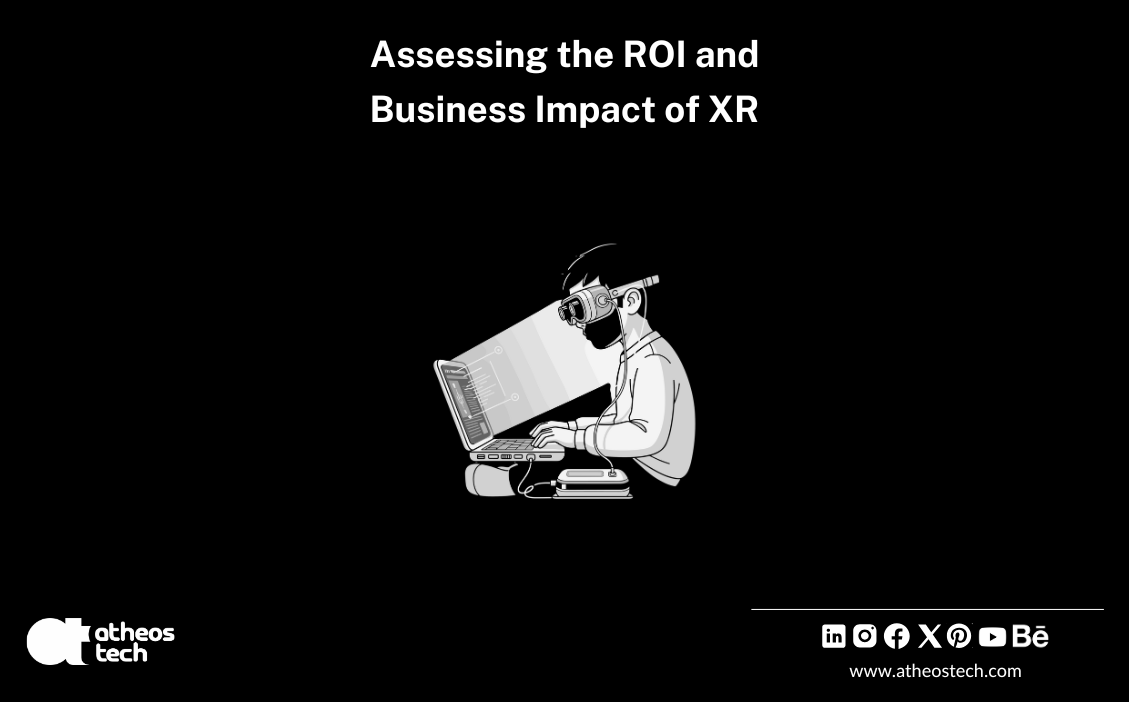
The most powerful technologies don’t announce themselves.
They change how decisions feel.
The First Shift Happens Before the Numbers Appear
Every serious business transformation begins the same way, not with numbers, but with discomfort.
A subtle realization that existing tools are no longer enough. That dashboards explain what happened, but never why. Those meetings last longer because clarity arrives late. Assumptions are slowly replacing that confidence in decisions.
This is the exact moment when organizations start noticing extended reality, not because it looks futuristic, but because it removes the friction they had stopped questioning.
We’ve seen this pattern repeatedly. Leaders don’t fall in love with XR because it is immersive. They commit to it because once they experience information spatially, contextually, and in real time, going back feels inefficient.
And that discomfort, the inability to return to old ways, is the first signal of ROI forming.
Before XR delivers measurable impact, it provides clarity.
And clarity always precedes performance.
That clarity doesn’t come from hardware or visuals alone. It comes from a structural shift in how information is delivered to the human mind.
Extended Reality (XR) introduces a new business layer, one that removes abstraction. Instead of asking people to imagine scenarios, interpret data, or translate instructions, XR places them inside the situation itself.
This layer is built using:
- Augmented Reality solutions, which enhance the physical world with live intelligence
- Virtual Reality Solutions, which simulate high-risk or high-cost environments safely
- Integrated XR technologies that allow interaction, not observation
What makes this shift critical is not novelty, it’s speed. When information is experienced rather than explained, understanding becomes immediate. And when understanding is immediate, hesitation disappears.
This is where XR quietly separates itself from traditional digital tools. And it is also where ROI stops being theoretical and starts becoming operational.
Once clarity enters the system, something unexpected happens: old measurement models start to feel inadequate.
Traditional ROI frameworks are built around linear inputs and outputs, money in, money out. But XR technology doesn’t operate linearly. It influences behavior, confidence, and decision quality long before revenue numbers change.
This is why many organizations underestimate XR at first. They look for instant profit spikes and miss the early signals:
- Faster comprehension
- Reduced back-and-forth
- Fewer mistakes made quietly
- Decisions made with conviction
These are not “soft benefits.” They are leading indicators of performance acceleration.
We treat XR ROI as layered. Financial impact is inevitable, but only after operational friction is removed. And that removal happens first in the places where humans interact most intensely with complexity.
Which brings us directly to training.
Training is where complexity meets human limitation.
Traditional training relies on explanation, repetition, and hope. Hope that employees remember. Hope they apply correctly. I hope mistakes don’t happen in critical moments.
Virtual Reality Solutions eliminate that uncertainty.
By immersing employees in realistic environments, XR converts learning into experience. Tasks are not described; they are performed. Mistakes are not theoretical; they are felt and corrected safely.
The immediate impact is measurable:
- Faster onboarding
- Higher skill retention
- Reduced dependency on supervision
- Lower incident rates
But more importantly, XR introduces a shift in workforce behavior. Employees trained through immersion operate with confidence instead of caution. And confidence directly affects speed, accuracy, and accountability.
Once organizations witness this transformation in training, they begin to ask a dangerous question:
If XR can eliminate friction here… where else can it do the same?
The answer usually lies in operations.
Operations are where small inefficiencies hide comfortably. Individually, they seem insignificant. Collectively, they are expensive.
Augmented Reality solutions expose these inefficiencies by placing intelligence directly into the operational environment. Instructions appear where work happens. Diagnostics surface before failures escalate. Expertise travels digitally instead of physically.
This transition matters because it shifts operations from reactive to anticipatory.
The ROI compounds through:
- Reduced downtime
- Faster issue resolution
- Fewer operational errors
- Lower dependency on tribal knowledge
What XR changes here is not just efficiency, but visibility. When teams can see systems behaving in real time, decisions become proactive instead of corrective.
And once operations stabilize and accelerate, leadership attention naturally shifts outward, toward customers and revenue.
Most sales challenges are not caused by poor messaging. They are caused by an incomplete understanding.
Customers hesitate when they cannot visualize outcomes. They delay decisions when they must imagine value.
XR solutions remove that burden.
By allowing customers to experience products, environments, or processes before committing, XR replaces persuasion with certainty. The conversation shifts from “trust us” to “see for yourself.”
This shift directly impacts:
- Engagement duration
- Conversion velocity
- Decision confidence
- Post-sale satisfaction
XR doesn’t pressure customers. It empowers them. And empowered customers move faster, with fewer objections and stronger conviction.
At this point, XR has influenced training, operations, and customer engagement. The organization begins to feel something unfamiliar: momentum.
That momentum naturally fuels innovation.
Innovation slows down when ideas live only in language. Meetings stretch. Feedback loops multiply. Misalignment grows.
XR technologies remove that friction by turning ideas into environments.
Designs can be walked through. Processes can be stress-tested. Scenarios can be experienced before investment decisions are finalized.
The ROI appears as:
- Reduced prototyping costs
- Faster approvals
- Fewer late-stage revisions
- Accelerated time-to-market
More importantly, XR aligns stakeholders instantly. When everyone sees the same thing, interpretation disappears. Decisions happen faster, not because of urgency, but because of clarity.
And by now, the pattern should be obvious.
XR doesn’t improve one function.
It synchronizes many.
Which raises the final question executives inevitably ask:
How do we measure all of this properly?
“Start seeing real value from extended reality.”
Measuring XR ROI: Connecting Performance to Proof
By the time organizations arrive at this stage, something important has already changed.
They are no longer asking whether XR works.
They are asking how to prove what they can already feel.
This is where many measurement frameworks fail, because XR ROI cannot be compressed into a single number. XR does not behave like a marketing campaign or a software license. It reshapes how people operate, decide, and perform. And when behavior changes, performance follows in patterns, not spikes.
High-performing enterprises understand this. They don’t search for one metric to justify XR. They track a constellation of indicators that together reveal a far more accurate story.
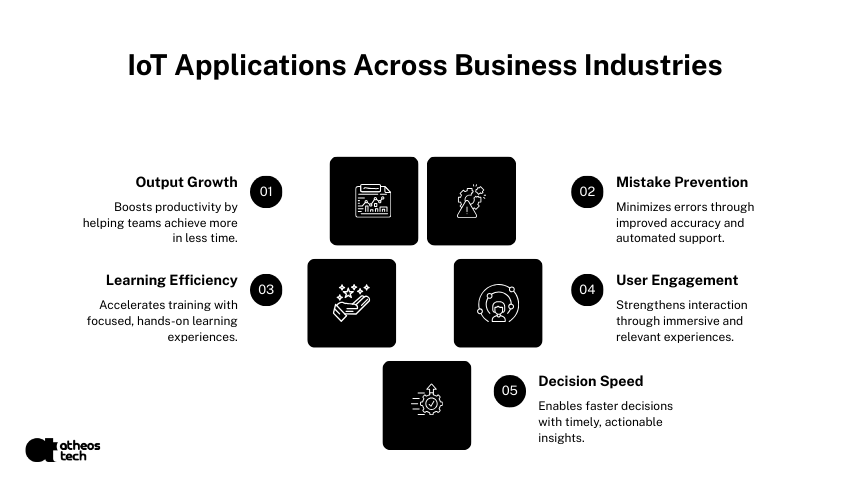
XR shortens the distance between understanding and execution. Tasks are completed faster, not because teams rush, but because hesitation disappears. When employees see what to do, where to do it, and how outcomes unfold in real time, momentum becomes measurable. Productivity acceleration is one of the earliest and most consistent signals of XR ROI.
Errors thrive in ambiguity. XR removes ambiguity by making processes spatial, contextual, and visible. Whether in training environments, operational workflows, or customer-facing scenarios, mistakes decline because people are no longer guessing. Reduced errors translate directly into cost control, safety improvements, and reputational protection.
Traditional training measures time spent. XR measures the capability gained. With immersive learning, organizations see faster onboarding, stronger retention, and fewer repetitions required to reach proficiency. Training efficiency becomes a financial metric, one that compounds as organizations scale.
Engagement is often misunderstood as attention. XR reveals it as presence. When users are immersed, interaction is deeper, learning is stronger, and recall is longer-lasting. Whether employees or customers, deeper engagement correlates directly with performance quality, satisfaction, and loyalty.
Perhaps the most underestimated metric of all. XR collapses decision cycles by replacing explanation with experience. Leaders no longer debate hypothetical outcomes; they walk through them. As clarity increases, approval processes shorten, confidence rises, and strategic moves happen earlier than competitors expect.
Individually, each of these indicators tells a story. Together, they form undeniable proof.
XR makes ROI visible because behavior becomes visible. Actions change. Reactions sharpen. Outcomes stabilize. The numbers simply follow.
This is why ROI is never an afterthought. We define these performance markers before XR deployment begins, aligning them with business objectives and leadership expectations. That way, XR impact is not discovered accidentally months later; it is reported deliberately, measured continuously, and trusted instinctively.
Because when performance shifts this clearly, proof is no longer something you search for.
It’s something you recognize immediately.
Productivity Acceleration
XR shortens the distance between understanding and execution. Tasks are completed faster, not because teams rush, but because hesitation disappears. When employees see what to do, where to do it, and how outcomes unfold in real time, momentum becomes measurable. Productivity acceleration is one of the earliest and most consistent signals of XR ROI.
Error Reduction
Errors thrive in ambiguity. XR removes ambiguity by making processes spatial, contextual, and visible. Whether in training environments, operational workflows, or customer-facing scenarios, mistakes decline because people are no longer guessing. Reduced errors translate directly into cost control, safety improvements, and reputational protection.
Training Efficiency
Traditional training measures time spent. XR measures the capability gained. With immersive learning, organizations see faster onboarding, stronger retention, and fewer repetitions required to reach proficiency. Training efficiency becomes a financial metric, one that compounds as organizations scale.
Engagement Depth
Engagement is often misunderstood as attention. XR reveals it as presence. When users are immersed, interaction is deeper, learning is stronger, and recall is longer-lasting. Whether employees or customers, deeper engagement correlates directly with performance quality, satisfaction, and loyalty.
Decision Cycle Speed
Perhaps the most underestimated metric of all. XR collapses decision cycles by replacing explanation with experience. Leaders no longer debate hypothetical outcomes; they walk through them. As clarity increases, approval processes shorten, confidence rises, and strategic moves happen earlier than competitors expect.
Individually, each of these indicators tells a story. Together, they form undeniable proof..
XR makes ROI visible because behavior becomes visible. Actions change. Reactions sharpen. Outcomes stabilize. The numbers simply follow..
This is why ROI is never an afterthought. We define these performance markers before XR deployment begins, aligning them with business objectives and leadership expectations. That way, XR impact is not discovered accidentally months later; it is reported deliberately, measured continuously, and trusted instinctively..
Because when performance shifts this clearly, proof is no longer something you search for.
It’s something you recognize immediately.
AtheosTech’s Approach to Extended Reality Services
This interconnected impact is why we deliver Extended reality services as a strategy, not experiments.
We don’t ask where XR looks impressive.
We ask where it removes the most friction.
By aligning XR initiatives with business objectives, adoption psychology, and measurable KPIs, we ensure XR becomes embedded, not abandoned.
And once embedded, XR stops being questioned.
The Long-Term ROI of Extended Reality (XR)
Over time, XR evolves from a solution to a capability.
Organizations that adopt Extended reality (XR) early build a structural advantage. They make decisions faster. Train smarter. Innovate confidently. Engage customers with clarity others can’t match.
This advantage compounds quietly until it becomes obvious to everyone else.
XR Rewards Those Who Follow the Thread
XR ROI is not a moment.
It is a sequence.
Clarity leads to confidence.
Confidence leads to speed.
Speed leads to performance.
Performance leads to dominance.
We design extended reality journeys where each step naturally pulls the next, ensuring organizations don’t just adopt XR, but grow into it.
Continue the Experience
Explore how AtheosTech’s XR technology and XR solutions turn immersive experiences into sustained business advantage.
Once you start seeing clearly,
Stopping is no longer an option.
FAQ's
ROI in extended reality refers to the measurable business value gained from XR investments, such as cost savings, productivity improvements, better training outcomes, and increased customer engagement.
AtheosTech tracks clear KPIs such as reduced training time, higher productivity, fewer errors, and improved engagement to ensure extended reality delivers measurable value.
Yes. XR training improves knowledge retention, reduces errors, and allows employees to practice real-world scenarios safely, leading to faster skill development and better performance.
Training, collaboration, product visualization, and customer engagement typically show the strongest ROI. AtheosTech implements XR where it has the most immediate and long-term impact.
Many clients see early improvements within weeks, especially in training and collaboration. Long-term ROI grows as extended reality becomes part of everyday business operations.
FAQ's
ROI in extended reality refers to the measurable business value gained from XR investments, such as cost savings, productivity improvements, better training outcomes, and increased customer engagement.
AtheosTech tracks clear KPIs such as reduced training time, higher productivity, fewer errors, and improved engagement to ensure extended reality delivers measurable value.
Yes. XR training improves knowledge retention, reduces errors, and allows employees to practice real-world scenarios safely, leading to faster skill development and better performance.
Training, collaboration, product visualization, and customer engagement typically show the strongest ROI. AtheosTech implements XR where it has the most immediate and long-term impact.
Many clients see early improvements within weeks, especially in training and collaboration. Long-term ROI grows as extended reality becomes part of everyday business operations.