How IoT Platforms Turn Real-Time Data Into Business Intelligence
Imagine this: Your marketing team just landed a game-changing partnership with a major US retailer. The traffic surge is exactly what you prayed for, the culmination of months of strategy and high-spend campaigns. But as the clock hits peak hours, the dream turns into a nightmare. Your internal system starts crawling. Your user experience tanks as mobile apps hang on infinite loading spinners. Your engineering lead pales, mentioning “cascading failures” and database queries locking up under the weight of large datasets.
In the high-stakes world of American tech, this is the “Scale-up Paradox.” You’ve built a product people want, but your infrastructure wasn’t designed to actually let them use it.
At AtheosTech, we’ve seen this script play out with founders and CMOs from Silicon Valley to the New York FinTech corridor. The culprit is rarely the front-end design or the brand aesthetic; it’s the invisible plumbing. API Integration isn’t just a technical checkbox; it’s the operational backbone of your business. If your APIs aren’t engineered for high performance, you aren’t just losing speed; you’re losing revenue, burning through your CAC (Customer Acquisition Cost), and damaging your long term brand equity.
To a business owner, an API (Application Programming Interface) might seem like a simple bridge, a way to get “App A” to talk to “App B.” But from the perspective of a senior digital marketing strategist, an API is a product in its own right.
Professional API Development is the art of creating digital doorways. If those doors are too small, people get stuck (poor user experience). If they have no locks, anyone can walk in (security vulnerabilities). If they are built with poor materials, they collapse under pressure.
Top-tier api development services ensure these doorways are wide, secure, and smart. We don’t just look at whether the data moves from point A to point B; we look at the velocity of that movement and the resource cost of every single call. In a world where “instant” is the only acceptable speed, your api design is the difference between a fluid customer journey and a broken one.
Most companies treat System Integration like a DIY home renovation. They add a feature here, a third-party tool there, and suddenly they have “spaghetti architecture.” This is often the result of “Technical Debt”, choosing the fastest, cheapest way to launch a feature rather than the most sustainable one.
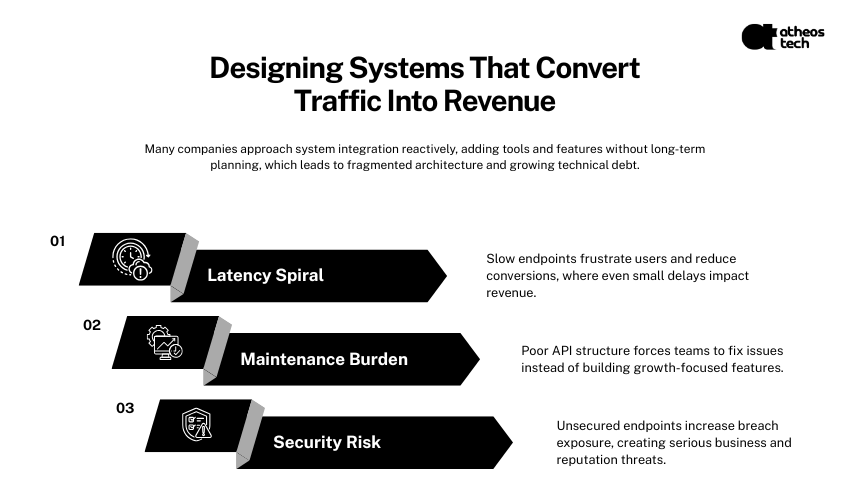
Slow api endpoints lead to frustrated users. In the USA market, where attention spans are measured in milliseconds, a 100ms delay can drop conversion rates by 7%.
When you lack proper api development services, your team spends 80% of their time fixing broken links and manual data patches instead of building new, revenue-generating features.
Without professional oversight, you're often one unshielded endpoint away from a massive data breach. Security vulnerabilities aren't just IT problems; they are PR disasters that can end a company.
Most companies treat System Integration like a DIY home renovation. They add a feature here, a third-party tool there, and suddenly they have “spaghetti architecture.” This is often the result of “Technical Debt”, choosing the fastest, cheapest way to launch a feature rather than the most sustainable one.
Slow api endpoints lead to frustrated users. In the USA market, where attention spans are measured in milliseconds, a 100ms delay can drop conversion rates by 7%.
When you lack proper api development services, your team spends 80% of their time fixing broken links and manual data patches instead of building new, revenue-generating features.
Without professional oversight, you're often one unshielded endpoint away from a massive data breach. Security vulnerabilities aren't just IT problems; they are PR disasters that can end a company.
Performance is a psychological lever. When an interface responds in real time, it creates a “flow state” for the user. It feels premium. It feels reliable. This builds an unconscious level of trust. Conversely, a laggy interface feels “cheap” or “untrustworthy,” regardless of how much you spent on the UI/UX design.
Strategic api design considers the human on the other end. This is where optimizing api performance becomes a marketing strategy. We ask:
Traditional “monolith” systems are like a single, massive ship. If one part of the engine fails, or if you need to carry more weight in the back, the whole ship is affected. An api development company like ours breaks this into a fleet of agile microservices. If your “payment” service is seeing a spike, you scale only that service. This is the definition of efficiency.
Why ask the database the same question a thousand times a second? Caching is like having a “speed-dial” for data. By storing the results of frequent database queries in high-speed memory, we drastically reduce server load. This ensures that the thousandth user gets the same lightning-fast response as the first.
Inefficient data retrieval is the silent killer of high performance. Many developers write queries that work with 100 rows of data but fail with 1,000,000. Professional api development involves indexing, query tuning, and read/write splitting to ensure that large datasets are handled with surgical precision.
In API Development, every byte counts. We use modern techniques like Gzip compression and efficient data formats to ensure your api integration remains snappy. By reducing payload sizes, we ensure that your app feels fast even on legacy 4G networks or in regions with poor connectivity.
To protect your internal system, we must govern it. Implementing rate limiting prevents any single user or automated script from hogging all the resources. This acts as a “traffic light” system, ensuring that your api endpoints remain available and fast for your legitimate, high-value traffic.
Not every task needs to happen while the user is watching a “loading” bar. We move heavy tasks, like generating a 50-page PDF report or syncing data with a CRM, to the background. By using message queues, the user experience remains buttery smooth, while the heavy lifting happens behind the scenes in real time.
Distance equals delay. If your server is in Virginia and your user is in San Francisco, there is a physical limit to how fast data can travel. By deploying API logic to the “edge” (closer to the user), we slash latency and improve api performance regardless of geographical location.
Security is often seen as a speed bump, but we use it as a performance enhancer. By filtering out malicious traffic and bot attacks at the gateway level, we save your server’s CPU for real users. We eliminate security vulnerabilities through robust api design from day one.
Professional api integration services ensure your servers are “stateless.” This means any server can handle any request at any time. When your traffic triples, we don’t need a bigger server; we just plug in ten more small ones. This “Lego-style” scaling is how companies like Netflix and Uber stay online.
We move from reactive to proactive. Using advanced telemetry, we watch your api endpoints in real-time. If the server load hits 70%, our systems automatically spin up new resources before the user ever feels a slowdown. This is “Zero-Friction” scalability.
Traditional "monolith" systems are like a single, massive ship. If one part of the engine fails, or if you need to carry more weight in the back, the whole ship is affected. An api development company like ours breaks this into a fleet of agile microservices. If your "payment" service is seeing a spike, you scale only that service. This is the definition of efficiency.
Why ask the database the same question a thousand times a second? Caching is like having a "speed-dial" for data. By storing the results of frequent database queries in high-speed memory, we drastically reduce server load. This ensures that the thousandth user gets the same lightning-fast response as the first.
Inefficient data retrieval is the silent killer of high performance. Many developers write queries that work with 100 rows of data but fail with 1,000,000. Professional api development involves indexing, query tuning, and read/write splitting to ensure that large datasets are handled with surgical precision.
In API Development, every byte counts. We use modern techniques like Gzip compression and efficient data formats to ensure your api integration remains snappy. By reducing payload sizes, we ensure that your app feels fast even on legacy 4G networks or in regions with poor connectivity.
To protect your internal system, we must govern it. Implementing rate limiting prevents any single user or automated script from hogging all the resources. This acts as a "traffic light" system, ensuring that your api endpoints remain available and fast for your legitimate, high-value traffic.
Not every task needs to happen while the user is watching a "loading" bar. We move heavy tasks, like generating a 50-page PDF report or syncing data with a CRM, to the background. By using message queues, the user experience remains buttery smooth, while the heavy lifting happens behind the scenes in real time.
Distance equals delay. If your server is in Virginia and your user is in San Francisco, there is a physical limit to how fast data can travel. By deploying API logic to the "edge" (closer to the user), we slash latency and improve api performance regardless of geographical location.
Security is often seen as a speed bump, but we use it as a performance enhancer. By filtering out malicious traffic and bot attacks at the gateway level, we save your server’s CPU for real users. We eliminate security vulnerabilities through robust api design from day one.
Professional api integration services ensure your servers are "stateless." This means any server can handle any request at any time. When your traffic triples, we don't need a bigger server; we just plug in ten more small ones. This "Lego-style" scaling is how companies like Netflix and Uber stay online.
We move from reactive to proactive. Using advanced telemetry, we watch your api endpoints in real-time. If the server load hits 70%, our systems automatically spin up new resources before the user ever feels a slowdown. This is "Zero-Friction" scalability.
The E-commerce Surge. A high-end lifestyle brand saw its checkout API hang every time an influencer posted a link. The database queries were unoptimized, causing the whole site to crash. We re-engineered their api integration services, implemented aggressive caching, and optimized their data flow.
Result: 40% faster checkout times and a 22% increase in mobile conversions during their largest product drop in history.
The SaaS Scaling Wall. A B2B SaaS platform struggled as it moved from 100 users to 10,000. Their internal system couldn’t handle the large datasets being pulled for reports. We implemented an asynchronous api design and moved reporting to a dedicated microservice.
Result: Report generation went from “minutes of waiting” to “instant background notification,” drastically improving user retention.
We don’t just write code; we engineer ROI. Our approach to API Development is built on a “Luxury Engineering” model, where every line of code is purposeful, elegant, and built to last.
We don't just ask what you want to build; we ask how you plan to grow.
We apply rigorous design principles to ensure your API is intuitive for developers and lightning-fast for users.
We stress-test your system to its breaking point in a sandbox so it never breaks in the real world.
We monitor, tweak, and optimize because we know that high performance is a moving target.
We don't just ask what you want to build; we ask how you plan to grow.
We apply rigorous design principles to ensure your API is intuitive for developers and lightning-fast for users.
We stress-test your system to its breaking point in a sandbox so it never breaks in the real world.
We monitor, tweak, and optimize because we know that high performance is a moving target.
Your API is the “hidden” salesperson of your company. If it’s fast and reliable, the sale goes through. If it’s slow or buggy, the customer leaves.
When you invest in professional api development services, you are shortening your “Time to Market.” You are making it easier for partners to integrate with you, creating new revenue streams through System Integration. You are reducing your cloud hosting bills by optimizing api performance, so you use fewer resources to do more work.
The digital landscape in the USA is unforgiving. There is no “participation trophy” for a website that almost works or an app that is “usually” fast. In the premium market, your infrastructure is your reputation, and AtheosTech is here to ensure that reputation remains gold-standard.
You can either spend the next two years paying for “patchwork” fixes and emergency downtime, or you can build a foundation that supports your ambition. Seamless API Integration is the ultimate leverage; it allows a small team to act like a giant and a giant to move with the speed of a startup.
Stop settling for “functional” and start demanding high performance. Partner with a team that understands the intersection of technical precision and business growth.
A well-engineered API acts as a high-speed highway between your data and your interface. By optimizing api performance, specifically through improving response times and reducing payload sizes, AtheosTech eliminates the "lag" that causes users to abandon apps. When your api endpoints respond in real time, the entire application feels more premium, responsive, and reliable.
Absolutely. The primary cause of server crashes during data-heavy tasks is unoptimized database queries. Our api integration services implement strategies like pagination, asynchronous processing, and intelligent caching. This ensures your internal system can process millions of records without increasing the server load to a breaking point.
Many businesses fall into the "functional but fragile" trap. Common security vulnerabilities we find include broken object-level authorization (BOLA), lack of rate limits, and exposed sensitive data in payloads. As a premier api development company, AtheosTech bakes security into the design principles from day one, ensuring your business remains protected long term.
System Integration allows your entire tech stack, from CRM to payment gateways, to share data seamlessly. At AtheosTech, we call this "operational velocity." When your systems are unified through high-performance APIs, you can launch new features faster, automate manual workflows, and scale your user base without a linear increase in overhead costs.
If your team is struggling to deploy updates without breaking existing features, or if your server load is high even during moderate traffic, it’s time for a transition. AtheosTech helps you decouple your architecture so that each component can scale independently, providing the ultimate foundation for high performance and global growth.
A well-engineered API acts as a high-speed highway between your data and your interface. By optimizing api performance, specifically through improving response times and reducing payload sizes, AtheosTech eliminates the "lag" that causes users to abandon apps. When your api endpoints respond in real time, the entire application feels more premium, responsive, and reliable.
Absolutely. The primary cause of server crashes during data-heavy tasks is unoptimized database queries. Our api integration services implement strategies like pagination, asynchronous processing, and intelligent caching. This ensures your internal system can process millions of records without increasing the server load to a breaking point.
Many businesses fall into the "functional but fragile" trap. Common security vulnerabilities we find include broken object-level authorization (BOLA), lack of rate limits, and exposed sensitive data in payloads. As a premier api development company, AtheosTech bakes security into the design principles from day one, ensuring your business remains protected long term.
System Integration allows your entire tech stack, from CRM to payment gateways, to share data seamlessly. At AtheosTech, we call this "operational velocity." When your systems are unified through high-performance APIs, you can launch new features faster, automate manual workflows, and scale your user base without a linear increase in overhead costs.
If your team is struggling to deploy updates without breaking existing features, or if your server load is high even during moderate traffic, it’s time for a transition. AtheosTech helps you decouple your architecture so that each component can scale independently, providing the ultimate foundation for high performance and global growth.
Adding {{itemName}} to cart
Added {{itemName}} to cart