- AtheosTech
Why Immersion Changes How Humans Decide
Why immersive experiences reduce hesitation and accelerate confident decision-making
The Moment Before a Decision Is Made
Every decision, personal or professional, begins long before numbers appear on a screen.
It begins in the mind.
Before a CEO signs off on a strategy, before a customer commits to a product, before a team adopts a new process, the brain silently asks one question:
“Do I feel confident about this?”
That confidence is rarely built through logic alone. It is shaped by experience, imagination, and emotional certainty. This is why extended reality is changing how decisions are made, and why its return on investment is far deeper than spreadsheets can initially show.
At AtheosTech, we don’t view XR as a visual layer. We view it as a psychological advantage.
Why Traditional Digital Experiences Fail to Create Certainty
Most digital content is designed to explain.
Websites explain.
Presentations explain.
Videos explain.
But explanation creates distance.
When people are forced to imagine outcomes on their own, uncertainty grows. The brain fills gaps with doubt, assumptions, and hesitation. This is especially true in complex environments like enterprise solutions, training systems, or strategic planning.
This is where XR tech fundamentally changes the interaction model.
Instead of asking users to imagine success, extended reality places them inside it. And once that happens, the decision process transforms from analytical guessing into experiential knowing.
What Immersion Actually Does to the Brain
Immersion is not just engagement; it is absorption.
When someone enters an immersive environment, their attention narrows naturally. External distractions fade. Cognitive effort decreases. Emotional processing increases. The brain shifts from passive intake to active participation.
This state is powerful because:
- The brain treats immersive input as lived experience
- Emotional centers activate alongside rational thought
- Memory formation becomes stronger and longer-lasting
This is why immersive experiences feel intense, memorable, and convincing. They don’t just communicate information; they create internal reference points the brain trusts.
And trust is the foundation of ROI.
Presence:
The Psychological Switch That Changes Everything
Presence is the feeling of “being there.”
When presence is achieved, users stop noticing the technology itself. The medium disappears. What remains is experience. This matters because the human brain assigns higher credibility to experiences it perceives as real. When presence is strong, skepticism weakens. Evaluation turns into acceptance.
In extended reality (XR), presence is what transforms simulations into perceived reality. And perceived reality directly influences belief.
Once belief is established, persuasion is no longer required.
Emotion:
The Hidden Driver of Performance and Profit
Emotion is not the opposite of logic; it is its accelerator.
When emotions are engaged, decision-making becomes faster, clearer, and more confident. Immersive environments naturally evoke emotion because they stimulate multiple senses and reduce cognitive distance.
Users may feel:
- Curiosity when exploring
- Confidence when navigating outcomes
- Relief when uncertainty disappears
- Excitement when potential becomes tangible
These emotional responses are not side effects. They are the reason extended reality solutions outperform traditional tools in adoption, understanding, and retention.
People don’t remember features.
They remember how something made them feel.
Mental and Sensory Immersion Explained Simply
There are two main ways immersion works, and both matter.
Mental immersion engages imagination and narrative. It pulls users into a story, a scenario, or a future version of themselves. This is common in simulations, guided journeys, and scenario-based learning.
Sensory immersion engages sight, sound, movement, and space. It creates the physical feeling of presence, especially powerful in Virtual Reality Solutions.
When combined, these forms of immersion reinforce each other. The mind imagines while the body responds. This alignment creates clarity faster than explanation ever could.
Why Experience-Based Memory Creates Long-Term ROI
Information-based learning fades quickly. Experience-based learning stays. Immersive interactions are stored in the brain similarly to real-world memories. They resurface naturally when related decisions are required in the future.
This is why extended reality software delivers ongoing value:
- Faster recall
- Stronger emotional association
- Higher confidence in future decisions
The return is not just immediate; it compounds.
Explore Extended Reality Services
Cultural Immersion and Human Understanding
Beyond business performance, immersion reshapes perspective.
Cultural immersion allows people to step into environments and experiences they may never encounter otherwise. This builds empathy, understanding, and emotional intelligence, not through instruction, but through lived experience.
When people feel a sense of another reality, barriers dissolve. Learning becomes personal. Understanding becomes instinctive.
This human impact is one of the most underestimated returns of immersive technology.
How ROI Manifests in Real Business Terms
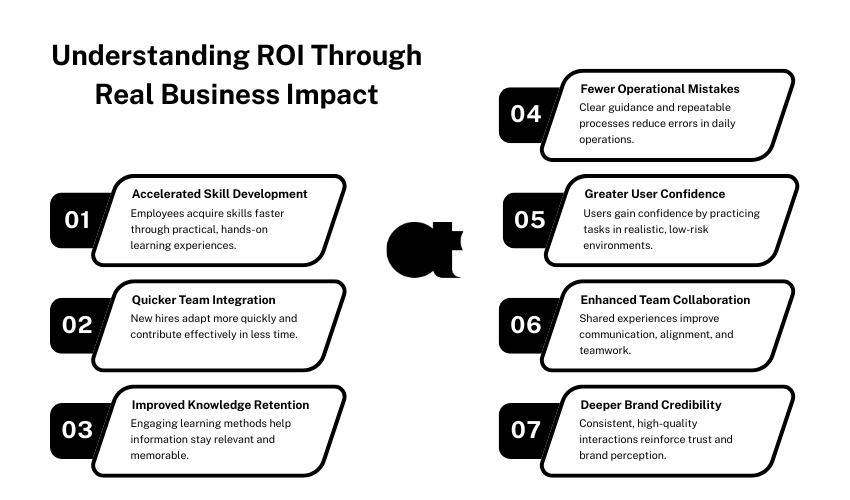
When businesses hear the word ROI, most minds jump straight to revenue charts, quarterly profits, and sales dashboards. That expectation is exactly why ROI in XR often gets misunderstood.
Immersive technology doesn’t always pay back in instant dollars. Instead, it reshapes the conditions that create revenue, and those changes compound over time.
Think of XR ROI as operational gravity. You may not see it instantly, but everything starts moving faster, smoother, and with less resistance.
- Reduced Training Time
- Faster Onboarding
- Higher Retention
- Lower Error Rates
- Increased Confidence
- Better Collaboration
- Stronger Brand Trust
Traditional training relies on explanations, slides, manuals, and repetition. XR replaces explanation with experience. Employees don’t hear how something works; they do it. Mistakes happen safely, learning accelerates naturally, and muscle memory forms faster. What once took weeks now takes days, sometimes hours.
That reduction isn’t just about saving time; it’s about getting people productive sooner, which directly impacts output and cost efficiency.
Onboarding delays are silent profit killers. New hires often take months to fully understand processes, environments, and expectations. Immersive onboarding places them directly inside real-world scenarios from day one. They see workflows, interact with systems, and understand roles contextually, not theoretically.
The result is confidence instead of confusion, and momentum instead of hesitation.
People leave when they feel disconnected or overwhelmed. XR creates clarity early. When employees understand their role deeply and feel capable quickly, they stay longer. Retention improves not because of perks, but because uncertainty disappears.
Lower turnover means reduced hiring costs, less disruption, and stronger institutional knowledge.
Errors usually happen when people are unsure. XR allows teams to practice high-risk or complex tasks repeatedly without real-world consequences. By the time they perform in reality, mistakes have already been made and corrected virtually.
Fewer errors lead to fewer delays, fewer losses, and fewer compliance issues.
Confidence is not emotional; it’s experiential. When someone has already “been there” virtually, the real situation feels familiar. That familiarity transforms hesitation into decisive action, especially in high-pressure environments.
Confident teams move faster, communicate better, and require less supervision.
Immersive environments align understanding across departments. Instead of abstract discussions, teams share a common visual and experiential reference. Decisions become clearer, debates shorten, and alignment strengthens.
Collaboration stops being a meeting; it becomes a shared experience.
For customers and stakeholders, XR builds belief before commitment. Experiencing a product, solution, or process removes doubt. Trust grows when people see value instead of imagining it.
Trust accelerates decisions, and faster decisions drive growth.
All of these outcomes directly shape performance, efficiency, and scalability. They may not show up as revenue on day one, but they create the conditions where revenue becomes inevitable.
ROI isn’t measured by novelty or visuals. It’s measured by how effectively immersion turns hesitation into momentum, and momentum into measurable results.
- Reduced Training Time
- Faster Onboarding
- Higher Retention
- Lower Error Rates
- Increased Confidence
- Better Collaboration
- Stronger Brand Trust
Traditional training relies on explanations, slides, manuals, and repetition. XR replaces explanation with experience. Employees don’t hear how something works; they do it. Mistakes happen safely, learning accelerates naturally, and muscle memory forms faster. What once took weeks now takes days, sometimes hours.
That reduction isn’t just about saving time; it’s about getting people productive sooner, which directly impacts output and cost efficiency.
Onboarding delays are silent profit killers. New hires often take months to fully understand processes, environments, and expectations. Immersive onboarding places them directly inside real-world scenarios from day one. They see workflows, interact with systems, and understand roles contextually, not theoretically.
The result is confidence instead of confusion, and momentum instead of hesitation.
People leave when they feel disconnected or overwhelmed. XR creates clarity early. When employees understand their role deeply and feel capable quickly, they stay longer. Retention improves not because of perks, but because uncertainty disappears.
Lower turnover means reduced hiring costs, less disruption, and stronger institutional knowledge.
Errors usually happen when people are unsure. XR allows teams to practice high-risk or complex tasks repeatedly without real-world consequences. By the time they perform in reality, mistakes have already been made and corrected virtually.
Fewer errors lead to fewer delays, fewer losses, and fewer compliance issues.
Confidence is not emotional; it’s experiential. When someone has already “been there” virtually, the real situation feels familiar. That familiarity transforms hesitation into decisive action, especially in high-pressure environments.
Confident teams move faster, communicate better, and require less supervision.
Immersive environments align understanding across departments. Instead of abstract discussions, teams share a common visual and experiential reference. Decisions become clearer, debates shorten, and alignment strengthens.
Collaboration stops being a meeting; it becomes a shared experience.
For customers and stakeholders, XR builds belief before commitment. Experiencing a product, solution, or process removes doubt. Trust grows when people see value instead of imagining it.
Trust accelerates decisions, and faster decisions drive growth.
All of these outcomes directly shape performance, efficiency, and scalability. They may not show up as revenue on day one, but they create the conditions where revenue becomes inevitable.
ROI isn’t measured by novelty or visuals. It’s measured by how effectively immersion turns hesitation into momentum, and momentum into measurable results.
Why Immersion Aligns Perfectly With Human Psychology
The human brain evolved through experience, not explanation. We learn by doing. We trust what we feel. We remember what moves us.
Extended technology aligns perfectly with these instincts. It doesn’t fight human behavior; it works with it. That alignment is why immersive systems feel natural, intuitive, and convincing without effort.
The Competitive Advantage of Experience-Led Strategy
Businesses that rely only on information compete on clarity. Businesses that use immersion compete on belief. When customers, teams, or stakeholders experience outcomes directly, comparison becomes irrelevant. Confidence replaces doubt. Decisions become decisive.
This is why immersive strategies are no longer optional; they are strategic differentiators.
Final Reflection: Why XR Is an Investment in Certainty
People don’t resist change because they lack information. They resist because they lack certainty. Spreadsheets inform, presentations persuade, but experiences convince.
Extended reality removes uncertainty by collapsing the distance between “what might happen” and “what it feels like.” When people experience something, even virtually, it stops being hypothetical. It becomes real. Familiar. Safe.
And familiarity changes everything.
Once something feels familiar:
- Risk feels manageable
- Decisions feel justified
- Commitment feels natural
That familiarity is where trust lives.
That trust is where decisions happen.
This is the hidden power of XR; it doesn’t push people forward. It pulls resistance away. It replaces fear with understanding and doubt with confidence.
That is the true ROI of immersion.
At AtheosTech, we don’t design immersive experiences to impress audiences with technology. We design them to create certainty, because certainty is what moves humans, teams, and businesses forward.
FAQ's
Immersive technology, such as extended reality (XR), places users inside a digital experience instead of asking them to imagine outcomes. When people interact with environments rather than read or watch explanations, their brains process the situation as real. This reduces uncertainty and increases confidence, leading to faster and more decisive choices. At AtheosTech, immersive experiences are designed to turn understanding into action.
Traditional content explains information, while immersion allows people to experience it. When users see, move, and interact within an environment, emotional and cognitive understanding happen at the same time. This makes decisions feel safer and more familiar. AtheosTech uses immersive design to eliminate doubt and help users trust what they are deciding.
Hesitation usually comes from not knowing what to expect. XR removes this gap by letting users experience scenarios before real-world action is required. Whether it’s training, product exploration, or collaboration, immersion creates familiarity. XR is used to transform unknown outcomes into clear, confident decisions.
The benefits of immersive experiences include reduced training time, faster onboarding, fewer errors, higher retention, and stronger collaboration. These improvements lead to better efficiency and long-term growth. AtheosTech measures success by how effectively immersion improves performance and decision confidence across teams.
XR is an investment in certainty because it turns possibilities into experiences. Once something is experienced, it feels familiar and less risky. That familiarity builds trust, and trust drives decisions. At AtheosTech, immersive solutions are created to deliver clarity, confidence, and measurable impact, not just visual appeal.
FAQ's
Immersive technology, such as extended reality (XR), places users inside a digital experience instead of asking them to imagine outcomes. When people interact with environments rather than read or watch explanations, their brains process the situation as real. This reduces uncertainty and increases confidence, leading to faster and more decisive choices. At AtheosTech, immersive experiences are designed to turn understanding into action.
Traditional content explains information, while immersion allows people to experience it. When users see, move, and interact within an environment, emotional and cognitive understanding happen at the same time. This makes decisions feel safer and more familiar. AtheosTech uses immersive design to eliminate doubt and help users trust what they are deciding.
Hesitation usually comes from not knowing what to expect. XR removes this gap by letting users experience scenarios before real-world action is required. Whether it’s training, product exploration, or collaboration, immersion creates familiarity. XR is used to transform unknown outcomes into clear, confident decisions.
The benefits of immersive experiences include reduced training time, faster onboarding, fewer errors, higher retention, and stronger collaboration. These improvements lead to better efficiency and long-term growth. AtheosTech measures success by how effectively immersion improves performance and decision confidence across teams.
XR is an investment in certainty because it turns possibilities into experiences. Once something is experienced, it feels familiar and less risky. That familiarity builds trust, and trust drives decisions. At AtheosTech, immersive solutions are created to deliver clarity, confidence, and measurable impact, not just visual appeal.