How IoT Platforms Turn Real-Time Data Into Business Intelligence
The “Lights On” Trap: Why Your Infrastructure is Eating Your Innovation
Imagine this scenario: It’s 2:00 PM on a Tuesday. Your product team has just finalized a breakthrough feature, a seamless checkout integration that will clearly differentiate you from your biggest competitor in the USA market. You turn to your CTO and ask the golden question: “When can we go live?”
The room goes quiet. The answer isn’t “today.” It isn’t even “tomorrow.”
“We need to provision new servers,” they explain, looking exhausted. “We have to wait for the maintenance window next Thursday to avoid disrupting current traffic. Then we need to manually check for compliance issues to ensure the new data flow doesn’t violate US privacy laws.”
By the time you actually launch, ten days have passed. The market momentum has cooled. Your developer team is burned out from late-night patches, and your CFO is asking why your IT budget is skyrocketing while your output speed is flatlining.
This is what we at AtheosTech call the “Legacy Trap.” You are paying premium prices for capital expenditure (CapEx) hardware and outdated processes that actively slow you down. You are spending 80% of your resources just keeping the lights on, leaving only 20% for actual growth.
In the fast-paced digital economy, modern businesses aren’t just “using the internet”; they are aggressively migrating to Cloud-First DevOps models. They are moving from a mindset of “maintenance” to a mindset of “velocity.”
If you are looking for Cloud solutions that actually drive revenue rather than just hosting data, you have to stop treating the cloud like a data center and start treating it like a growth engine.
Many business leaders fall into a common trap. They believe that moving to the cloud simply means taking their current, messy server setup and dumping it into AWS or Google Cloud Platform. In the industry, we call this “Lift and Shift.” While it gets you off-premise, it rarely delivers the speed or cost savings you were promised.
True Cloud DevOps Services represent a fundamental shift in architecture. It is the fusion of cloud strategies with the DevOps culture, a methodology that bridges the gap between software development (Dev) and IT operations (Ops).
To understand why this is superior, you must understand the difference between “Cloud-Enabled” and “Cloud Native.”
You buy a virtual server. You install software. You patch it
You write code that creates the infrastructure. If traffic spikes, the system automatically spins up new resources. When the spike ends, it shuts them down to ensure cost efficiency.
You buy a virtual server. You install software. You patch it
You write code that creates the infrastructure. If traffic spikes, the system automatically spins up new resources. When the spike ends, it shuts them down to ensure cost efficiency.
This is achieved through advanced Cloud Engineering Services that utilize three core pillars:
We stop manually clicking buttons to set up servers. We write code that builds your environment. This eliminates human error and ensures that your staging environment matches production perfectly.
This is the automated pipeline. Every time a developer saves code, it is automatically tested, security-checked, and prepared for deployment.
The system breathes. It expands and contracts based on real-time user demand.
We stop manually clicking buttons to set up servers. We write code that builds your environment. This eliminates human error and ensures that your staging environment matches production perfectly.
This is the automated pipeline. Every time a developer saves code, it is automatically tested, security-checked, and prepared for deployment.
The system breathes. It expands and contracts based on real-time user demand.
Cloud solutions in this context aren’t just about storage; they are about agility. It’s about building a system that heals itself, scales itself, and allows your business to pivot instantly.
We often see companies claim they have “moved to the cloud,” yet their bills are higher, and their speed is lower. Why? Because they lacked professional DevOps Consulting to guide the architectural transition.
Here is where the failure happens:
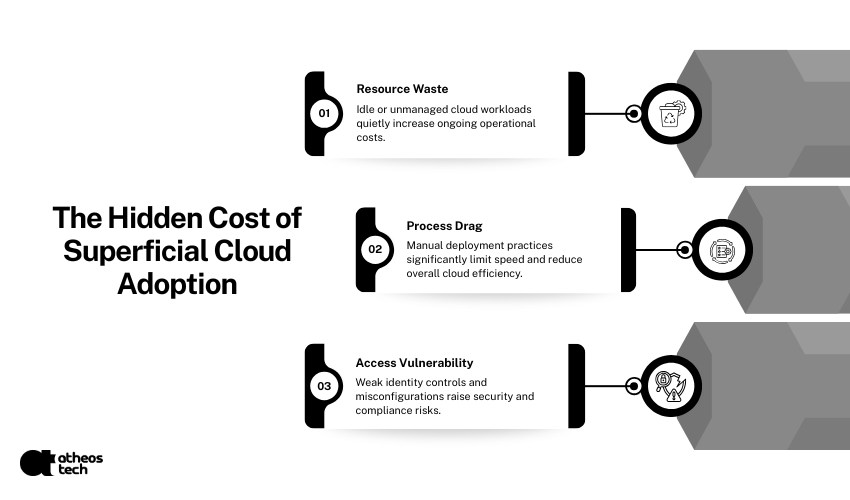
Without proper automation tools, teams often spin up cloud-based servers for a test or to handle a temporary workload and then forget to turn them off. These "zombie" resources bleed your budget silently, month after month. Cost optimization isn't a setting you toggle on a dashboard; it's a discipline engineered into the system.
If you are on the cloud but your developer team still manually deploys code via FTP or command line, you are driving a Ferrari in a school zone. You aren't utilizing what cloud platforms offer. You are paying for the capability of speed without implementing the processes to use it.
In a traditional setup, you build a wall around your data center (perimeter security). In the cloud, identity is the new perimeter. Without proper DevOps services, businesses often leave storage buckets open to the public internet or fail to rotate keys. This creates massive compliance requirements risks.
The consequence? You trade heavy upfront capital expenditure for bloated operating costs, without gaining the speed that justifies the switch. This is why Cloud DevOps Consulting is not an optional add-on; it is the insurance policy for your migration.
We often see companies claim they have “moved to the cloud,” yet their bills are higher, and their speed is lower. Why? Because they lacked professional DevOps Consulting to guide the architectural transition.
Here is where the failure happens:
Without proper automation tools, teams often spin up cloud-based servers for a test or to handle a temporary workload and then forget to turn them off. These "zombie" resources bleed your budget silently, month after month. Cost optimization isn't a setting you toggle on a dashboard; it's a discipline engineered into the system.
If you are on the cloud but your developer team still manually deploys code via FTP or command line, you are driving a Ferrari in a school zone. You aren't utilizing what cloud platforms offer. You are paying for the capability of speed without implementing the processes to use it.
In a traditional setup, you build a wall around your data center (perimeter security). In the cloud, identity is the new perimeter. Without proper DevOps services, businesses often leave storage buckets open to the public internet or fail to rotate keys. This creates massive compliance requirements risks.
The consequence? You trade heavy upfront capital expenditure for bloated operating costs, without gaining the speed that justifies the switch. This is why Cloud DevOps Consulting is not an optional add-on; it is the insurance policy for your migration.
“Is your infrastructure built for speed?”
Let’s talk about the human element. In the competitive US tech market, retaining top talent is a massive challenge. Nothing kills morale faster than “Deployment Fear.”
Deployment Fear is the anxiety engineers feel when they push code, knowing that if it breaks, fixing it will take hours of manual labor, phone calls, and stress. When your developer team is afraid to deploy, they deploy less often. Innovation stalls.
Cloud DevOps services introduce “Psychological Safety” through automation:
When your developers trust the system, they take calculated risks. They innovate faster. They ship features in smaller, safer batches rather than one giant, risky release.
Furthermore, this directly impacts customer experience. Users don’t care about your server struggles; they care that your app works. Cloud computing with proper DevOps ensures that when you update your app, the user experiences zero downtime. It feels like magic to them, but it’s engineering to us.
To understand the ROI of Cloud Engineering Services, let’s look at two realistic scenarios based on the challenges we solve.
The Situation: A mid-sized US retailer was hosting on a legacy private cloud. They were profitable, but their infrastructure was rigid. The Crisis: During a Black Friday sale, their traffic tripled. Their servers couldn’t handle the load. Because scaling required manual intervention (calling the hosting provider to add capacity), the site went down for 4 hours during peak sales. The Pivot: They engaged DevOps Consulting to migrate to a cloud native auto-scaling group. The Result: The following year, traffic quadrupled. The automation tools sensed the load and spun up 50 extra server instances instantly. Customer experience remained flawless. Crucially, when traffic dropped at 2:00 AM, the servers shut down automatically. This resulted in massive cost savings compared to running peak-capacity servers all year round.
The Situation: A New York Fintech startup needed to meet rigorous compliance requirements (SOC2 and HIPAA) to land enterprise clients. The Crisis: Their manual auditing process took weeks. Developers were manually logging access, and spreadsheets were used to track changes. Sales were stalling because they couldn’t prove their security posture quickly enough. The Pivot: They adopted DevOps as a Service. We implemented “Policy as Code,” where security rules are checked automatically every time code is saved. The Result: They passed the audit in record time. Furthermore, they reduced their cloud costs by 20% by identifying unused resources that the manual audits had missed.
We don’t just sell you software; we engineer your business’s central nervous system. Our approach to Cloud DevOps Consulting is built on precision, luxury-tier service, and future-proofing. We believe that moving to the cloud is an opportunity to pay down technical debt and build a foundation for the next decade of growth.
Our framework consists of four phases:
We analyze your current cloud costs and infrastructure. We usually find 20–30% in immediate waste, resources that are over-provisioned or completely unused. We map out the “Why” before we touch the “How.”
We break your monoliths down. Using cloud native principles, we make your application portable and resilient. We use technologies like Docker and Kubernetes to ensure your application runs the same on a developer’s laptop as it does in production.
We stop manual server setup immediately. We write code that builds your environment. This documentation-through-code ensures that if disaster strikes, your entire infrastructure can be redeployed in minutes, not days.
Cloud strategies are not “set and forget.” We provide ongoing DevOps as a Service to monitor cost efficiency, security patches, and performance in real-time. We ensure your infrastructure evolves as fast as your business does.
We analyze your current cloud costs and infrastructure. We usually find 20–30% in immediate waste, resources that are over-provisioned or completely unused. We map out the "Why" before we touch the "How."
We break your monoliths down. Using cloud native principles, we make your application portable and resilient. We use technologies like Docker and Kubernetes to ensure your application runs the same on a developer's laptop as it does in production.
We stop manual server setup immediately. We write code that builds your environment. This documentation-through-code ensures that if disaster strikes, your entire infrastructure can be redeployed in minutes, not days.
Cloud strategies are not "set and forget." We provide ongoing DevOps as a Service to monitor cost efficiency, security patches, and performance in real-time. We ensure your infrastructure evolves as fast as your business does.
How does cloud migration translate to the bottom line? Why should a CEO care about Kubernetes?
Because your infrastructure is the conversion architecture of your business.
If you can release features weekly instead of quarterly, you capture market share faster. You beat competitors to the punch.
Shifting from heavy upfront capital expenditure to flexible operating expenses improves cash flow. You stop paying for "just in case" capacity and start paying for "just in time" value.
Gartner estimates the cost of downtime is $5,600 per minute. Cloud solutions with high availability architecture mitigate this risk.
With cloud platforms offering global regions, you can deploy your application to servers in Europe or Asia with a single click, instantly improving speed for international customers.
Your infrastructure is the invisible product you sell. If it’s slow, expensive, and rigid, your actual product will suffer. If it is fast, lean, and adaptive, it becomes a competitive advantage.
How does cloud migration translate to the bottom line? Why should a CEO care about Kubernetes?
Because your infrastructure is the conversion architecture of your business.
If you can release features weekly instead of quarterly, you capture market share faster. You beat competitors to the punch.
Shifting from heavy upfront capital expenditure to flexible operating expenses improves cash flow. You stop paying for "just in case" capacity and start paying for "just in time" value.
Gartner estimates the cost of downtime is $5,600 per minute. Cloud solutions with high availability architecture mitigate this risk.
With cloud platforms offering global regions, you can deploy your application to servers in Europe or Asia with a single click, instantly improving speed for international customers.
Your infrastructure is the invisible product you sell. If it’s slow, expensive, and rigid, your actual product will suffer. If it is fast, lean, and adaptive, it becomes a competitive advantage.
The question for modern leadership is no longer “Should we use the cloud?” The question is “Are we using our Cloud solutions to survive, or to dominate?”
You can continue to bleed money on costs due to inefficiency. You can continue to frustrate your developer team with outdated tools and manual “fire-fighting.” You can accept that “deployment day” is a day of stress and potential downtime.
Or, you can step into the modern era.
Cloud-First DevOps is the operational model of the world’s most valuable companies. It ensures that your Cloud solutions offer true cost savings, superior customer experience, and the agility to pivot instantly when the market demands it.
AtheosTech provides the Cloud Engineering Services and DevOps as a Service expertise you need to make this transition seamless. We turn technical complexity into business velocity. Don’t let your infrastructure be the bottleneck that throttles your vision.
Many businesses see costs rise because they simply "lift and shift" old inefficiencies. AtheosTech uses a precision-engineered approach to cost optimization, identifying "zombie" resources and implementing automated scaling. We ensure your Cloud solutions follow an OpEx model that scales down when not in use, preventing budget bleed.
Most vendors focus only on the tools; AtheosTech focuses on the architecture and the culture. Our DevOps Consulting integrates security, automation, and speed into your team's DNA. We don’t just move your data, we re-engineer your workflows to ensure your developer team can ship features 10x faster with zero downtime.
We specialize in "Zero-Friction" migrations. The AtheosTech framework utilizes blue-green deployments and phased microservices transitions. This allows us to move your infrastructure to cloud platforms incrementally, ensuring your customer experience remains seamless and uninterrupted throughout the entire process.
Security is not an afterthought at AtheosTech; it is baked into our Cloud Engineering Services via "Policy as Code." We automate your compliance requirements (such as SOC2, HIPAA, or GDPR) by building guardrails directly into your deployment pipelines. This ensures every update is automatically checked for security vulnerabilities before it goes live.
Absolutely. We offer DevOps as a Service, acting as an elite extension of your leadership. While we handle the heavy lifting of Cloud DevOps Services, we also provide the strategic roadmap and mentorship your internal team needs to thrive in a cloud native environment, bridging the gap between legacy knowledge and modern innovation.
Many businesses see costs rise because they simply "lift and shift" old inefficiencies. AtheosTech uses a precision-engineered approach to cost optimization, identifying "zombie" resources and implementing automated scaling. We ensure your Cloud solutions follow an OpEx model that scales down when not in use, preventing budget bleed.
Most vendors focus only on the tools; AtheosTech focuses on the architecture and the culture. Our DevOps Consulting integrates security, automation, and speed into your team's DNA. We don’t just move your data, we re-engineer your workflows to ensure your developer team can ship features 10x faster with zero downtime.
We specialize in "Zero-Friction" migrations. The AtheosTech framework utilizes blue-green deployments and phased microservices transitions. This allows us to move your infrastructure to cloud platforms incrementally, ensuring your customer experience remains seamless and uninterrupted throughout the entire process.
Security is not an afterthought at AtheosTech; it is baked into our Cloud Engineering Services via "Policy as Code." We automate your compliance requirements (such as SOC2, HIPAA, or GDPR) by building guardrails directly into your deployment pipelines. This ensures every update is automatically checked for security vulnerabilities before it goes live.
Absolutely. We offer DevOps as a Service, acting as an elite extension of your leadership. While we handle the heavy lifting of Cloud DevOps Services, we also provide the strategic roadmap and mentorship your internal team needs to thrive in a cloud native environment, bridging the gap between legacy knowledge and modern innovation.
Adding {{itemName}} to cart
Added {{itemName}} to cart