Prototyping & Wireframing: Reducing Development Risk Before Code
Creativity was once the final frontier of human intelligence. Machines could calculate faster, store more information, and operate without rest, but creativity belonged to people. It came from emotion, memory, struggle, and imagination. It was deeply human.
Then artificial intelligence arrived, not loudly, not aggressively, but steadily. First, as a tool. Then, as a collaborator. Now, in many creative spaces, as a producer. AI solutions are reshaping industries, from content creation to immersive experiences.
From AI-generated content to immersive extended reality (XR) environments, creativity is no longer confined to the human mind alone. This shift has sparked a global debate: Is AI replacing human creativity, or redefining it? More importantly, in the long run, where does each truly win?
At AtheosTech, we work closely with businesses adopting XR tech, extended reality solutions, and AI solutions company offerings. What we see isn’t a creative collapse, it’s a creative evolution. One that only makes sense when we understand how creativity itself has changed.
Traditionally, creativity was slow, intentional, and deeply personal. A writer drew from lived experiences. A designer relied on intuition. An artist expressed emotion shaped by culture and time. Creative works reflected identity, not efficiency.
But the digital era changed expectations. Businesses needed constant creative outputs, content, visuals, campaigns, and experiences at an unprecedented pace. Creativity became continuous, not occasional. This pressure quietly exposed a limitation: human creativity, while powerful, does not scale effortlessly.
This gap didn’t reduce the value of creativity. It changed its role. Creativity was no longer just expression; it became infrastructure. And that transformation prepared the ground for AI solutions, AI Consulting Services, and enterprise AI solutions to enter, not as a rival, but as a solution to scale.
The rise of Extended Reality (XR) marked a turning point no one could ignore. Unlike traditional content, XR experiences are immersive, interactive, and responsive. Users don’t just observe, they participate.
In virtual reality solutions and augmented reality solutions, creativity must function in real time. Environments adapt to movement. Visuals respond to behavior. Narratives shift dynamically. This level of complexity cannot be maintained by human effort alone.
Here, creativity is no longer static; it is alive. To support this, creators rely on extended reality software, AI-powered technologies, and intelligent systems that can manage constant change. This is where Machine Learning Development Services and AI/ML solutions became essential, not optional.
AI creativity does not mean AI has imagination. It means AI solutions can analyze enormous volumes of existing creative works and identify patterns humans cannot process manually.
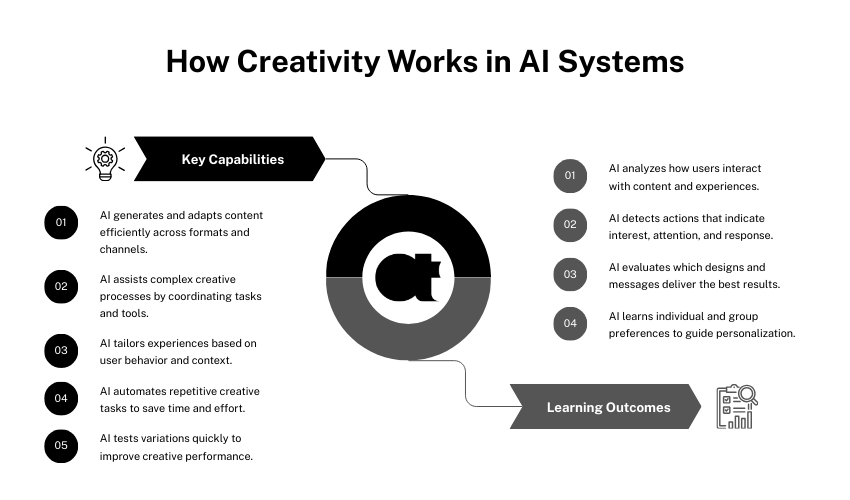
Through pattern recognition, AI learns:
Using this knowledge, AI produces creative outputs that feel refined and relevant. This is why AI-generated content appears impressive: it’s optimized by data.
AI can:
In XR solutions, AI can instantly handle environments based on user behavior. But handling creativity is not the same as understanding it. This is why human – AI collaboration remains critical.
AI does not feel emotion. It does not experience culture. It does not understand meaning beyond patterns.
Every AI output is shaped by existing data. That means AI creativity is always dependent on what already exists. It can remix, improve, and optimize, but it cannot truly originate ideas without reference.
This limitation becomes clear when creativity demands emotional depth. An AI can design a visually stunning XR environment, but without human input, it lacks narrative intention. It looks impressive, yet feels empty. Users may admire it, but they rarely remember it.
And that is where human creativity reclaims its importance.
Discover how AI solutions and human creativity merge.
Human creativity comes from lived experience. Every idea is shaped by emotion, memory, cultural understanding, and intuition. Humans create not just to function, but to communicate meaning.
Humans excel at:
In immersive extended reality (XR) environments, these qualities matter even more. XR amplifies emotion. When users feel present inside an experience, even small emotional inaccuracies feel unnatural.
AI can assist with structure and execution, but humans must guide intention.
The future of creativity is not about choosing between AI and humans. It’s about knowing how to combine their strengths with intention and control. When used intelligently, AI doesn’t replace creative thinking; it amplifies it.
In modern creative processes, each plays a distinct role. AI handles repetitive, data-driven tasks that slow teams down. It accelerates experimentation, explores variations at speed, and processes insights humans would take far longer to uncover. This allows ideas to move faster from concept to execution.
Humans, meanwhile, remain responsible for what machines cannot replicate. They shape the story, define tone, and establish purpose. They ensure every creative decision aligns with cultural understanding, emotional depth, and ethical boundaries.
This balance is how teams augment human creativity instead of replacing it.
We design extended reality services where AI enhances efficiency, but humans retain creative control. The result is scalable creativity that feels authentic, intentional, and unmistakably human.
AI performs best when guided by humans. Without careful oversight, cracks begin to appear, sometimes subtle, sometimes striking, a nd the consequences can impact both creativity and credibility. AI may:
Global patterns don’t always translate locally. An algorithm might produce content that looks polished but fails to respect cultural norms or regional sensitivities, which can unintentionally alienate audiences.
AI excels at recombining existing data, but originality can suffer. Creative outputs may feel repetitive, formulaic, or lacking emotional resonance, particularly in immersive environments where authenticity is critical.
AI often delivers content that sounds authoritative, yet may be factually wrong or contextually misleading. Without human verification, these errors can undermine trust and erode audience confidence.
Complex ethical decisions require human judgment. AI cannot intuit subtle moral implications or account for social impact in a way humans naturally do.
Global patterns don’t always translate locally. An algorithm might produce content that looks polished but fails to respect cultural norms or regional sensitivities, which can unintentionally alienate audiences.
AI excels at recombining existing data, but originality can suffer. Creative outputs may feel repetitive, formulaic, or lacking emotional resonance, particularly in immersive environments where authenticity is critical.
AI often delivers content that sounds authoritative, yet may be factually wrong or contextually misleading. Without human verification, these errors can undermine trust and erode audience confidence.
Complex ethical decisions require human judgment. AI cannot intuit subtle moral implications or account for social impact in a way humans naturally do.
In XR environments, these mistakes become magnified. Immersion depends on trust, and trust hinges on emotionally resonant experiences. A minor misstep, a misaligned narrative, an insensitive visual, or a poorly timed interaction can instantly break the sense of presence and engagement.
AI is undeniably powerful, but it is not a creative leader. AI solutions, AI ML development companies, and artificial intelligence as a service providers can support, accelerate, and scale creativity, but meaningful outcomes require human insight, oversight, and emotional calibration. Only through this human–AI collaboration can creativity maintain authenticity, cultural depth, and lasting impact.
AI operates in the now. Humans create with the future in mind.
Human creativity considers impact, memory, and cultural evolution. While AI optimizes for immediate performance, humans focus on legacy, cultural relevance, and long-term emotional resonance.
Over time:
AI follows patterns. Humans create direction. And in the long run, direction defines lasting creativity.
The future of AI is not about eliminating creativity; it’s about expanding what’s possible. AI will continue to transform extended technology, automate execution, and enhance immersive platforms with intelligence and precision.
Humans will continue to define:
Together, they push creativity beyond previous limits. Not faster. Not louder. But deeper, smarter, and far more impactful.
AI wins where speed, scale, and precise execution are essential. Humans win where creativity requires meaning, emotional depth, cultural understanding, and imagination.
The real advantage lies with those who balance both, especially in extended reality, where immersive experiences demand intelligence and intention.
At AtheosTech, we don’t debate whether AI can create. We design ecosystems where AI solutions, enterprise AI solutions, Machine Learning Development Services, and human creativity work together, strategically, responsibly, and boldly.
Because creativity in extended reality isn’t about producing more. It’s about creating experiences that last.
AI creativity is the ability of AI solutions to analyze data, recognize patterns, and generate creative outputs. While AI can assist with design, content, and XR experiences, it lacks emotional depth and cultural understanding, which humans bring to truly emotionally resonant work.
No. AI excels at speed, efficiency, and pattern recognition, but humans define meaning, emotion, and cultural relevance. The best results come from human-AI collaboration, where AI handles repetitive tasks, and humans provide vision and purpose.
In extended reality solutions and virtual reality solutions, AI automates environment adjustments, predicts user preferences, and optimizes interactions. Combined with human oversight, it ensures experiences are immersive, dynamic, and culturally aligned.
Humans bring originality, intuition, and ethical judgment. In long-term projects, human creativity ensures work is emotionally resonant, culturally relevant, and memorable,qualities AI alone cannot provide.
Businesses can use AI solutions, AI Consulting Services, and Machine Learning Development Services to automate repetitive tasks, test variations, and generate ideas. By pairing AI with human insight, teams augment human creativity, scaling output while keeping experiences authentic and meaningful.
AI creativity is the ability of AI solutions to analyze data, recognize patterns, and generate creative outputs. While AI can assist with design, content, and XR experiences, it lacks emotional depth and cultural understanding, which humans bring to truly emotionally resonant work.
No. AI excels at speed, efficiency, and pattern recognition, but humans define meaning, emotion, and cultural relevance. The best results come from human-AI collaboration, where AI handles repetitive tasks, and humans provide vision and purpose.
In extended reality solutions and virtual reality solutions, AI automates environment adjustments, predicts user preferences, and optimizes interactions. Combined with human oversight, it ensures experiences are immersive, dynamic, and culturally aligned.
Humans bring originality, intuition, and ethical judgment. In long-term projects, human creativity ensures work is emotionally resonant, culturally relevant, and memorable,qualities AI alone cannot provide.
Businesses can use AI solutions, AI Consulting Services, and Machine Learning Development Services to automate repetitive tasks, test variations, and generate ideas. By pairing AI with human insight, teams augment human creativity, scaling output while keeping experiences authentic and meaningful.
Adding {{itemName}} to cart
Added {{itemName}} to cart