

- AtheosTech
How AI Improves Operational Efficiency and Cost Optimization
How AI solutions drive smarter operations, reduce costs, and boost business performance
Key Takeaways
Key Takeaways
- AI solutions increase operational efficiency by automating repetitive tasks and reducing human error.
- Enterprise AI solutions improve customer service, demand forecasting, and predictive maintenance.
- AI algorithms analyze market trends and external factors to optimize business processes in real time.
- Artificial intelligence (AI) reduces operational costs while improving accuracy and scalability.
- Organizations gain long-term competitive advantage through intelligent automation and data-driven decisions.
Introduction: The Role of AI in Modern Business Operations
Operational efficiency and cost optimization define success in competitive markets. Traditional systems rely on manual effort, fixed logic, and delayed reporting. Artificial intelligence (AI) transforms this model by introducing intelligent, adaptive systems that learn from data and improve continuously.
AI solutions combine machine learning, predictive analytics, and generative AI to automate business processes, reduce waste, and increase productivity. As industries scale, enterprise AI solutions become essential for managing complexity, volume, and speed.
Industry Examples of AI Impacting Efficiency
Using AI Agents for Greater Efficiency
The newest era of AI involves AI assistants and autonomous AI agents.
- AI assistants respond to user input and execute predefined tasks.
- AI agents operate proactively, plan actions, and complete goals independently.
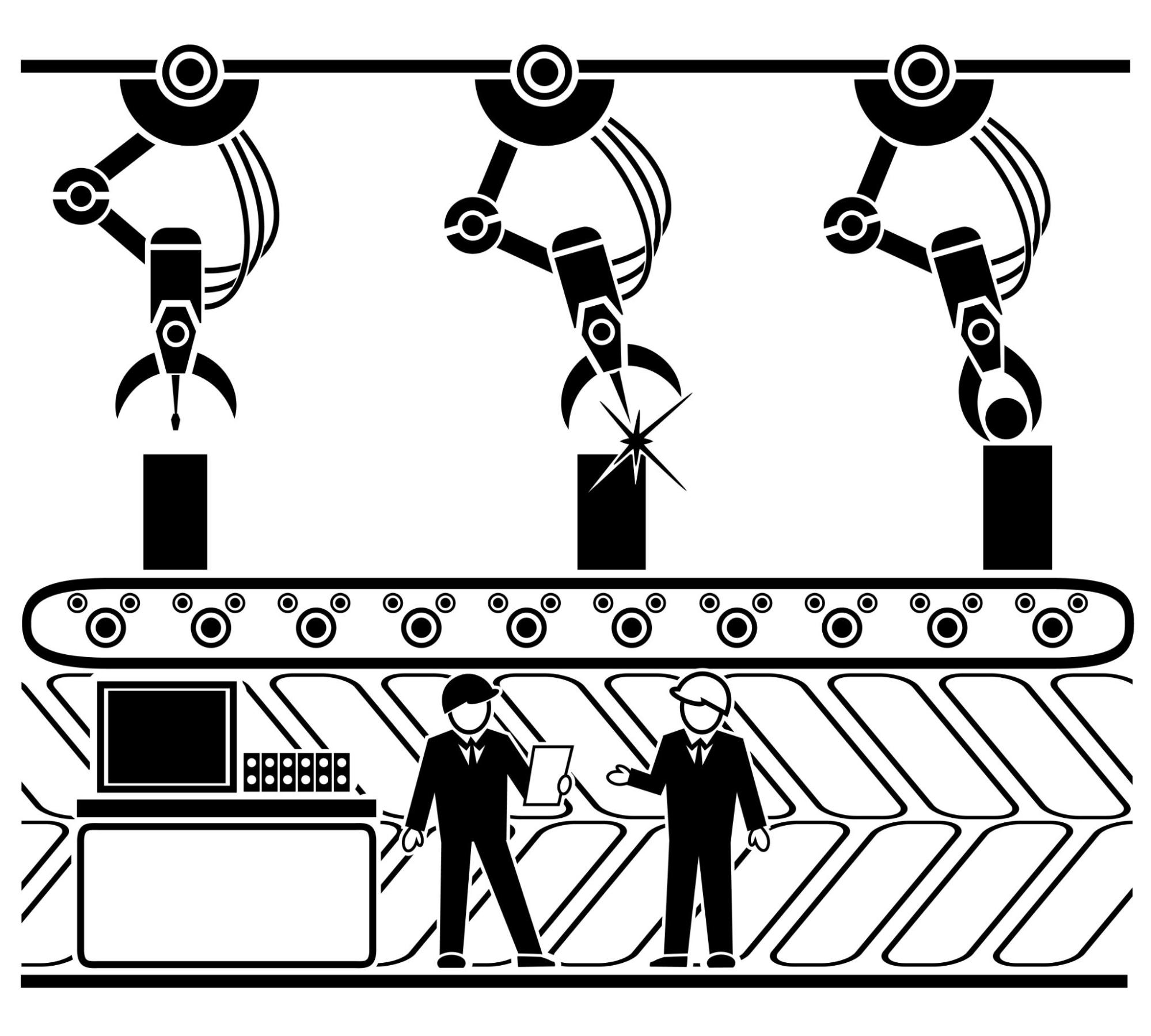
AI agents use generative AI and foundation models to analyze tasks, break them into steps, execute workflows, and deliver outcomes. These systems produce content, optimize campaigns, manage operations, and even support navigation systems in autonomous vehicles.
Example use cases include marketing automation, customer segmentation, A/B testing, and real-time route optimization in logistics and transportation.
The Future of Business Efficiency and AI
Productivity and efficiency depend on intelligent systems and skilled employees. AI improves strategy execution, workflow management, creative processes, health systems, manufacturing, sales, finance, and retail operations. AI systems push organizations forward by improving speed, accuracy, and decision quality.
Employees who adapt to AI-driven workflows unlock new efficiencies across business operations.
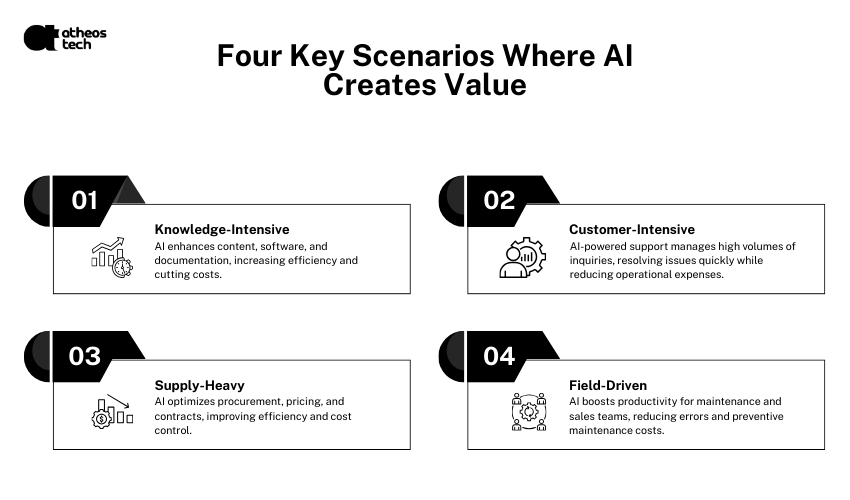
AI Offers Value in Four Key Situations
AI delivers the highest impact in environments with high volume, complexity, and repeatable processes.
AI Offers Value in Four Key Situations
AI delivers the highest impact in environments with high volume, complexity, and repeatable processes.
Avoiding Common AI Transformation Pitfalls
Align Technology with Process and Culture
AI success depends on behavioral change, not just algorithms. New workflows, reskilling, and agile learning systems enable effective human–AI collaboration.
Control Cost and Complexity
AI at scale increases technology expenses. Focus on high-impact AI/ML solutions and maintain a manageable application portfolio.
The Impact of AI on Operational Efficiency
AI improves efficiency by:
- Automating repetitive tasks
- Reducing human error
- Enhancing predictive maintenance
- Optimizing supply chains
- Improving customer service
Predictive analytics and AI systems enable real-time optimization of workflows, inventory, and logistics.
The Role of AI in Data Analysis and Insights
AI transforms data into intelligence. AI algorithms detect patterns, trends, and anomalies across massive datasets. Predictive analytics supports demand forecasting, market trend analysis, and operational risk management.
Data-driven decision-making improves accuracy, speed, and strategic clarity.
The Role of AI in Data Analysis and Insights
AI transforms data into intelligence. AI algorithms detect patterns, trends, and anomalies across massive datasets. Predictive analytics supports demand forecasting, market trend analysis, and operational risk management.
Data-driven decision-making improves accuracy, speed, and strategic clarity.
Future Trends in AI for Business (Expanded)

Case Studies of Successful AI Implementation (Expanded)
AI solutions are delivering measurable operational efficiency and cost optimization across multiple industries. The following examples show how artificial intelligence improves real-world business performance.

Final Perspective
AI solutions redefine operational efficiency and cost optimization. Artificial intelligence automates business processes, improves customer service, reduces operational costs, and creates a lasting competitive advantage. Enterprise success depends on intelligent execution, governance, and continuous improvement, principles reflected in platforms such as AtheosTech.
FAQ's
AI solutions are systems powered by artificial intelligence that analyze data, automate business processes, and improve decision-making. These systems use AI algorithms, machine learning, and predictive analytics to reduce human error, optimize workflows, and improve customer service and operational efficiency.
AI reduces operational costs by automating repetitive tasks, minimizing errors, improving demand forecasting, and optimizing resource allocation. AI systems process large volumes of data in real time, allowing faster decisions and reducing waste across business operations.
Predictive analytics uses historical data and market trends to forecast outcomes such as demand, equipment failures, and customer behavior. This allows businesses to act proactively instead of reactively, reducing downtime, improving inventory planning, and supporting cost savings.
AI-powered systems handle customer inquiries using chatbots and virtual assistants. These tools provide instant responses, smart routing, and personalized support. AI improves response time, consistency, and overall customer experience while lowering support costs.
Processes with high volume, repetition, and data dependency benefit the most. These include document processing, customer support, demand forecasting, predictive maintenance, compliance checks, and workflow management.
FAQ's
AI solutions are systems powered by artificial intelligence that analyze data, automate business processes, and improve decision-making. These systems use AI algorithms, machine learning, and predictive analytics to reduce human error, optimize workflows, and improve customer service and operational efficiency.
AI reduces operational costs by automating repetitive tasks, minimizing errors, improving demand forecasting, and optimizing resource allocation. AI systems process large volumes of data in real time, allowing faster decisions and reducing waste across business operations.
Predictive analytics uses historical data and market trends to forecast outcomes such as demand, equipment failures, and customer behavior. This allows businesses to act proactively instead of reactively, reducing downtime, improving inventory planning, and supporting cost savings.
AI-powered systems handle customer inquiries using chatbots and virtual assistants. These tools provide instant responses, smart routing, and personalized support. AI improves response time, consistency, and overall customer experience while lowering support costs.
Processes with high volume, repetition, and data dependency benefit the most. These include document processing, customer support, demand forecasting, predictive maintenance, compliance checks, and workflow management.