
Explore our complete capabilities and methodologies.


Browse our industry-specific software and architectures.

Automation no longer means simple scripts or scheduled tasks. In 2026, automation defines how organizations respond to customers, manage data, and make decisions. Traditional automation focuses on doing. Artificial intelligence focuses on understanding and improving.
Modern business environments involve:
Traditional automation cannot adapt to these conditions on its own. AI solutions exist to handle complexity, uncertainty, and growth. The difference between AI and traditional automation shapes how fast operations scale, how accurately decisions happen, and how effectively organizations compete.
Traditional automation uses predefined rules and workflows. Every step is designed in advance and executed exactly as written. These systems work on “if-then” logic.
Examples:
Traditional systems never analyze context or meaning. They simply follow instructions.
Traditional automation operates through a fixed and linear process. Every action comes from logic written in advance by humans. These systems never think, evaluate, or adjust. They simply execute.
Traditional automation performs best in environments where work follows clear, repeatable patterns and change happens slowly. These systems succeed when logic remains simple and conditions remain consistent.
AI-powered automation uses artificial intelligence and machine learning to analyze data, understand patterns, and improve decisions over time. These systems do not depend on rigid rules. They learn from experience.
AI systems:
AI solutions transform automation into intelligence.
AI-powered automation uses artificial intelligence and machine learning to analyze data, understand patterns, and improve decisions over time. These systems do not depend on rigid rules. They learn from experience.
AI systems:
AI solutions transform automation into intelligence.
Traditional automation follows instructions. AI automation understands environments.
| Area | Traditional | AI |
|---|---|---|
| Thinking | None | Pattern-based |
| Learning | Manual | Automatic |
| Flexibility | Low | High |
| Data Handling | Structured only | All types |
| Growth | Linear | Exponential |
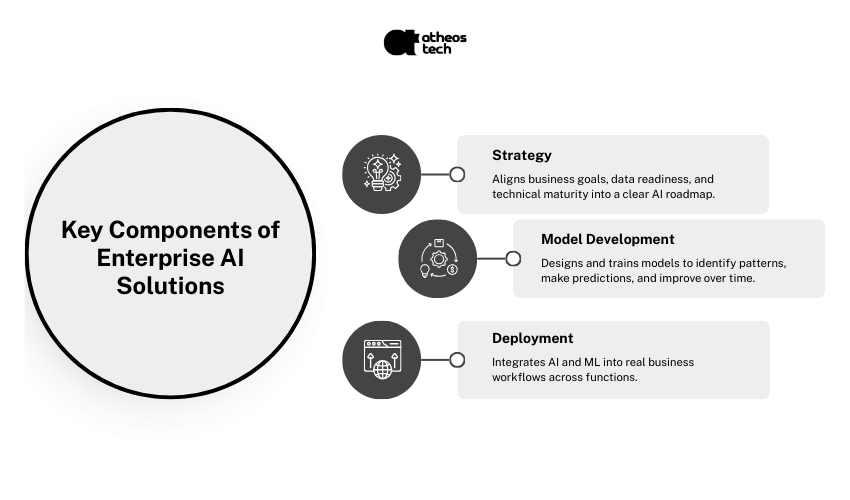
Enterprise AI solutions integrate strategy, technology, and execution into a single, intelligent system. These solutions are not single tools. They are complete frameworks that integrate data, models, and automation across the organization.
AI solutions define the future of business automation. Traditional systems perform tasks. AI systems learn, think, and improve. Intelligent automation reshapes customer service, document processing, and decision-making.
Strategic execution aligns with platforms such as AtheosTech, where AI meets real-world enterprise transformation.
Traditional automation follows fixed, predefined rules and executes tasks exactly as programmed. AI automation uses artificial intelligence and machine learning to analyze data, learn patterns, and improve decisions over time. Traditional systems automate actions, while AI systems automate intelligence.
AI solutions analyze historical data, current conditions, and real-time signals at the same time. This allows AI systems to detect trends, assess risks, and predict outcomes with high accuracy. Decisions become faster, more consistent, and less dependent on manual judgment.
Enterprises operate in complex, fast-changing environments. AI-powered automation adapts to new data, handles unstructured information, and improves continuously. Traditional systems remain static and require manual updates. AI systems scale with growth and complexity.
Common challenges include poor data quality, integration with legacy systems, skill gaps, compliance concerns, and employee resistance. These challenges get addressed through data preparation, explainable AI, expert consulting, and structured training programs.
An AI automation roadmap defines goals, prepares data, selects high-impact use cases, deploys AI in stages, and measures ROI continuously. This structured approach ensures AI adoption remains aligned with business strategy and delivers measurable value.
Traditional automation follows fixed, predefined rules and executes tasks exactly as programmed. AI automation uses artificial intelligence and machine learning to analyze data, learn patterns, and improve decisions over time. Traditional systems automate actions, while AI systems automate intelligence.
AI solutions analyze historical data, current conditions, and real-time signals at the same time. This allows AI systems to detect trends, assess risks, and predict outcomes with high accuracy. Decisions become faster, more consistent, and less dependent on manual judgment.
Enterprises operate in complex, fast-changing environments. AI-powered automation adapts to new data, handles unstructured information, and improves continuously. Traditional systems remain static and require manual updates. AI systems scale with growth and complexity.
Common challenges include poor data quality, integration with legacy systems, skill gaps, compliance concerns, and employee resistance. These challenges get addressed through data preparation, explainable AI, expert consulting, and structured training programs.
An AI automation roadmap defines goals, prepares data, selects high-impact use cases, deploys AI in stages, and measures ROI continuously. This structured approach ensures AI adoption remains aligned with business strategy and delivers measurable value.
Adding {{itemName}} to cart
Added {{itemName}} to cart