- AtheosTech
AI vs Traditional Automation: What Businesses Should Choose in 2026
A clear, in-depth comparison of AI solutions and traditional systems for smarter business decisions in 2026
Key Takeaways
Key Takeaways
- AI solutions represent intelligent automation, where systems analyze, learn, and improve over time.
- Traditional systems follow fixed logic, while AI systems adapt using historical data and real-time inputs.
- AI-powered platforms understand natural language and operate in real time.
- Intelligent automation reduces human intervention and improves customer service and document processing.
- Enterprise AI solutions scale faster and deliver higher long-term ROI than traditional systems.
- The future of automation belongs to AI-driven, continuously improving technologies.
Introduction: Why Automation Strategy Matters in 2026
Automation no longer means simple scripts or scheduled tasks. In 2026, automation defines how organizations respond to customers, manage data, and make decisions. Traditional automation focuses on doing. Artificial intelligence focuses on understanding and improving.
Modern business environments involve:
- Large volumes of data
- Real-time decision requirements
- Constant change in customer behavior
- Pressure to reduce costs while increasing speed
Traditional automation cannot adapt to these conditions on its own. AI solutions exist to handle complexity, uncertainty, and growth. The difference between AI and traditional automation shapes how fast operations scale, how accurately decisions happen, and how effectively organizations compete.
Understanding Traditional Automation in Depth
What Traditional Automation Is
Traditional automation uses predefined rules and workflows. Every step is designed in advance and executed exactly as written. These systems work on “if-then” logic.
Examples:
- If a customer submits a form → store the data
- If inventory drops below a set number → reorder stock
- If it is the first day of the month → generate a report
Traditional systems never analyze context or meaning. They simply follow instructions.
How Traditional Automation Works (In Depth)
Traditional automation operates through a fixed and linear process. Every action comes from logic written in advance by humans. These systems never think, evaluate, or adjust. They simply execute.
A human creates a rule.
A business analyst or developer designs a workflow based on known steps. Each rule defines exactly what the system must do in a specific situation. For example, “If an invoice arrives, then store it in Folder A.” The system depends entirely on this predefined logic.
The system waits for a trigger.
Traditional automation does nothing until a specific event happens. A trigger can be a form submission, a file upload, a date on the calendar, or a system update. Until that trigger appears, the automation remains idle.
The action runs exactly as defined.d
Once the trigger occurs, the system executes the action with no interpretation or adjustment. It does not evaluate context, intent, or unusual conditions. The output always matches the rule exactly.
No learning takes place.ce
Traditional systems do not improve with experience. If errors happen or performance drops, nothing changes inside the system automatically. Learning never occurs.
Manual updates control all changes.
If business conditions change, rules must be rewritten by humans. New logic must be added manually. The system remains unchanged until someone redesigns the workflow.
A human creates a rule.
A business analyst or developer designs a workflow based on known steps. Each rule defines exactly what the system must do in a specific situation. For example, “If an invoice arrives, then store it in Folder A.” The system depends entirely on this predefined logic.
The system waits for a trigger.
Traditional automation does nothing until a specific event happens. A trigger can be a form submission, a file upload, a date on the calendar, or a system update. Until that trigger appears, the automation remains idle.
The action runs exactly as defined.d
Once the trigger occurs, the system executes the action with no interpretation or adjustment. It does not evaluate context, intent, or unusual conditions. The output always matches the rule exactly.
No learning takes place.ce
Traditional systems do not improve with experience. If errors happen or performance drops, nothing changes inside the system automatically. Learning never occurs.
Manual updates control all changes.
If business conditions change, rules must be rewritten by humans. New logic must be added manually. The system remains unchanged until someone redesigns the workflow.
Strengths of Traditional Automation (Expanded)
Consistency
Every task runs the same way every time. There is no variation in output.
Stability
Traditional systems behave predictably. Performance remains steady under known conditions.
Simple Governance
Rules are visible and easy to audit. Compliance teams can trace every action back to a rule.
Fast for Repetitive Tasks
Large volumes of identical work move through the system efficiently.
Low Technical Risk
The technology is mature, well-tested, and widely supported.
Consistency
Every task runs the same way every time. There is no variation in output.
Stability
Traditional systems behave predictably. Performance remains steady under known conditions.
Simple Governance
Rules are visible and easy to audit. Compliance teams can trace every action back to a rule.
Fast for Repetitive Tasks
Large volumes of identical work move through the system efficiently.
Low Technical Risk
The technology is mature, well-tested, and widely supported.
Limitations of Traditional Automation (Expanded)

No Learning Capability
Traditional automation never improves unless rules change.
Rigid Structure
Unexpected inputs cause breakdowns. There is no flexibility.
Manual Updates Required
Every new scenario requires human redesign.
Weak with Documents and Language
Emails, PDFs, and text-heavy data cause problems.
Low Adaptability
Traditional systems struggle in fast-changing environments.
No Learning Capability
Traditional automation never improves unless rules change.
Rigid Structure
Unexpected inputs cause breakdowns. There is no flexibility.
Manual Updates Required
Every new scenario requires human redesign.
Weak with Documents and Language
Emails, PDFs, and text-heavy data cause problems.
Low Adaptability
Traditional systems struggle in fast-changing environments.
Best Use Cases for Traditional Automation (Expanded)
Traditional automation performs best in environments where work follows clear, repeatable patterns and change happens slowly. These systems succeed when logic remains simple and conditions remain consistent.
Traditional automation fits best when:
- Workflows Are Stable and Predictable
- Decisions Involve Simple Logic
- Data Is Clean and Structured
- Variability Remains Low
Processes that follow the same steps every time are ideal. When tasks do not change often, fixed rules remain effective and reliable.
If decisions only require yes-or-no answers based on set conditions, traditional automation works efficiently. There is no need for interpretation or analysis.
Traditional systems handle spreadsheets, databases, and form fields well. When data follows a defined format, automation runs smoothly.
When customer behavior, volume, and inputs remain consistent, traditional automation stays effective.
Traditional automation fits best when:
- Workflows Are Stable and Predictable
- Decisions Involve Simple Logic
- Data Is Clean and Structured
- Variability Remains Low
Processes that follow the same steps every time are ideal. When tasks do not change often, fixed rules remain effective and reliable.
If decisions only require yes-or-no answers based on set conditions, traditional automation works efficiently. There is no need for interpretation or analysis.
Traditional systems handle spreadsheets, databases, and form fields well. When data follows a defined format, automation runs smoothly.
When customer behavior, volume, and inputs remain consistent, traditional automation stays effective.
Examples of Traditional Automation in Action
Employee hours, salaries, and deductions follow defined rules. Automation ensures accurate and timely payments.
Stock levels change based on sales and restocking. Fixed logic updates records automatically.
Reports run on a timetable with consistent data sources and layouts.
Contact forms and registrations follow predictable formats and routing.
Examples of Traditional Automation in Action
Employee hours, salaries, and deductions follow defined rules. Automation ensures accurate and timely payments.
Stock levels change based on sales and restocking. Fixed logic updates records automatically.
Reports run on a timetable with consistent data sources and layouts.
Contact forms and registrations follow predictable formats and routing.
Understanding AI-Powered Automation in Depth
What AI Automation Is (Expanded)
AI-powered automation uses artificial intelligence and machine learning to analyze data, understand patterns, and improve decisions over time. These systems do not depend on rigid rules. They learn from experience.
AI systems:
- Understand natural language
- Analyze historical data
- Detect patterns
- Improve continuously
AI solutions transform automation into intelligence.
How AI Automation Works (Expanded)
- Data enters the system
- AI models analyze patterns.
- Predictions and decisions occur.r
- Feedback improves performance
- Accuracy increases over ti.me
Information arrives from documents, sensors, emails, logs, and databases.
Machine learning models identify relationships and trends.
The system selects the best action based on probability, not fixed rules.
Results feed back into the system.
Each cycle makes the system smarter.
Core Capabilities of AI Systems (Expanded)
- Context Understanding
- Learning from Experience
- Advanced Decision-Making
- Real-Time Processing
- Autonomous AI Agents
AI understands meaning, not just words.
Accuracy improves as more data arrives.
AI handles uncertainty and complexity.
Insights happen instantly.
AI agents perform tasks independently.
Understanding AI-Powered Automation in Depth
What AI Automation Is (Expanded)
AI-powered automation uses artificial intelligence and machine learning to analyze data, understand patterns, and improve decisions over time. These systems do not depend on rigid rules. They learn from experience.
AI systems:
- Understand natural language
- Analyze historical data
- Detect patterns
- Improve continuously
AI solutions transform automation into intelligence.
How AI Automation Works (Expanded)
- Data enters the system
- AI models analyze patterns.
- Predictions and decisions occur.r
- Feedback improves performance
- Accuracy increases over ti.me
Information arrives from documents, sensors, emails, logs, and databases.
Machine learning models identify relationships and trends.
The system selects the best action based on probability, not fixed rules.
Results feed back into the system.
Each cycle makes the system smarter.
Core Capabilities of AI Systems (Expanded)
- Context Understanding
- Learning from Experience
- Advanced Decision-Making
- Real-Time Processing
- Autonomous AI Agents
AI understands meaning, not just words.
Accuracy improves as more data arrives.
AI handles uncertainty and complexity.
Insights happen instantly.
AI agents perform tasks independently.
Key Differences Explained Clearly
Traditional automation follows instructions. AI automation understands environments.
| Area | Traditional | AI |
|---|---|---|
| Thinking | None | Pattern-based |
| Learning | Manual | Automatic |
| Flexibility | Low | High |
| Data Handling | Structured only | All types |
| Growth | Linear | Exponential |
Business Benefits of AI Automation (In Detail)
AI systems analyze information from many sources at the same time. This includes past behavior, current conditions, and real-time signals coming from customers, systems, and markets. Instead of relying on fixed rules, AI identifies patterns and trends that humans or traditional systems miss.
AI analyzes:
- Past behavior to understand what has worked before
- Current conditions to understand what is happening now
- Real-time signals to respond instantly
This improves:
- Risk assessment by identifying unusual activity or warning signs early
- Demand forecasting by predicting what customers will want next
- Customer insights by understanding preferences and behavior patterns
As a result, decisions happen faster and with higher accuracy.
AI automation reduces operational costs by improving efficiency across processes. Errors decrease because AI checks work continuously. Delays drop because AI removes manual handoffs. Rework declines because outputs become more accurate the first time.
AI reduces:
- Human errors in data handling
- Process delays caused by waiting for approvals
- Rework from incorrect inputs
Resources get allocated more efficiently because AI directs effort where it adds the most value.
AI processes massive data sets instantly. Tasks that once took hours or days happen in seconds. Manual steps disappear as AI systems handle workflows from start to finish.
This increases operational speed without increasing workload.
AI-powered customer service platforms use intelligent automation to respond to requests quickly and accurately.
AI-powered support includes:
- Chatbots that answer common questions instantly
- Voice assistants that understand spoken requests
- Smart routing that sends issues to the right team
Support becomes faster, consistent, and available around the clock.
AI automation transforms how documents get handled. Instead of manual review, AI reads and understands content.
AI automates:
- Invoice reading by extracting amounts and dates
- Contract analysis by identifying key terms
- Compliance checks by validating rules
Accuracy increases while effort drops because AI handles large volumes without fatigue.
Business Benefits of AI Automation (In Detail)
AI systems analyze information from many sources at the same time. This includes past behavior, current conditions, and real-time signals coming from customers, systems, and markets. Instead of relying on fixed rules, AI identifies patterns and trends that humans or traditional systems miss.
AI analyzes:
- Past behavior to understand what has worked before
- Current conditions to understand what is happening now
- Real-time signals to respond instantly
This improves:
- Risk assessment by identifying unusual activity or warning signs early
- Demand forecasting by predicting what customers will want next
- Customer insights by understanding preferences and behavior patterns
As a result, decisions happen faster and with higher accuracy.
AI automation reduces operational costs by improving efficiency across processes. Errors decrease because AI checks work continuously. Delays drop because AI removes manual handoffs. Rework declines because outputs become more accurate the first time.
AI reduces:
- Human errors in data handling
- Process delays caused by waiting for approvals
- Rework from incorrect inputs
Resources get allocated more efficiently because AI directs effort where it adds the most value.
AI processes massive data sets instantly. Tasks that once took hours or days happen in seconds. Manual steps disappear as AI systems handle workflows from start to finish.
This increases operational speed without increasing workload.
AI-powered customer service platforms use intelligent automation to respond to requests quickly and accurately.
AI-powered support includes:
- Chatbots that answer common questions instantly
- Voice assistants that understand spoken requests
- Smart routing that sends issues to the right team
Support becomes faster, consistent, and available around the clock.
AI automation transforms how documents get handled. Instead of manual review, AI reads and understands content.
AI automates:
- Invoice reading by extracting amounts and dates
- Contract analysis by identifying key terms
- Compliance checks by validating rules
Accuracy increases while effort drops because AI handles large volumes without fatigue.
Enterprise AI Solutions in Practice
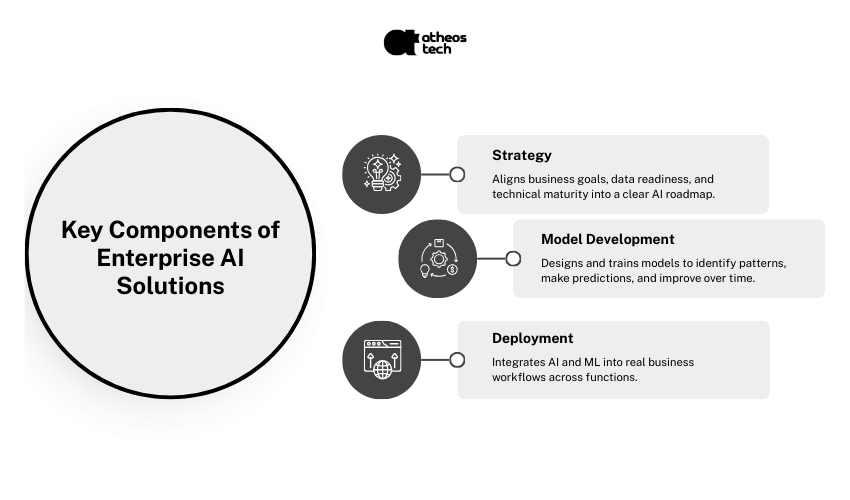
Enterprise AI solutions integrate strategy, technology, and execution into a single, intelligent system. These solutions are not single tools. They are complete frameworks that integrate data, models, and automation across the organization.
Enterprise AI solutions combine:
AI Consulting Services
AI consulting services define the strategy. These services assess business goals, data readiness, and technical maturity. The outcome is a clear roadmap that aligns AI adoption with measurable business results.
Machine Learning Development Services
Machine learning development services design and train models using historical data. These models learn patterns, make predictions, and improve performance over time.
AI/ML Solutions
AI/ML solutions deploy intelligence into real workflows such as customer service, finance, operations, and marketing.
Enterprise AI solutions combine:
AI Consulting Services
AI consulting services define the strategy. These services assess business goals, data readiness, and technical maturity. The outcome is a clear roadmap that aligns AI adoption with measurable business results.
Machine Learning Development Services
Machine learning development services design and train models using historical data. These models learn patterns, make predictions, and improve performance over time.
AI/ML Solutions
AI/ML solutions deploy intelligence into real workflows such as customer service, finance, operations, and marketing.
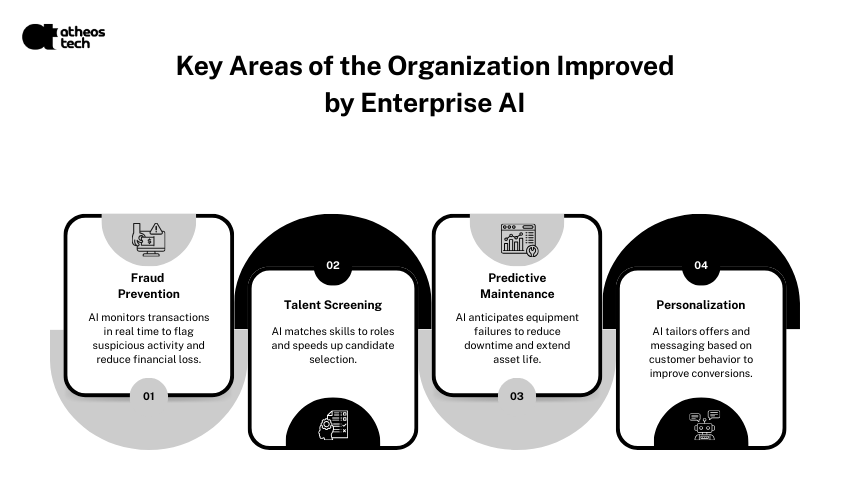
Departments Improved by Enterprise AI
Finance → Fraud Detection
AI analyzes transaction patterns in real time. Suspicious behavior gets flagged instantly. This reduces financial loss and strengthens security.
HR → Talent Screening
AI reviews resumes, matches skills, and identifies strong candidates faster. Recruitment becomes data-driven instead of manual.
Operations → Predictive Maintenance
AI monitors equipment behavior and predicts failures before they happen. Downtime drops and asset life increases.
Sales → Personalization
AI analyzes customer behavior and tailors offers, messages, and timing. Conversion rates improve through relevance.
Departments Improved by Enterprise AI
Finance → Fraud Detection
AI analyzes transaction patterns in real time. Suspicious behavior gets flagged instantly. This reduces financial loss and strengthens security.
HR → Talent Screening
AI reviews resumes, matches skills, and identifies strong candidates faster. Recruitment becomes data-driven instead of manual.
Operations → Predictive Maintenance
AI monitors equipment behavior and predicts failures before they happen. Downtime drops and asset life increases.
Sales → Personalization
AI analyzes customer behavior and tailors offers, messages, and timing. Conversion rates improve through relevance.
Challenges and Solutions (Expanded)
AI depends on data. Inconsistent, incomplete, or outdated data reduces accuracy. Clean, labeled, and structured data solves performance problems and improves results.
Older systems often lack modern connectivity. APIs and middleware connect traditional platforms with AI systems, enabling smooth data flow and automation.
AI engineering and model development require expertise. AI consulting services provide trained professionals who design, build, and deploy intelligent systems.
Explainable AI models show how decisions happen. This transparency builds trust and supports regulatory compliance in finance, healthcare, and legal industries.
Teams often hesitate to trust automation. Training programs build confidence by showing how AI supports productivity rather than replacing value.
Challenges and Solutions (Expanded)
AI depends on data. Inconsistent, incomplete, or outdated data reduces accuracy. Clean, labeled, and structured data solves performance problems and improves results.
Older systems often lack modern connectivity. APIs and middleware connect traditional platforms with AI systems, enabling smooth data flow and automation.
AI engineering and model development require expertise. AI consulting services provide trained professionals who design, build, and deploy intelligent systems.
Explainable AI models show how decisions happen. This transparency builds trust and supports regulatory compliance in finance, healthcare, and legal industries.
Teams often hesitate to trust automation. Training programs build confidence by showing how AI supports productivity rather than replacing value.
AI Automation Roadmap (Expanded)
Success starts with clarity. Goals define what AI must improve: cost efficiency, customer service, speed, or accuracy.
Clean, structured, and relevant data becomes the foundation for AI performance.
High-impact, low-risk processes come first. Document processing, customer support, and analytics deliver fast results.
AI rolls out department by department. This approach reduces risk and improves learning.
ROI gets tracked through efficiency, accuracy, cost reduction, and customer satisfaction.
AI Automation Roadmap (Expanded)
Success starts with clarity. Goals define what AI must improve: cost efficiency, customer service, speed, or accuracy.
Clean, structured, and relevant data becomes the foundation for AI performance.
High-impact, low-risk processes come first. Document processing, customer support, and analytics deliver fast results.
AI rolls out department by department. This approach reduces risk and improves learning.
ROI gets tracked through efficiency, accuracy, cost reduction, and customer satisfaction.
Final Perspective
AI solutions define the future of business automation. Traditional systems perform tasks. AI systems learn, think, and improve. Intelligent automation reshapes customer service, document processing, and decision-making.
Strategic execution aligns with platforms such as AtheosTech, where AI meets real-world enterprise transformation.
FAQ's
Traditional automation follows fixed, predefined rules and executes tasks exactly as programmed. AI automation uses artificial intelligence and machine learning to analyze data, learn patterns, and improve decisions over time. Traditional systems automate actions, while AI systems automate intelligence.
AI solutions analyze historical data, current conditions, and real-time signals at the same time. This allows AI systems to detect trends, assess risks, and predict outcomes with high accuracy. Decisions become faster, more consistent, and less dependent on manual judgment.
Enterprises operate in complex, fast-changing environments. AI-powered automation adapts to new data, handles unstructured information, and improves continuously. Traditional systems remain static and require manual updates. AI systems scale with growth and complexity.
Common challenges include poor data quality, integration with legacy systems, skill gaps, compliance concerns, and employee resistance. These challenges get addressed through data preparation, explainable AI, expert consulting, and structured training programs.
An AI automation roadmap defines goals, prepares data, selects high-impact use cases, deploys AI in stages, and measures ROI continuously. This structured approach ensures AI adoption remains aligned with business strategy and delivers measurable value.
FAQ's
Traditional automation follows fixed, predefined rules and executes tasks exactly as programmed. AI automation uses artificial intelligence and machine learning to analyze data, learn patterns, and improve decisions over time. Traditional systems automate actions, while AI systems automate intelligence.
AI solutions analyze historical data, current conditions, and real-time signals at the same time. This allows AI systems to detect trends, assess risks, and predict outcomes with high accuracy. Decisions become faster, more consistent, and less dependent on manual judgment.
Enterprises operate in complex, fast-changing environments. AI-powered automation adapts to new data, handles unstructured information, and improves continuously. Traditional systems remain static and require manual updates. AI systems scale with growth and complexity.
Common challenges include poor data quality, integration with legacy systems, skill gaps, compliance concerns, and employee resistance. These challenges get addressed through data preparation, explainable AI, expert consulting, and structured training programs.
An AI automation roadmap defines goals, prepares data, selects high-impact use cases, deploys AI in stages, and measures ROI continuously. This structured approach ensures AI adoption remains aligned with business strategy and delivers measurable value.