- AtheosTech
Building the Netherlands' Digital Foundation: How the Dutch Construction Sector Is Rebuilding for the Age of BIM, Compliance, and AI-Driven Procurement
Industry Overview: The Dutch Construction Sector Today
The State of the Dutch Construction Industry in 2026
A stark contradiction defines the Dutch construction sector in 2026. On one hand, demand is reaching historic highs. National housing agreements dictate that over 900,000 new homes must be built by 2030 to accommodate demographic shifts. On the other hand, the industry is battling a severe Dutch housing construction decline. According to recent data from ING and Statistics Netherlands (CBS), roughly 68,000 homes are projected for delivery in 2026, falling drastically short of the required ~100,000 annual completions.
This bottleneck is heavily driven by the ongoing stikstof vergunning (nitrogen permitting) crisis. The Council of State’s stringent rulings on nitrogen emissions have stalled thousands of building permits. Securing an approved permit through the Omgevingsloket is now a major operational hurdle, forcing investors and developers to reconsider where their capital is deployed. Consequently, the actual revenue growth in the Netherlands building industry is shifting aggressively toward public infrastructure, offshore wind energy, and industrial capacity.
Mega-projects such as the Zuidasdok redevelopment in Amsterdam and the Hollandse Kust Noord wind farm are reshaping where the money flows. Supported by a 20.9% drop in sector bankruptcies recorded in 2025, the market is projected to grow at an Average Annual Growth Rate (AAGR) of 2.7% between 2026 and 2029.
Underneath this macroeconomic shift lies an intense capacity squeeze. A skilled Dutch construction worker (vakmensen) is incredibly difficult to recruit, making the labor shortage a structural ceiling on growth.
Because a bouwbedrijf cannot simply hire its way out of this scarcity, operational efficiency becomes a matter of survival. Construction digital transformation is no longer a luxury. Firms must leverage AI driven predictive maintenance to optimize their existing heavy machinery and avoid site downtime, while simultaneously adopting advanced AI procurement strategies for construction companies to forecast volatile Dutch construction materials costs.
High-Impact Pain Points and Digital Solutions
For many Dutch construction companies, the most severe pain point is the disconnect between generating leads and converting profitable projects. A firm flooded with low-margin repair requests will exhaust its limited labor pool without maximizing its revenue. This is exactly where digital marketing serves as a critical service.
Through our AI driven marketing strategies, a business can achieve precise, intent-based targeting. Instead of ranking for broad “construction in Dutch” queries, firms capture the exact developers searching for specific BENG (Bijna EnergieNeutrale Gebouwen) compliance expertise. By filtering out low-quality leads, businesses utilize their limited workforce exclusively for high-margin, scalable contracts, drastically improving their capacity economics.
Key Players and Market Structure
Understanding how the Dutch construction sector is digitizing requires looking at its structural reality. The sector is not entirely dominated by boardroom giants. While a small number of large contractors (aannemers) like Royal BAM Group, Heijmans, and VolkerWessels handle massive civil engineering projects, the overwhelming majority of the market’s 273,500 enterprises consist of micro-enterprises, independent contractors (ZZP’ers), and specialized installation firms (installatiebedrijven).
This fragmentation creates distinct niches and applicable business models:
The Specialised Trade (Installateur): Operating on a high-volume, direct-to-consumer revenue model. Their primary bottleneck is quote-to-booking speed. Custom CRM solutions and automated ISDE subsidy calculators allow them to capture high-intent leads instantly.
The Civil Engineering Firm (Civiele techniek): Operating on a low-volume, high-value B2B model. Their revenue depends on navigating formal aanbestedingen (tenders) via TenderNed. They require digital portals that seamlessly display BIM in Dutch construction capabilities and verifiable track records.
To serve these diverse niches, AtheosTech does not force firms into rigid, off-the-shelf software. We recognize the dominance of leading platforms like AFAS, Procore, and Bouw7 in the market. While we do not provide exact clones of these platforms, we engineer custom enterprise portals and construction ERP software Netherlands that deliver similar, enterprise-grade capabilities tailored specifically to your unique workflow.
Project Engagement Model
Our approach follows a structured engagement framework drawn directly from our working dynamics philosophy:
Diagnose (Strategy & Consultation): We assess your specific niche, analyzing whether your primary bottleneck is lead quality, labor capacity, or compliance exposure. We act as IT Doctors before prescribing a solution.
Plan (Web & App Engineering): We design the necessary IT foundation, mapping out custom CRM architectures and secure AI solutions that fit your specific revenue model.
Automate (Digital Growth): We deploy Artificial Intelligence Services and localized digital marketing to scale your operations profitably, ensuring you win the right tenders.
Effective Digital Compliances
Central to this entire infrastructure is regulatory compliance. The rollout of the Wet kwaliteitsborging voor het bouwen (Wkb) requires firms to maintain a precise, ten-year digital opleverdossier. For Gevolgklasse 1 projects, an independent kwaliteitsborger must have transparent access to this project data. Furthermore, the 5% aanneemsom notaris regeling (escrow payment) is strictly tied to resolving gebreken (defects) digitally. Additionally, with the Cyberbeveiligingswet (NIS2 compliance) enforcing supply chain cybersecurity, your digital tools must be absolutely impregnable.
AtheosTech’s AI services and custom software builds are always engineered to be fully Wkb and NIS2 compliance-ready from day one. Whether we are deploying AI driven network management to secure site data or integrating Building Information Modeling Netherlands protocols to meet strict BIM compliance standards, our Responsible AI integrations ensure your business exceeds all Dutch building regulations.
Market Trends and Statistics Shaping Dutch Construction
To understand where the Netherlands building industry is heading, one must look at the data driving the market. For executives, procurement leads, and woningcorporaties, tracking Dutch construction market statistics 2026 provides the most accurate roadmap for where capital should be deployed. The data reveals a sector that is rapidly adopting high-end design technologies, yet dangerously lagging in operational and transactional digitization.
According to WifiTalents, Building Information Modeling (BIM) adoption reached 58% among Dutch firms in 2023. Globally, the BIM market is accelerating, expanding from USD 4.69 billion in 2025 to an estimated USD 5.42 billion in 2026, as reported by Global Growth Insights. Furthermore, the NBS Digital Construction Report 2025 highlights that approximately 49% of architects are already utilizing AI solutions in their daily workflows.
However, a severe operational gap exists. While 3D design and AI in architecture are gaining traction, cloud project management tool adoption hovered at just 19% in 2023. Even more alarming, e-commerce and digital ordering platforms were utilized by a mere 1.6% of construction establishments. This data exposes a critical pain point: Dutch construction companies are designing for the future but managing their supply chains in the past.
This operational inefficiency is directly colliding with rising costs. Tender prices grew by 2.1% year-over-year in 2024, while the labor cost index outpaced it with a 3.2% year-over-year increase. When labor costs rise faster than project margins, firms that rely on manual workflows and outdated Dutch construction materials procurement are structurally disadvantaged.
At AtheosTech, we utilize digital marketing and technology consulting to close this exact digital gap. By deploying AI driven marketing, we help firms target the specific developers searching for digitized, highly efficient contractors. For example, if a firm upgrades its operations to include real-time cloud management, our digital marketing services ensure that this operational superiority becomes a visible, high-converting asset. A business can achieve significantly higher tender win rates simply by proving to clients that its supply chain and project tracking are fully digitized.
The Rise of Prefabrication and Circularity
To combat the labor shortage and strict stikstof vergunning limitations, the market is pivoting aggressively toward off-site construction. According to ResearchAndMarkets, the prefabricated construction market in the Netherlands is expected to reach EUR 3.49 billion in 2026, with an upward trajectory projecting it to exceed EUR 4.32 billion by 2030. Modularization is expanding beyond affordable housing into grid and rail infrastructure.
For the aannemer focusing on prefabricated modules, the applicable business model shifts from on-site labor management to factory quality assurance. These firms require robust construction ERP software Netherlands that integrates manufacturing workflows with site delivery schedules. Following our Project Working Model, we guide these firms through a “Diagnose, Plan, Automate” cycle to build custom digital supply chain portals. These custom portals perform at the same enterprise level as Procore or AFAS, but they are engineered specifically to handle the Opleverdossier requirements of modular Gevolgklasse 1 builds.
Where the Netherlands Leads Europe
Zooming out to the macroeconomic level, the European Commission notes that the construction sector accounts for roughly 9% of EU GDP, employing approximately 18 million people across the bloc. Within this massive ecosystem, the Netherlands occupies a unique leadership position.
The European Commission and BUILD UP highlight the Netherlands, alongside Estonia and Finland, as a pioneer in digital building permits and property registries. The Dutch integration of the Omgevingswet into the unified Omgevingsloket is considered a benchmark for European digital governance. The country also demonstrates exceptionally high BIM maturity within the prefabricated sector.
Because the Netherlands leads in regulatory digitization, the baseline expectation for any Dutch construction worker or project manager is much higher than in neighboring countries. The construction compliance Netherlands framework demands that firms operate digitally.
Our AI Consulting Services and AI driven network management are specifically designed to meet these advanced national standards. We ensure that our clients are always Wet kwaliteitsborging voor het bouwen (Wkb) and Cyberbeveiligingswet (NIS2) compliance-ready, securing their position at the forefront of the European market.
To perfectly integrate your business categories, I have dedicated Section 3 entirely to breaking down these seven niches. This allows us to map the exact Business & Revenue Models, Pain Points, and tailored Digital Solutions for each specific face of the industry, fulfilling all your requirements for localized terminology, engagement models, and compliance readiness.
The Seven Faces of Dutch Construction: Niches, Models, and Solutions
The Dutch construction sector is highly fragmented. Treating an infrastructure giant the same as a local plumber leads to failed digital transformations. At AtheosTech, our Strategy & Consultation phase (Step 1 of our Project Engagement Model) always begins by isolating your specific niche to deploy the exact technology required for your revenue model.
Here is how we map the digital landscape across the seven primary business categories of the Netherlands building industry:
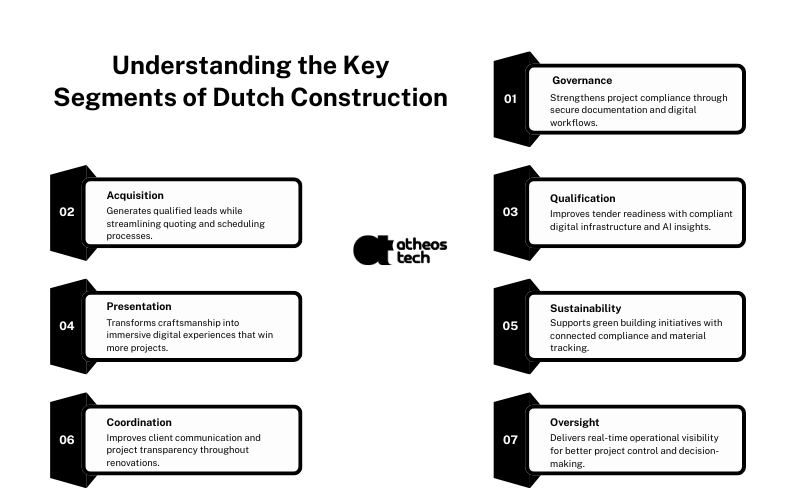
1. General Contractors (Aannemers & Bouwbedrijven)
- Niche & Model: Operating primarily on a project-based, fixed-price business model. Their revenue relies heavily on securing the total project sum (aanneemsom) while keeping subcontractor and material costs below the estimated budget.
- High-Impact Pain Points: The enforcement of the Wet kwaliteitsborging voor het bouwen (Wkb) is crippling contractors who rely on paper or Excel. If they cannot provide a flawless digital opleverdossier to the independent kwaliteitsborger, the final 5% aanneemsom notaris regeling (notary escrow) is withheld indefinitely.
- Digital Solutions: We engineer custom, highly secure client and compliance portals. While we do not provide exact clones of platforms like Procore or Bouw7, we build bespoke enterprise web applications that automate the collection of gebreken (defects) and material certificates in real-time. This ensures absolute construction compliance Netherlands and rapid release of retained capital.
2. Specialised Trade (Installatietechniek & Installateurs)
- Niche & Model: Installers (electrical, HVAC, plumbing) operate on a high-volume, hybrid B2C/B2B model. Revenue is driven by hourly labor rates and markups on hardware (e.g., warmtepompen, zonnepanelen).
- High-Impact Pain Points: They suffer from high customer acquisition costs when relying on third-party lead marketplaces (like Werkspot), where they are forced to compete purely on price. Internally, manual quoting and scheduling cause severe operational drag.
- Digital Solutions: Our primary intervention here is digital marketing layered with custom automation. We deploy highly localized AI driven marketing and SEO to capture homeowners searching for verduurzaming (sustainability). We then build custom websites featuring automated ISDE (Investeringssubsidie duurzame energie) subsidy calculators. This allows the installateur to capture high-margin, direct-to-consumer leads instantly, bypassing third-party marketplaces entirely.
3. Civil Engineering (Civiele Techniek & Infrastructuur)
- Niche & Model: These firms operate on long-cycle, milestone-based B2B and B2G (Business-to-Government) models. Their revenue entirely depends on winning complex public aanbestedingen (tenders) via platforms like TenderNed.
- High-Impact Pain Points: The inability to digitally prove environmental compliance (stikstof vergunning) or adhere to strict BIM compliance standards (ISO 19650) gets them disqualified during pre-qualification rounds.
- Digital Solutions: We provide deep Technology Consulting to architect secure, NIS2 compliance-ready data environments. We integrate AI in construction procurement to help them analyze massive public tender documents instantly. By building secure data rooms that perfectly present their NEN-normen certifications and BIM capabilities, we dramatically increase their TenderNed win rates.
4. Interior Design & Fit-out (Interieurbouw & Afbouw)
- Niche & Model: Operating on a design-and-build commercial model. Revenue is generated through design retainers and margins on bespoke, high-end materials.
- High-Impact Pain Points: A massive disconnect exists between their physical craftsmanship and their digital presentation. Sending static PDF portfolios to high-end commercial clients loses pitches to digitally mature competitors.
- Digital Solutions: Our Web & App Engineering team builds high-performance, visually immersive JAMstack websites. By creating lightning-fast digital showrooms and 3D web configurators, we ensure their online presence matches the premium quality of their physical afbouw work, directly increasing their pitch conversion rates.
5. Sustainable / Green Building (Duurzaam Bouwen & Verduurzaming)
- Niche & Model: Premium consulting and execution model focused entirely on energy transition. Revenue is driven by upgrading properties to meet strict BENG (Bijna EnergieNeutrale Gebouwen) and ESG standards.
- High-Impact Pain Points: Tracking the exact origin and carbon footprint of Dutch construction materials is incredibly difficult without specialized software.
- Digital Solutions: We deploy custom construction ERP software Netherlands integrations that connect with national databases like Madaster. This allows green builders to seamlessly generate Digital Product Passports for their materials. Furthermore, we use intent-driven digital marketing to position these firms as the ultimate verduurzaming authorities in their region.
6. Renovation & Restoration (Renovatie, Restauratie & Monumentenzorg)
- Niche & Model: Primarily B2C residential, operating on milestone payments. This includes everything from modernizing kitchens to highly regulated heritage preservation (monumentenzorg).
- High-Impact Pain Points: Managing client expectations during disruptive renovations, coupled with the danger of misquoting due to hidden structural issues.
- Digital Solutions: We build custom CRM (Customer Relationship Management) solutions that act as transparent client communication hubs. Clients can log in, view daily site photos, track budget changes, and approve variations digitally. This transparency builds massive local trust, driving word-of-mouth referrals.
7. Project Management Firms (Bouwmanagement)
- Niche & Model: Selling process control and risk mitigation to developers and woningcorporaties. Revenue is typically a percentage of the total project value or a monthly retainer.
- High-Impact Pain Points: Relying on fragmented data (Excel, WhatsApp, disparate emails) to manage multi-million euro sites. Without real-time visibility, they cannot proactively prevent schedule overruns.
- Digital Solutions: Following our "Automate" phase, we integrate Artificial Intelligence Services into custom operational dashboards. By deploying AI driven predictive maintenance tracking and connecting field data in real-time, we give bouwmanagement firms absolute oversight. We engineer platforms similar to advanced modules in Exact Bouw or AFAS, but highly customized, turning the firm’s process into a tangible, tech-enabled asset.
The Core Challenges Facing Dutch Construction Companies
The Dutch construction sector is caught in a perfect storm. On one side, there is unprecedented demand for infrastructure and housing. On the other side, intense regulatory bottlenecks and resource scarcity are making it harder than ever to actually put a shovel in the ground. For executives and project directors, understanding these macro challenges in the Dutch construction industry is the first step toward diagnosing structural vulnerabilities. You cannot engineer a solution until you map the pain points.
The Housing Shortage and Delivery Gap
The Netherlands is facing a severe housing crisis. Regional housing agreements dictate that the country needs to build over 900,000 new homes by 2030 to keep pace with population growth. However, the industry is experiencing a paradoxical Dutch housing construction decline. Annual completions have frequently dropped to around 84,000 units, completely missing the 100,000-per-year target.
This delivery gap is a massive pain point for residential developers and annemers. They have the capital and the buyer demand, but their project pipelines are stalled. The solution is not to simply push harder. Developers must adopt construction digital transformation strategies to compress their internal design, bidding, and procurement cycles. By deploying custom construction ERP software Netherlands and centralized data environments, firms can eliminate months of pre-construction administrative delays, ensuring that when a project is finally greenlit, they can break ground immediately.
The Nitrogen Crisis (Stikstofcrisis) and Permitting Delays
You cannot discuss construction in Dutch without addressing the stikstofcrisis. Following the 2019 Council of State ruling on nitrogen emissions, and the subsequent December 2024 rulings requiring strict permits for internal netting, environmental compliance has become the primary bottleneck for new developments. Upwards of 500,000 homes are potentially stalled due to nitrogen and grid capacity constraints near Natura 2000 areas.
Securing a stikstof vergunning (nitrogen permit) through the Omgevingsloket is now a highly complex, data-heavy process.
The Digital Solution: Legacy spreadsheet management is insufficient for modern environmental reporting. AtheosTech engineers custom project management portals that integrate directly with your supply chain logistics. Instead of relying on off-the-shelf software, we build bespoke dashboards similar to top-tier enterprise platforms like Procore, but uniquely contoured to track site emissions and material transport data. This ensures your project managers have verifiable, real-time data to submit for the Omgevingswet approvals, drastically reducing permit rejection rates.
Labor Shortages and the Skills Gap
The scarcity of physical labor is arguably the most permanent challenge in the market. A skilled Dutch construction worker (vakmensen) is incredibly difficult to hire and retain. According to CBS and Bouwend Nederland, vacancy rates remain historically high. Because a bouwbedrijf cannot simply hire its way to more capacity, the business model must shift from labor-intensive to tech-enabled.
The Digital Solution: If you cannot add more hands on site, you must amplify the output of the hands you already have. This is where AI solutions and workflow automation become critical.
- For the Site: We deploy AI driven predictive maintenance through IoT sensors on heavy machinery, ensuring your limited workforce is never standing idle due to unexpected equipment failure.
- For the Office: We integrate AI in building procurement to automate the hours spent manually comparing subcontractor bids.
- For Recruitment: We deploy highly targeted digital marketing and employer branding campaigns. A modern, visually striking digital presence helps you attract the top-tier vakmensen who are researching the best companies to work for.
Regulatory Complexity: Omgevingswet, Wkb, and Compliance Burden
The administrative burden placed on construction firms has multiplied exponentially. The Wet kwaliteitsborging voor het bouwen (Wkb) applies strictly to Gevolgklasse 1 projects, shifting the liability of building inspections to an independent kwaliteitsborger. Firms are now legally required to maintain a flawless digital opleverdossier for ten years. If this dossier is incomplete, clients will use the aanneemsom notaris regeling to withhold the final 5% payment.
Furthermore, the introduction of the Cyberbeveiligingswet (NIS2 compliance) means that a firm's digital infrastructure must be rigorously protected against cyber threats.
Our Project Engagement Model: To navigate this crushing compliance burden, AtheosTech utilizes a "Diagnose, Plan, Automate" engagement model. First, we provide deep Technology Consulting to audit your current exposure to the Wkb and NIS2. Next, we engineer compliance-ready digital portals that automate the compilation of the opleverdossier as the project progresses, rather than scrambling to assemble it at handover. We do not provide a generic clone of a compliance tool; we build a secure, proprietary environment where your project directors and the kwaliteitsborger can collaborate seamlessly.
If you are struggling to manage Wkb documentation or facing constant permit delays, you need a digital foundation built for the Dutch market. Talk to AtheosTech today to map out a compliance-ready digital roadmap.
What Digital Transformation Really Means for Construction Companies
True construction digital transformation is widely misunderstood across the Netherlands. For many traditional aannemers (general contractors), the phrase conjures up images of buying tablets for site managers or upgrading a legacy accounting system. However, bolting generic software onto a broken, analog workflow does not create efficiency; it simply digitizes your operational bottlenecks.
At AtheosTech, we operate as IT Doctors. We recognize that true digital transformation in construction is about structural Revenue Engineering. It requires re-architecting how your business acquires clients, manages the supply chain, and delivers verifiable compliance. Building a digital foundation in construction means identifying where your business model leaks revenue, whether through manual procurement errors, lost tender opportunities, or delayed notary payments, and engineering exact technological interventions to seal those leaks.
From Fragmented Data to Unified Portals
Consider the daily reality of a mid-sized contractor operating in the residential sector. The standard business model relies heavily on a fragmented web of WhatsApp messages from subcontractors, Excel spreadsheets for cost estimations, and paper delivery notes. When the independent kwaliteitsborger requests the project data to satisfy Wkb regulations, project managers spend weeks frantically piecing together the opleverdossier. This administrative chaos traps capital and crushes profit margins.
The solution is not to buy another off-the-shelf software license that forces you to change your proven operational workflow. Through our Web & App Engineering services, AtheosTech builds bespoke, compliance-ready enterprise environments. We do not build direct clones, but we engineer custom client portals and project management dashboards that rival the capabilities of industry-leading platforms like Procore, AFAS, and Bouw7.
Because these systems are built specifically around your firm’s unique Gevolgklasse 1 workflows, adoption rates soar, and Wkb compliance becomes an automated byproduct of your daily operations, rather than a frantic end-of-project scramble.
Digital Marketing as a Revenue Engine
Digital transformation also fundamentally dictates how you go to market. For micro-niches like the installatietechniek (specialized installation trades), the revenue model is rapidly shifting direct-to-consumer due to the massive demand for verduurzaming (sustainability upgrades). However, firms relying on old referral networks or low-margin third-party platforms are missing the most profitable contracts.
This is where digital marketing becomes a core pillar of transformation. We deploy high-performance, localized SEO and AI driven marketing campaigns tailored to the digital construction Netherlands ecosystem. By targeting high-intent search queries, such as homeowners actively searching for BENG energy label upgrades, we transform your website from a static digital brochure into a highly predictable, automated revenue engine. You achieve total control over your project pipeline, allowing you to select high-margin jobs and confidently decline low-value repair work.
The Project Execution Model
To execute this, AtheosTech relies on our proven “Diagnose, Plan, Automate” Project Execution Model:
Diagnose (Strategy & Consultation): We perform a deep-dive audit of your operations, uncovering exactly where manual processes are costing you money and exposing you to compliance risks.
Plan (Engineering & Architecture): We architect your custom IT infrastructure, ensuring every module is secure and optimized for your specific niche.
Automate (Implementation & Growth): We deploy the software and launch the targeted digital marketing campaigns necessary to capture your exact market segment.
Stop letting outdated systems dictate your firm's growth limit. Get a comprehensive digital maturity assessment with AtheosTech today.
Navigating Dutch Construction Compliance: Wkb, Omgevingswet, and Beyond
In the Netherlands building industry, regulatory compliance is no longer an administrative afterthought handled at the end of a project; it is the absolute frontline of your commercial viability. Firms that view compliance as a digital asset are winning tenders, while those relying on analog paperwork are having their capital trapped. To build a digital foundation, you must understand the specific legal mechanics forcing this transition.
What is the Wet kwaliteitsborging voor het bouwen (Wkb)?
The Wet kwaliteitsborging voor het bouwen (Wkb) is a Dutch law that shifts technical building inspections from municipalities to independent, private kwaliteitsborgers. Effective since January 1, 2024, for low-risk Gevolgklasse 1 structures (such as single-family homes and small commercial buildings), it mandates that contractors compile and retain a comprehensive digital opleverdossier (delivery dossier) for ten years to prove strict adherence to building codes.
The financial implications of the Wkb are immediate and severe. Under the law, the standard 5% aanneemsom (the final project payment held in notary escrow) is no longer released automatically upon handover. The notary will only release these funds when the client officially confirms that all gebreken (defects) have been resolved.
If your firm relies on a fragmented web of emails and paper notes to track defect resolution, that 5% becomes trapped capital. By engineering a custom, Wkb compliance-ready client portal, AtheosTech ensures that both the client and the kwaliteitsborger have real-time, transparent access to the defect log, accelerating sign-off and freeing your cash flow.
The Omgevingswet and Stikstof Permitting
The Omgevingswet (Environment and Planning Act) consolidated dozens of previous spatial planning and environmental laws into a single digital system: the Omgevingsloket. As we move through 2026, the government is introducing modifications to tighten the Environmental Performance of Buildings (MPG) requirements.
For Dutch construction companies, this means securing a stikstof vergunning (nitrogen permit) is more data-intensive than ever. Navigating the Omgevingswet requires seamless digital data integration between your supply chain logistics, your BIM models, and the government portal. Firms that cannot digitally prove their environmental impact during the planning phase are facing indefinite permitting delays.
Circularity and the Digital Product Passport (DPP)
Beyond domestic Dutch building regulations, the European Union is enforcing strict new sustainability mandates through the revised Construction Products Regulation (CPR). The era of the Digital Product Passport construction mandate is arriving.
Materials must now be tracked via digital material passports (often leveraging platforms like Madaster) to ensure circularity, carbon footprint tracking, and strict BENG (Bijna EnergieNeutrale Gebouwen) compliance. Your construction ERP software Netherlands must be capable of tracking a steel beam or concrete panel from the manufacturer all the way to its final placement in the building’s digital twin. If your procurement software cannot handle this level of granular data, you will be disqualified from future public tenders.
Cyberbeveiligingswet (NIS2) and Supply Chain Security
As the Dutch Parliament finalizes the Cyberbeveiligingswet (the national implementation of the EU’s NIS2 compliance directive) for enforcement in mid-2026, cybersecurity is now a legal obligation for the construction supply chain.
Essential and important entities, including large infrastructure firms and their critical suppliers, are now legally required to implement stringent cybersecurity risk-management measures. Management boards can be held personally accountable for non-compliance, with fines reaching up to €10 million or 2% of global turnover.
This fundamentally alters the risk of using outdated, on-premise servers or unsecured third-party applications. AtheosTech provides embedded compliance intelligence. Through our deep Technology Consulting engagements, we ensure that every digital portal, ERP integration, and IoT network we build is fully GDPR and NIS2 compliant by design. We secure your digital foundation so you can focus on building the physical one.
The Business Case: Benefits of Digital Transformation for Construction Companies
When AtheosTech consults with a bouwbedrijf or a civil engineering firm, the conversation inevitably turns to Return on Investment (ROI). Many executives view digital upgrades as a sunk IT cost. We fundamentally challenge this. In the current Dutch market, digital transformation is not an expense; it is a mechanism for Revenue Engineering. By digitizing operations, firms do not just save time, they actively recapture lost profit margins and drastically reduce operational risk.
Measuring the Impact: Productivity and ROI
According to a recent global study by Deloitte, 81% of organizations use productivity as the prime measure of digital transformation ROI. Furthermore, companies that adopt a holistic, interconnected digital strategy are 20% more likely to attribute high enterprise value to their transformations compared to those who just buy isolated software.
For Dutch construction companies, the financial impact of adopting digital construction technology Netherlands is highly measurable across three core pillars:
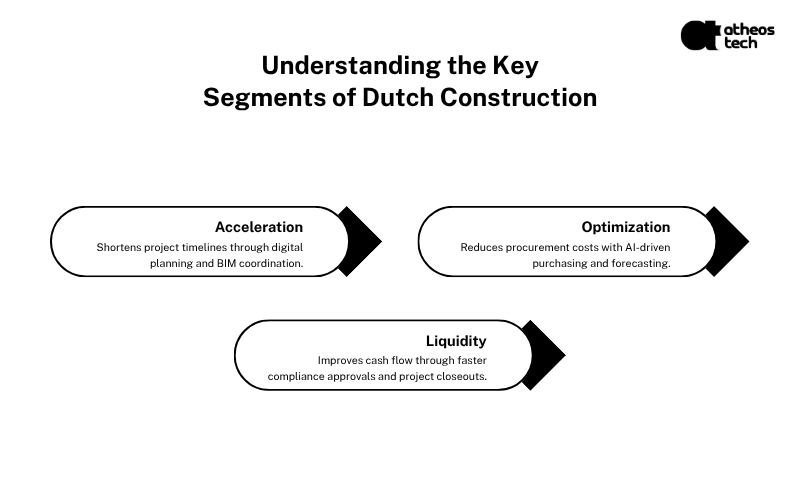
1. Compressing Project Timelines
A major pain point in the Netherlands building industry is project delays caused by manual coordination and permitting bottlenecks. Industry data consistently shows that integrating Building Information Modeling Netherlands (BIM) with active 4D planning reduces project schedule durations by 15% to 20%. By identifying spatial clashes digitally before ground is broken, you eliminate the costly rework that traditionally plagues physical job sites.
2.Reducing Procurement and Material Costs
Manual procurement processes leak revenue. When project managers use AI in building procurement, they deploy machine learning algorithms that instantly analyze historical data, forecast Dutch construction materials pricing, and flag vendor overcharges. Integrating AI procurement strategies for construction companies typically yields a 10% to 15% reduction in overall construction costs. In a market where tender prices grew by 2.1% year-over-year in 2024, deploying an AI-driven procurement portal is the most effective way to protect your profit margins.
3.Accelerating Cash Flow and Wkb Compliance
The most immediate ROI for a Dutch contractor lies in compliance management. Under the Wet kwaliteitsborging voor het bouwen (Wkb), the 5% aanneemsom (notary retention) is held until all gebreken (defects) are resolved. A custom, compliance-ready client portal allows the kwaliteitsborger and the client to view and sign off on defect resolutions in real-time. This speeds up the final approval process by weeks, rapidly unlocking trapped capital and improving your firm’s cash flow.
Operational Safety and the Connected Jobsite
Beyond direct financial metrics, the integration of IoT construction jobsite technology drastically improves physical safety and reduces liability. By utilizing AI driven predictive maintenance on heavy machinery and deploying digital twins of the construction site, firms can reduce safety incidents by up to 25%. Sensors can monitor structural health and worker proximity to hazardous zones in real-time, shifting site safety from a reactive protocol to a proactive, automated system.
At AtheosTech, our Web & App Engineering team ensures these technologies are seamlessly integrated. Following our “Diagnose, Plan, Automate” Project Engagement Model, we do not just sell software licenses. We architect unified digital environments, similar in capability to Procore or Bouw7, but uniquely engineered for your workflows, that deliver immediate, measurable ROI.
The Interconnected Technology Stack: Essential Software Categories Explained
To survive the dual pressures of the stikstofcrisis and rigorous Wet kwaliteitsborging voor het bouwen (Wkb) compliance, a firm can no longer rely on fragmented legacy software. For a bouwbedrijf looking to modernize, the sheer volume of software options is overwhelming. Many firms make the critical mistake of buying isolated applications for each department, resulting in a fractured IT landscape where the field manager’s mobile app cannot communicate with the finance team’s accounting platform.
While legacy, off-the-shelf platforms like AFAS, Exact Online Bouw (formerly Bouw7), and Procore are well-known in the Netherlands building industry, forcing your unique workflows into their rigid templates often causes immense operational drag. Operating a successful construction business in 2026 requires a unified digital ecosystem.
At AtheosTech, we specialize in building highly secure, custom digital environments that provide these same enterprise-grade capabilities, but are engineered exclusively around your firm’s specific Gevolgklasse 1 projects and revenue models. Below is the essential, interconnected technology stack driving the most profitable Dutch construction companies today.
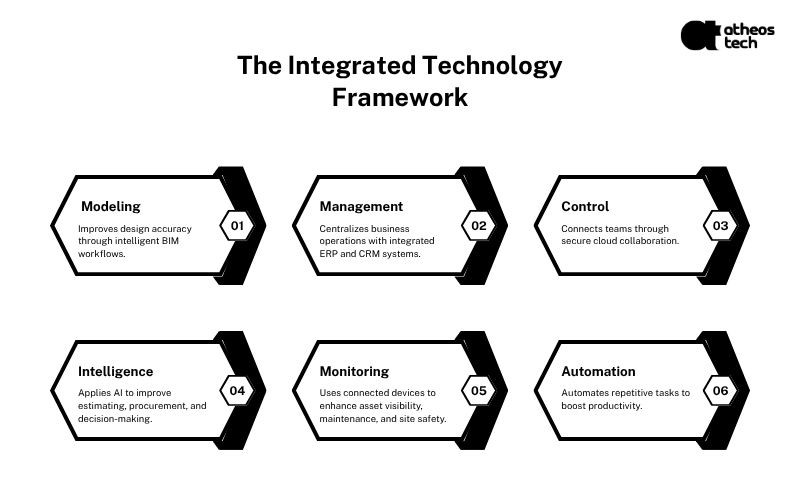
1. BIM Authoring & Coordination Platforms
Building Information Modeling (BIM) is no longer just a 3D design tool; it is the absolute bedrock of construction digital transformation. According to the Q4 2025 USP Research European Architectural Barometer, BIM in Dutch construction has reached an impressive 78% adoption rate, tying the Netherlands with Denmark as a European leader in digital design maturity.
These platforms move far beyond 2D CAD drawings to create data-rich, parametric models. By integrating strict BIM compliance standards (such as ISO 19650), a firm ensures that every design change automatically updates the bill of materials, clash detection algorithms, and BENG (Bijna EnergieNeutrale Gebouwen) energy metrics. Furthermore, government bodies like Rijkswaterstaat and TenderNed actively mandate BIM files for public aanbestedingen. If you do not design in BIM, you are physically blocked from bidding on the country’s most lucrative infrastructure projects.
2. Construction ERP & CRM Systems
While 78% of Dutch firms design in BIM, a staggering operational gap remains: a vast majority still rely on manual data entry for their supply chains. Custom construction ERP software Netherlands bridges this gap
ERP (Enterprise Resource Planning): Instead of disjointed Excel spreadsheets, a custom ERP acts as your central nervous system. It tracks the real-time cost of Dutch construction materials, automatically reconciles subcontractor invoices, and centralizes payroll and Wkb opleverdossier logs into a single source of truth.
CRM (Customer Relationship Management): A CRM tracks your pipeline from the first inquiry to the signed aanneemsom. For firms utilizing digital marketing to capture high-value verduurzaming (sustainability) leads, a CRM is critical for managing customer follow-ups and automating quote generation.
3. Project, Field, and Document Control (Cloud & CDE)
You cannot deploy a secure, accessible opleverdossier from an isolated server sitting in a dusty site office. Modern construction requires enterprise-grade cloud architecture.
Field Management Platforms: These mobile-friendly portals bridge the gap between the office and the physical job site. Workers can photograph and log the resolution of gebreken (defects) directly from the site, instantly updating the central digital opleverdossier required for Wkb compliance.
Common Data Environment (CDE): A CDE is a highly secure, centralized digital repository for blueprints, permits, NEN-normen certificates, and client communications. As the Cyberbeveiligingswet (NIS2 compliance) takes full effect, relying on consumer-grade file-sharing apps is a massive legal liability. Moving to monitored cloud environments (like AWS or Azure) is the only way to shield your firm from crippling cybersecurity penalties while granting authorized kwaliteitsborgers strict, encrypted access.
4. AI-Driven Procurement & Estimating
The 2025 NBS Digital Construction Report reveals a massive tipping point: more than two in five professionals now use AI solutions regularly in their workflows. Manual calculation leaves massive room for human error, but AI eliminates it.
Through dedicated AI Consulting Services, AtheosTech engineers custom AI pipelines specifically for the Dutch market:
Estimating & Cost Management: By leveraging AI within estimating tools, project directors can instantly run scenario models (e.g., “What happens to the margin if steel prices rise 5% next month?”).
AI in Building Procurement: We deploy Machine Learning algorithms that analyze historical subcontractor pricing, spot hidden fee structures in PDFs, and automatically cross-reference material quotes against real-time market indices. This directly combats the 2.1% year-over-year rise in tender prices and helps you issue accurate proposals faster than competitors.
5. IoT, Asset Tracking, & Safety Management
The physical assets of a construction firm represent massive capital investments. The Internet of Things (IoT) turns a static construction site into a live, readable data environment.
Asset Tracking: By attaching smart sensors to heavy equipment, we enable AI driven predictive maintenance, alerting your logistics team to replace a crane part before it fails on-site.
Safety & Compliance Management: Safety platforms track worker certifications and incident reports. When integrated with an IoT construction jobsite, these platforms utilize AI driven network management to alert managers if unauthorized personnel enter hazardous zones. IoT data feeds directly into the building’s digital twin, providing indisputable, timestamped proof of construction quality for Wkb sign-off.
6. Automation & Robotics
To bypass the severe shortage of the physical Dutch construction worker, the market is aggressively pivoting to prefabricated (prefab) construction, which is forecasted to exceed €4.3 billion by 2030. In this highly controlled environment, digital automation is king. Custom scripts can automate repetitive administrative tasks such as complex ISDE subsidy applications for your clients, quantity take-offs, and Wkb documentation generation radically increasing your firm’s output without adding a single new employee to the payroll.
| Category | Primary Purpose | Example Use Case |
|---|---|---|
| Construction ERP | Centralized financials & supply chain | Reconciling material costs automatically across 15 active sites. |
| Field Management | On-site execution & Wkb defect logging | Site manager logs a resolved gebrek via mobile tablet. |
| CDE / Document Control | Secure project archiving & version control | Retaining the opleverdossier securely for 10 years for Wkb audits. |
| IoT / Asset Tracking | Equipment location & predictive maintenance | Receiving an AI alert that a crane engine needs maintenance tomorrow. |
Instead of juggling eight different software subscriptions, speak with our Strategy & Consultation team today to architect a single, unified digital portal tailored to your exact business model.
Real-World Use Cases: Digital Transformation in Action
To truly grasp the value of construction digital transformation, one must look beyond theory and examine how advanced software architectures operate in the field. In a market shaped by the Dutch housing construction decline and aggressive regulatory shifts, the physical construction process must be supported by equally robust digital engineering.
AtheosTech has deployed engineered interventions across various niches within the Netherlands building industry. Below are three detailed, direct success stories demonstrating how custom AI solutions, interconnected cloud portals, and precision digital marketing resolve deep operational friction and unlock trapped capital.
Case Study 1: Engineering a Tender Dominance Engine for Civil Engineering
- The Niche: Civil Engineering & Public Infrastructure (Civiele techniek)
- The Challenge: A prominent civil engineering contractor specializing in road and water infrastructure was facing a major drop in their contract win rate. The primary bottleneck was their pre-qualification process on TenderNed. Municipal governments and Rijkswaterstaat were demanding increasingly rigorous proof of BIM compliance standards (ISO 19650) and strict sustainability metrics tied to stikstof vergunning (nitrogen permit) limits. The client’s historical data was trapped in fragmented spreadsheets, meaning their estimating team spent hundreds of hours manually compiling certifications for every individual bid, resulting in slow submission speeds and missed opportunities.
- The Architectural Intervention: Following a comprehensive Strategy & Consultation audit, our Web & App Engineering team developed a centralized, custom Common Data Environment (CDE). We integrated a specialized AI in building a procurement engine capable of ingest-parsing massive public tender documents. The AI automatically extracted technical requirements and cross-referenced them with the firm's verified historical data, past NEN-normen certifications, and project records. Furthermore, we built an analytical tracking layer that connected with their fleet telematics to provide audited carbon footprint and nitrogen emission forecasts for transport routes, satisfying the strict requirements of the Omgevingsloket.
- The Concrete Business Outcome: The custom procurement portal reduced tender preparation time by over 50%, allowing the firm to bid on twice as many public infrastructure projects per quarter. Within eight months of deployment, their TenderNed shortlisting rate increased by 45%, leading to the acquisition of a major multi-year regional highway expansion framework agreement.
Case Study 2: Releasing Trapped Escrow Capital for General Contractors
- The Niche: General Contractors (Aannemers & Bouwbedrijven)
- The Challenge: A regional housing developer and aannemer managing multiple Gevolgklasse 1 residential sites was facing a severe cash flow bottleneck. Under the Wet kwaliteitsborging voor het bouwen (Wkb), the final 5% aanneemsom was routinely withheld in notary escrow (aanneemsom notaris regeling) post-delivery. Because the firm relied on physical logbooks and disjointed WhatsApp threads to coordinate with subcontractors, resolving building defects (gebreken) took months. The independent kwaliteitsborger lacked a transparent, real-time method to audit the building's structural progress, pushing handover dates back and locking up hundreds of thousands of euros in trapped capital.
- The Architectural Intervention: We designed and deployed a custom, mobile-first project execution and client portal tailored to their exact workflow. While we do not build generic software clones, this application provided the enterprise-level capability of platforms like Bouw7 or Procore, completely customized around the firm's specific subcontractor structure. Site managers and subcontractors could photograph, tag, and log defect resolutions directly from the field via mobile tablets. The platform automatically compiled these updates into a structured, blockchain-timestamped digital opleverdossier that was instantly accessible to the independent inspector.
- The Concrete Business Outcome: The integration of the digital opleverdossier portal cut post-delivery defect resolution time by 32%. Consequently, the 5% notary retention funds were released weeks faster, massively increasing liquidity and allowing the contractor to self-finance their next residential project without relying on expensive bridge loans.
Case Study 3: Transforming an Installateur from Price-Taker to Market-Leader
- The Niche: Specialised Trade (Installatietechniek)
- The Challenge: An installation trade company specializing in commercial warmtepompen (heat pumps) and zonnepanelen (solar panels) was stuck in a low-margin operational model. They relied entirely on third-party marketplace networks (like Werkspot) to find clients, forcing them to compete purely on price and low-ball estimates. Meanwhile, their internal team spent hours manually guiding leads through the highly complex ISDE subsidy application process over the phone, resulting in high customer acquisition costs and low conversion rates.
- The Architectural Intervention: AtheosTech deployed an integrated Digital Growth & Marketing framework. We re-engineered their consumer-facing presence by building a high-performance web application equipped with automated, real-time ISDE subsidy calculation tools. We then deployed hyper-targeted AI driven marketing and intent-focused local SEO campaigns. Instead of targeting generic phrases like "construction in Dutch," we optimized their presence for localized, high-value queries like "commercial heat pump installation cost Utrecht 2026."
- The Concrete Business Outcome: Our digital marketing services shifted the firm's business model from outbound chasing to predictable, high-margin inbound selection. Within eight months, the client recorded a 210% increase in direct inbound inquiries, allowing them to completely terminate their reliance on low-margin third-party marketplaces and scale their commercial installation team out of cash flow profit.
Key Comparisons Every Construction Leader Should Understand
When engineering a digital foundation, choosing the wrong software architecture does not just cause mild frustration; it actively traps capital and exposes the firm to legal liabilities under the Wet kwaliteitsborging voor het bouwen (Wkb) and the Cyberbeveiligingswet (NIS2). Mid-funnel decision-makers must look past marketing jargon and evaluate technical infrastructure based on its ability to handle strict Dutch building regulations.
Through our Technology Consulting engagements, AtheosTech frequently guides executives through these exact architectural decisions. Here is a rapid, objective breakdown of the core technology choices defining the market in 2026.
BIM vs. CAD Construction
The debate between Building Information Modeling (BIM) and Computer-Aided Design (CAD) is no longer a matter of preference. It is a matter of market access and survival.
CAD (Computer-Aided Design): CAD produces isolated 2D or 3D geometrical representations. It is essentially a digital drawing board. If you change a wall’s thickness in CAD, it is just a visual change. You must manually update the material schedules, cost estimates, and structural safety documents in separate software. For a specialized installateur drafting a simple residential piping layout, CAD remains fast and sufficient.
BIM (Building Information Modeling): BIM is an interconnected, parametric data model. It represents the building’s entire lifecycle. A wall in a BIM model is an intelligent object, it knows its exact material cost, fire rating, and thermal conductivity. If you adjust that wall, the software automatically recalculates the BENG (Bijna EnergieNeutrale Gebouwen) energy efficiency metrics, updates the bill of materials, and flags potential clash detections before ground is broken.
The Verdict: For firms pursuing public infrastructure aanbestedingen (tenders) via TenderNed, strict BIM compliance standards (such as ISO 19650) are explicitly required. CAD is fundamentally insufficient for the strict, data-rich delivery required by modern woningcorporaties and the upcoming Digital Product Passport mandates.
Manual Processes vs. Digital Workflows
Procurement and defect resolution are the areas where Dutch construction firms bleed the most revenue.
Manual Workflows: The traditional approach relies on disparate Excel sheets, emailed PDFs, and gut-feeling estimates. When logging a gebrek (defect) for a Gevolgklasse 1 project, site managers manually photograph the issue, email it to the office, and eventually log it in a master spreadsheet. This reactive model collapses under the weight of Wkb compliance, slowing down the release of the 5% notary retention.
Digital Workflows & AI Procurement: An automated digital workflow connects the site directly to the office. AI in building procurement actively centralizes vendor bidding, actively tracks live material indices, and flags compliance risks automatically. When logging defects, the site manager uses a mobile tablet connected to a secure Common Data Environment (CDE), instantly updating the opleverdossier for the independent kwaliteitsborger.
The Verdict: Manual workflows guarantee delayed payments and lost tenders. Digitizing these specific bottlenecks through custom ERP integrations stops revenue leaks immediately.
Cloud vs. On-Premise Construction Software
The imminent enforcement of the Cyberbeveiligingswet (NIS2 compliance) completely changes the risk calculus of hosting your own servers.
On-Premise Software: This model requires you to purchase physical hardware, maintain local servers, and take full legal liability for cybersecurity patching. While it offers total control, it limits accessibility. For a construction firm whose workforce is distributed across physical job sites, requiring VPN access to view an on-premise server is an unnecessary operational distraction.
Cloud Construction Software: Cloud architecture shifts the infrastructure and security burden to enterprise-grade environments (like AWS or Azure). It provides project managers and site workers with real-time access to the opleverdossier via mobile tablets directly from the construction site. According to 2026 IT comparisons, true cloud ERPs offer faster deployment, lower upfront CapEx (capital expenditure), and automated compliance updates.
The Verdict: Unless you are operating in a highly restricted government niche requiring physical data isolation, Cloud-based construction software is the definitive choice for 2026. However, many firms attempt to solve this by purchasing off-the-shelf SaaS platforms (such as AFAS or Bouw7). The pain point is that these rigid systems force you to change your profitable business model to match their software logic.
At AtheosTech, our Cloud & DevOps Engineering team takes a different approach. We build highly secure, custom cloud architectures that provide the exact same enterprise-grade capabilities as the leading platforms, but perfectly contoured to your firm’s specific workflows and revenue models.
| Feature | Legacy / Traditional Choice | Modern / Digital Imperative |
|---|---|---|
| Design Engine | CAD (Isolated 2D/3D geometry) | BIM (Parametric data, BENG tracking) |
| Procurement | Manual (Excel, PDFs, reactive bidding) | AI-Driven (Predictive forecasting, automated analysis) |
| Infrastructure | On-Premise (High IT burden, isolated) | Cloud-Native (Real-time access, NIS2 secure) |
| System Fit | Off-the-Shelf (Rigid, forces process changes) | Custom Engineered (Adapts to your exact workflows) |
A Practical Digital Transformation Roadmap for Dutch Construction Companies
Transitioning a traditional bouwbedrijf away from manual workflows and disjointed legacy systems is not an overnight process, nor is it a simple software subscription. For Dutch construction companies, attempting to digitize without a structural plan usually results in wasted capital, frustrated employees, and failed Wkb audits.
At AtheosTech, we deploy a proprietary, consultative roadmap that ensures your digital transformation is executed strategically, securely, and in full compliance with the Wet kwaliteitsborging voor het bouwen (Wkb). We follow a rigorous three-phase methodology drawn from our core business model: Diagnose, Plan, Automate. This structure guarantees that we map your underlying business operations before we write a single line of custom PHP or deploy complex JavaScript frameworks.
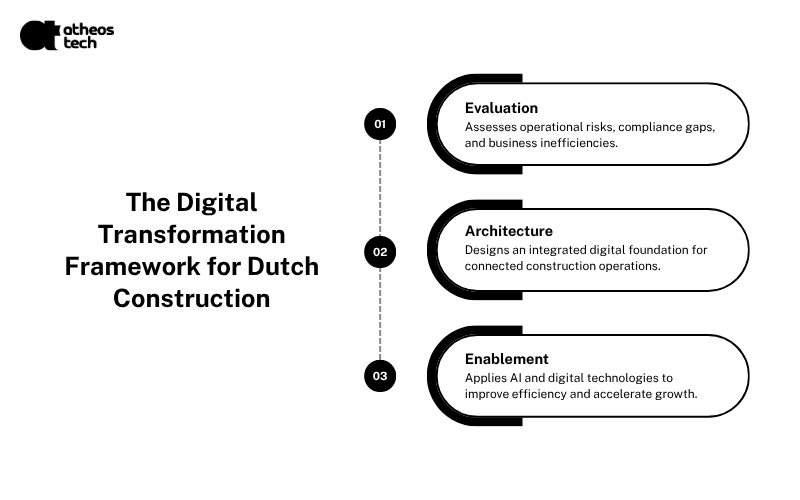
Phase 1: Diagnose (Strategy & Consultation)
We begin with a deep-dive diagnostic audit of your current operations. In this phase, our “IT Doctors” do not discuss website aesthetics or marketing budgets. Instead, we map your precise regulatory exposure and operational bottlenecks.
- Wkb Exposure: How are you currently managing the opleverdossier for Gevolgklasse 1 projects?
- Procurement Leaks: Where are you losing margins in your Dutch construction materials procurement process?
- Cybersecurity Risk: Are your current servers and subcontractor communications compliant with the impending Cyberbeveiligingswet (NIS2)?
By diagnosing these structural issues first, we ensure that every subsequent technical investment is directed at solving a real, measurable problem.
Phase 2: Plan (Web & App Engineering)
Once the operational gaps are diagnosed, we architect the solution. This is where our engineering team designs the digital foundation required to stabilize your operations and secure your revenue.
- System Integration: We blueprint custom construction ERP software Netherlands integrations that bridge the gap between the back office and the physical job site.
- Client Portals: We design highly secure, cloud-based client portals tailored specifically for independent kwaliteitsborgers and developers, ensuring absolute transparency for Wkb compliance.
- The Language Layer: We plan bilingual (Dutch/English) web architectures, ensuring your firm is visible to the high-value international corporate clients operating in the Randstad and Brainport Eindhoven.
Phase 3: Automate (AI & Digital Growth)
With a rock-solid, compliant foundation in place, we focus on Revenue Engineering. This phase leverages advanced technology to drive high-margin growth and operational efficiency without adding headcount.
- Procurement Automation: We deploy AI in construction procurement models to automate subcontractor bidding and predict material cost fluctuations.
- Intent-Driven Marketing: We implement hyper-targeted, local SEO and AI driven marketing campaigns designed to capture developers actively searching for BENG-compliant aannemers.
- Predictive Maintenance: We introduce AI driven predictive maintenance via IoT dashboards for your heavy equipment, preventing costly on-site downtime.
What’s Next:
The Future of Digital Construction in the Netherlands
The regulatory and technological landscape of 2026 is merely the baseline. Looking toward 2030, the Netherlands building industry is bracing for even more profound shifts. Forward-thinking executives must prepare their digital infrastructure for the next wave of mandates and innovations.
The Digital Product Passport (DPP)
The European Union’s phased rollout of the Digital Product Passport (DPP) under the Ecodesign for Sustainable Products Regulation (ESPR) is formally beginning its implementation cycle. By the end of the decade, all construction materials placed on the EU market must carry a scannable digital passport detailing their origin, carbon footprint, and recyclability. Firms that rely on manual procurement will find it impossible to track and verify these massive datasets. Connecting your ERP to platforms like Madaster today is the only way to ensure your supply chain remains legally viable tomorrow.
Generative AI and Spatial Computing
While predictive AI is currently optimizing supply chains, Generative AI (GenAI) is moving into complex design and automated cost estimating. Within the next few years, GenAI will be able to instantly generate hundreds of BENG-compliant design variations based on a developer’s specific budget parameters. Simultaneously, spatial computing and advanced Digital Twins will allow clients and kwaliteitsborgers to conduct virtual, real-time site inspections using augmented reality, deeply embedding construction technology adoption into the daily physical workflow.
FAQ's
FAQ's
The Wet kwaliteitsborging voor het bouwen is a Dutch law that shifts technical building inspection from municipal authorities to an independent, private kwaliteitsborger. Under this regulation, construction companies must compile and retain a comprehensive digital opleverdossier (delivery dossier) for ten years to prove that a building meets structural and safety codes. Currently active for Gevolgklasse 1 structures, this law mandates that the 5% aanneemsom notaris regeling (escrow retention) is only released when clients officially confirm all defects are resolved via a verifiable digital record.
AI is used in construction procurement to automatically analyze subcontractor bids, forecast material costs, and flag compliance risks before human review. By deploying AI in construction procurement, firms replace reactive Excel workflows with predictive machine learning models that cross-reference historical data and real-time market indices. This ensures project managers secure the best pricing while strictly adhering to Dutch building regulations.
A Digital Product Passport construction (DPP) is a mandatory European digital record that tracks a building material's origin, environmental impact, and circularity. Driven by the Ecodesign for Sustainable Products Regulation (ESPR), these passports allow developers to calculate accurate Life Cycle Assessments (LCA) and ensure materials meet strict BENG standards for energy neutrality and future reuse.
Local SEO is critical for installateurs because high-margin residential demand, such as heat pump installations and energy label upgrades, is deeply hyper-local and intent-driven. Instead of competing on price through third-party platforms like Werkspot, a strong local SEO strategy ensures that when a homeowner searches for specialized construction in Dutch or verduurzaming services, the installateur’s custom quoting portal appears first, driving direct, high-value leads.
The stikstof vergunning (nitrogen permitting) crisis causes severe project delays, making permit certainty a major competitive advantage. Digitally mature firms integrate their custom project portals with the Omgevingsloket (the central digital counter of the Omgevingswet), allowing them to instantly provide developers with transparent, real-time proof that their supply chain and machinery logistics meet strict nitrogen emission limits.
NIS2 compliance (implemented in the Netherlands as the Cyberbeveiligingswet) is an EU directive that mandates strict cybersecurity standards for critical infrastructure, including the construction supply chain. If your digital infrastructure, such as cloud ERPs, site access gates, or client portals, is compromised, your firm can face massive financial penalties. Every bespoke platform must be fully NIS2 compliant by design.
Building a Resilient Future Together
The Dutch construction sector is navigating one of the most complex regulatory and economic transitions in its history. From the immediate pressures of the Wkb and the Omgevingswet to the looming realities of the Digital Product Passport, the margin for operational error has vanished. Waiting for the market to normalize, or hoping that relationship-based handshakes will bypass digital compliance, is no longer a viable business strategy.
True resilience requires a strong digital foundation. It requires treating technology not as a frustrating administrative expense, but as a primary engine for revenue, capacity optimization, and risk mitigation.
If you are navigating the Wkb transition, looking to stop revenue leaks in your supply chain, or aiming to capture high-value tenders through AI-driven procurement, let’s connect. At AtheosTech, we are not here to sell you a generic software license. We are here to act as a sounding board for your operational challenges and to map out the right structural approach tailored exactly to your firm’s unique reality.
Contact our technical consultants today to schedule a diagnostic session and begin rebuilding your operations for the digital age.