Prototyping & Wireframing: Reducing Development Risk Before Code
The End of “Fix It After It Breaks”
Not long ago, maintenance followed a simple rule: wait until something breaks, then fix it. If a machine stopped working, a technician was called. If a system failed, production slowed down or stopped completely. This approach was effective when operations were smaller and less complex. But today, in a world powered by IoT devices, real-time data, and AI solutions, this old method creates more problems than solutions.
Modern businesses run on speed, accuracy, and uptime. Downtime is no longer just an inconvenience; it directly impacts revenue, customer trust, and brand reputation. This is why companies are moving away from reactive maintenance and stepping into something smarter: predictive maintenance powered by AI and IoT.
At the center of this shift is a powerful partnership. IoT collects real-time data from machines, and AI turns that data into clear, intelligent predictions. Together, they allow businesses to fix problems before they happen, not after damage is already done.
This blog explores how AI enhances IoT predictive maintenance, why this combination is so effective, and how it is transforming operations across industries.
To understand how AI improves predictive maintenance, we first need to understand what predictive maintenance really is and how IoT (Internet of Things) makes it possible.
IoT refers to physical devices, like machines, tools, vehicles, and sensors, that are connected to the internet. These devices continuously collect data analytics such as:
In traditional maintenance, machines are checked on a fixed schedule. For example, every three months, a machine is inspected, whether it needs it or not. That’s called preventive maintenance.
Predictive maintenance goes further. Instead of guessing when a machine might fail, IoT devices monitor it in real time. They watch how the equipment behaves every second of every day. If something starts to look unusual, even slightly, the system notices.
But raw data alone isn’t enough. That’s where AI comes in.
IoT gives us the eyes. AI gives us the brain.
Every second, IoT devices generate massive amounts of data. One factory can produce millions of data points every hour. Humans can’t analyze this volume manually. AI/ML development companies and machine learning development companies create AI/ML solutions that make sense of it all.
AI uses machine learning algorithms to:
Over time, AI becomes smarter. It studies past failures, understands what caused them, and improves future predictions. Instead of reacting to alarms, businesses get early warnings with clear insights.
So instead of saying:
“Something is wrong,”
AI says:
“This motor will likely fail in 9 days due to rising vibration and heat.”
That level of intelligence changes everything.
To understand how AI improves predictive maintenance, we first need to understand what predictive maintenance really is and how IoT (Internet of Things) makes it possible.
IoT refers to physical devices, like machines, tools, vehicles, and sensors, that are connected to the internet. These devices continuously collect data analytics such as:
In traditional maintenance, machines are checked on a fixed schedule. For example, every three months, a machine is inspected, whether it needs it or not. That’s called preventive maintenance.
Predictive maintenance goes further. Instead of guessing when a machine might fail, IoT devices monitor it in real time. They watch how the equipment behaves every second of every day. If something starts to look unusual, even slightly, the system notices.
But raw data alone isn’t enough. That’s where AI comes in.
IoT gives us the eyes. AI gives us the brain.
Every second, IoT devices generate massive amounts of data. One factory can produce millions of data points every hour. Humans can’t analyze this volume manually. AI/ML development companies and machine learning development companies create AI/ML solutions that make sense of it all.
AI uses machine learning algorithms to:
Over time, AI becomes smarter. It studies past failures, understands what caused them, and improves future predictions. Instead of reacting to alarms, businesses get early warnings with clear insights.
So instead of saying:
“Something is wrong,”
AI says:
“This motor will likely fail in 9 days due to rising vibration and heat.”
That level of intelligence changes everything.
Now let’s connect everything into one smooth process. This is where raw data stops being just numbers and starts becoming intelligent insight. Machines don’t just collect information; they communicate with AI in a meaningful way. Every signal, reading, and small change is analyzed using AI solutions and ML development company expertise, turning machine behavior into smart, timely decisions.
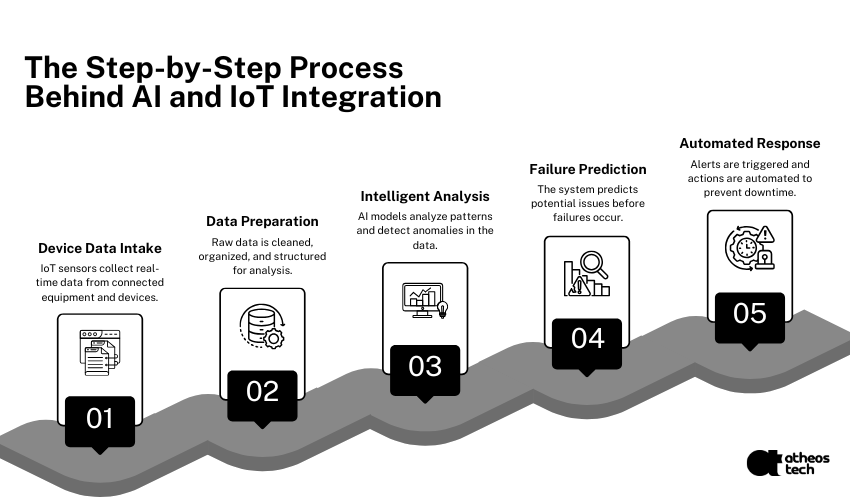
Sensors are installed on machines, tools, vehicles, and systems. These IoT sensors continuously send real-time data about performance and condition, tracking temperature, vibration, pressure, speed, and energy usage every second.
The data flows into cloud platforms or edge systems. Information is cleaned, organized, and prepared for analysis. Raw data can be messy, but AI solutions companies and artificial intelligence as a service providers ensure only relevant insights are delivered for predictive modeling.
AI models study the data. They compare current behavior with historical patterns. They look for anomalies, small changes that suggest something is going wrong.
Over time, AI learns what “normal” looks like for each machine. If a motor usually vibrates at a certain level and suddenly changes, AI notices. It doesn’t just react to big failures; it catches tiny warning signs long before humans would see them.
When AI detects a risk, it sends an alert. Not a random warning, but a clear, data-based prediction with context.
Instead of saying “machine error,” the system explains what is likely to fail, why, and when. This helps teams act with confidence. They’re no longer guessing; they’re responding to intelligent, evidence-based insights.
Maintenance teams receive precise instructions. Advanced AI ML development companies can even automate actions, such as slowing a machine, switching systems, or scheduling a repair. Insight becomes immediate impact, reducing unplanned downtime and boosting efficiency.
Now let’s connect everything into one smooth process. This is where raw data stops being just numbers and starts becoming intelligent insight. Machines don’t just collect information; they communicate with AI in a meaningful way. Every signal, reading, and small change is analyzed using AI solutions and ML development company expertise, turning machine behavior into smart, timely decisions.
Sensors are installed on machines, tools, vehicles, and systems. These IoT sensors continuously send real-time data about performance and condition, tracking temperature, vibration, pressure, speed, and energy usage every second.
The data flows into cloud platforms or edge systems. Information is cleaned, organized, and prepared for analysis. Raw data can be messy, but AI solutions companies and artificial intelligence as a service providers ensure only relevant insights are delivered for predictive modeling.
AI models study the data. They compare current behavior with historical patterns. They look for anomalies, small changes that suggest something is going wrong.
Over time, AI learns what “normal” looks like for each machine. If a motor usually vibrates at a certain level and suddenly changes, AI notices. It doesn’t just react to big failures; it catches tiny warning signs long before humans would see them.
When AI detects a risk, it sends an alert. Not a random warning, but a clear, data-based prediction with context.
Instead of saying “machine error,” the system explains what is likely to fail, why, and when. This helps teams act with confidence. They’re no longer guessing; they’re responding to intelligent, evidence-based insights.
Maintenance teams receive precise instructions. Advanced AI ML development companies can even automate actions, such as slowing a machine, switching systems, or scheduling a repair. Insight becomes immediate impact, reducing unplanned downtime and boosting efficiency.
Now that we understand the process, let’s look at the real improvements AI brings. This is where technology stops being impressive on paper and starts creating real, visible impact on the factory floor, in fleets, and across entire operations.
AI doesn’t wait for something to break. It studies long-term machine behavior using smart AI algorithms and learns what “normal” really looks like. When a motor, pump, or system starts acting slightly different, AI notices immediately. That means repairs happen at the perfect time, not too early (which wastes money) and not too late (which causes chaos).
Unplanned downtime is one of the biggest enemies of productivity. With AI watching machines in real time, issues are caught days or even weeks before failure. Teams can fix problems during planned stops instead of rushing during emergencies. The result? Reduced downtime, smoother workflows, and operations that stay on schedule.
Traditional maintenance follows the calendar. AI follows the machine. Instead of servicing equipment just because the date says so, AI schedules work only when data shows it’s needed. This turns guesswork into precision and makes every maintenance hour count.
Small issues create big damage when ignored. AI spots those tiny warning signs, earl, a vibration change, a heat spike, a pressure drop, and stops problems from growing. That means machines last longer, run more efficiently, and deliver better performance year after year.
Fewer emergency repairs. Less overtime. Fewer part replacements. Better use of labor. AI helps companies cut waste at every level. The cost savings don’t come from one big change; they come from hundreds of smart, data-driven decisions happening every day.
Each of these benefits connects back to one goal: running operations smoothly, efficiently, and intelligently, the way modern, AI-powered businesses are meant to operate.
AI doesn’t wait for something to break. It studies long-term machine behavior using smart AI algorithms and learns what “normal” really looks like. When a motor, pump, or system starts acting slightly different, AI notices immediately. That means repairs happen at the perfect time, not too early (which wastes money) and not too late (which causes chaos).
Unplanned downtime is one of the biggest enemies of productivity. With AI watching machines in real time, issues are caught days or even weeks before failure. Teams can fix problems during planned stops instead of rushing during emergencies. The result? Reduced downtime, smoother workflows, and operations that stay on schedule.
Traditional maintenance follows the calendar. AI follows the machine. Instead of servicing equipment just because the date says so, AI schedules work only when data shows it’s needed. This turns guesswork into precision and makes every maintenance hour count.
Small issues create big damage when ignored. AI spots those tiny warning signs, earl, a vibration change, a heat spike, a pressure drop, and stops problems from growing. That means machines last longer, run more efficiently, and deliver better performance year after year.
Fewer emergency repairs. Less overtime. Fewer part replacements. Better use of labor. AI helps companies cut waste at every level. The cost savings don’t come from one big change; they come from hundreds of smart, data-driven decisions happening every day.
Each of these benefits connects back to one goal: running operations smoothly, efficiently, and intelligently, the way modern, AI-powered businesses are meant to operate.
“Unlock Smarter Maintenance Today with AI Solutions”
This technology isn’t theoretical. It’s already working inside real businesses, solving real problems, and quietly transforming how industries operate day by day. AI-powered IoT predictive maintenance has moved beyond experimentation; it’s now a competitive advantage.
Factories use AI/ML solutions to monitor production lines, detect bearing wear, and spot machine failures before they interrupt operations.
AI tracks IoT sensors in turbines, transformers, and pipelines, identifying stress and micro-leaks early to prevent outages.
Fleet vehicles use AI solutions to monitor engine health, brakes, and tires, ensuring trucks stay operational and deliveries remain on time.
Hospitals rely on predictive maintenance for MRI machines, ventilators, and diagnostic tools, preventing downtime in life-critical equipment.
AI monitors HVAC, elevators, and power systems in real time, ensuring safety, comfort, and energy efficiency.
Across all industries, the story is the same: less downtime, better performance, and smarter decisions powered by AI.
This technology isn’t theoretical. It’s already working inside real businesses, solving real problems, and quietly transforming how industries operate day by day. AI-powered IoT predictive maintenance has moved beyond experimentation; it’s now a competitive advantage.
Factories use AI/ML solutions to monitor production lines, detect bearing wear, and spot machine failures before they interrupt operations.
AI tracks IoT sensors in turbines, transformers, and pipelines, identifying stress and micro-leaks early to prevent outages.
Fleet vehicles use AI solutions to monitor engine health, brakes, and tires, ensuring trucks stay operational and deliveries remain on time.
Hospitals rely on predictive maintenance for MRI machines, ventilators, and diagnostic tools, preventing downtime in life-critical equipment.
AI monitors HVAC, elevators, and power systems in real time, ensuring safety, comfort, and energy efficiency.
Across all industries, the story is the same: less downtime, better performance, and smarter decisions powered by AI.
All of this leads to strong, measurable business outcomes. AI-powered predictive maintenance doesn’t just protect machines; it strengthens the entire business structure.
In simple terms: AI doesn’t just fix machines, it builds confidence across the business.
AI filters noise and focuses on signals that matter, transforming overwhelming data collection into actionable intelligence.
Machine learning development companies ensure models improve over time, reducing inaccurate predictions.
AI integrates seamlessly with existing equipment, bridging old and new technologies to enhance predictive maintenance.
AI filters noise and focuses on signals that matter, transforming overwhelming data collection into actionable intelligence.
Machine learning development companies ensure models improve over time, reducing inaccurate predictions.
AI integrates seamlessly with existing equipment, bridging old and new technologies to enhance predictive maintenance.
Instead of creating complexity, AI simplifies AI management.
The next step is edge AI, which processes data right at the device, enabling faster decisions and real-time actions without relying solely on the cloud.
This means:
• Faster decisions
• Less cloud dependency
• Real-time reactions
Machines won’t just report problems; they’ll respond to them instantly. The future of maintenance isn’t centralized. It’s intelligent, local, and lightning-fast.
A smart strategy always begins with understanding your operations and assets. You can’t optimize what you don’t fully know. The first step is a clear assessment of your machines, systems, and processes to identify where AI and IoT can add the most value.
Next, install smart IoT sensors on key equipment to continuously collect real-time data. These sensors act as the eyes and ears of your machines, feeding critical information into AI systems.
Then, choose AI platforms that align with your operational goals. Whether it’s predictive analytics, anomaly detection, or automated alerts, the right platform ensures that the data collected is transformed into actionable insights.
Finally, partner with experienced teams like AtheosTech, a leading AI solutions company, to guide the integration of technology, strategy, and execution. With the combined power of AI solutions, AI Consulting Services, and enterprise AI solutions, raw data is no longer just numbers; it becomes real business power, helping you reduce downtime, save costs, and make smarter decisions.
AI solutions and IoT aren’t trends; they are the foundation of modern operations. Predictive maintenance powered by artificial intelligence AI prevents failures, strengthens reliability, and gives managers full control.
Companies that embrace AI-driven IoT today won’t just survive, they’ll lead. With accurate predictions, reduced downtime, and smarter AI management, predictive maintenance becomes a competitive edge, not just a tool. Businesses gain intelligence, precision, and proactive foresight, setting the standard for operational excellence.
It combines AI solutions with IoT devices to monitor equipment in real time, using AI algorithms to predict machine failures before they happen, reducing unplanned downtime and saving costs. With AtheosTech, businesses can leverage advanced AI/ML solutions for smarter operations.
IoT sensors gather real-time data on temperature, vibration, and performance. AI analyzes this to detect anomalies, deliver accurate predictions, and schedule maintenance only when necessary.
Industries with complex machinery or critical systems, such as manufacturing, energy, logistics, healthcare, and smart buildings, gain the most from enterprise AI solutions provided by AtheosTech.
Yes. AI solutions companies like AtheosTech provide enterprise AI solutions that work with both modern and legacy systems, bridging technology gaps seamlessly.
Benefits include reduced downtime, smarter maintenance schedules, lower operational costs, extended asset lifespan, and enhanced data analytics. AtheosTech’s Machine Learning Development Services help businesses achieve all these benefits efficiently.
It combines AI solutions with IoT devices to monitor equipment in real time, using AI algorithms to predict machine failures before they happen, reducing unplanned downtime and saving costs. With AtheosTech, businesses can leverage advanced AI/ML solutions for smarter operations.
IoT sensors gather real-time data on temperature, vibration, and performance. AI analyzes this to detect anomalies, deliver accurate predictions, and schedule maintenance only when necessary.
Industries with complex machinery or critical systems, such as manufacturing, energy, logistics, healthcare, and smart buildings, gain the most from enterprise AI solutions provided by AtheosTech.
Yes. AI solutions companies like AtheosTech provide enterprise AI solutions that work with both modern and legacy systems, bridging technology gaps seamlessly.
Benefits include reduced downtime, smarter maintenance schedules, lower operational costs, extended asset lifespan, and enhanced data analytics. AtheosTech’s Machine Learning Development Services help businesses achieve all these benefits efficiently.
Adding {{itemName}} to cart
Added {{itemName}} to cart