- AtheosTech
How AI Improves Operational Efficiency and Cost Optimization
How AI solutions drive smarter operations, reduce costs, and boost business performance
Key Takeaways
Key Takeaways
- AI solutions increase operational efficiency by automating repetitive tasks and reducing human error.
- Enterprise AI solutions improve customer service, demand forecasting, and predictive maintenance.
- AI algorithms analyze market trends and external factors to optimize business processes in real time.
- Artificial intelligence (AI) reduces operational costs while improving accuracy and scalability.
- Organizations gain long-term competitive advantage through intelligent automation and data-driven decisions.
Introduction: The Role of AI in Modern Business Operations
Operational efficiency and cost optimization define success in competitive markets. Traditional systems rely on manual effort, fixed logic, and delayed reporting. Artificial intelligence (AI) transforms this model by introducing intelligent, adaptive systems that learn from data and improve continuously.
AI solutions combine machine learning, predictive analytics, and generative AI to automate business processes, reduce waste, and increase productivity. As industries scale, enterprise AI solutions become essential for managing complexity, volume, and speed.
Industry Examples of AI Impacting Efficiency
Human Resources
AI technologies automate human resources operations and support objective decision-making. AI systems enable data-based talent acquisition, performance management, and employee retention. Recruitment, onboarding, payroll processing, and benefits administration operate faster and with fewer errors. AI algorithms also reduce bias by evaluating candidates on skills and performance data instead of subjective criteria.
Healthcare
AI has become integral to healthcare delivery. AI systems support clinical decision-making, imaging analysis, and patient monitoring. Predictive analytics improves diagnosis accuracy and treatment planning. AI-powered virtual nursing assistants enhance patient care, while AI-enabled robotics support minimally invasive surgeries. Operational efficiency improves through faster workflows and reduced administrative burden.
Finance
Machine learning development services drive efficiency in financial services. AI algorithms improve forecasting, fraud detection, cybersecurity, risk management, and customer support. Credit scoring, compliance checks, and algorithmic trading operate at scale. Financial institutions achieve cost savings and accuracy by replacing manual processes with AI/ML solutions.
Manufacturing
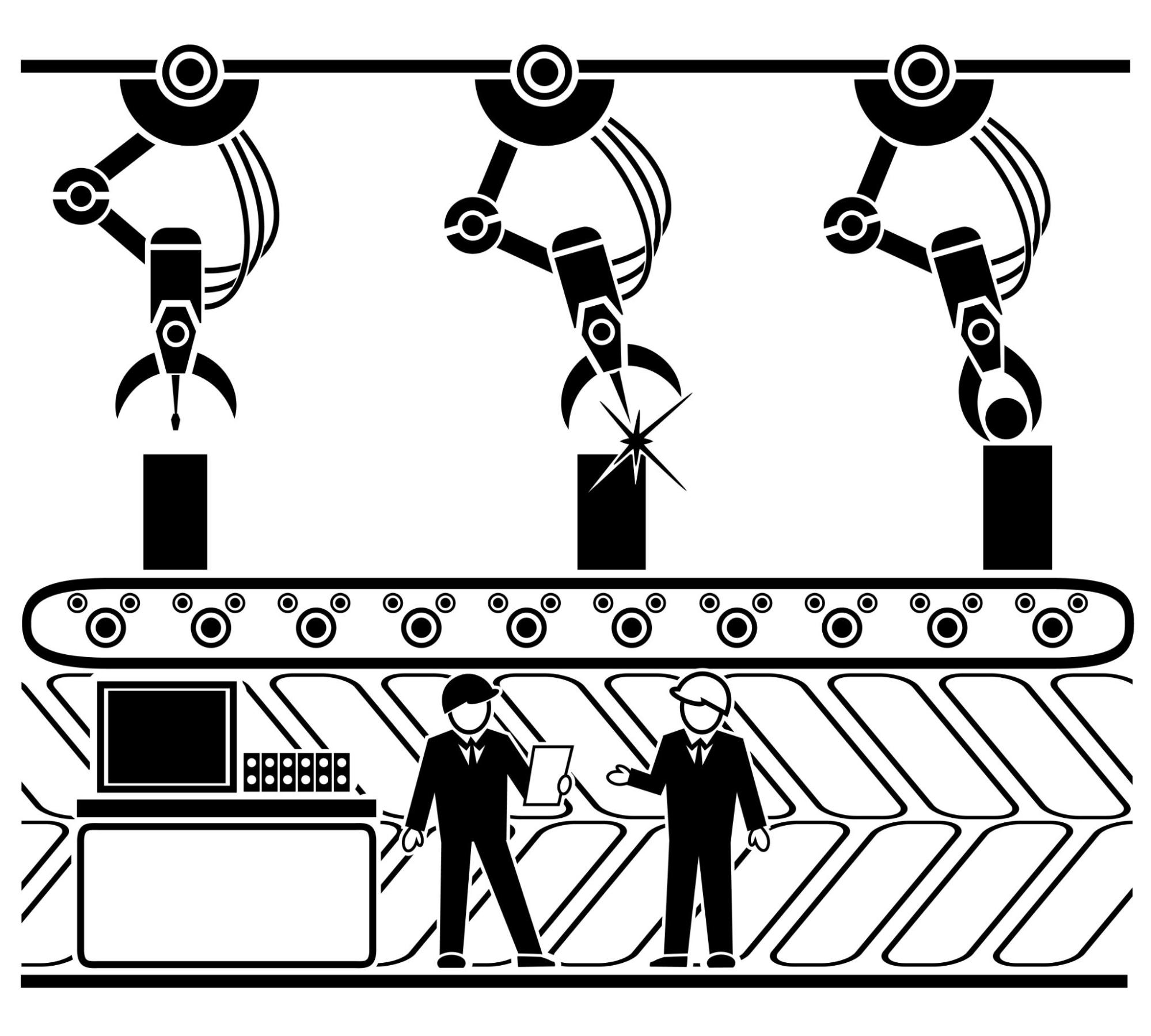
AI transforms manufacturing through predictive maintenance and digital twin technology. A digital twin creates a virtual version of physical systems for real-time simulation and optimization. Equipment failures get predicted before breakdowns occur, reducing downtime and maintenance costs. Business operations benefit from continuous performance improvement.
Retail and Commerce
AI-powered retail platforms enhance customer experience and business efficiency. AI systems analyze customer behavior to deliver personalized products and recommendations. AI-powered virtual assistants and chatbots provide instant customer support. Inventory planning, pricing strategies, and marketing campaigns operate through predictive analytics and automation.
Human Resources
AI technologies automate human resources operations and support objective decision-making. AI systems enable data-based talent acquisition, performance management, and employee retention. Recruitment, onboarding, payroll processing, and benefits administration operate faster and with fewer errors. AI algorithms also reduce bias by evaluating candidates on skills and performance data instead of subjective criteria.
Healthcare
AI has become integral to healthcare delivery. AI systems support clinical decision-making, imaging analysis, and patient monitoring. Predictive analytics improves diagnosis accuracy and treatment planning. AI-powered virtual nursing assistants enhance patient care, while AI-enabled robotics support minimally invasive surgeries. Operational efficiency improves through faster workflows and reduced administrative burden.
Finance
Machine learning development services drive efficiency in financial services. AI algorithms improve forecasting, fraud detection, cybersecurity, risk management, and customer support. Credit scoring, compliance checks, and algorithmic trading operate at scale. Financial institutions achieve cost savings and accuracy by replacing manual processes with AI/ML solutions.
Manufacturing
AI transforms manufacturing through predictive maintenance and digital twin technology. A digital twin creates a virtual version of physical systems for real-time simulation and optimization. Equipment failures get predicted before breakdowns occur, reducing downtime and maintenance costs. Business operations benefit from continuous performance improvement.
Retail and Commerce
AI-powered retail platforms enhance customer experience and business efficiency. AI systems analyze customer behavior to deliver personalized products and recommendations. AI-powered virtual assistants and chatbots provide instant customer support. Inventory planning, pricing strategies, and marketing campaigns operate through predictive analytics and automation.
Using AI Agents for Greater Efficiency
The newest era of AI involves AI assistants and autonomous AI agents.
- AI assistants respond to user input and execute predefined tasks.
- AI agents operate proactively, plan actions, and complete goals independently.
AI agents use generative AI and foundation models to analyze tasks, break them into steps, execute workflows, and deliver outcomes. These systems produce content, optimize campaigns, manage operations, and even support navigation systems in autonomous vehicles.
Example use cases include marketing automation, customer segmentation, A/B testing, and real-time route optimization in logistics and transportation.
The Future of Business Efficiency and AI
Productivity and efficiency depend on intelligent systems and skilled employees. AI improves strategy execution, workflow management, creative processes, health systems, manufacturing, sales, finance, and retail operations. AI systems push organizations forward by improving speed, accuracy, and decision quality.
Employees who adapt to AI-driven workflows unlock new efficiencies across business operations.
AI Offers Value in Four Key Situations
AI delivers the highest impact in environments with high volume, complexity, and repeatable processes.
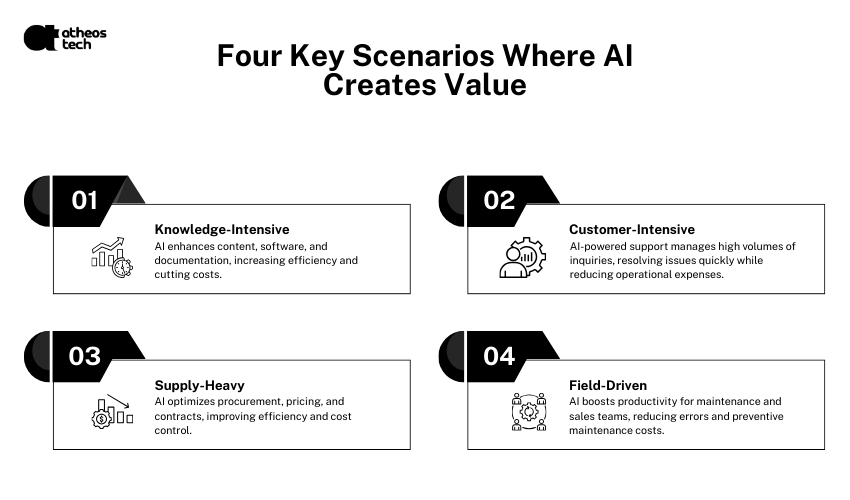
1. Heavy Reliance on Codified Knowledge
Generative AI improves content creation, software development, and documentation. Production efficiency increases dramatically while operational costs decline.
2. High Interaction with Individual Customers
AI-powered customer support handles large volumes of customer inquiries. Chatbots and AI agents categorize and resolve issues instantly, reducing staff workload and operational expenses.
3. Large Supply Bases
AI optimizes procurement, pricing negotiations, and contract analysis. Smart contracts and automated RFPs improve efficiency and cost control.
4. Significant Field Forces
AI systems improve productivity for maintenance and sales teams. Predictive analytics reduces errors and lowers preventive maintenance costs.
AI Offers Value in Four Key Situations
AI delivers the highest impact in environments with high volume, complexity, and repeatable processes.
1. Heavy Reliance on Codified Knowledge
Generative AI improves content creation, software development, and documentation. Production efficiency increases dramatically while operational costs decline.
2. High Interaction with Individual Customers
AI-powered customer support handles large volumes of customer inquiries. Chatbots and AI agents categorize and resolve issues instantly, reducing staff workload and operational expenses.
3. Large Supply Bases
AI optimizes procurement, pricing negotiations, and contract analysis. Smart contracts and automated RFPs improve efficiency and cost control.
4. Significant Field Forces
AI systems improve productivity for maintenance and sales teams. Predictive analytics reduces errors and lowers preventive maintenance costs.
Avoiding Common AI Transformation Pitfalls
Align Technology with Process and Culture
AI success depends on behavioral change, not just algorithms. New workflows, reskilling, and agile learning systems enable effective human–AI collaboration.
Control Cost and Complexity
AI at scale increases technology expenses. Focus on high-impact AI/ML solutions and maintain a manageable application portfolio.
The Impact of AI on Operational Efficiency
AI improves efficiency by:
- Automating repetitive tasks
- Reducing human error
- Enhancing predictive maintenance
- Optimizing supply chains
- Improving customer service
Predictive analytics and AI systems enable real-time optimization of workflows, inventory, and logistics.
The Role of AI in Data Analysis and Insights
AI transforms data into intelligence. AI algorithms detect patterns, trends, and anomalies across massive datasets. Predictive analytics supports demand forecasting, market trend analysis, and operational risk management.
Data-driven decision-making improves accuracy, speed, and strategic clarity.
AI automates scheduling, data entry, reporting, and customer support. Productivity increases through 24/7 system availability. Challenges include workforce transition and infrastructure investment. Long-term value depends on skills development and strategic execution.
AI optimizes demand forecasting, inventory planning, logistics routing, and vendor management. Real-time analytics improve visibility and responsiveness. Transportation efficiency improves through route optimization and delivery monitoring.
The Role of AI in Data Analysis and Insights
AI transforms data into intelligence. AI algorithms detect patterns, trends, and anomalies across massive datasets. Predictive analytics supports demand forecasting, market trend analysis, and operational risk management.
Data-driven decision-making improves accuracy, speed, and strategic clarity.
AI automates scheduling, data entry, reporting, and customer support. Productivity increases through 24/7 system availability. Challenges include workforce transition and infrastructure investment. Long-term value depends on skills development and strategic execution.
AI optimizes demand forecasting, inventory planning, logistics routing, and vendor management. Real-time analytics improve visibility and responsiveness. Transportation efficiency improves through route optimization and delivery monitoring.
Future Trends in AI for Business (Expanded)
The evolution of artificial intelligence is accelerating, and several major trends are defining how AI will improve operational efficiency and cost optimization in the years ahead.

- AI + IoT Integration
- Explainable AI (XAI)
- Human-AI Collaboration
- Generative AI for Content and Design
- AI-Driven Decision Intelligence
AI combined with the Internet of Things creates intelligent, connected environments. IoT devices generate real-time data from machines, vehicles, and facilities. AI systems analyze this data instantly to optimize performance. In factories, AI and IoT improve predictive maintenance, energy management, and production planning. In logistics, connected sensors and AI algorithms enhance route planning and asset tracking. This integration turns physical operations into data-driven, self-optimizing systems.
As AI systems influence more business decisions, transparency becomes essential. Explainable AI ensures that decision-making processes remain understandable and auditable. XAI shows why an AI system reached a specific conclusion. This builds trust with leadership, regulators, and operational teams. In industries such as finance, healthcare, and insurance, explainable AI supports compliance, governance, and ethical use of AI solutions.
The future of work centers on collaboration between people and AI systems. AI handles data processing, pattern detection, and repetitive tasks. Human expertise focuses on strategy, creativity, and judgment. AI-powered copilots support employees with real-time insights, recommendations, and automation. This partnership increases productivity while maintaining human control over critical business decisions.
Generative AI transforms how digital content is created. AI systems produce marketing copy, product descriptions, designs, and code at scale. These tools accelerate innovation and reduce production costs. Generative AI also supports rapid experimentation by creating multiple variations of content for testing and optimization. Businesses gain speed, flexibility, and creative power without increasing operational overhead.
Future AI solutions will focus on decision intelligence, combining analytics, forecasting, and automation into a single operational layer. AI systems will not only provide insights but also recommend actions and execute workflows. This will improve strategic alignment across finance, operations, sales, and customer service.
These trends define the next generation of enterprise AI solutions. Organizations that adopt these capabilities gain faster execution, stronger governance, and sustainable competitive advantage.
Case Studies of Successful AI Implementation (Expanded)
AI solutions are delivering measurable operational efficiency and cost optimization across multiple industries. The following examples show how artificial intelligence improves real-world business performance.

- Healthcare: AI-Powered Clinical Analytics
- Retail: Predictive Analytics for Inventory Optimization
- Transportation: Autonomous and AI-Driven Systems
- Manufacturing: Predictive Maintenance and Process Optimization
- Finance: Fraud Detection and Risk Analytics
Healthcare organizations use AI algorithms to analyze medical images, patient histories, and clinical data. These systems improve diagnosis accuracy by identifying patterns that human review often misses. Predictive analytics also supports early disease detection and treatment planning. AI-powered systems reduce diagnostic errors, shorten analysis time, and improve patient outcomes while lowering operational costs.
Retailers apply AI solutions to demand forecasting and inventory management. Machine learning models analyze historical data, customer behavior, market trends, and external factors. This allows businesses to stock the right products in the right locations at the right time. AI reduces overstocking and stockouts, improves cash flow, and increases customer satisfaction through better product availability.
Transportation companies use AI systems to improve safety and efficiency. Autonomous driving platforms process real-time sensor data to detect obstacles, predict traffic patterns, and optimize routes. AI also supports fleet management by monitoring vehicle health and predicting maintenance needs. These systems reduce accidents, fuel costs, and downtime while increasing delivery reliability.
Manufacturers deploy AI-powered predictive maintenance to monitor equipment performance. Machine learning models analyze sensor data to detect early signs of failure. This prevents unplanned downtime and extends asset lifespan. AI also optimizes production scheduling, quality control, and resource allocation.
Financial institutions use AI systems to detect fraud and assess risk in real time. AI algorithms analyze transaction patterns and identify anomalies instantly. This improves security, reduces false positives, and lowers compliance costs.
Final Perspective
AI solutions redefine operational efficiency and cost optimization. Artificial intelligence automates business processes, improves customer service, reduces operational costs, and creates a lasting competitive advantage. Enterprise success depends on intelligent execution, governance, and continuous improvement, principles reflected in platforms such as AtheosTech.
FAQ's
AI solutions are systems powered by artificial intelligence that analyze data, automate business processes, and improve decision-making. These systems use AI algorithms, machine learning, and predictive analytics to reduce human error, optimize workflows, and improve customer service and operational efficiency.
AI reduces operational costs by automating repetitive tasks, minimizing errors, improving demand forecasting, and optimizing resource allocation. AI systems process large volumes of data in real time, allowing faster decisions and reducing waste across business operations.
Predictive analytics uses historical data and market trends to forecast outcomes such as demand, equipment failures, and customer behavior. This allows businesses to act proactively instead of reactively, reducing downtime, improving inventory planning, and supporting cost savings.
AI-powered systems handle customer inquiries using chatbots and virtual assistants. These tools provide instant responses, smart routing, and personalized support. AI improves response time, consistency, and overall customer experience while lowering support costs.
Processes with high volume, repetition, and data dependency benefit the most. These include document processing, customer support, demand forecasting, predictive maintenance, compliance checks, and workflow management.
FAQ's
AI solutions are systems powered by artificial intelligence that analyze data, automate business processes, and improve decision-making. These systems use AI algorithms, machine learning, and predictive analytics to reduce human error, optimize workflows, and improve customer service and operational efficiency.
AI reduces operational costs by automating repetitive tasks, minimizing errors, improving demand forecasting, and optimizing resource allocation. AI systems process large volumes of data in real time, allowing faster decisions and reducing waste across business operations.
Predictive analytics uses historical data and market trends to forecast outcomes such as demand, equipment failures, and customer behavior. This allows businesses to act proactively instead of reactively, reducing downtime, improving inventory planning, and supporting cost savings.
AI-powered systems handle customer inquiries using chatbots and virtual assistants. These tools provide instant responses, smart routing, and personalized support. AI improves response time, consistency, and overall customer experience while lowering support costs.
Processes with high volume, repetition, and data dependency benefit the most. These include document processing, customer support, demand forecasting, predictive maintenance, compliance checks, and workflow management.