- AtheosTech
Industry 4.0 in Swiss High-Tech Manufacturing: The Complete Guide to Smart Factory Platforms, Supplier Integration, and the Digital Infrastructure Behind Modern Production
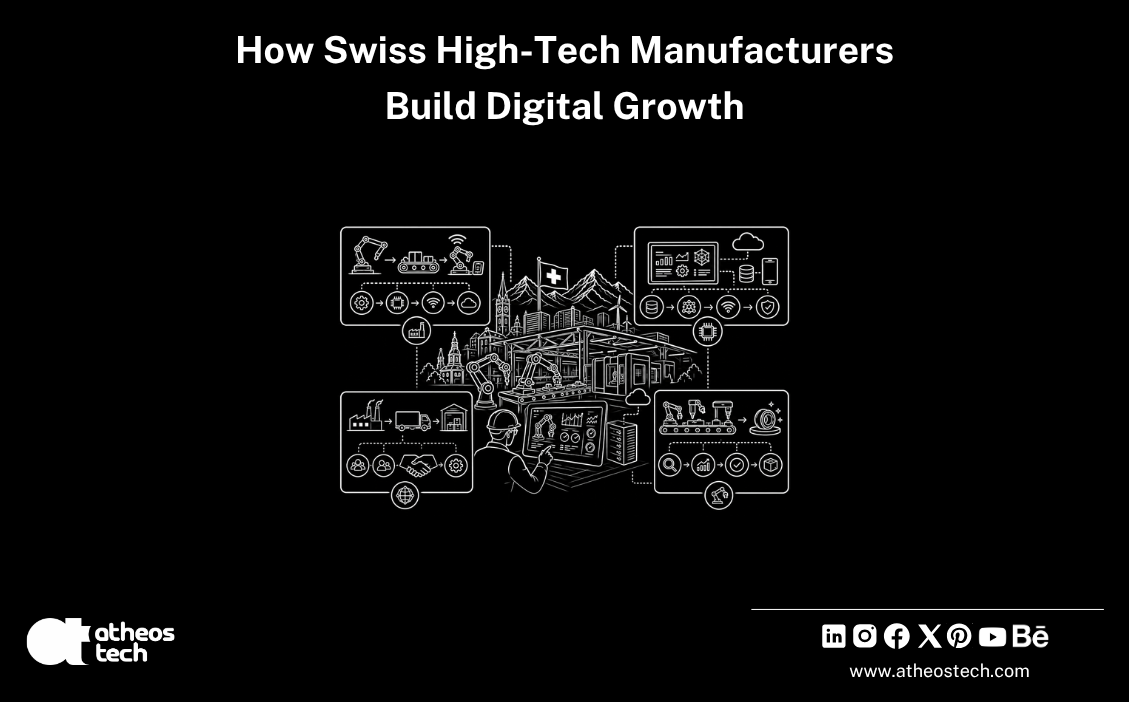
The Swiss manufacturing industry is the global benchmark for Präzision (precision). However, in the age of the fourth industrial revolution, world-class hardware is no longer enough. Many firms in Canton Zürich have run CHF 40M production lines on digital infrastructure from 2009, relying on manual Excel sheets while competitors utilize real-time data. At AtheosTech, we bridge this gap, ensuring your modern production software is as precise as your engineering.
What is Industry 4.0 in Swiss manufacturing?
Industry 4.0 in Swiss manufacturing refers to the integration of IoT sensors, AI-driven analytics, cloud-based MES/ERP platforms, and supplier networks into a connected smart factory ecosystem. Switzerland’s high-tech sectors, watchmaking, medtech, precision engineering, and industrial automation, are increasingly adopting digital infrastructure to compete globally.
At AtheosTech, we help manufacturers bridge this digital divide. From custom software development to high-level IT consulting, we build the infrastructure that ensures your digital ops are as precise as your engineering.
What Makes Swiss High-Tech Manufacturing Different from the Rest of Europe?
While the rest of the continent focuses on mass-market production, the Swiss manufacturing industry thrives on high-complexity, low-volume, and extreme-precision niches. From the Uhrenindustrie (watchmaking) in the Jura Mountains to the life-saving Medtech clusters in Zug and Basel, Switzerland has built a unique identity based on Präzision (precision) and Zuverlässigkeit (reliability).
However, this unique identity creates a specific set of challenges for digital transformation. Unlike the broader European market, Swiss production is dominated by the Mittelstand, highly specialized, family-owned SMEs (KMU) that are global leaders in their physical product but often remain “digital laggards”. These firms are hidden champions that face unique pressures that make smart manufacturing a necessity rather than a choice.
Why is digital transformation a cost-survival tool in Switzerland?
In Switzerland, the strength of the Swiss Franc (CHF) creates a permanent margin squeeze. Unlike manufacturers in lower-cost regions, Swiss firms cannot compete on price. Digital transformation, through real-time data and automated workflows, is the primary tool for margin optimization and efficiency, allowing Swiss firms to remain globally competitive despite high overhead costs.
The Swiss Context: Beyond the Machinery
To understand why a generic Industry 4.0 approach fails here, one must look at the local environment:
- Regulatory & Linguistic Complexity: Despite being in the heart of Europe, Switzerland operates under its own regulatory frameworks (like the nDSG data protection laws). Furthermore, a factory floor in a German-speaking canton operates with a different cultural and linguistic nuance than one in a French-speaking Atelier. A modern production interface that only offers English is often a barrier to adoption for local workers.
- The Prove It Culture: Swiss decision-makers are notoriously skeptical of flashy tech trends. They value long-term stability over rapid, unproven iterations. In the Swiss manufacturing industry, a vendor must provide a Proof of Concept (PoC) and show a direct impact on real-time OEE (Overall Equipment Effectiveness) before a contract is even considered.
- Precision over Speed: While ‘move fast and break things’ works in Silicon Valley, it is a non-starter in a Swiss factory where a 0.001mm deviation is a catastrophe. Any digital manufacturing solution must mirror the meticulous nature of the physical engineering it supports.
At AtheosTech, we don’t just provide software; we understand the Swiss Soul of manufacturing. We recognize that distance is no barrier, but local relevance is non-negotiable. Our teams are structured to deliver solutions that respect these regional differences and linguistic needs.
The Pain Points Swiss Manufacturers Face on the Road to Industry 4.0
Engineering excellence is often sabotaged by digital friction. For many Swiss KMU (SMEs), these nine bottlenecks represent the biggest hurdles to achieving a truly smart factory.
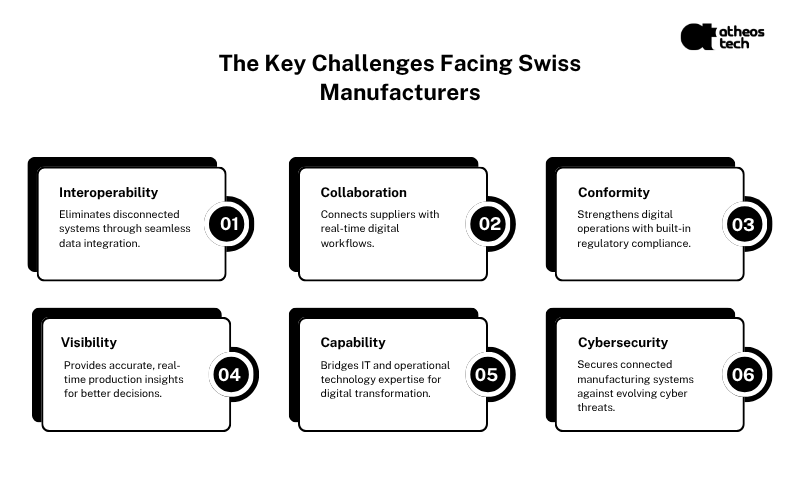
Why are legacy systems creating data silos?
Most firms suffer from islands of automation. When your ERP (SAP, Abacus) has no Schnittstellen (interfaces) with your MES systems or SCADA, data must be re-entered manually. This sunk-cost fallacy, keeping 15-year-old software because it works, actually creates errors and stalls modern production.
Is manual supplier integration your black hole?
In the Swiss manufacturing industry, it’s common to see order confirmations still sent via PDF or fax. Without digital Supply chain Integration, you lack real-time visibility into supplier capacity, making your supply chain fragile and reactive.
How does compliance complexity impact your digital infrastructure?
Whether it’s MDR for Medtech or Swissmedic for Pharma, compliance is a moving target. Swiss manufacturers must navigate both federal frameworks (Swissmedic, nDSG) and EU regulations (GDPR, MDR). A compliance-ready digital infrastructure is not just a feature; it is a mandatory requirement for global market access.
Why is there no "Single Source of Truth"?
Without automated OEE (Overall Equipment Effectiveness) tracking, production data is a "best guess." Decisions are made on stale reports rather than real-time shop-floor reality.
Where is the expertise for IT/OT convergence?
Switzerland has world-class mechanical engineers, but a shortage of professionals who understand both PLC logic and cloud architecture. This skills gap makes digital transformation prohibitively expensive to manage in-house.
Is your factory floor a cybersecurity target?
Connecting CNC machines to the network for smart manufacturing increases your attack surface. Many firms have strong office firewalls but leave their "Operational Technology" (OT) entirely unsecured against rising ransomware threats.
At AtheosTech, we turn these pain points into profit. From IT consulting to custom software, we build the backbone your factory deserves.
The Digital Infrastructure Blueprint for a Swiss Smart Factory
To survive the fourth industrial revolution, Swiss manufacturers need more than just individual tools; they need a cohesive digital infrastructure. We utilize the 360° Digital Infrastructure Stack, a framework specifically designed to align with the precision and compliance requirements of the Schweizer Industrie.
How do you build a solid data foundation on the shop floor?
Modernizing manufacturing processes starts with connectivity. Most Swiss factories have high-value legacy machines that lack modern Internet of Things (IoT) capabilities. We implement IIoT sensor integration to retrofit these assets, using protocols like OPC-UA and MQTT to collect data from PLCs. By utilizing edge computing, we process data locally for real-time speed before it ever hits the cloud.
What is a Smart Factory Platform?
A Smart Factory Platform serves as the “central brain” of your production. It integrates your MES systems (Manufacturing Execution Systems) for real-time control with your ERP (such as Abacus or SAP Business One). This creates a digital twin, a virtual model of your physical production lines, allowing you to simulate changes and optimize performance without downtime.
At AtheosTech, we specialize in custom software development for MES modules and API integrations that bridge the gap between your office and the factory floor.
Why is a Supplier Integration Platform critical for Swiss firms?
Supplier integration is the digital linking of your procurement and quality workflows with your partners’ systems. It replaces manual emails with automated portals and API-first connectivity, providing real-time visibility into Tier 1, 2, and 3 supplier capacity and delivery status.
Through custom web development, we build B2B portals that synchronize inventory and demand signals, ensuring your supply chain is as resilient as your production.
How do you manage Compliance and Quality Management (eQMS)?
For Medtech and Pharma, compliance is a prerequisite for production. A compliance-ready QMS for Swiss manufacturers must include 21 CFR Part 11-aligned electronic records, GDPR-compliant data handling, and Swiss nDSG requirements. This ensures Rückverfolgbarkeit (traceability) for global markets like the EU and the USA.
How can Analytics and AI optimize your manufacturing operations?
We move you from reactive troubleshooting to predictive maintenance. By applying artificial intelligence to machine sensor data, we build dashboards that track OEE in real-time. Furthermore, we implement AI quality inspection using computer vision manufacturing techniques to catch sub-micron defects before products leave the line.
How do you secure OT/IT environments against cyber threats?
Smart manufacturing requires bridging the gap between the office (IT) and the machine (OT). We implement network segmentation to isolate your production floor and deploy SIEM monitoring to detect threats. Our IT consulting ensures your digital infrastructure is “secure by design”.
Why does customer-facing digital infrastructure matter?
Your digital excellence shouldn’t stop at the factory gate. We design B2B customer portals and after-sales platforms using world-class UI/UX design. Whether it’s a product configurator or a warranty management system, we ensure your digital interface matches your physical product’s quality.
Industry 4.0 by Niche: Tailoring Digital Transformation to Swiss Excellence
In the Swiss manufacturing industry, “one-size-fits-all” fails. To succeed, Industry 4.0 technologies must be adapted to your specific business models and regulatory landscape.
Watchmaking & Luxury Goods (Horlogerie)
For Swiss watchmakers, smart manufacturing is about Traçabilité (traceability). We build bespoke manufacturing software for material genealogy and anti-counterfeiting digital passports. Our "Ace of One" approach ensures your system respects the heritage of your Atelier while providing modern data control.
Medtech & Life Sciences
We help Medtech firms navigate strict FDA/MDR validation (IQ/OQ/PQ). From eQMS workflows to clinical traceability, we ensure your digital infrastructure, which may be classified as a Medical Device (SaMD), is compliant and secure.
Precision Engineering & Industrial Automation
For firms focused on Hochpräzision (high precision), we integrate CAD/CAM systems with real-time scheduling. We implement industrial dashboard UX to manage sub-micron quality data and tooling lifecycles, ensuring peak efficiency.
Pharma & Chemical Manufacturing
Modern pharma relies on Electronic Batch Records (EBR) and GxP-compliant cloud computing. We develop systems for serialization and track-and-trace (EU Falsified Medicines Directive) while integrating environmental monitoring directly into your MES systems.
Food Technology & Agri-Processing
In the "Nestlé ecosystem", we digitize HACCP workflows and cold chain monitoring. Our solutions focus on ingredient traceability and automated certification management (IFS, BRC) to ensure total food safety.
Navigating Swiss and EU Compliance in an Industry 4.0 Environment
In the Swiss manufacturing industry, compliance is the foundation of Zuverlässigkeit (reliability). As you adopt Industry 4.0 technologies, your digital infrastructure must be architected to meet strict legal standards.
What compliance frameworks apply to Swiss manufacturers adopting Industry 4.0 technology?
Swiss manufacturers must adhere to a "double-layer" of regulation: the Swiss Data Protection Act (nDSG) and federal mandates like Swissmedic, alongside EU regulations like GDPR, MDR, and the new EU AI Act. Success requires a digital infrastructure that automates audit trails and ensures data sovereignty.
Critical Regulatory Landscapes
Beyond mindset, medtech companies face significant operational hurdles that slow down digital transformation:
- Swiss-Specific: The nDSG (new Swiss Data Protection Act), effective September 2023, requires strict handling of all personal data within smart factory systems. Furthermore, Swissmedic demands rigorous validation for any software used in modern production for pharma or medtech.
- EU & Global: Exporters must remain GDPR compliant. High-risk artificial intelligence tools (e.g., automated quality decisions) now fall under the EU AI Act, while Medtech firms must navigate the complex EU MDR requirements to maintain market access.
- Standards: Global competitiveness requires adherence to ISO 9001/13485, ISO 27001 for cybersecurity, and IATF 16949 for the automotive supply chain.
AtheosTech: Compliance by Design
ompliance shouldn't be a "bolt-on". At AtheosTech, we integrate nDSG requirements and GxP standards into the core of your custom software. Through our IT consulting, we ensure your digital transformation includes local data residency, automated audit trails, and role-based security.
Why Generic "Industry 4.0 Platforms" Are Failing Swiss Manufacturers
The market is currently flooded with “clones”, massive, one-size-fits-all Industry 4.0 platforms designed for generic mass production. While these tools are powerful, they often fail the Swiss manufacturing industry because they lack the flexibility required for high-precision, low-volume, and compliance-heavy niches.
The Clone List: Common Tools and Their Limitations
Many Swiss firms are sold on global platforms that promise a total digital transformation out of the box. Common examples include:
- Siemens MindSphere / Insights Hub: Often too complex for mid-sized Swiss KMU.
- SAP S/4HANA Manufacturing: Requires massive, expensive consulting teams to maintain.
- PTC ThingWorx: Can become a “black box” that is difficult to customize for niche needs.
- Rockwell FactoryTalk: Built for high-volume discrete manufacturing, not bespoke Swiss artisan craft.
- GE Digital (iFIX): Often feels like a 20th-century tool trying to fit into a 21st-century smart factory.
The problem? These platforms are clones, repackaged solutions that force your factory to adapt to the software, rather than the software adapting to your manufacturing processes.
How AtheosTech Bridges the Gap
We don’t just sell you a license; we build your digital infrastructure. We recognize that a watchmaker in Neuchâtel needs a different solution than a medtech firm in Zug.
Where generic platforms fail, AtheosTech delivers:
- Bridging the Legacy Gap: We don’t replace your existing MES systems or ERP; we build custom APIs and middleware to connect them, ensuring a “Single Source of Truth”.
- Local Compliance Mastery: Generic tools don’t understand the nDSG (Swiss Data Protection Act) or Swissmedic requirements. We build compliance into the architecture from day one.
- The Ace of One Approach: We provide a dedicated team that speaks your language (German, French, Italian) and understands your specific industrial culture.
By acting as a 360° digital consultancy, we ensure your modern production software is as precise and reliable as the hardware it controls. We don’t offer generic clones; we offer the “one right answer” for your business.
Why Local Language and "Native Feel" Are Essential for Swiss Manufacturing
In the Swiss manufacturing industry, “English-only” software is an operational risk. While English is the language of global tech, it is rarely the language of the shop floor. For a smart factory to function with Zuverlässigkeit (reliability), the digital infrastructure must speak the language of its people.
The Linguistic Reality of the Shop Floor
Switzerland’s strength lies in its linguistic diversity. A worker in a Canton Zürich facility speaks Schweizerdeutsch (Swiss-German), while an Atelier in Geneva operates in French. If a quality control operator is forced to enter data into MES systems in a second language, errors are inevitable. Localization is not a “feature”; it is a safeguard against production defects.
What is Native Feel in Swiss manufacturing software?
Native Feel goes beyond translation. It means localizing the digital manufacturing experience to include Swiss date formats (DD.MM.YYYY), CHF currency integration, and legal terminology aligned with Swiss law (nDSG). It ensures that UI labels, error messages, and training materials resonate with the local workforce culture, reducing the “friction of adoption”.
AtheosTech’s Regional Approach: Local Relevance is Non-Negotiable
We don’t treat localization as an afterthought. Our dedicated European regional teams ensure your manufacturing software respects the local context:
Linguistic Precision:
Swiss-German, French, and Italian UI localizations are the default.
Data Sovereignty:
We offer Switzerland-based cloud computing to ensure your data stays within our borders.
Cultural Context:
We understand the unique procurement cycles and business registration requirements across different Cantons.
By delivering a “Native Feel,” we ensure your modern production data is entered accurately in real-time, driving higher ROI on your digital transformation.
Understanding the Swiss Manufacturing Mindset: The Psychology of Digital Adoption
Successful digital transformation in the Swiss manufacturing industry is a human challenge as much as a technical one. To implement smart manufacturing effectively, you must align with the “Swiss DNA” of Präzision (precision) and long-term stability.
Precision Over Speed (Gründlichkeit):
Swiss firms don't "move fast and break things." They move deliberately. In modern production, a software glitch is as costly as a machine failure. AtheosTech honors this by avoiding rushed roadmaps; we prioritize rigorous testing and phased rollouts to ensure your digital infrastructure is as reliable as your physical engineering.
The Prove It Culture:
Swiss leaders value Beweise (evidence) over sales decks. They expect a Proof of Concept (PoC) and verified references before committing. While procurement takes longer, once trust is earned, it lasts for decades.
Partner, Not Vendor:
The Swiss Mittelstand (SME sector) doesn't want a "contractor", they want a partner who understands their manufacturing processes like a colleague. Our philosophy at AtheosTech is built on these long-term, trust-based relationships.
The Fear of Stillstand (Disruption):
With downtime costing up to CHF 50,000 per hour, any Industry 4.0 transition must have an airtight risk mitigation plan. We ensure real-time stability through parallel migrations and rollback protocols.
Language & Cantonal Pride:
English-only software shows a lack of respect for local identity. Whether it’s a German-speaking shop floor in Zürich or a French-speaking Atelier in the Jura, localization is a sign of respect, not just a feature.
CONCLUSION
The Swiss manufacturing industry has set the global standard for Präzision (precision), quality, and Zuverlässigkeit (reliability) for over a century. In the era of the fourth industrial revolution, your digital infrastructure should reflect those same standards.
At AtheosTech, we reject generic clones. We build bespoke smart factory solutions tailored to your unique production, nDSG/Swissmedic compliance, and 10-year vision. No rigid templates, just software that works for you.
The AtheosTech Trust Signals:
- 360° Digital Consultancy: From strategy to delivery, we handle the entire lifecycle.
- No Third-Party Vendors: One integrated team, zero “broken telephone” communication.
- Security First: Signed NDA from day one; all intellectual property and technical architecture are fully protected.
- Local Language Delivery: Native-level support in German, French, and Italian.
- Flexible Engagement: Whether you need a 2-week systems audit or a long-term dedicated development team.
Don’t let your software hold your machines back.
FAQs
FAQs
Industry 4.0 refers to the integration of digital technologies, such as the internet of things (IoT), AI, and cloud computing, into the production process. In Switzerland, this means connecting high-precision machinery, supply chain partners, and compliance systems into a unified digital infrastructure to ensure Schweizer Qualität (Swiss quality) in a global market.
The main hurdles include integrating legacy MES systems, managing complex compliance (such as nDSG and Swissmedic), and overcoming the skills gap in IT/OT convergence. Additionally, many firms struggle with "English-only" software that doesn't fit the linguistic diversity of the Swiss shop floor.
Swiss manufacturers must adhere to the nDSG (Swiss Data Protection Act), and exporters must comply with EU GDPR. Specific sectors also require Swissmedic validation, EU MDR (Medtech), and ISO 9001/13485 standards. Any manufacturing software must be built with automated audit trails to remain compliant.
A phased approach is most effective. Typically, an engagement starts with a 2–4 week discovery and systems audit. Modular delivery of specific tools (like a supplier portal) takes 3–5 months, while a full-scale MES systems integration can take 9–18 months, depending on the complexity of your manufacturing processes.
Off-the-shelf platforms like SAP or Siemens work for generic needs but often require expensive customization for Swiss niches. Custom-built solutions typically offer better ROI, as they are designed around your existing digital infrastructure and specific compliance needs without the "feature bloat" of generic clones.