- AtheosTech
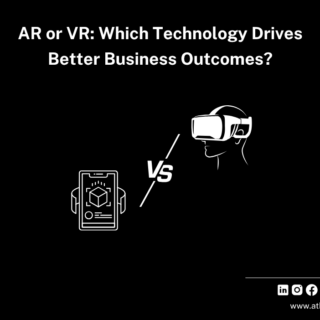
AR vs. VR for Business: Which Immersive Weapon is Right for Your Mission?
Beyond the Headset: Mastering Augmented and Virtual Reality to Optimize Enterprise Workflows and Human Performance.
As a strategist who has sat across from enough CMOs to know that “cool” doesn’t pay the bills, I’ve seen a recurring pattern in the US enterprise landscape. A founder sees a competitor launch a sleek Virtual Reality training module or an Augmented Reality retail filter and immediately wants “one of those.”
But here’s the reality: in 2026, the novelty of immersive technology has worn off. We are no longer in the “wow” phase; we are in the “ROI or bust” phase. Virtual reality experiences are everywhere, but only the strategic ones generate revenue.
I recently spoke with a logistics lead at a Fortune 500 firm who spent mid-six figures on VR headsets for warehouse training, only to find that the “play area” requirements and the time it took to calibrate the sensors actually slowed their onboarding by 15%. They chose a nuclear option for a tactical problem. What they actually needed was a hands-free AR overlay for real-time picking.
They bought a cinema when they needed a flashlight.
Choosing between VR vs AR is not just a tech decision; it is a mission-critical strategic choice. At AtheosTech, a premier VR development company, we don’t start with the headset; we start with the bottleneck. Whether you’re looking to slash training costs, decrease equipment downtime, or skyrocket your conversion rates, you need to compare AR and VR to understand which “immersive weapon” is right for your specific mission.
The Arsenal Defined: AR, VR, and the XR Tech Landscape
To lead in this space, we have to cut through the jargon. All of these technologies offer what we call extended reality (XR). But they operate on fundamentally different psychological and physical planes.
Augmented Reality (AR): The Efficiency Layer
Augmented Reality (AR) keeps you grounded in the physical world. It uses AR glasses, smartphones, or tablets to project 3D models and data directly onto your real-world environment.
- The Strategic Intent: Enhancement.
- The UX: AR enhances the user’s current reality by overlaying digital content, like a “heads-up display” for a fighter pilot or a “virtual try-on” for a luxury watch.
Virtual Reality (VR): The Simulation Engine
Virtual Reality (VR) is total immersion. When wearing VR headsets, the user’s field of view is completely replaced by a computer-generated virtual environment.
- The Strategic Intent: Transformation.
- The UX: It transports the user to a place that is too dangerous, too expensive, or physically impossible to visit in real life. A high-quality virtual reality experience can make users forget their physical surroundings entirely.
Why Most Businesses Fail: The "Off-the-Shelf" Trap
In the USA market, many founders fall for the “Off-the-Shelf” trap. They purchase a generic virtual reality (VR) training suite because it’s cheaper up front. But within six months, they hit a “Scalability Ceiling.”
Generic tools aren’t built for your unique data flows or your specific brand voice. They don’t integrate with your CRM, and they certainly don’t optimize for SXO (Search Experience Optimization). When you use a cookie-cutter solution, you aren’t building an asset; you’re renting a handicap.
We focus on custom immersive technology because custom tech is the only way to own your data sovereignty and ensure your xr technology actually converts traffic into revenue.
Our Insight: If your Virtual Reality Technology doesn’t talk to your sales database, you don’t have a solution; you have a toy.
“Your mission deserves the right weapon to build the future of your enterprise.”
Where Strategy Meets Psychology: The Physics of "Presence"
Why does a VR simulation stick in the brain while a safety video is forgotten by lunch? It’s the difference between watching and doing. It is the core of what makes Virtual Reality Solutions so potent.
- Muscle Memory in VR: When an employee practices a high-stakes repair in a virtual environment, the brain’s motor cortex fires as if it’s happening in real time. This builds “presence”, the psychological state where the user forgets they are in a simulation.
- Contextual Intelligence in AR: AR wins by reducing “cognitive load.” Instead of a technician looking at a manual, then back at the machine (a process that loses 20% of information in the “eye-hop”), augmented reality puts the instruction exactly where the hand is moving in the real world.
Real Business Scenarios: Mission-Specific Deployments
To help you identify your own “best fit,” let’s look at two real-life tactical shifts we’ve seen recently.
Scenario 1: The "Zero-Error" Manufacturing Floor (AR Mission)
A US aerospace firm was seeing a 4% error rate in complex wiring assemblies.
- The Mistake: They tried to “video train” their way out of it. It didn’t work.
- The AtheosTech Move: We deployed AR glasses that recognized the specific part the worker was holding and projected a green “pathway” for the wire in real time.
- The Result: Errors dropped to near-zero. AR and VR were both considered, but AR won because the worker needed their hands free and their eyes on the physical world.
Scenario 2: The "High-Stakes" Leadership Training (VR Mission)
A financial firm needed its managers to handle difficult, emotionally charged HR terminations.
- The Mistake: Role-playing with colleagues felt “silly” and lacked stakes.
- The AtheosTech Move: We created virtual reality solutions with AI-powered avatars that responded to tone, eye contact, and word choice within immersive virtual environments.
- The Result: Managers reported a 60% increase in confidence. Virtual reality vr was the only way to create the “social pressure” required for the training to be effective.
The AtheosTech Framework: Engineering Growth
We don’t just “build apps.” We engineer a 4-layer strategic framework to ensure your immersive experiences aren’t just seen; they are indexed and valued by the market.
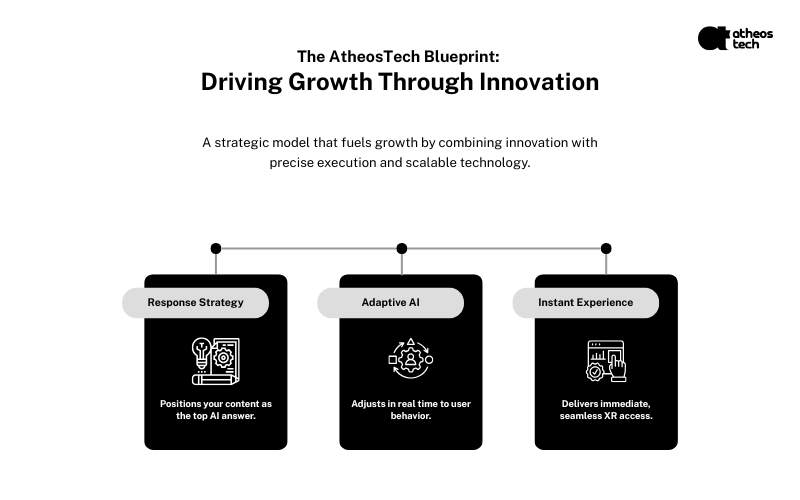
AEO & GEO (Answer & Generative Engine Optimization):
We structure your 3D assets so that AI models (like Google’s SGE or OpenAI’s Search) can "see" and recommend your virtual showrooms as the definitive answer for users.
AIO (AI Optimization):
We use AI to make your virtual environments adaptive. If a trainee is struggling, the simulation gets easier in real time. When a customer browses, AR highlights products they’ve previously liked.
SXO (Search Experience Optimization):
We ensure the "web-to-XR" transition is seamless. We prioritize WebAR for instant, friction-free conversion, ensuring your virtual reality experience starts the moment a user clicks.
AEO & GEO (Answer & Generative Engine Optimization):
We structure your 3D assets so that AI models (like Google’s SGE or OpenAI’s Search) can "see" and recommend your virtual showrooms as the definitive answer for users.
AIO (AI Optimization):
We use AI to make your virtual environments adaptive. If a trainee is struggling, the simulation gets easier in real time. When a customer browses, AR highlights products they’ve previously liked.
SXO (Search Experience Optimization):
We ensure the "web-to-XR" transition is seamless. We prioritize WebAR for instant, friction-free conversion, ensuring your virtual reality experience starts the moment a user clicks.
Conversion Architecture: The ROI of the 3rd Dimension
In 2026, the real value of xr tech is data. In a traditional 2D website, you know where a user clicked. With what we build, you know where they looked, what they hesitated over, and how they moved within the virtual environments.
This is Conversion Architecture. We turn that behavioral data into a feedback loop for your sales team.
- AR enhances the retail funnel by reducing “buyer’s remorse.” Snap reports that AR try-ons increase buying confidence by up to 80%.
- VR applications in B2B sales allow you to bring a “digital twin” of a 10-ton piece of machinery to a trade show on a single headset, offering high-impact immersive experiences anywhere in the world.
ROI-Driven Close: Don't Let Your Competition Define Reality
As a founder or CMO, your job is to future-proof your growth. The shift to immersive technology is no longer a “maybe.” With North America leading the world in XR technology adoption, your customers are already expecting these experiences.
The question is: Will you give them a generic, low-res gimmick, or a premium, custom-engineered asset that speaks to the authority of your brand?
At AtheosTech, we don’t just understand the code; we understand the commerce. We build virtual reality solutions and augmented reality tools that don’t just look like the future, they pay for it.
FAQ's
FAQ's
Generally, AR is more accessible because it can run on existing hardware like smartphones. However, VR often provides a higher ROI for long-term training because it slashes the time to competency by up to 75%.
Security is non-negotiable. Unlike off-the-shelf platforms that may sell your behavioral data, AtheosTech custom builds ensure you have full data sovereignty. We implement "Zero Trust Architecture" within every virtual environment.
In 2026, the adoption of "Smart Glasses" is surging. However, we always recommend a "Hybrid Approach", building experiences that work on both AR glasses and standard mobile devices to ensure maximum reach.
Yes. By using AEO and SXO strategies, we help your 3D content rank in AI-driven search engines. This puts your brand in front of users the moment they ask for an immersive solution.
A high-impact, custom AtheosTech build typically takes 3 to 6 months. This includes the strategic discovery phase, custom 3d model creation, and full integration with your existing business logic.