- AtheosTech
The Digital Aannemer: How Dutch General Contractors Are Using Client Portals, BIM Collaboration, and Online Visibility to Win More Tenders
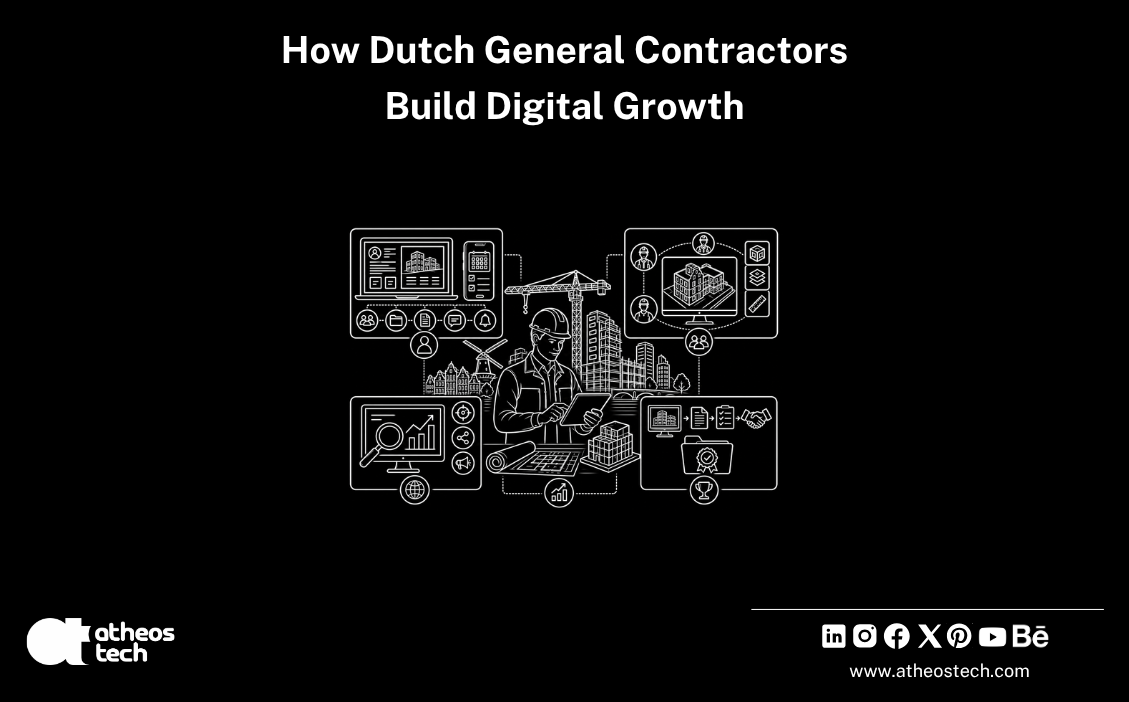
The Digital Aannemer is no longer a buzzword in Dutch construction circles, it is becoming the baseline expectation of every opdrachtgever, gemeente, and aanbestedende dienst evaluating a bid. Dutch general contractors have historically competed on price, craftsmanship, and reputation built over decades. That competitive formula still matters, but it is no longer sufficient on its own.
Today, BIM samenwerking, transparent client portals, and strong online visibility are quietly deciding who gets shortlisted for a tender and who gets passed over before the gunning phase even begins. This shift is not theoretical. With more than half of Dutch construction firms already using Building Information Modeling on live projects, and with the Wet kwaliteitsborging voor het bouwen (Wkb) placing new documentation and accountability burdens on aannemers, digital maturity has become a genuine differentiator in a tender-driven market.
This blog unpacks why Dutch general contractors are undergoing this digital transformation, digitizing client relationships, collaboration workflows, and their public-facing presence, and building genuine digitale infrastructuur behind the scenes. As a 360° digital consultancy and IT solutions partner, AtheosTech helps construction businesses in the Netherlands design the right digital solution and IT solution to build this digital foundation and win more work.
The Dutch Construction Sector at a Digital Crossroads
The Netherlands construction market is large, mature, and under real structural pressure at the same time. A few data points frame why digitization has moved from “nice to have” to “necessary”:
- The Dutch construction market was valued at roughly USD 108.7 billion in 2025 and is projected to keep growing steadily through 2035, driven by major infrastructure and housing programs.
- BIM adoption reached approximately 58% of Dutch construction firms by 2023, one of the highest rates in Europe, while cloud-based project management tools sit at closer to 19% adoption, showing a gap between design-stage digitization and day-to-day project collaboration.
- Labor costs have risen steadily year over year, while tender prices have shown only modest growth, squeezing margins and making efficient, low-rework project delivery essential.
- A chronic housing shortage continues to push demand for faster, more predictable delivery timelines, particularly in prefabricated and modular construction, where digital coordination is not optional. (Source)
This combination, high BIM maturity in design paired with lower adoption of collaborative digital tools further down the supply chain, is exactly the gap where general contractors either fall behind or pull ahead. Firms that connect design-stage BIM data with client-facing communication and back-office reporting are the ones positioning themselves as the modern “digital aannemer” that public and private opdrachtgevers now actively look for.
Pain Points Dutch General Contractors Face Today
Before recommending any solution, it is worth being specific about what is actually breaking down inside Dutch aannemersbedrijven day to day. Based on industry patterns across the sector, the recurring friction points are:
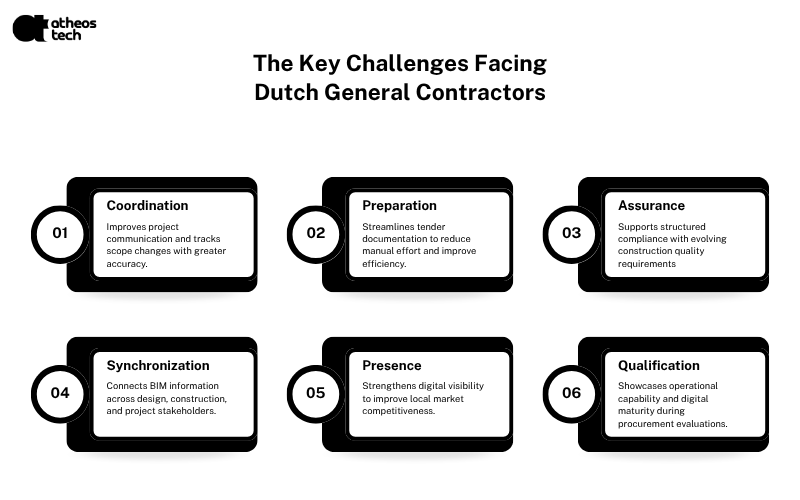
Fragmented client communication. Meer- en minderwerk (scope changes) are still tracked via email and WhatsApp for many mid-sized contractors, leading to disputes at oplevering (handover) over what was agreed and when.
Manual, repetitive tender preparation. Every aanbesteding through TenderNed requires proposal documents, EMVI (Economisch Meest Voordelige Inschrijving) narratives, and compliance declarations rebuilt largely from scratch, consuming valuable business development time.
New documentation obligations under the Wkb. Since the Wet kwaliteitsborging voor het bouwen took effect on 1 January 2024, aannemers working on gevolgklasse 1 buildings must maintain a complete opleverdossier and demonstrate compliance to an independent kwaliteitsborger (Independent quality assurer), extending liability even for defects discovered after handover.
Disconnected BIM data. Design-stage BIM models are often locked inside specialist software, disconnected from what site teams, subcontractors, and clients actually see day to day.
Weak digital visibility relative to company size. Many established regional aannemers still rank poorly on local search, lack a managed Google Bedrijfsprofiel, or have thin case-study content, even though they may have decades of delivery experience.
Difficulty proving track record during gunning. Procurement scoring increasingly rewards demonstrable digital process maturity (data security, BIM protocols, quality documentation), which is hard to convey through a static PDF portfolio.
Each of these pain points has a digital fix, and most of them intersect. A contractor solving client communication with a portal is also, indirectly, building the documentation trail the Wkb requires.
There is also a capacity dimension worth noting. Site managers are already stretched across multiple projects, and every hour spent chasing scope-change confirmations or reformatting tender proposals is an hour not spent managing the build. Digitizing these administrative layers frees up experienced people to focus on delivery and client relationships, which is what wins repeat business in Dutch construction.
Further Reading
For a deeper look at how the broader Dutch construction sector is preparing for compliance-driven, AI-influenced procurement, read our related article:
BIM Collaboration: From Design Silos to Shared Digital Models
BIM adoption in the Netherlands wasn’t accidental. Public clients such as Rijkswaterstaat and the Rijksvastgoedbedrijf drove it, prescribing BIM for major projects and shaping open standards such as CB-NL. The Netherlands now ranks among Europe’s most BIM-mature countries, valued for better collaboration, efficient planning, and fewer costly on-site clashes.
That said, BIM maturity is not evenly distributed. Studies of the sector consistently find that clients and suppliers score lowest on BIM maturity. In contrast, consultancy, engineering firms, and contractors score highest, meaning the contractor is often the party expected to bridge the gap between a sophisticated design model and a client who has never opened Revit or Navisworks in their life.
What this means practically for general contractors:
- Adopting or aligning with ISO 19650 and open BIM/IFC data exchange standards is increasingly expected on public tenders, not just appreciated.
- BIM’s biggest measurable benefits, according to Dutch contractors and installers themselves, are improved external collaboration, more efficient construction sequencing, and a better end result for the client, all of which are commercially persuasive points in a tender submission.
- The construction sector still lacks universal legal mandates for BIM in the Netherlands, so contractual agreements around model ownership, IP, and liability (particularly under Dutch Copyright Act provisions) must be handled deliberately rather than assumed.
How AtheosTech supports this: we build custom dashboards and lightweight web or mobile interfaces that pull structured data out of BIM models and present it to non-technical stakeholders, site supervisors, subcontractors, and clients, without requiring them to own specialist BIM licenses. This is achieved through custom API integration with a contractor’s existing BIM authoring tools, connecting model data to portals, ERP, and CRM systems rather than leaving it locked away. We also develop custom integrations similar to established platforms like Autodesk Construction Cloud or BIM 360 workflows, tailored to a contractor’s existing toolchain rather than locking them into a single vendor ecosystem.
BIM data only helps if it reaches the people using it. A perfect 3D model still causes rework if the ploegleider (Site foreman) is working from an outdated 2D drawing. Real digital maturity means getting that data to the werf (Construction site) in a usable form, simplified for a foreman, full detail for a design coordinator.
Client Portals: Rebuilding Trust with Opdrachtgevers (Client)
If BIM collaboration solves the technical coordination problem, the klantportaal (client portal) solves the trust and communication problem, and for general contractors, trust is the entire business.
A secure, branded client portal typically gives an opdrachtgever:
- Real-time visibility into project status, planning, and milestones
- A single source of truth for drawings, permits, and technical documentation
- A structured way to review and approve meer- en minderwerk instead of relying on scattered email threads
- Direct access to invoices, payment schedules, and the escrow-related 5% regeling relevant under Dutch contracting norms
- A digital paper trail that doubles as Wkb-compliant documentation
This matters because under the Wkb, aannemers must hand over a complete opleverdossier at completion and stay liable for defects found even after delivery. A client portal that logs decisions, approvals, and change requests becomes that evidentiary record, cutting admin overhead and reducing disputes at oplevering.
Niche-specific portal features worth prioritizing:
- Document vaults with version control for tekeningen (drawings) and vergunningen (permits)
- Digital sign-off workflows for scope changes, tied to the aanneemsom (contract sum)
- Mobile-first access, since clients and site managers rarely review documents from a desktop
- API integration with ERP/CRM systems already used by the aannemer’s back office
How AtheosTech supports this: we design and build custom klantportalen for aannemers and bouwbedrijven, similar in spirit to the extranet-style portals offered by specialist Dutch digital agencies, but built around the specific data flows of a construction business: planning, meer-/minderwerk, opleverdossiers, and subcontractor coordination, integrated with the contractor’s existing CRM, ERP, or project management software.
A client portal doesn’t need every feature at launch. Most contractors see the fastest return by starting with one high-friction workflow, usually meer-/minderwerk approval or document sharing, then expanding once clients are comfortable. This phased approach also avoids overwhelming site staff with a whole new system overnight.
Winning Tenders in a Digital-First Aanbesteding Landscape
Dutch public procurement is one of the most digitized systems in Europe, and that digitization is not a side detail; it is the primary channel through which most aannemers now access public and utility-sector work.
Some key facts about the current landscape:
- TenderNed is the mandatory electronic procurement platform for Dutch public tenders above the national advertising threshold, and it is used for a large share of below-threshold opportunities too. It provides end-to-end functionality: notice publication, document distribution, the nota van inlichtingen (Q&A process), digital bid submission, and award publication.
- The Netherlands spends tens of billions of euros annually through public procurement, and the Aanbestedingswet 2012 (Public Procurement Act) governs how national government, municipalities, provinces, and water authorities must tender works, services, and supplies.
- Electronic submission has been mandatory since 1 July 2017, and digital bids are stored in an encrypted digital kluis (vault) that requires two authorized individuals to open simultaneously, underscoring how seriously data integrity is treated in Dutch procurement.
- The Gids Proportionaliteit (Proportionality Guide) is designed to keep tender requirements proportionate to contract size, which structurally favors well-prepared SMEs over larger firms that simply have more submission volume.
- Bidders need eHerkenning (a paid, verified digital identity credential) to register and submit through TenderNed, an often-overlooked administrative step that can delay a first-time bidder’s participation. (Source)
For a general contractor, winning a gunning decision often comes down to how organized the submission is. EMVI scoring rewards demonstrable quality and risk management, where strong digital documentation gives a clear edge over scattered, last-minute submissions.
How AtheosTech supports this: we build custom tools that help contractors manage recurring tender documentation, structure EMVI narrative content, and maintain a reusable digital library of certifications, case studies, and compliance evidence, reducing the time BD teams spend rebuilding submissions from zero for every aanbesteding.
Compliance as a Competitive Edge: Wkb, AVG, and ISO 19650
Compliance in Dutch construction is not just a legal obligation; it is increasingly a selling point contractors can lead within a tender or client pitch. Three frameworks matter most right now:
Wet kwaliteitsborging voor het bouwen (Wkb): in force since 1 January 2024 for gevolgklasse 1 buildings (simple new-build structures like single-family homes and small business premises), the Wkb shifts technical quality checks from the gemeente to an independent kwaliteitsborger and significantly raises contractor liability, including a requirement to disclose insurance coverage and hand over a complete opleverdossier at delivery. (Source)
AVG (GDPR): client portals, CRM systems, and digital tender submissions all process personal and commercially sensitive data, meaning secure hosting, access controls, and data handling practices are not optional extras.
ISO 19650 / open BIM standards: increasingly referenced in Dutch public tenders and central government BIM standards (such as those maintained by the Rijksvastgoedbedrijf), even though BIM itself is not yet a blanket legal mandate in the Netherlands.
AtheosTech builds every client portal, BIM integration, and tender-support tool with these frameworks in mind from the start, meaning our solutions for Dutch general contractors are always AVG-compliant, Wkb-documentation-ready, and structured to align with ISO 19650 data exchange principles where BIM is involved.
Niche & Business Models Within Dutch General Contracting
“General contractor” covers a wide spread of business models in the Netherlands, and each niche has slightly different digital priorities:
Woningbouw (residential new-build):
high exposure to Wkb gevolgklasse (Consequence class) 1 rules; client portals are especially valuable here because individual homeowners expect consumer-grade digital experiences.
Utiliteitsbouw (commercial/institutional building):
larger, longer projects where BIM collaboration and multi-stakeholder document control matter most.
Renovatie en verduurzaming (renovation and sustainability retrofits):
a fast-growing niche tied to national energy-efficiency targets, where transparent client communication about phased works and subsidies is a major trust factor.
Infrastructuur (civil/infrastructure contracting):
dominated by large public tenders through TenderNed and Rijkswaterstaat frameworks, where digital tender readiness is close to mandatory.
Bouwteam and turnkey models:
collaborative early-contractor-involvement models are gaining traction as an alternative to traditional design-bid-build, requiring even tighter digital collaboration between architect, contractor, and client from day one.
Revenue models vary accordingly, from fixed-price aanneemsom contracts typical in woningbouw, to milestone-based billing on larger utiliteitsbouw and infra projects, to bouwteam (Early-contractor-involvement project team model) arrangements where the contractor is paid partly for early-stage design collaboration. Digital tooling needs to flex with these models rather than assume a one-size-fits-all project structure.
This niche distinction shapes where to invest first. A woningbouw specialist gets faster returns from a polished client portal, since homeowners judge the experience partly on how well they’re kept informed. An infrastructure contractor bidding through TenderNed gets more from tender-readiness tooling and BIM/ISO 19650 alignment, since their real “client” is a procurement evaluator. Knowing which niche a business sits in should guide that priority.
Ready to make your business easier to find, trust, and hire?
Online Visibility: Why Aannemers Can No Longer Rely on Word-of-Mouth Alone
Reputation has always mattered in Dutch construction, but reputation used to travel through personal networks and repeat clients. Today, it travels through search engines first.
Key visibility factors that matter specifically for aannemers:
Digital marketing for a general contractor is not about running generic ad campaigns; it is about being findable, credible, and well-documented at the exact moment a homeowner, project developer, or aanbestedende dienst (contracting authority) is evaluating options. A contractor with strong online visibility converts more inbound leads without discounting price and builds the kind of public digital footprint that quietly reinforces trust during a formal tender evaluation.
AtheosTech’s digital marketing services for Dutch aannemers focus on:
- Lokale SEO and Google Bedrijfsprofiel management tailored to construction search behavior
- Content marketing, including case studies and portfolio content structured for both consumer trust and tender credibility
- PPC marketing campaigns designed to generate qualified project inquiries in competitive niches
- Reputation and review management workflows
- Web development solutions and website architecture built to convert local search traffic into qualified project inquiries
The AtheosTech Engagement Model for Dutch Contractors
Construction businesses operate on project timelines, not typical software-buyer timelines, so our working dynamics as a custom IT consultant are built to match that reality:
Discovery and scoping phase: understanding the contractor's existing tools (ERP, CRM, BIM software), tender history, and client communication gaps before proposing a solution.
Phased, modular delivery: rather than a single large build, we typically deliver a client portal or BIM dashboard in stages tied to real project milestones, so the contractor sees value early rather than waiting for a "big bang" launch.
Integration-first approach: we prioritize connecting to systems the contractor already trusts (ERP, CRM, document management, BIM authoring tools) instead of forcing a rip-and-replace.
Ongoing support and iteration: construction businesses evolve project-to-project, so our working dynamic includes continuous refinement based on how site teams and clients actually use the tools day to day, not a one-time handover.
This model is particularly suited to aannemers because it respects the realities of the industry: overlapping projects, seasonal workload swings, and a strong preference for tools that fit into existing workflows rather than demanding an entirely new way of working. These working dynamics reflect how AtheosTech operates as a custom IT consultant across every sector we serve, not just construction.
Conclusion
The Dutch construction sector is not waiting for digitization to arrive, it is already reshaping how tenders are won, how clients are retained, and how compliance is documented. General contractors who invest in BIM collaboration, transparent client portals, and genuine online visibility are the ones building the trust and evidentiary track record that both private opdrachtgevers and public aanbestedende diensten are now looking for.
The Wkb has raised the documentation stakes, TenderNed has made procurement fully digital, and clients increasingly expect the same transparency from their aannemer that they get from any other modern service provider. Becoming a digital aannemer is not about chasing every new technology trend, it is about building the specific digitale infrastructuur, in collaboration, communication, and visibility, that turns technical competence into consistently won tenders.
As a 360° digital consultancy, AtheosTech partners with Dutch general contractors to design and deliver exactly this kind of digital foundation.
Want to see what a client portal or BIM-integrated workflow could look like for your business?
FAQs
FAQs
It refers to Dutch general contractors who have adopted digital tools, such as client portals, BIM collaboration platforms, and structured online visibility, to run more transparent, efficient, and tender-competitive construction businesses.
No. BIM is not a blanket legal mandate in the Netherlands, but it is strongly encouraged by major public clients like Rijkswaterstaat and the Rijksvastgoedbedrijf, and it is increasingly expected in tender evaluations, particularly for utiliteitsbouw and infrastructure projects.
The Wkb, in force since 1 January 2024, shifts technical building quality checks from the gemeente to an independent kwaliteitsborger and increases contractor liability for defects, including a requirement to provide a complete opleverdossier at project handover.
TenderNed is the mandatory digital platform for Dutch public procurement above the national threshold. Contractors must register, often using eHerkenning, and submit bids electronically, with proportionality rules under the Aanbestedingswet 2012 designed to keep requirements fair for SMEs.
At minimum, a klantportaal should offer real-time project status visibility, secure document sharing, digital approval workflows for meer-/minderwerk, and audit-trail documentation that supports Wkb compliance.
Even contractors with decades of word-of-mouth reputation now compete in local search results. Weak online visibility can mean losing inbound leads to less experienced competitors who simply rank better and can also affect how independent evaluators perceive a bidder during procurement research.