- AtheosTech
The Dutch Interior Design and Fit-out Firm's Digital Growth Guide: Portfolio Platforms, Client Visualisation Tools, and the Online Presence That Wins Commercial Projects
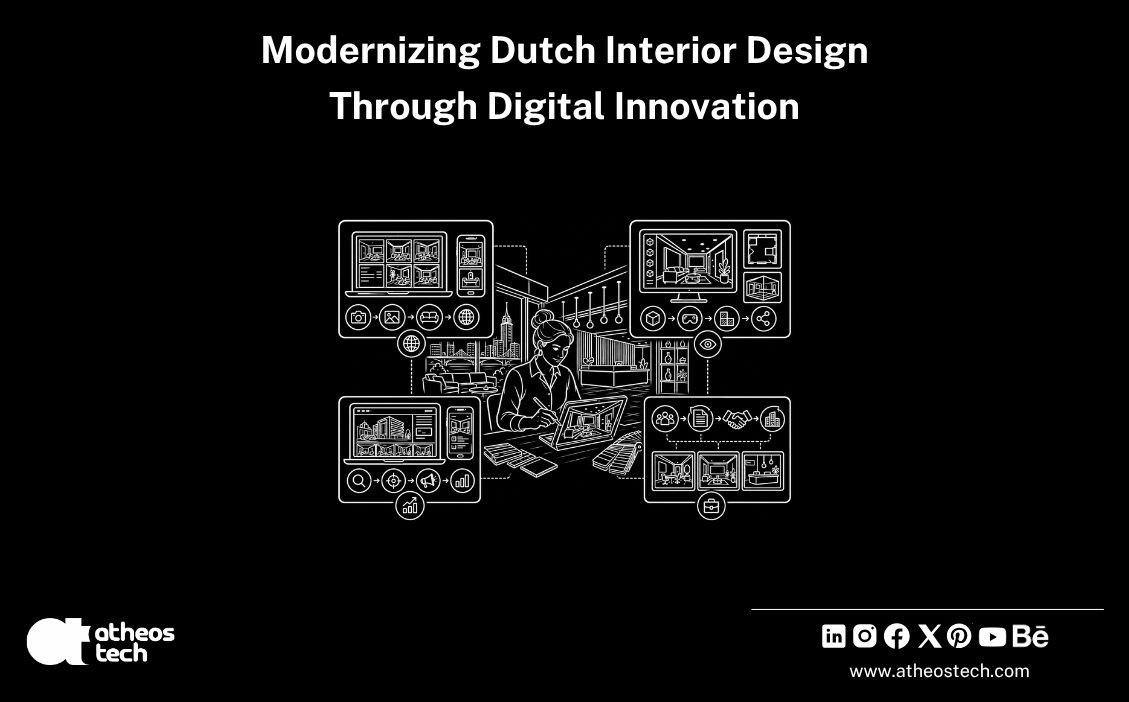
For a Dutch interior design or fit-out firm, digital growth for Dutch interior design and fit-out firms is no longer a marketing afterthought; it is the deciding factor in whether a commercial client shortlists you or scrolls past you. The Netherlands has one of Europe’s most digitally mature procurement and construction markets, and buyers, from a Rotterdam retail chain to an Amsterdam corporate office manager, now expect to evaluate a firm’s craftsmanship, compliance readiness, and creative range entirely online before a single meeting is booked.
This guide breaks down what that digital foundation actually looks like: the portfolio platforms that convert browsers into briefs, the client visualisation tools that let a prospect experience a space before it is built, the compliance signals Dutch commercial clients look for, and the digital marketing and digital transformation approach that ties it all together.
AtheosTech, as a 360° digital consultancy and IT solutions partner, works specifically at this intersection of design, technology, and the Dutch commercial procurement process.
The Dutch Interior Design and Fit-Out Market: Where the Growth Is Coming From
The Dutch interior fit-out sector is expanding on the back of commercial demand in Amsterdam, Rotterdam, Utrecht, The Hague, and Eindhoven, driven by office reconfiguration, hospitality and retail refits, and a strong sustainability agenda. A few structural realities are shaping how firms need to operate digitally:
- Skilled-labour pressure. The Netherlands faces a shortage of ~100,000 skilled workers by 2030, pushing firms toward automation, efficiency tools, and remote client approval workflows over on-site headcount dependency.
- Sustainability as a buying criterion. Dutch clients increasingly demand bio-based materials, circular design, and energy-efficient retrofits. Initiatives like Energiesprong have normalised zero-energy renovation, making sustainability credentials something that must be visible and provable online, not just mentioned in a pitch.
- Design culture built on integration. Dutch interior design treats architecture, built-in furniture, and layout as one cohesive system. A firm’s digital presence must reflect the same integrated clarity, as cluttered or generic websites work against the brand instinctively.
- Commercial clients researching before contacting. Whether through a private brief or a public-sector aanbesteding (tender), buyers now complete extensive digital due diligence, portfolio depth, project visualisation, compliance documentation, before a firm is even invited to bid.
This is the backdrop against which digitale infrastructuur (digital infrastructure) for a Dutch fit-out firm needs to be built: not a brochure website, but a working digital system that supports research, comparison, and procurement.
Why this matters more in the Netherlands than in many other markets:
- Small, dense, networked market. The Dutch fit-out sector is highly referral-driven. A weak digital presence is noticed faster here than in larger, more fragmented markets.
- Methodical B2B buyers. Facility managers and procurement officers research thoroughly before first contact. A firm’s website and portfolio are part of the vetting process, not just marketing collateral.
- High digital standards by default. Poor mobile performance or unstructured project information gets a firm quietly filtered out before a call is ever booked.
- Sustainability documentation is now a commercial requirement. EU-linked frameworks are pushing building owners to formally document fit-out partners. Firms supplying this digitally have a structural advantage.
Put together, these dynamics mean that digital transformation for a Dutch interior design or fit-out firm is not optional groundwork before growth; it is one of the primary growth levers itself, alongside craftsmanship and project delivery.
Further Reading
Digital transformation in Dutch interior fit-out does not happen in isolation from what is happening across the wider Dutch construction sector. For a deeper look at how compliance, BIM adoption, and AI-driven procurement are reshaping the broader industry.
Pain Points Holding Dutch Design and Fit-Out Firms Back Digitally
Based on how Dutch commercial clients now evaluate and select interior design and fit-out partners, the recurring pain points are:
- Static, image-only portfolios fail to communicate process, compliance capability, or project scale – the three things commercial buyers specifically evaluate.
- Without 3D visualisation or virtual walkthroughs, prospects commit budget on 2D renders alone, slowing decisions and losing deals to firms that can show more.
- Firms without CRM systems, digital project trackers, or client portals waste significant time on manual coordination that should be automated.
- Compliance frameworks like Wet kwaliteitsborging voor het bouwen (WKB) and BREEAM-NL certification are increasingly expected by procurement teams. Firms that cannot communicate compliance readiness clearly on their own platforms are quietly dismissed before conversations begin.
- Without optimisation for lokale SEO, firms do not appear when buyers search “kantoorinrichting” (office fit-out) or “interieurontwerp bedrijfspand” (interior design for commercial property) and simply do not make the shortlist.
Each of these is a digital solution or IT solution problem before it is a design problem, and it is exactly where a technology partner adds value alongside the creative and construction expertise the firm already has.
A few of these pain points deserve a closer look:
- Outdated portfolio, invisible cost. Firms never know how many briefs they were excluded from because a competitor’s pages looked more current. This loss leaves no feedback loop and persists for years.
- Visualisation gaps hurt larger bids. Decision-makers rarely commit six or seven-figure budgets without an interactive sense of the finished result. 2D renders do not close these deals.
- Manual coordination erodes margin. Without a CRM or client portal, updates and approvals move through email threads and WhatsApp groups, consuming skilled staff time that should be spent on billable work.
- Compliance gaps surface at the worst moment. Firms that cannot produce WKB documentation or BREEAM-NL details on request are deprioritised in favour of a competitor who has it ready to download from day one.
- Search invisibility compounds over time. Firms not investing in lokale SEO watch competitors absorb organic search demand year on year, making recovery progressively harder and more expensive. (Source: Rijksoverheid.nl)
Understood individually, these pain points look like separate problems. In practice, they are symptoms of the same underlying issue: a fit-out firm’s digital presence has not kept pace with how commercial buyers now research, compare, and commit budget.
Portfolio Platforms: Building the Digital Shopfront That Wins Briefs
A commercial client evaluating three or four interior design and fit-out firms will spend more time on the firm’s portfolio platform than on any single conversation. That platform needs to function less like a photo album and more like a structured case-study library.
What a modern portfolio platform needs:
- Filterable project case studies by sector (corporate office, retail, hospitality, healthcare, education)
- Before/after and process documentation, not just final photography
- Downloadable project specification sheets for procurement teams
- Client testimonials tied to specific project outcomes
- Fast-loading, mobile-first structure (a significant share of users abandon a slow or clunky mobile experience for a competitor)
- SEO-structured content architecture so individual projects rank for relevant commercial search terms
Firms researching what “good” looks like in portfolio presentation often study platforms like Houzz, Archilovers, Behance, and Pinterest, which have effectively trained buyer expectations around visual storytelling and project categorisation. AtheosTech does not build a copy of any of these platforms; instead, we design custom portfolio and CMS solutions inspired by what performs well on platforms like these, tailored to a Dutch fit-out firm’s specific project types, compliance documentation needs, and commercial buyer journey. This is a core part of our web development solutions offering, built on custom IT consultant-led architecture rather than templated builds.
Beyond the visual layer, a portfolio platform built for commercial conversion should also include:
- A clear sector-based navigation structure, so a facility manager searching for office fit-out examples is not wading through residential kitchen projects to find relevant work
- Structured metadata on every project page (location, sector, project size, timeline, sustainability certifications achieved), which supports both SEO performance and the kind of quick-scan evaluation procurement teams do when shortlisting firms
- Integrated lead capture points tied directly into a CRM, so an interested visitor requesting a project brochure or consultation becomes a tracked, followed-up lead rather than an anonymous website visit
- A blog or insights section, feeding directly into the firm’s content marketing strategy, that demonstrates ongoing expertise rather than a one-time portfolio upload
It is worth noting that portfolio platforms are not static assets. The firms that get the most commercial value from theirs treat them the way a product team treats a product: reviewed quarterly, updated with new case studies as projects complete, and continuously optimised based on which pages actually generate enquiries. This is where an ongoing web development solutions partnership tends to outperform a one-time website build.
Client Visualisation Tools: Winning the Project Before the Contract Is Signed
Visualisation is where interior design and fit-out firms most directly compete on technology, not just creativity. A commercial client comparing bids is far more likely to move forward with a firm that can show them the finished space interactively, before construction begins.
Visualisation capabilities that influence commercial decisions:
- 3D walkthroughs and interactive renders that let a client explore a proposed office or retail layout from any angle
- Virtual tour technology, similar in function to what platforms like Matterport offer, for remote stakeholders to review a space without an on-site visit
- AR (augmented reality) previews, allowing a client to place furniture or finishes into a real photographed space via mobile device
- BIM-linked visualisation (Building Information Modelling), connecting design visuals directly to technical drawings and specifications, which is increasingly expected on larger commercial and public-sector projects
- API integration between design software (such as SketchUp or Revit-based BIM tools) and the firm’s own client portal, so updates to a design automatically reflect in what the client sees online (Source: Credence Research)
These tools shorten the sales cycle considerably: a client who can “walk through” a space digitally needs far less persuasion than one working from static renders. AtheosTech builds custom visualisation and client portal solutions similar to what platforms like Matterport, Coohom, and BIM-integrated tools offer, connected directly into a firm’s existing design workflow through API integration, rather than requiring firms to adopt an entirely new software stack.
Why visualisation has become a commercial dealbreaker, not just a design nicety:
- It de-risks the buying decision. Commercial decision-makers are often approving budgets on behalf of a wider organisation, a board, a retail brand’s head office, or a hospital trust. Being able to show colleagues or stakeholders an interactive walkthrough, rather than describing a design verbally, makes internal approval significantly easier to secure.
- It reduces costly late-stage revisions. When a client can explore a proposed layout in detail before construction starts, misunderstandings about scale, flow, or finish are caught early, when changes are cheap, rather than mid-build, when they are not.
- It supports remote and multi-site decision-making. For retail chains or corporate clients evaluating a fit-out across several locations, virtual tour technology allows stakeholders based anywhere to review and comment without coordinating multiple in-person site visits.
- It strengthens tender submissions. For firms bidding into public or semi-public procurement via TenderNed, an interactive visualisation attached to a proposal stands out considerably against competitors submitting static PDF renders.
What a well-built client visualisation system typically includes, from a technical standpoint:
- A client portal where visualisation assets, specification documents, and approval workflows live in one place, rather than scattered across email attachments
- Version control, so a client reviewing a design revision can clearly see what changed from the previous iteration
- Mobile-optimised rendering, since a meaningful share of client reviews now happen on a phone or tablet rather than a desktop workstation
- Secure, permissioned access, particularly important for commercial clients handling confidential store layouts or unreleased brand concepts ahead of a public launch
AtheosTech approaches this as a systems-integration challenge as much as a design-tool challenge: connecting a firm’s existing design software to a client-facing visualisation layer via API integration, so designers keep working in the tools they already know while clients get a polished, branded viewing experience.
Compliance and Trust Signals Dutch Commercial Clients Expect
Compliance is not a footnote for Dutch interior design and fit-out firms; it is increasingly a visible part of how buyers filter serious firms from the rest. The digital presence needs to reflect this.
Key compliance and procurement frameworks relevant to the sector:
- Wet kwaliteitsborging voor het bouwen (WKB): In force since 1 January 2024, this shifts building quality checks from municipalities to independent kwaliteitsborgers (quality assessors). Currently applies to lower-risk categories (gevolgklasse 1) including smaller commercial premises, with contractors carrying extended liability for defects.
- BREEAM-NL: The Dutch sustainability assessment standard for buildings and interiors, increasingly requested by commercial clients pursuing certified fit-outs as part of their own ESG commitments.
- Aanbestedingswet 2012: Governs how public-sector and semi-public contracts are tendered in the Netherlands, built around principles of proportionality and transparency.
- TenderNed: The Netherlands’ official e-procurement platform where public tenders are published, searchable by CPV code, sector, and region.
- PIANOo: The government’s Public Procurement Expertise Centre, publishing guidance, model documents, and proportionality standards that shape how contracting authorities evaluate bidders.
- ESPD / UEA (Uniform Europees Aanbestedingsdocument): The standardised self-declaration document suppliers use to demonstrate eligibility when bidding on above-threshold tenders.(Source: Business.gov.nl)
For a fit-out firm, this means compliance documentation, certifications, insurance disclosures, and quality-assurance processes need to be structured, searchable, and presentable digitally, ready to be attached to a tender response or shared directly with a procurement team. AtheosTech builds all client-facing platforms as compliance-ready by design, meaning the underlying digitale infrastructuur (digital infrastructure) supports structured documentation, secure data handling, and the kind of transparent record-keeping that WKB, BREEAM-NL, and Dutch procurement processes increasingly require.
A closer look at how these frameworks affect a firm’s digital presence specifically:
- WKB and liability shift. Extended contractor liability and mandatory opleverdossier requirements mean audit-ready quality processes are now a client-facing trust signal, not just an internal filing obligation.
- BREEAM-NL beyond the logo. Clients want the sustainability story – materials sourcing, energy performance, circular design choices. Case studies that tell this narrative do more commercial work than a certification badge alone.
- Tender-readiness as a year-round capability. Firms bidding via TenderNed should maintain compliance documents and ESPD/UEA-ready information continuously, not under deadline pressure. PIANOo proportionality guidance means firm size alone is not a disqualifier.
- Raamovereenkomst and digital records. Multi-project framework agreements require consistent documentation across every delivery. Incomplete records risk agreement renewal directly.
For a Dutch interior design and fit-out firm, none of this compliance information needs to sit in static PDFs buried in a “downloads” folder. Built correctly, it becomes structured content: searchable, linkable, and reusable across tender submissions, client conversations, and the firm’s own portfolio platform.
Niche & Business Models in the Dutch Fit-Out Sector
Not every interior design and fit-out firm competes in the same lane, and the digital strategy should reflect the specific niche and revenue model a firm operates under.
Common micro-niches in the Dutch market:
- Corporate office fit-out, driven by hybrid-work reconfiguration and flexible workspace demand
- Retail and hospitality interiors, where brand experience and speed of turnaround matter most
- Healthcare and institutional interiors, with strict regulatory and hygiene-driven design requirements
- Sustainable and bio-based design-build, aligned with circular economy and Energiesprong-style retrofit demand
Applicable business and revenue models:
- Design-build (turnkey) model: the firm manages design and construction under one contract, typically the highest-margin model but with the most compliance exposure (WKB liability applies directly)
- Consultancy-only model: design and specification services without construction delivery, lower risk, often project-fee based
- Framework agreements (raamovereenkomst): recurring, multi-project contracts with a single commercial client or public authority, common with larger retail chains, universities, or municipal bodies, and a strong argument for retainer-based digital marketing rather than one-off campaigns
Each of these niches and models changes what the portfolio platform should emphasise, and what compliance documentation needs to be front and centre.
How niche should shape digital strategy in practice:
- A firm focused on corporate office fit-out should lead its portfolio with workplace strategy case studies, hybrid-work layout examples, and any wellness or productivity-linked design outcomes, since these are the metrics office decision-makers care about.
- A firm working in retail and hospitality benefits from a faster-moving, visually driven content strategy (strong on platforms like Pinterest and Instagram) and portfolio pages that emphasise turnaround speed and brand consistency across multiple locations.
- A firm in healthcare and institutional interiors should foreground regulatory compliance, hygiene-driven material choices, and accessibility considerations, areas where procurement teams in this niche scrutinise documentation closely.
- A firm positioned around sustainable and bio-based design-build has a natural content marketing advantage: this niche generates genuine media and search interest in the Netherlands, and firms that publish detailed, evidence-based sustainability content tend to build authority and backlinks faster than more generic competitors.
On revenue model and digital investment: firms operating a design-build (turnkey) model generally see the strongest return from investing heavily in visualisation tools and compliance documentation, since these directly influence high-value, high-risk purchase decisions. Firms operating a consultancy-only model often get more value from content marketing and thought-leadership content, since their sales cycle depends more on demonstrated expertise than on construction-risk reassurance. Firms working primarily through framework agreements benefit most from a retainer-based digital marketing and platform-maintenance approach, since the relationship is ongoing rather than transactional.
Engagement Models AtheosTech Recommends for This Sector
Drawing from our working dynamics approach to client engagement, the right model depends on where a firm sits in its digital maturity and growth stage:
- Project-based engagement: best suited to firms needing a one-time portfolio platform build, visualisation tool integration, or a defined campaign, ideal for smaller or newly-formed fit-out studios testing digital investment.
- Retainer-based engagement: recommended for firms operating on framework agreements or with consistent commercial pipeline, where ongoing SEO, content, and platform updates need ongoing management rather than a single build.
- Dedicated extended-team engagement: suited to larger design-build firms bidding on public and semi-public tenders, where compliance documentation, CRM, visualisation tools, and marketing all need continuous, coordinated technical support.
The right starting point is usually a conversation about current pipeline sources (referral vs. tender vs. inbound digital) before locking into a specific engagement structure.
A few practical signals that help indicate which model fits best:
- If most new business currently comes through referral or word of mouth, a project-based engagement focused on building the digital foundation (portfolio platform, visualisation tools) is typically the right first step, before adding ongoing marketing spend.
- If the firm already has a functioning website and portfolio but inconsistent inbound enquiry volume, a retainer-based engagement centred on SEO, content marketing, and PPC marketing tends to close that gap most efficiently.
- If the firm is actively bidding on public or semi-public tenders through TenderNed, or managing several parallel framework agreements, a dedicated extended-team engagement ensures compliance documentation, visualisation assets, and marketing content are all kept current without pulling internal design staff away from billable project work.
Regardless of the model, the underlying principle behind AtheosTech’s working dynamics is the same: technology and marketing work should integrate with a firm’s existing design and delivery process, not compete with it for attention.
Digital Marketing: The Growth Engine Behind Every Other Piece
None of the above, portfolio platform, visualisation tools, or compliance-ready infrastructure, generates commercial briefs on its own. Digital marketing is what puts a firm in front of the right buyers at the right stage of their research.
What this looks like in practice for a Dutch interior design and fit-out firm:
- Lokale SEO (local SEO) and Google Business Profile optimisation, so the firm appears when a facilities manager or business owner searches for fit-out services in their city
- Content marketing, including project case studies, compliance explainers (WKB, BREEAM-NL), and design-trend commentary that positions the firm as a knowledgeable authority rather than just a contractor
- PPC marketing for high-intent commercial searches is particularly useful for firms bidding into competitive urban markets like Amsterdam or Rotterdam
- Digital PR, securing coverage and backlinks through project launches, award announcements, and expert commentary, which also strengthens domain authority for organic search
- Industry data consistently shows that firms publishing consistent blog and case-study content generate significantly more inbound leads than those that do not, and email marketing continues to deliver strong returns for nurturing past clients and long sales-cycle prospects
This is where AtheosTech’s role as a 360° digital consultancy comes together: content marketing, PPC marketing, lokale SEO, and digital transformation of the firm’s underlying platforms are not separate workstreams; they are built to work as one system.
A few additional pointers on making digital marketing work specifically for this sector:
- Time content around budget cycles. Corporate fit-out decisions align with fiscal year planning and lease renewals. Content and PPC campaigns timed around these periods consistently outperform always-on generic campaigns.
- Case studies outperform generic content. A detailed breakdown of a completed office fit-out – brief, compliance considerations, outcome – converts better with commercial buyers than broad interior design trend content aimed at residential audiences.
- Reputation management is part of the vetting process. Dutch B2B buyers check Google reviews and LinkedIn activity before making contact. An active Google Business Profile and consistent LinkedIn presence directly support commercial credibility.
- Marketing spend should match deal size. Firms winning six-figure commercial contracts can justify substantially more investment in SEO, content, and paid campaigns than residential-focused studios, since the return per closed deal is considerably higher.
Ready to turn your portfolio into a lead-generating system?
AtheosTech helps Dutch interior design and fit-out firms combine SEO, content, and paid strategy into one measurable digital marketing engine. Get in touch to discuss what that looks like for your firm.
Native Digital Presence: Speaking the Dutch Commercial Market's Language
A digital presence that feels native to the Netherlands goes beyond translation. It reflects the directness, functional clarity, and consensus-driven (poldermodel) communication style that characterises Dutch business culture, alongside specific terminology buyers actually search for and recognise:
- Using correct Dutch industry terms naturally within content: kantoorinrichting (office fit-out), interieurontwerp (interior design), verbouwing (renovation/rebuild), bedrijfspand (commercial property)
- Displaying KvK (Dutch Chamber of Commerce) registration and relevant certifications visibly, a trust marker Dutch B2B buyers actively look for
- Writing in a tone that is confident and evidence-led rather than heavily promotional, Dutch commercial buyers respond better to clear capability statements and proof (case studies, certifications, data) than to sales language
- Structuring content to answer practical, logistics-focused questions early (timelines, compliance, project scale) rather than leading purely with aesthetics
This native feel, combined with the technical and compliance depth covered above, is what separates a firm that merely has a Dutch-language website from one that reads as genuinely built for the Dutch commercial market.
A few additional native-feel considerations worth building into the digital strategy:
- Match language to the buyer. Dutch works for locally discoverable, search-optimised content. English serves international stakeholders reviewing proposals. Offering both covers the full procurement journey effectively.
- Regional identity matters within the Netherlands. Location-specific landing pages for Amsterdam, Rotterdam, Utrecht, Den Haag, and Eindhoven capture meaningfully different search behaviour and client expectations across each city.
- Directness beats polish. Dutch business culture favours clear, substantiated claims over aspirational language. Content leading with specifics – square metres delivered, certifications held, timelines met – builds more credibility than broad brand statements.
- Consistency across channels reinforces trust. Website, LinkedIn, and tender documentation must present consistent messaging, certifications, and project references. Discrepancies are quickly noticed by thorough Dutch procurement reviewers.
Conclusion
Digital growth for a Dutch interior design and fit-out firm is not a single website project, it is an interconnected system: a portfolio platform structured for how commercial buyers actually research, visualisation tools that let clients experience a space before it exists, compliance-ready digital infrastructure built around WKB, BREEAM-NL, and Dutch procurement standards, and a digital marketing engine that keeps the right buyers finding all of it.
Firms that treat these as separate, disconnected efforts consistently lose ground to competitors who treat them as one coordinated digital transformation strategy.
Want an honest assessment of where your firm's digital presence stands today?
AtheosTech offers 360° digital consultancy and IT solutions for Dutch interior design and fit-out firms, custom IT consulting, not off-the-shelf templates.
FAQs
FAQs
Typically 3 to 6 months, depending on competition in the target city and consistency of content publishing, though local SEO improvements (Google Business Profile, local citations) can show faster initial movement.
The Netherlands Interior Design Market was valued at approximately USD 1,411.8 million in 2024, up from USD 1,300.0 million in 2018, and is projected to reach approximately USD 1,808.3 million by 2032, growing at a CAGR of around 3.20% over the forecast period. The Randstad region accounts for the largest regional share, supported by dense populations and high renovation activity.
- Strong housing renovation activity across Dutch cities, with compact urban homes pushing demand for flexible, functional layouts
- Retail and hospitality operators investing in themed, brand-driven interiors to strengthen customer experience
- Office operators redesigning workspaces to support hybrid work and improve employee comfort
- Rising adoption of energy-efficient materials in line with national sustainability goals
- Growing use of smart lighting, modular furniture, and eco-certified décor across new and renovation projects
Key players named in recent market research include IKEA Netherlands, Marcel Wanders Studio, Piet Hein Eek, Grand & Johnson, and Framework Studio, alongside a broader landscape of established design studios and emerging local firms competing across residential, retail, hospitality, and commercial segments.
It is not legally mandatory for most private commercial projects, but it has become a strong commercial differentiator, particularly for clients with their own sustainability commitments, and is often a scoring criterion in larger tenders.