- AtheosTech
Installatietechniek in the Digital Age: How Dutch Specialised Trade Contractors Are Automating Quoting, Scheduling, and Customer Acquisition
Digital transformation in installatietechniek (installation engineering) is no longer a side project for the Netherlands’ specialised trade contractors; it has become the difference between a bedrijf (company) that grows and one that quietly stalls under its own paperwork.
From cv-monteurs (boiler technicians) and elektrotechnici (electrical technicians) to klimaattechniek (climate technology) and sanitair (plumbing) specialists, Dutch installatiebedrijven (installation companies) are under pressure from three directions at once: a stubborn personeelstekort (staff shortage), rising expectations around verduurzaming (sustainability transition), and a customer base that now researches, compares, and books services online before a single phone call is made.
The Trendrapport 2026 from 4PS points to AI, prefab installations, and datagedreven (data-driven) service en onderhoud (service and maintenance) as the biggest opportunities for the sector to work faster, smarter, and more sustainably.
This blog looks at exactly how that shift is happening in practice: how offertes (quotes) and calculations (calculations) are being automated, how planning and monteur (technician) scheduling are becoming digital-first, and how customer acquisition is moving away from expensive, one-off leads toward owned, data-driven channels.
Along the way, we will look at the niches, compliance requirements, and engagement models that matter specifically to Dutch installatiebedrijven, and where AtheosTech’s IT solution and digital marketing offering fits into that picture as part of a wider Digital Transformation for the business.
The State of the Dutch Installatietechniek Sector
The installatiebranche (installation industry) is one of the most structurally important sectors in the Dutch economy, touching nearly every new build, renovation, and verduurzaming (sustainability) project in the country. A few data points set the scene:
- Industry forecasts for 2026 describe the market as growing “slim en selectief” (smart and selective): a modest uptick in woningbouw (residential construction), a stabilising utiliteitsbouw (commercial/utility construction) segment, and continued strong demand for renovatie (renovation) and verduurzaming, according to sector analysis published by HeWa Solutions. (Source)
- The personeelstekort (technical labour shortage) remains the single biggest brake on growth. Vacancies keep climbing while vergrijzing (an ageing workforce) and limited opleidingscapaciteit (training capacity) constrain how fast new vakmensen (skilled tradespeople) can be trained.
- Warmtepompen (heat pumps) have gone from niche product to mainstream standard in new-build and large-scale renovations, driven by both overheidsmaatregelen (government schemes) and rising energy cost awareness among consumers.
- New European rules are accelerating building automation requirements: from 2026, buildings with HVAC/AC installations above 290 kW must have a Gebouwautomatiserings- en Controlesysteem (GACS), with smaller systems following in 2029.
- Waterstof (hydrogen) is emerging as a future energy carrier, with manufacturers already producing cv-ketels (central heating boilers) suitable for both aardgas (natural gas) and hydrogen, and installateurs (installers) starting to prepare for new safety and installation requirements. (Source)
Taken together, this is a sector with strong underlying demand but shrinking capacity per bedrijf (company). That combination is exactly why digitalisering (digitalization), automating the parts of the business that do not require a pair of hands on-site, has become an operational necessity rather than a nice-to-have.
AtheosTech Services Relevant to Private Specialist Clinics
Based on the pain points and infrastructure needs above, the AtheosTech services most relevant to a Dutch private specialist clinic include:
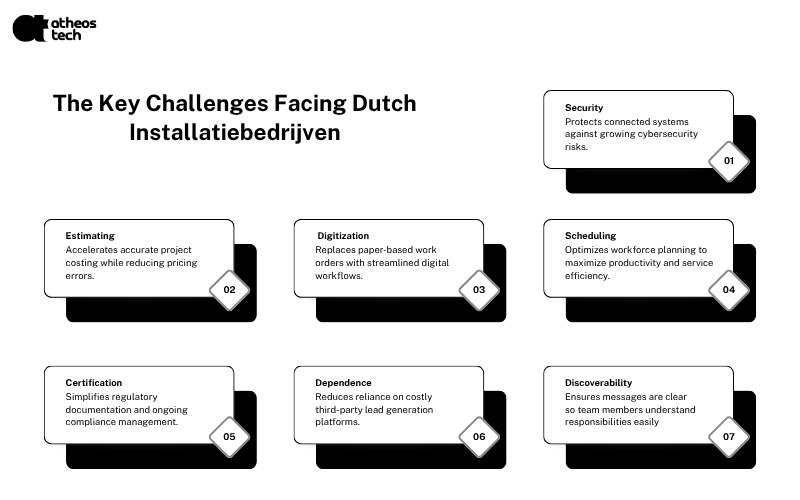
Manual calculatie (calculation) and offertes (quotes) Many bedrijven (companies) still price projects using spreadsheets or, in some cases, paper. A recent industry piece on calculatiesoftware (calculation software) for installatietechniek notes that installatiebedrijven need accurate, fast calculation of costs, materials, labour, and margins for every project, and that doing this manually invites errors and slows down the sales cycle.
Paper werkbonnen (work orders) and delayed facturatie (invoicing) A widely cited pattern in field service software comparisons: monteurs (technicians) drive from job to job with a stack of paper werkbonnen, these trickle into the office in the evening, get manually entered into the boekhouding (bookkeeping), and by invoicing time there are on average two errors and three hours of unbilled work per batch.
Personeelstekort (staff shortage) and inefficient planning With too few vakmensen (skilled tradespeople) and too many jobs, poor route planning and scheduling directly translates into lost billable hours and frustrated customers waiting for a monteur (technician).
Compliance and administrative load Certification tracks (VCA, BRL, InstallQ, SEI) require ongoing documentation, audits, and bijscholing (further training), which is time-consuming to track manually.
Dependence on paid lead marketplaces Many installatiebedrijven rely heavily on platforms such as Werkspot or Homedeal for new work, where a single shared lead can cost anywhere from roughly €40 to €80, or in some reported cases considerably more once conversion rates are factored in, with no guarantee that the lead is even serious.
Weak online vindbaarheid (findability) Consumers increasingly search, compare, and read reviews before calling anyone, and installatiebedrijven without a strong Google presence or up-to-date Google Business Profile simply do not appear in that first, decisive search.
Cybersecurity exposure from connected installations As warmtepompen, security cameras, and smart climate systems increasingly connect to the internet, they also become a target. Industry guidance from Wij Techniek flags IoT-connected devices as a growing risk that installateurs are now responsible for securing, not just installing.
Every one of these pain points has a digital solution or IT solution behind it, and most Dutch installatiebedrijven are only solving two or three of them at a time. That patchwork approach is where AtheosTech’s 360° digital consultancy and IT solutions model adds the most value: connecting quoting, scheduling, customer data, marketing, and compliance into one coherent digitale infrastructuur.
Niches and Business Models in Dutch Installatietechniek
“Installatietechniek” is not one homogeneous market. It splits into clear micro-niches, each with its own buying behaviour, seasonality, and margin structure:
Verwarming en cv-techniek (heating and central-heating technology) – cv-ketel (boiler) installation, onderhoud (maintenance), and the fast-growing warmtepomp (heat pump) segment
Elektrotechniek (electrical engineering) – wiring, laadpalen (EV chargers), and increasingly slimme beveiliging (smart security)
Klimaattechniek (climate technology) – air conditioning, ventilatie (ventilation), and koeltechniek (refrigeration technology), now folding into integrated GACS building-automation projects
Sanitair en loodgieterswerk (plumbing and sanitary work) – bathroom installation, water systems, and leak/legionella-related maintenance
Duurzame techniek (sustainable technology) – zonnepanelen (solar panels), zonneboilers (solar water heaters), and hybride verwarmingssystemen (hybrid heating systems), largely policy-driven through schemes like ISDE
On the business-model side, three structures dominate:
ZZP (zelfstandige zonder personeel, self-employed person without staff)
solo vakmensen (tradespeople), typically project-based, highly price-sensitive to lead costs, and the group most exposed to marketplace dependency
MKB installatiebedrijf (small/medium-sized installation company)
small to mid-sized companies (roughly 5 to 50 medewerkers, employees) that combine project work with recurring onderhoudscontracten (maintenance contracts)
Consolidated / franchise groups
larger regional players, often the result of the consolidation trend flagged by HeWa Solutions, where digital systems need to scale across multiple vestigingen (branches/locations)
Revenue models follow a similar split: one-off projectfacturatie, recurring onderhoudscontracten (periodic servicing, increasingly the most resilient revenue stream as it survives economic swings better than new installations), and service-level subscriptions tied to smart monitoring, where the installatiebedrijf is paid to keep a system running rather than just to install it once. This last model is exactly where predictive maintenance dashboards and IoT monitoring create new, ongoing revenue, and it is a niche AtheosTech builds custom software for.
Further Reading
If you found this useful, you may also want to read our related blog on how the broader construction ecosystem around installatietechniek is digitising:
Automating Quoting: From Beer Mat to Calculation Software
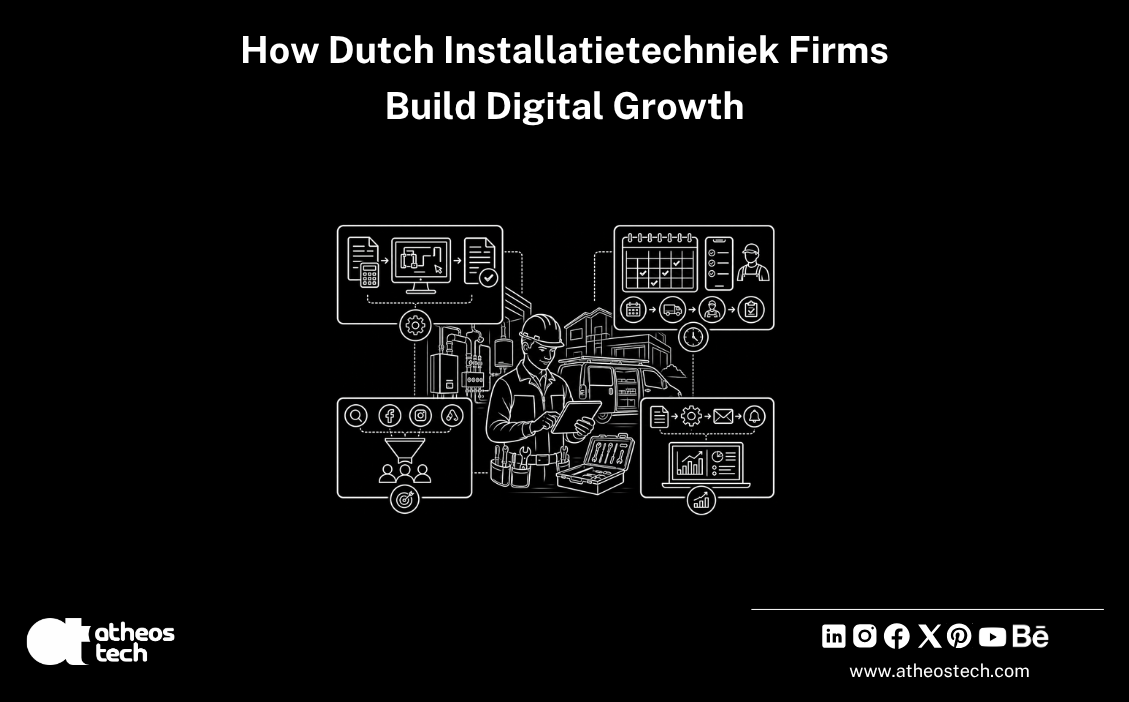
The phrase used in Dutch trade press to describe the least digitised installatiebedrijven is memorable: companies still calculating “op de achterkant van een bierviltje” (on the back of a beer mat). At the other end of the spectrum are bedrijven using dedicated calculatiesoftware voor installatietechniek, specialised software that helps installatiebedrijven accurately and quickly calculate costs, material delivery, labour time, and profit margins for installation projects.
What good quoting automation actually does for an installatiebedrijf:
- Builds offertes from pre-defined templates with parameters that can still be adjusted per project, so consistency and speed both improve
- Automatically pulls current pricing through koppelingen (integrations) with supplier webshops and groothandels, built on solid API integration, so margins reflect real-time material costs instead of last month’s price list
- Tracks every cost category in a calculation, labour, material, materieel (equipment), onderaannemers (subcontractors), and indirect costs, in one place
- Allows nacalculatie: comparing final project costs (including meerwerk and werkbonnen) against the original budget, so margin leakage is caught and corrected proactively
This is where a CPQ (configure-price-quote) system, built or customised for the specific niche of an installatiebedrijf, turns quoting from a bottleneck into a competitive advantage. As a custom IT consultant for this sector, AtheosTech designs and integrates this kind of offerte- en calculatiesoftware, tailored to Dutch pricing structures, VAT rules, and supplier ecosystems via reliable API integration, without positioning it as a copy of any single existing platform, but as a custom solution built around how a specific installatiebedrijf actually works.
Automating Scheduling and Field Service Operations
If quoting automation solves the “how much” problem, field service software solves the “who, where, and when” problem, which for most installatiebedrijven is the more painful of the two.
Common capabilities now considered standard in this category:
Digitale werkbonnen replacing paper: capturing photos, klanthandtekening (customer signature), and materiaalregistratie on-site
GPS and route optimisation, which becomes the deciding factor for larger teams with heavy driving schedules
Real-time planning boards, letting dispatchers reassign monteurs to urgent jobs without phone-tag
IoT-based remote monitoring, where sensors on cv-ketels, ventilatiesystemen, and sanitaire voorzieningen feed real-time performance data back to the office, so storingen (faults) can be predicted before they happen, according to reporting from Installatie.nl
Voorraadbeheer integraties, giving monteurs live visibility into available materials and tools via an app, so they are never stuck mid-job waiting on parts
The direct business impact, as summarised in a recent Dutch software-comparison piece, is straightforward: eliminating the paper werkbon-to-boekhouding pipeline removes both the average two errors per batch and the roughly three hours of unbilled work that pipeline typically produces.
For a business already short on technical staff, that reclaimed time is effectively free labour capacity. AtheosTech builds and integrates field service and planning platforms suited to this exact workflow, connected directly to the calculatiesoftware above and the CRM below through custom web development solutions, so a job moves from quote to schedule to invoice without re-entering data three times.
Customer Acquisition in the Digital Age
This is the area where installatiebedrijven most often leave structural savings on the table. There are, broadly, two ways to acquire new klanten today, and understanding both is essential before deciding where to invest.
- Paid lead marketplaces.
Platforms such as Werkspot and Homedeal are the best-known klusplatforms in the Netherlands. The mechanics are similar across both:
- A consumer places a job description, and it gets shared with several vakmensen at once (commonly three to five),
- And the installatiebedrijf pays a per-lead fee, reported by multiple sources in the €40 to €80 range, sometimes higher, regardless of whether that lead converts into paid work.
- Industry commentary estimates the effective cost per won job on Werkspot at closer to €200 once win rates are factored in.
- These platforms remain useful for filling short-term capacity gaps and reaching consumers who are actively comparing multiple vakmensen, but they come with a structural drawback: the installatiebedrijf is renting visibility it does not own, and margins are shared with several competitors on every single lead.
- Owned digital channels.
- The alternative, increasingly adopted by installatiebedrijven that have outgrown marketplace dependency,
- Is to build a direct acquisition engine: a website optimised for local search, a well-maintained Google Business Profile, review generation, and paid search campaigns that drive traffic to the bedrijf’s own domain rather than a third-party platform.
- The trade-off is upfront investment in vindbaarheid (online findability) versus the variable, unpredictable cost-per-lead of a marketplace.
- Several Dutch marketing providers now build exactly this kind of “eigen leadkanaal” for installatiebedrijven, arguing that at a sustained volume of roughly ten or more jobs a month, an owned channel typically pays for itself within a few months compared to ongoing marketplace fees.
For most Dutch installatiebedrijven, the realistic answer is not “either/or” but a phased shift: use marketplaces to fill immediate capacity while systematically building owned SEO, content, and CRM assets that reduce marketplace dependency over time.
This is precisely the kind of customer acquisition strategy AtheosTech designs for installatietechniek clients, combining lokale SEO, PPC marketing through Google Ads management, and CRM-driven follow-up so that every lead, whether it originally came from a marketplace or a search engine, ends up inside a system the bedrijf actually owns.
A well-implemented CRM (klantbeheer software) also solves a second problem: most installatiebedrijven have highly valuable existing customer data (past jobs, onderhoudshistorie) sitting unused. Centralising this makes it possible to proactively reach out for periodic onderhoud or new diensten, directly improving klanttevredenheid and repeat revenue, a point echoed in Installatie.nl’s coverage of CRM adoption in the sector.
Ready to reduce your dependency on paid lead platforms and build a digital acquisition engine your business actually owns?
Talk to AtheosTech about a digital marketing strategy built for the Dutch installatietechniek sector.
Digital Marketing as the Growth Engine
Digital marketing is not a bolt-on to the services above; it is the connective layer that makes quoting automation, scheduling efficiency, and CRM data actually generate new business. For Dutch installatiebedrijven, an effective digital marketing approach typically includes:
- Lokale SEO, targeting terms like “installatiebedrijf [plaatsnaam]” and niche terms such as “warmtepomp installateur” or “airco monteur,” so the bedrijf appears in Google’s local pack and Maps results, not just organic listings
- Google Business Profile optimisation, since reviews and profile completeness heavily influence which vakman a consumer calls first
- Content marketing, publishing genuinely useful guides (subsidies, ISDE regelingen, maintenance tips) that build trust and long-term organic visibility
- PPC marketing (Google Ads), used surgically for high-intent, high-margin services where marketplace CPCs, reported in the €15 to €38 per click range for the bouwsector, are worth paying because the resulting job value justifies it
- Reputation and review management, turning satisfied onderhoudscontract customers into public proof points that reduce the trust gap a new visitor feels before calling
What a business can realistically achieve through this: fewer unqualified leads, a shorter sales cycle because prospects arrive pre-informed, and a growing share of new work that costs a predictable monthly investment rather than a variable per-lead fee.
AtheosTech treats digital marketing as a core, always-included solution for installatietechniek clients precisely because none of the automation above compounds in value without a steady, well-targeted stream of new klanten feeding it.
Compliance: Building Digital Systems That Respect Dutch Regulation
Digitalisering in this sector cannot be separated from its compliance landscape. Several frameworks specifically shape how software and data should be handled:
AtheosTech builds every CRM, scheduling, and marketing system for installatietechniek clients to be AVG-compliant by design, and structures data handling, documentation workflows, and certification-tracking features so they align with Wkb, VCA, and InstallQ requirements rather than working around them.
Engagement Models for Installatietechniek Clients
Not every installatiebedrijf needs the same relationship with its digital partner. Based on AtheosTech’s working dynamics and the scope of work involved, three engagement models tend to fit this sector best:
Fixed-scope project engagement – suited to a defined, one-time deliverable such as building a calculatiesoftware integration, a new website, or a field service platform rollout with a clear start and end point
Dedicated team/staff augmentation – suited to larger installatiebedrijven or consolidated groups running multiple ongoing digital initiatives (ERP integration, CRM rollout, multi-vestiging scheduling systems) that need continuous, embedded development capacity
Retainer-based growth partnership – best suited to ongoing digital marketing, SEO, and Google Ads management, where results compound over months and the engagement needs to flex with seasonal demand (for example, warmtepomp campaigns ramping up ahead of ISDE subsidy deadlines)
Most installatiebedrijven start with a fixed-scope engagement to solve one acute pain point (usually quoting or scheduling), then move toward a retainer model once digital marketing becomes the primary growth lever.
Why Work With AtheosTech
AtheosTech operates as a 360° digital consultancy and IT solutions partner, which matters specifically in this sector because installatietechniek problems rarely sit in one silo. A slow offerte process, a scheduling gap, weak lokale SEO Services, and an outdated CRM are usually symptoms of the same underlying issue: disconnected systems.
As a custom IT consultant for installatietechniek, AtheosTech’s role is to connect calculatiesoftware, field service and planning tools, CRM, and digital marketing into a single, AVG- and Wkb-aware digitale infrastructuur and digital solution, so that every klant interaction, from first Google search to final werkbon, flows through one coherent system rather than five disconnected tools.
Conclusion
The Dutch installatietechniek sector is growing, but growing “slim en selectief,” as the market itself is now often described, meaning the bedrijven that win are the ones that remove friction rather than simply add capacity they cannot staff.
Automating calculatie and offertes protects margins. Digitising scheduling and field service work reclaims hours currently lost to paper and phone-tag. And shifting customer acquisition from rented marketplace leads to an owned, SEO- and CRM-driven engine turns marketing spend into a compounding asset instead of a recurring cost. None of these shifts require replacing the vakmanschap that defines this industry; they simply remove the administrative weight sitting on top of it.
If your installatiebedrijf is ready to automate quoting, scheduling, and customer acquisition without losing the compliance and quality standards Dutch clients expect,
AtheosTech is ready to help you build that foundation.
Get in touch to start with a digital assessment tailored to your niche.
FAQs
FAQs
Automating calculatie, offertes, and scheduling, since these are the processes most commonly still run manually and the ones where digitisation saves the most billable time, alongside reducing dependency on paid lead marketplaces.
Both can help fill short-term capacity gaps, but per-lead costs are shared across several competing vakmensen and can add up quickly. Most bedrijven benefit from combining marketplace leads with an owned SEO and CRM-driven acquisition channel over time.
VCA, InstallQ/BRL certification schemes, SEI-erkenning, and F-gassen certification are the most commonly required, alongside AVG compliance for any customer data stored in CRM or marketing systems.
The Wet kwaliteitsborging voor het bouwen (Building Quality Assurance Act) shifts more documentation and liability responsibility onto installatiebedrijven, which means digital systems for quoting, scheduling, and project records increasingly need to support clear, auditable documentation trails.
It depends on where the bottleneck actually is. If jobs are being lost to slow quoting or planning chaos, fix that first. If capacity is available but the phone isn't ringing enough, digital marketing and owned lead generation should come first.