

- AtheosTech
Can 400,000 Dutch Business Services Survive the Next Wave of AI?
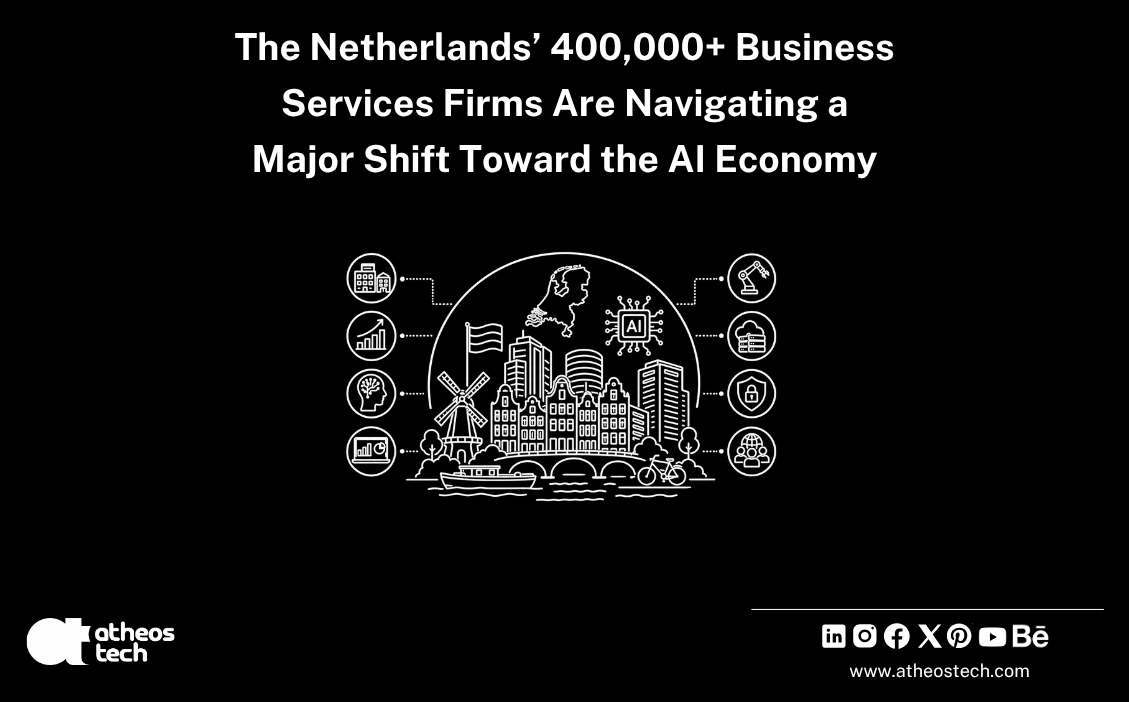
Over 400,000+ Dutch business services face extinction without AI transformation. Discover why traditional operations are obsolete and how to modernize profitably.
The Digital Reckoning Explained
The Nederlandse (Dutch) zakelijke dienstverlening (business services) sector, comprising over 400,000 firms, faces its biggest transformation in 50 years. Firms still running on manual workflows, disconnected systems, and legacy infrastructure are losing 30 to 40% operationele efficiëntie (operational efficiency) to AI-enabled competitors. The question is no longer if you will modernize, but whether you will lead the transformation or be disrupted by it. The AI economy impact on B2B business services is unprecedented, forcing a rapid shift from manual execution to intelligent, automated systems.
Key Market Realities:
- 84% of Dutch SMEs plan increased AI investment over the next three years, cementing the country’s position as a hub for Europe’s AI acceleration.
- 95% of Dutch organizations use AI in some form, yet only 5% capture real value due to poor workflow automation and missing skill sets.
- 41% of companies cite talent shortage as their number one operational pressure.
- AI-enabled firms show 43% faster scaling capacity compared to their traditional counterparts.
The Firms Winning in 2026 Are No Longer the Ones with the Biggest Teams, They Are the Ones with the Smartest Systems
Across the Netherlands, something quiet but devastating is happening. Traditional business and service firms (traditionele zakelijke dienstverleners), accounting practices (accountantskantoren), HR consultancies (HR-adviesbureaus), legal advisories, and logistics coordinators are slowly losing ground. Not because their expertise has diminished. Not because their client relationships have weakened. But because their operational infrastructure has become their competitive liability (concurrentienadeel). The transition into the AI agent economy is ruthlessly separating those who adapt from those who stagnate.
While competitors process client onboarding (klantacceptatie) in 48 hours through automated workflows, traditional Dutch businesses still spend 7 to 10 days manually transferring data between systems. While AI-powered agencies deliver real-time performance dashboards, traditional firms still compile reports in Excel spreadsheets over weekends. While modern business intelligence services predict client churn (klantverloop) through behavioral analytics, traditional firms only discover dissatisfaction when clients leave.
If you are leading a service and business operation today, you must ask yourself these critical diagnostic questions:
- Are your senior consultants still spending 6 to 8 hours weekly on administrative tasks that an artificial intelligence AI system could easily automate?
- Do your teams work from 4 to 6 disconnected platforms that do not communicate?
- Can you answer “What is our real-time project profitability?” without pulling manual reports?
- Are client onboarding experiences still dependent on long email chains and spreadsheet handoffs?
- Do your employees complain about legacy systems being obstacles to their daily productivity?
- Is reporting still something that happens after the work week instead of during it?
- Can your business process services scale to double the revenue without doubling the operational chaos?
- Are you losing bids to competitors who offer digital client portals and real-time transparency?
Every hesitation or “no” to these questions is a clear signal. You are not just losing time, you are losing market position.
The Netherlands' Business Services Sector: A €92 Billion Industry at a Digital Crossroads
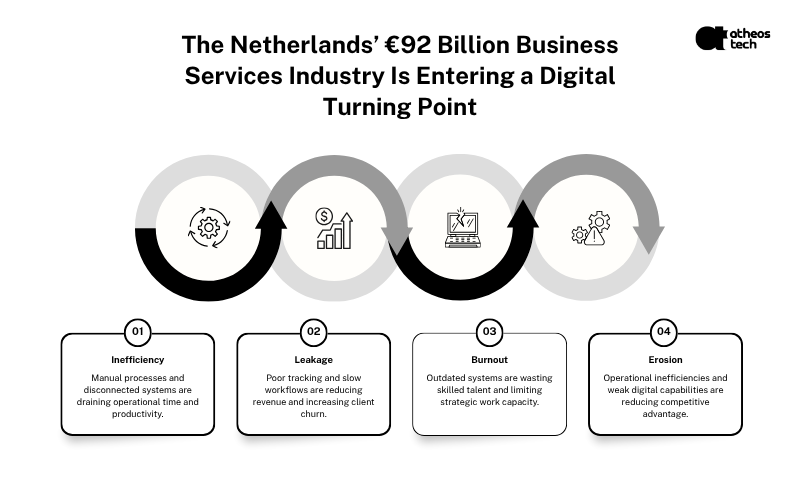
The Netherlands’ business services sector (zakelijke dienstverlening) employs over 1.2 million professionals and generates approximately 12% of the nation’s GDP (bruto binnenlands product). With over 400,000 active firms, the market is a powerhouse of European commerce. Yet beneath these impressive figures lies a quiet fragmentation crisis.
Research shows that while the industry experienced steady growth over the last decade, the foundational infrastructure supporting these firms is beginning to buckle under modern demands. Every business services professional is currently feeling the squeeze of outdated technology, trying to keep up with an accelerated digital world.
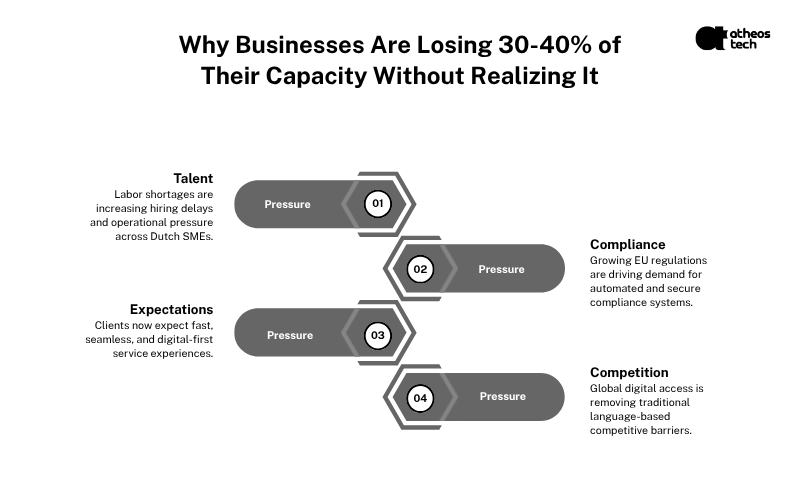
To understand why so many Dutch companies (Nederlandse bedrijven) feel paralyzed, we must look at the three simultaneous pressures squeezing their operational margins today.
Pressure 1:
The Talent Scarcity Crisis (Het Personeelstekort)
The battle for skilled labor is reshaping how firms operate. Currently, 41% of Dutch SMEs (het MKB) cite the talent shortage as their top operational constraint. The average time-to-hire for technical and specialized roles now stretches between 4 and 6 months, and every unfilled position costs an estimated €15,000 to €25,000 in lost productivity. Traditional hiring simply will not solve this demographic shift. Especially for smaller companies, the only sustainable path forward is multiplying the output of their existing team through intelligent systems.
Pressure 2:
The Regulatory Complexity Explosion (De Regelgevingsdruk)
Navigating compliance (naleving) is no longer just a legal issue. It is a massive operational burden. The EU Digital Services Act (DSA) and intensifying GDPR (AVG - Algemene Verordening Gegevensbescherming) requirements for data handling demand pristine, automated audit trails. For firms offering business management consulting services or participating in global business services, relying on manual compliance checks is a massive liability. The cost of non-compliance through fines and reputation damage far outweighs the investment in secure, automated data architecture.
Pressure 3:
The Client Expectation Revolution (De Veranderende Klantverwachting)
Modern B2B clients now expect B2C-level digital experiences. They want real-time reporting, self-service portals, and mobile accessibility. They have zero patience for long email chains and delayed responses. The "Amazon effect" has reached professional services. Firms providing business consulting services must realize that their clients are comparing their digital delivery not just to other consultancies, but to the best technology platforms they use every day. Creating a frictionless digital experience is now a fundamental competitive advantage (concurrentievoordeel).
Pressure 4:
The Collapse of the Language Moat (Grensloze Concurrentie)
Historically, Dutch business services firms enjoyed a natural protective moat: the Dutch language. If a foreign consultancy or agency wanted to target mid-market clients in Utrecht or Groningen, they had to hire native Dutch speakers. That barrier has now evaporated.
Today, highly aggressive, digitally mature agencies in Berlin, London, and Eastern Europe are using advanced AI-Powered workflows to generate native-level Dutch SEO content, proposals, and targeted LinkedIn outreach. They are bidding for Dutch contracts without having a single physical office in the Netherlands. If your firm’s digital presence is weak, you are no longer just losing to the firm down the street. You are losing to borderless, AI-driven competitors who have optimized their digital funnels to capture Dutch search demand from hundreds of miles away.
The Paradox of Dutch Digital Adoption
Despite these pressures, a strange paradox exists in the market. The Netherlands ranks number three in Europe for cloud infrastructure adoption, with 81% of SMEs utilizing cloud storage. However, they struggle significantly with effective AI adoption. Data reported in 2025 indicates that while the Dutch have the infrastructure to lead Europe, they rank much lower for the effective implementation of predictive analytics and process automation.
This reveals the core issue: Dutch firms have modernized their storage and access, but not their decision-making, automation, or operational intelligence.
Here is a clear look at how Dutch adoption compares to the broader European baseline:
| Metric | Dutch Adoption | EU Average | Effective Usage |
|---|---|---|---|
| Cloud Infrastructure | 81% | 67% | High |
| Process Automation | 34% | 41% | Medium |
| AI/ML Implementation | 23% | 28% | Low |
| Predictive Analytics | 12% | 15% | Very Low |
The data paints a clear picture. The infrastructure is there, but the intelligence is missing. To bridge this gap and turn basic cloud storage into a revenue-generating engine, firms require specialized guidance. Our business technology advisory services are specifically designed to help Dutch businesses transition from basic digitization to full operational intelligence, ensuring you capitalize on these advanced capabilities.
Why Thousands of Dutch Firms Feel Trapped Between Growth Ambitions and Operational Reality
If you are reading this, chances are you have experienced the frustration firsthand. Your firm is growing, your client roster is expanding, and your reputation is solid. But behind the scenes, your operations feel increasingly fragile. Every new client adds complexity. Every new project exposes system limitations. Every hiring round reveals just how dependent you have become on bedrijfskennis (institutional knowledge) rather than institutional systems.
You are not alone in this. Across the business to business service (B2B-dienstverlening) sector, from boutique agencies to firms with over 250 employees (250 medewerkers), leaders are dealing with the same operationele knelpunten (operational friction). You have likely invested in a CRM three years ago, but your team still maintains shadow spreadsheets because the CRM does not quite work for your specific process. You have talked about AI implementation (AI-implementatie) for two years, but every initiative stalls because no one has the time to deploy it during the piekseizoen (busy season). And the busy season is always right now.
These are the daily realities we see constantly when providing business IT consulting services:
If this sounds exactly like your current situation, it is because these are the defining symptoms of an industry in transition. But acknowledging the friction is only the first step. To fix it, you must understand exactly what it is costing you.
The Hidden Costs Quietly Draining 30 to 40% of Your Operational Capacity Every Month
Most Dutch business service firms dramatically underestimate the true cost of their operational inefficiency. Not because leadership is careless, but because these costs are diffuse. They are hidden across dozens of small frictions that never appear on a single financial line item. Yet when quantified, these invisible inefficiencies represent 30 to 40% of your total operational capacity. Whether you are leading companies with ten people or managing a large regional consultancy, this is equivalent to having a third of your workforce doing absolutely nothing all day.
Category 1:
The Time Hemorrhage
Let us look at the quantified time waste. Across an average team, 12 to 15 hours per week are lost to manual data entry. Another 8 to 10 hours are spent on duplicated work due to system disconnects, and 6 to 8 hours are wasted simply searching for missing information.
Consider the calculation for a 15-person consulting and business services firm: 12 hours a week of manual data entry equals 624 hours a year. At an average loaded cost of €75 per hour, that is €46,800 annually in wasted capital. This is the equivalent of one full-time employee doing nothing but redundant admin work.
Category 2:
The Revenue Leakage
The financial impact extends far beyond payroll. In organizations lacking unified business IT services, an average of 5 to 8% of billable time goes unrecorded. In a €1M revenue firm, that is €50,000 to €80,000 lost annually simply due to tracking failures. Furthermore, manual, slow processes lead to a 15 to 20% higher client churn rate. Without real-time project cost tracking, firms underprice their work, resulting in an average margin erosion of 8 to 12%.
Category 3:
The Human Cost
Your senior consultant, earning €85,000 annually, spends 14 hours per week on tasks that an automated system could handle in 2 hours. That is not just €46,000 in wasted salary. It is the massive opportunity cost of strategic thinking, relationship building, and innovation that never happens because they are buried in administrative quicksand. Exit interview data in the professional services sector frequently points to "outdated tech" and tool frustration as a primary reason top talent leaves. A modern workforce expects modern tools.
Category 4:
The Competitive Erosion
These costs compound rapidly. A firm losing 30% operational efficiency, leaking 10% of its revenue, and suffering from higher churn is effectively operating at half of its potential capacity. You are losing deals to competitors who boast faster turnarounds, and you face intense price pressure from leaner, AI-enabled agencies. Even a specialized
seo service business
or boutique legal firm will lose bids to competitors who offer digital client portals and real-time transparency.
The invisible cost is not just money. It is the business you could have been if your operations actually matched the quality of your expertise.
While Traditional Firms Hesitate, AI-Native Competitors Are Capturing Market Share at 3x Speed
Right now, across the Netherlands, two distinct types of business services firms are emerging. Both serve similar clients. Both have comparable expertise. But one is scaling at three times the rate of the other, operating with half the overhead, and boasting twice the client satisfaction scores. The difference is simple. One rebuilt their operations for the AI economy impact. The other is still running on 2015 infrastructure.
Here is exactly how the operational divide looks today:
| Operational Dimension | Traditional Firms | AI-Enabled Firms |
|---|---|---|
| Client Onboarding | 7 to 10 days, manual data entry, email-based | 24 to 48 hours, automated workflows, self-service |
| Decision-Making | Reactive, gut-based, delayed data access | Proactive, data-driven, predictive analytics |
| System Integration | 4 to 6 disconnected tools, manual bridges | Unified ecosystem, API-connected, single source |
| Scalability Model | Linear: +20% revenue requires +20%, staff | Exponential: +50% revenue requires +10%, staff |
| Employee Experience | 40% time on admin, tool frustration, burnout | 80% time on high-value work, empowered |
| Competitive Positioning | "Traditional service provider" | "Technology-enabled strategic partner" |
The Three Competitive Advantages You Cannot Fake
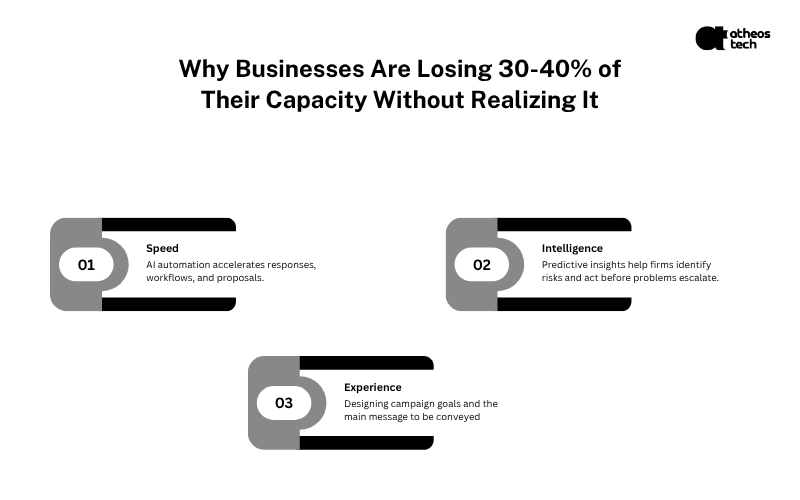
Speed as a Moat:
AI-enabled firms respond to RFPs in hours instead of days. They process client work while traditional firms are still gathering data. In a recent analysis of 250 Dutch professional service RFPs, firms with automated proposal systems won 38% more often. They won not because of better pricing, but because they responded four times faster with data-backed accuracy.
Intelligence as a Differentiator:
AI firms do not just report what happened, they predict what will happen next. When a traditional accounting firm realizes a client is unhappy, it is usually during an exit conversation. An AI-enabled firm receives automated alerts when engagement scores drop, giving them 60 days to intervene before churn occurs.
Experience as a Retention Tool:
Modern client experience is a massive competitive barrier. Your B2B clients in 2026 expect a dashboard they can access anytime from their phone with real-time project status and milestone tracking.
Market research from Dutch professional services shows that firms still operating on legacy infrastructure are losing 8 to 12% market share annually to digital-native competitors. This is where AtheosTech steps in. We stop this market share erosion by stripping out your fragmented tools and engineering a unified, data-backed system. We transform traditional agencies into highly scalable machines where every operational process ties directly back to predictable revenue.
How AI Is Transforming Every Corner of Dutch Business Services: Industry-by-Industry Breakdown
The AI integration process is never one-size-fits-all. Each vertical faces unique regulatory requirements and client expectations. Here is how modern B2B business services are reinventing themselves, and how AtheosTech builds the exact infrastructure to make it happen.
1. Accounting & Financial Advisory Services
The Pain Point: Manual transaction reconciliation consumes 15 to 20 hours weekly. Month-end closes take a full week, and compliance documentation is chaotic. When fintech-enabled competitors offer real-time financial dashboards, traditional firms delivering monthly PDF reports appear obsolete.
The Transformation: Artificial intelligence AI is utilized for automated transaction processing, bank feed reconciliation, and predictive cash flow modeling based on historical patterns.
How AtheosTech Helps: Modernizing accounting operations requires more than off-the-shelf software. We act as your specialized technology partner to build custom financial intelligence platforms. We integrate your existing Dutch tools, like Exact or Twinfield, with AI-powered automation and client-facing portals. Explore our Custom Software Development here.
2. HR & Recruitment Consultancies
The Pain Point: Manual candidate screening forces recruiters to review hundreds of resumes manually. Interview scheduling is an endless back-and-forth, and candidate databases quickly become unsearchable graveyards.
The Transformation: Intelligent matching uses AI resume parsing and skills extraction. Workflow automation handles calendar integration and digital onboarding without human bottlenecks.
How AtheosTech Helps: Standard sales tools fail recruiters. We develop purpose-built CRM systems tailored for talent acquisition. We ensure your systems are fully compliant with AVG/GDPR while seamlessly integrating with LinkedIn and assessment tools to give you the fastest time-to-hire in the market.
3. Legal & Compliance Advisory
The Pain Point: Contract review consumes hours of billable time per document. Version control is a nightmare, and relying on email for secure client communication is a massive risk. Furthermore, billable time tracking failures cause constant revenue leakage.
The Transformation: AI-powered document intelligence instantly flags risks and identifies clauses. Secure client platforms provide automated legal intake workflows and e-signature integration.
How AtheosTech Helps: Legal modernization demands security-first architecture. AtheosTech provides secure application development featuring end-to-end encryption, audit trail logging, and role-based access controls. We ensure your firm operates with maximum efficiency without ever compromising Dutch or EU compliance.
4. Marketing & Advertising Agencies
The Pain Point: Campaign reporting takes days to compile. Clients demand to know exactly what drives their revenue, but attribution chaos makes it impossible to prove ROI. A generic business plan consulting services approach fails when clients want live data.
The Transformation: A unified marketing intelligence platform automatically aggregates data across Google Ads, Meta, and LinkedIn. Predictive algorithms recommend budget reallocations instantly.
How AtheosTech Helps: We fundamentally believe in revenue engineering over vanity metrics. AtheosTech builds custom marketing analytics platforms equipped with bi-directional API integrations and white-labeled dashboards, ensuring your agency can prove its exact value in real-time.
5. Logistics & Supply Chain Consultancies
The Pain Point: Spreadsheet-based capacity planning leads to reactive problem-solving. Disconnected Transport Management Systems (TMS) and Warehouse Management Systems (WMS) leave clients entirely in the dark regarding their shipments.
The Transformation: Predictive logistics intelligence forecasts delays based on weather or port congestion. Unified visibility platforms provide exception-based alerts directly to clients.
How AtheosTech Helps: Logistics requires flawless multi-party system orchestration. Our business IT consulting services team develops custom middleware to connect your legacy systems with modern cloud infrastructure. We bridge the gap so your data flows instantly from the warehouse floor directly to your client's mobile device.
Whether you are in Legal, Finance, or Logistics, a generic 'out of the box' tool won't protect your competitive edge.
Your Clients Have Already Left 2020 Behind. Have You?
Here is an uncomfortable reality. Your clients’ expectations for professional business services (zakelijke dienstverlening) have been permanently reshaped by their experiences with consumer technology. They no longer compare your service solely to other consultants. They compare it to every frictionless digital experience they have. When a client can track a €15 package in real time but cannot see the status of their €50,000 project without emailing you, they notice the gap. Increasingly, they are migrating to firms that bridge that gap.
As we move deeper into 2026, industry predictions highlight a critical shift toward “real-time experience orchestration.” Buyers now demand proof over promises, and they expect instantaneous, data-driven interactions. To maintain a competitive advantage (concurrentievoordeel), Dutch companies must recognize these new baselines.
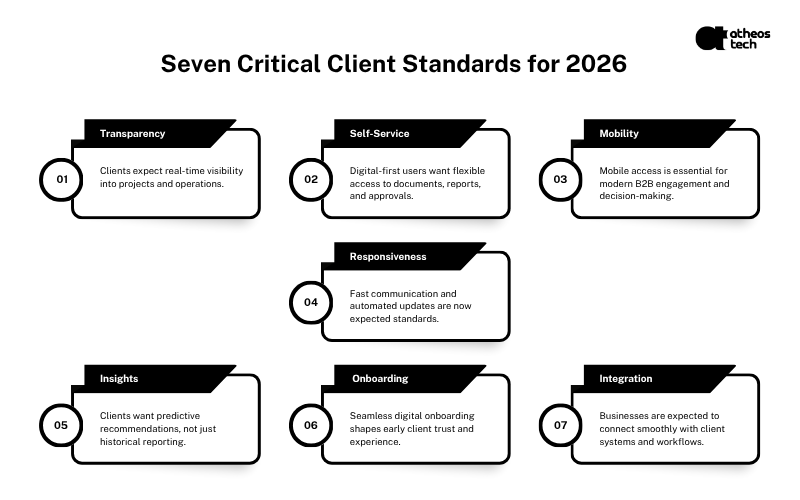
The Seven Non-Negotiable Client Expectations in 2026
The Churn Reality
Recent 2025/2026 data shows that outdated technology and poor digital experiences are a leading cause of churn in B2B relationships. Among younger decision-makers, tolerance for clunky, manual processes is practically zero. Operational modernity is not just about impressing your clients. It is a fundamental requirement to avoid losing them.
When a client asks for a timeline, a traditional firm takes six hours to send a static PDF. An AI-powered firm allows the client to open an app and see a live Gantt chart instantly. That is the exact competitive advantage that AtheosTech engineers provide for our partners. We build the client-facing portals that make your firm indispensable.
The Retention Reality: Building a Digital Moat
It is a dangerous misconception to view digital transformation purely as an acquisition engine. In the B2B services sector, it is primarily a defense mechanism.
When your clients are forced to dig through old email chains to find an invoice or request a project status update via WhatsApp, friction builds. If an AI-native competitor approaches that same client, offering a unified, white-labeled portal where they can view real-time project KPIs, approve documents with one click, and track their ROI, your expertise alone will not be enough to save the account. AtheosTech engineers digital architecture that does more than attract new leads. It builds a digital moat around your existing clients, making the switching cost to a competitor unappealingly high.
Why 70% of Digital Transformation Projects Still Fail in 2026 (And How to Be in the 30% That Succeed)
If you have hesitated to modernize your Dutch businesses, there is usually a very valid reason. You have likely seen transformation projects fail. Perhaps at a previous company or a peer firm, you watched an expensive rollout collapse. Industry statistics from Gartner and recent 2026 analyses confirm that nearly 70% of digital transformation initiatives fail to meet their original objectives. They run over budget, suffer from low user adoption, and eventually get abandoned.
These are not scare tactics. These are market realities. However, understanding exactly why these transformations fail is the first step to ensuring yours succeeds.
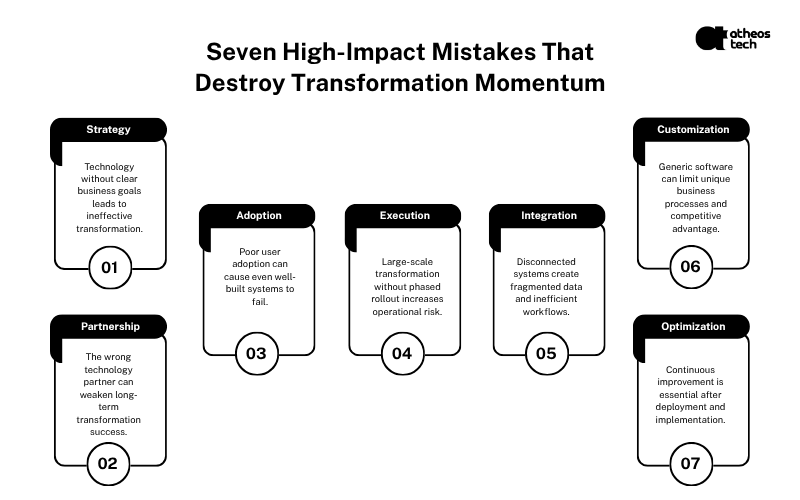
The Seven Fatal Transformation Mistakes
Mistake 1:
Starting with Technology Instead of Strategy
Many firms fall into the "technology trap." They buy software before defining their desired business outcomes. Stating "we need a CRM" is a tool answer, not a strategic goal. Successful AI adoption requires defining the exact business problem first.
Mistake 2:
Choosing the Wrong Technology Partner
Hiring the cheapest developer or a massive, impersonal consultancy often leads to disaster. True digital transformation requires a partner who understands both your business operations and the technology architecture. At AtheosTech, we act as your strategic transformation partner first and your technologist second. We do not just sell software, we engineer revenue.
Mistake 3:
Underestimating Change Management
You can build perfect technology, but if no one uses it, the project fails. Up to 70% of software implementations fail specifically because of poor user adoption. If your team is excluded from the design process or frustrated by poor usability, they will immediately revert to their old spreadsheets.
Mistake 4:
Big Bang vs. Incremental Approach
Attempting to replace everything in a massive three-month sprint is a recipe for operational chaos. The smartest Dutch SMEs implement workflow automation incrementally. They prove the ROI with one department first, build confidence, and then scale the solution.
Mistake 5:
Ignoring Integration Architecture
Implementing isolated solutions that do not talk to each other simply replaces an old fragmentation problem with a new one. If your new CRM does not sync with your accounting software, your data is useless. Modern transformation requires an API-first design to create a single source of truth.
Mistake 6:
Choosing Off-the-Shelf When You Need Custom
Forcing your unique business processes to fit the limitations of generic software will erode your market position. Generic tools are fine for standardized tasks like email. However, if your unique operational process is what sets you apart in the market, you require custom development to protect that edge.
Mistake 7:
No Post-Launch Optimization Plan
Treating the software launch as the finish line is a fatal error. The first 90 days of AI implementation always reveal unpredictable usage patterns. Continuous optimization is required to adapt to market changes and user feedback.
The 30% of firms that succeed view their digital transformation as a continuous operational evolution. By partnering with AtheosTech, you avoid these common pitfalls. We guide you through the strategy, the custom architecture, and the change management required to make your transformation a permanent success.
The AI-Ready Business Infrastructure: A Five-Layer Architecture for Operational Excellence
After analyzing over 200 successful business transformations across the Netherlands, a clear architectural pattern emerges. Successful Dutch businesses do not just add technology. They rebuild their operations across five interconnected layers. Each layer depends on the one below it. If you skip a layer, the entire structure becomes fragile.
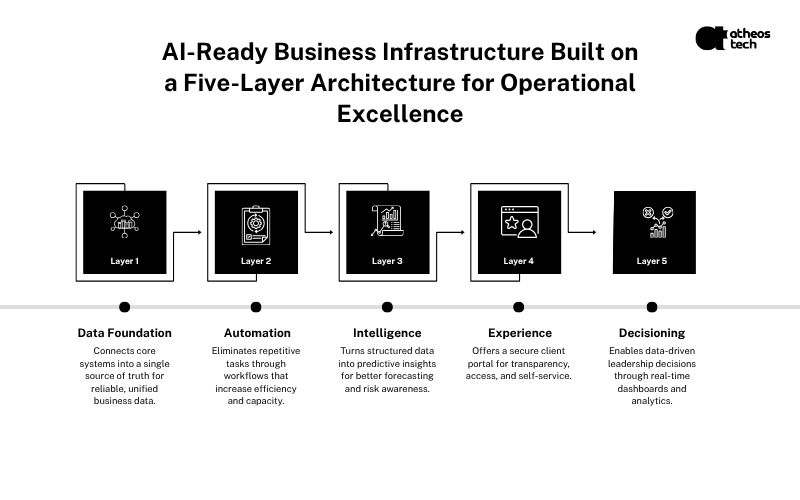
Layer 1: The Unified Data Foundation
AI cannot run on fragmented data. Before automation or intelligence, you need a single source of truth. This involves connecting your CRM, financial data, and operational tools into a consolidated architecture. With unified data, your team stops asking where information is and starts asking what they should do with it. Our business IT consulting services specialize in architecting these foundations specifically for the Dutch market.
Layer 2: Intelligent Automation
Once your data is unified, repetitive processes should be eliminated. This is where your operational capacity multiplies. By implementing workflow automation for administrative tasks, document generation, and communication triggers, firms typically redirect 12 to 18 hours per employee every week back to high-value work.
Layer 3: AI & Predictive Intelligence
With clean data and automated processes, your AI implementation can finally generate insights that humans cannot see. This layer transforms your firm from reactive to proactive. Instead of discovering a problem after it happens, you use predictive analytics to forecast project profitability and client churn risk before they impact your bottom line.
Layer 4: The Client Experience Platform
Internal excellence means little if your clients still perceive you as outdated. This layer is your digital storefront. A secure, white-labeled client portal provides real-time transparency and self-service capabilities. Research shows that firms with mature client portals report 22% lower churn and significantly higher satisfaction scores.
Layer 5: Business Intelligence & Decision Support
The top layer is the control tower for leadership. It provides real-time visibility into the health of your B2B business services. From executive dashboards to predictive planning tools, this layer ensures that every strategic decision is backed by hard data rather than gut feeling.
Most firms fail because they lack a unified data foundation. Let our architects audit your current stack and design a 5-layer system built for scale.
The Dutch Business Service Firm of 2030: What Winning Looks Like
Imagine it is 2030. You are running a professional services firm that generates €5M in revenue with a team of 25. But the daily reality is different from what it is today. You are not drowning in operational chaos or firefighting client issues. Instead, your firm runs as a well-orchestrated system. This is the inevitable destination for Dutch SMEs that commit to transformation today.
A Day in the Life of a 2030 Leader
Your morning begins with an AI-generated executive briefing on your phone. You see that your revenue is on track, but the system has flagged two projects at risk of budget overruns with recommended interventions. By mid-morning, a prospect submits an inquiry. Within minutes, your AI-powered assistant has analyzed the requirements, generated a custom proposal based on your margin targets, and scheduled a discovery call.
In the afternoon, you meet with a client. Instead of a static PDF report, you both look at a live dashboard in your client portal. The conversation is not about what happened last month. It is about strategic moves for the next quarter because the data is already processed and visualized. You end your day at 6:00 PM knowing there are no fires to fight and no reports to manually compile.
The Strategic Shift
By 2030, winning firms will not be viewed as mere providers. They will be technology-enabled strategic partners. These firms will charge a 30 to 40% premium pricing because their delivery experience is superior. They will attract the best talent because they provide the best tools.
The AI economy’s impact is creating a divide. Firms that lead today will reach this state by 2027. Those who wait until 2028 will struggle to catch up as the market shifts toward early movers. AtheosTech exists to ensure you are on the winning side of that divide. We do not just help you survive the transition. We help you dominate the new landscape.
Case Study: How a Mid-Sized Utrecht Financial Advisory Firm Reduced Operational Costs by 25% While Scaling Predictably
To understand the tangible AI economy impact, we must look at a real-world example. Consider a specialized 12-person financial advisory firm based in Utrecht. In early 2024, they were a successful but strained B2B business services provider. They were drowning in manual reconciliations, and their client onboarding process took nearly two weeks of administrative back and forth.
The Before State (2024)
The firm was trapped in a cycle where every new client added more chaos. They had 12 employees serving 48 clients, but their operational overhead sat at a heavy 31%. Senior advisors were spending 10 to 12 hours a week on admin rather than advisory work. Their AI adoption was non-existent, and they were losing prospects to younger, AI-Powered competitors.
The AtheosTech Transformation Journey
The firm partnered with AtheosTech for a multi-phase digital overhaul focused on revenue engineering.
- Data Unification: We replaced their disconnected tools with a unified data architecture, integrating their Exact accounting software with a custom CRM.
- Workflow Automation: We implemented workflow automation for onboarding and reporting. Manual data entry was drastically reduced across the board.
- Client Portal Launch: We deployed a secure, white-labeled portal where clients could access real-time financial dashboards.
- AI Intelligence Layer: Finally, we integrated artificial intelligence AI to flag early warning signs for client churn and identify expansion opportunities.
The After State (2026)
By the second quarter of 2026, the results demonstrated highly sustainable growth. The firm grew its revenue by 28% while adding only a single strategic hire. Their onboarding time dropped from 14 days to just 4 days. Most importantly, their operational overhead decreased to a much healthier 23%. They did not just survive the transition to the AI agent economy. They are now setting a steady, profitable pace in the Utrecht market.
| Metric | Before (2024) | After (2026) | Change |
|---|---|---|---|
| Annual Revenue | €1.8M | €2.3M | +28% |
| Operational Overhead | 31% | 23.2% | -25% |
| Onboarding Time | 14 Days | 4 Days | -71% |
| Client Churn | 12% | 8% | 33% |
The firm’s Managing Partner noted that they are finally running a business instead of fighting fires. That is the power of a strategic technology partnership.
Digital Transformation for Dutch Business Services: Your Questions Answered
We understand that the shift toward AI integration can feel overwhelming for Dutch SMEs. Here are the most frequent questions we receive from leaders across the Netherlands.
A full transformation typically takes 12 to 18 months to reach total maturity, but you will see results much sooner. Most firms we work with report a 20% increase in efficiency within the first 4 to 5 months as we finalize the data unification phase. We focus on incremental wins so your business is never paralyzed by the change.
Investment varies based on complexity, but for smaller companies with 10 to 15 employees, a foundational automation project often starts around €75,000. For firms with up to 250 employees requiring custom AI solutions, the investment is higher. However, when you factor in the saved labor hours and reduced churn, the payback period is typically under 12 months.
Actually, AI implementation is even more critical for SMEs. Large enterprises can afford to throw human labor at inefficiency, but Dutch companies with smaller teams must use technology as their force multiplier. AI allows you to operate with enterprise-level efficiency on a boutique headcount.
When handled correctly, AI actually improves compliance. By using AI-powered audit trails and automated data retention policies, you reduce the risk of human error. AtheosTech architects every system with privacy by design, ensuring you meet all Dutch Authority for Personal Data (AP) requirements.
Off-the-shelf tools are great for generic tasks, but your unique operational process is your competitive advantage. Custom business consulting services ensure the technology fits your business, not the other way around. If you want to lead Europe in your niche, you cannot rely on the same generic tools as everyone else.
Most firms are either just developers or just consultants. We are both. Our business technology advisory services bridge the gap between high-level strategy and technical execution. We do not just give you a report; we build the systems that drive your revenue.
Strategic Technology Partnership: How AtheosTech Guides Dutch Business Services Through AI-Era Transformation
If you have read this far, you understand the transformation imperative. You recognize the operational patterns holding your firm back and the competitive gap widening. But understanding the problem and knowing how to solve it are two different challenges. Most Dutch business service leaders we speak with say the same thing: “We know we need to modernize, but we do not know where to start or how to do this without destroying our current operations.” That is where a strategic business technology advisory services partnership becomes essential.
At AtheosTech, we do not believe in superficial fixes. We are architects of revenue engineering. We guide firms through a proven four-phase transformation methodology designed specifically for the Dutch market.
Our Transformation Methodology
By the second quarter of 2026, the results demonstrated highly sustainable growth. The firm grew its revenue by 28% while adding only a single strategic hire. Their onboarding time dropped from 14 days to just 4 days. Most importantly, their operational overhead decreased to a much healthier 23%. They did not just survive the transition to the AI agent economy. They are now setting a steady, profitable pace in the Utrecht market.
Strategic Discovery & Roadmap:
We perform a deep operational audit of your current systems and workflows. We identify the exact technology gaps and create a prioritized roadmap with clear ROI modeling.
Foundation Architecture:
We build your unified data layer. This is where we connect your legacy systems into a single source of truth, ensuring your business IT services are secure and scalable.
Automation & Intelligence Deployment:
We deploy your custom workflow automation and AI intelligence layers. This includes your white-labeled client portal and predictive analytics engines.
Optimization & Continuous Evolution:
Digital transformation is not a one-time project. We provide ongoing support to ensure your systems evolve as the AI agent economy advances.
Why Firms Choose AtheosTech?
We understand Dutch business culture. We know that decision-making is often consensus-driven and pragmatic. We do not apply generic international templates. Instead, we build solutions architected for your specific operational reality. Whether you need business management consulting services to reorganize your internal structure or a specialized SEO service business to capture market share, we provide the technical muscle to make it happen.
With a team of over 150 technical resources, we provide the end-to-end expertise required to turn your technology from a cost center into a competitive advantage. From custom software development to high-level growth marketing, we solve both sides of the equation.
The Dutch Business Services Sector Is Dividing into Two Groups: AI-Enabled Leaders and Everyone Else. Which Will You Be?
The transformation window is still open, but it is closing fast. Right now, in 2026, early movers are gaining 18 to 24 month competitive advantages that will be nearly impossible to bridge later. By 2028, AI-Powered operations will be the baseline expectation, not a differentiator. The firms beginning their journey today will lead the market by 2030. The firms waiting will be left explaining to their clients why their competitors offer a better, faster, and more transparent experience.
The Choice Framework:
You have two clear paths in front of you.
Path A: Begin Transformation Today.
Start building operational leverage. Gain a competitive advantage while your peers hesitate. Attract the best talent with modern tools and position your firm as a technology-enabled strategic partner.
Path B: Wait and See.
Continue losing efficiency to manual processes. Watch as your competitors capture market share and struggle to retain talent that expects modern systems.
The uncomfortable truth is that there is no “steady state” option. Markets do not wait, and neither do your clients.
The Tangible ROI: The Math of Doing Nothing
Let us quantify the cost of delay. Consider a typical Dutch SMB consultancy generating €800,000 annually. Currently, without workflow automation, they might be losing 15% of their billable hours to manual onboarding, disjointed email communications, and searching for lost documents. That is €120,000 in lost capacity every single year.
For a fraction of that lost revenue, that same firm could partner with AtheosTech to deploy a fully integrated CRM, an automated client portal, and an SEO-driven web presence. The math is undeniable. The cost of digital stagnation vastly outweighs the cost of transformation. Furthermore, the current EUR/INR exchange rate represents a unique window for Dutch businesses to achieve enterprise-grade digital infrastructure at SMB-friendly budgets. Effectively, you are getting high-end European strategic quality at optimized offshore execution speeds.
Start with Clarity, Not Commitment
We understand that transformation is a significant decision. That is why we offer a no-obligation Strategic Transformation Assessment. This 90-minute audit is designed to give you a clear view of your current state versus your future potential.
You will receive a preliminary roadmap, estimated ROI projections, and technology recommendations specific to your firm. This is not a sales pitch. It is a genuine consultation to determine if transformation makes sense for your business right now.
Stop fighting fires and start engineering your future. Let AtheosTech help you turn digital reckoning into your greatest growth opportunity.
You may also like