

- AtheosTech
Automating Rent Roll Collections and Contractor Dispatch for the Modern Dutch Property Manager

Property management in the Netherlands is going through its most significant shift in a generation, and digital transformation for Dutch property managers is no longer a competitive edge; it is becoming the baseline for staying in business. The Dutch vastgoedbeheer (property management) sector counts more than 5,500 registered property managers overseeing a market valued at roughly €20 billion, yet most of these firms still run tenant communication, maintenance requests, and portfolio reporting through a patchwork of spreadsheets, email threads, and phone calls.
At the same time, new legislation such as the Wet goed verhuurderschap (Good Landlordship Act) and the Wet betaalbare huur (Affordable Rent Act) has added real compliance obligations with real enforcement teeth, while tenants and property owners increasingly expect the same self-service, always-on digital experience they get from their bank or energy provider.
AtheosTech works with Dutch property managers, housing corporations, VvE boards, and private landlords to close that gap through a 360° digital consultancy and IT solutions approach: purpose-built platforms, workflow automation, and reporting systems that turn scattered manual processes into a connected, compliant, and scalable operation. This blog breaks down exactly where the pressure points are, what “modern” property management actually looks like in the Dutch market, and how the right digital solution turns compliance and complexity into an operational advantage rather than a burden.
The State of Property Management in the Netherlands
The numbers make the urgency clear:
- The Dutch vastgoedbeheer sector includes over 5,500 registered property managers, with the sector valued at approximately €20 billion. (Source)
- The Netherlands facility management market, which overlaps heavily with property and asset management, is worth an estimated USD 6.24 billion in 2026 and is projected to reach USD 7.56 billion by 2031, growing at a CAGR of roughly 3.88%. (Source)
- The broader European property management software market is forecast to grow from USD 8.26 billion in 2026 to USD 15.29 billion by 2034, an 8%+ CAGR, driven largely by demand for integrated digital platforms. (Source)
- Spending in facility and property management is shifting toward outcome-based contracts, with providers expected to document performance, energy efficiency, and compliance data rather than simply deliver a service.
What stands out about the Dutch market specifically is its fragmentation. Most property managers still offer core advisory services (tenant screening, rent collection) manually, and only a smaller subset have layered on integrated maintenance, insurance, or energy management. That gap between “administratively capable” and “digitally integrated” is exactly where firms are either gaining a competitive edge or falling behind, especially as institutional landlords, housing corporations, and larger vastgoedbeleggers (real estate investors) begin to expect real-time reporting as a baseline requirement, not a bonus.
Why this matters for you: if your competitors are still managing a 200-unit portfolio through email and Excel, a property manager offering a tenant portal, automated maintenance ticketing, and live portfolio dashboards is not just more efficient, they are structurally more attractive to institutional clients, housing corporations, and larger landlords choosing who manages their assets.
There is also a structural reason the Dutch market is ripe for this shift right now.
The wider Dutch real estate investment climate remains active, with commercial investment volume reaching approximately €6.0 billion in the first half of 2026, a roughly 38% increase year over year, even amid a more cautious and volatile macroeconomic backdrop.
At the same time, residential mortgage activity remains healthy, with existing-home sales expected to reach around 240,000 in 2026, close to 2025 levels and just under the 2017 record.
Pain Points Dutch Property Managers Face Today
Based on how the sector actually operates day to day, these are the highest-impact problems that digital and IT solutions are best positioned to solve:
Fragmented tenant communication. Maintenance requests, complaints, and general inquiries arrive through WhatsApp, phone, email, and paper forms, with no central record. This makes it nearly impossible to prove compliance with information obligations under the Wet goed verhuurderschap.
Reactive, undocumented maintenance handling. Without a ticketing system, requests get lost, response times are inconsistent, and there is no audit trail if a dispute or Huurcommissie (Rent Tribunal) complaint arises.
No centralized meerjarenonderhoudsplan (MJOP), the multi-year maintenance and budget plan that VvE boards and larger portfolios are expected to maintain. Manual tracking makes long-term budgeting unreliable.
Manual, siloed portfolio reporting. Financial, occupancy, and maintenance data often live in separate systems (or separate spreadsheets per property), making portfolio-level reporting slow and error-prone, particularly when boards, investors, or housing corporation supervisors request updates.
Rising compliance overhead. New tenant protection laws require documented, auditable processes (deposit handling, non-discrimination policy, service cost caps), which are difficult to enforce consistently without a system that builds compliance into the workflow itself.
Data protection risk. Property managers handle a large volume of personal data (identity documents, income data, in some cases special category data) without always having formalized AVG (privacy regulation) processes, exposing them to Autoriteit Persoonsgegevens (Dutch Data Protection Authority) enforcement risk
Weak digital visibility. Many property management firms have limited local SEO presence and rely almost entirely on referrals or listing platforms for new landlord and investor clients, leaving significant growth on the table.
Several of these pain points compound each other in practice. A property manager without centralized tenant communication also tends to lack a documented maintenance trail, since requests logged informally over WhatsApp rarely make it into a structured system. That, in turn, weakens portfolio reporting, because maintenance cost and response-time data never gets captured in a form that can be aggregated. The result is a firm that looks operationally fine day to day but cannot produce the audit trail a regulator, a housing corporation supervisory board, or an institutional investor would expect on short notice.
Each of these pain points maps directly to a category of digital or IT solution, which we will walk through below.
The Compliance Pressure Cooker: What Dutch Property Managers Must Now Get Right
Regulatory pressure on Dutch landlords and property managers has increased substantially in the past few years, and this is one of the strongest arguments for moving off manual processes.
Wet goed verhuurderschap (Good Landlordship Act), in force since 1 July 2023, requires landlords and property managers to:
- Provide tenants a written information sheet outlining their rights and obligations
- Draft and publish a written, public anti-discrimination policy with objective, non-discriminatory selection criteria
- Cap security deposits at a maximum of two months’ base rent for contracts signed after 1 July 2023
- Return deposits within 14 days of the tenancy ending, itemizing any deductions in writing
- Avoid charging service costs above what is legally defined
- Comply with municipal reporting obligations, since municipalities are now required to run a meldpunt ongewenst verhuurgedrag (reporting point for undesirable rental practices) where tenants can file complaints anonymously
Wet betaalbare huur (Affordable Rent Act) builds on this by giving municipalities enforcement power, since 1 January 2025, over maximum rents calculated through the Woningwaarderingsstelsel (WWS), the national housing valuation points system used to determine regulated rent ceilings. Non-compliant rents in the regulated segment can now trigger municipal enforcement action, not just Huurcommissie disputes. (Source)
AVG (the Dutch implementation of GDPR) applies fully to property managers, since they routinely process personal data such as names, contact details, income information, and in some cases bank statements or identity documents. Property managers are expected to:
- Only collect data that is strictly necessary for the stated purpose (regulators have specifically flagged agents who request payslips or bank statements for a simple viewing appointment)
- Maintain a written data security policy and breach-notification process
- Establish a legal basis (one of six grounds under the AVG) for every category of data processed
- Sign a verwerkersovereenkomst (data processing agreement) with any third party that processes tenant data on their behalf, such as a software vendor
- Maintain a register of processing activities if data processing is non-incidental, regardless of company size
The compliance-technology connection: every one of these obligations, the information sheet, the anti-discrimination policy, the deposit timeline, the WWS point calculation, the data processing register, is far easier to prove and enforce consistently when it is built into a digital workflow rather than tracked manually across spreadsheets and email folders. This is precisely why AtheosTech designs tenant portals, maintenance systems, and reporting dashboards to be Wet goed verhuurderschap and AVG compliance-ready from the ground up, with structured audit trails, automated document delivery, and role-based data access baked into the platform architecture.
It is also worth noting that enforcement is not theoretical. Municipalities are now required to operate a public complaint point for undesirable rental practices, and the Autoriteit Persoonsgegevens has already publicly flagged real estate professionals for over-collecting personal data during routine processes such as viewing appointments; in one documented case, agents were found requesting payslips and bank statements simply to schedule a viewing, far beyond what is proportionate for that purpose. For property managers, this means two things in practice:
- Data minimization needs to be a system design principle, not a policy document. If your intake forms, portal registration flows, and CRM only capture the fields actually required for a given process, you materially reduce your AVG exposure without needing to rely on staff remembering the policy in the moment.
- Every compliance obligation should produce a timestamped record. Whether it is delivery of the information sheet, a deposit deduction notice, or a data processing agreement with a vendor, a system that logs these events automatically gives you a defensible position if a tenant, municipality, or the Autoriteit Persoonsgegevens ever asks for evidence.
This is the practical difference between “being compliant” and “being able to prove you are compliant,” and it is the second one that actually protects a property management business during an audit or dispute.
Niches and Business Models in Dutch Property Management
“Property manager” covers several distinct business models in the Netherlands, and each has different digital priorities:
Recognizing which niche a client falls into changes the digital solution significantly, a housing corporation needs governance-grade reporting and WWS calculation tools, while a private landlord managing five units needs a lightweight tenant portal and automated rent reminders. AtheosTech scopes every engagement around the client’s actual niche and revenue model rather than offering a single generic platform.
The revenue model distinction matters just as much as the operational one. A percentage-of-rent model, common among private landlord beheerders, means the property manager’s margin is directly tied to occupancy and rent collection speed, which makes automated rent reminders and vacancy-reduction tooling a direct revenue lever, not just a convenience. A fixed annual VvE fee model, by contrast, rewards operational efficiency, since the property manager’s profitability depends on how few staff-hours it takes to service each building, which is exactly what MJOP digitization and automated owner communication are designed to reduce. Understanding which model a client runs on should shape which parts of the digital roadmap get prioritized first.
Further Reading
If you manage or invest in Dutch residential real estate, you may also want to read our related blog:
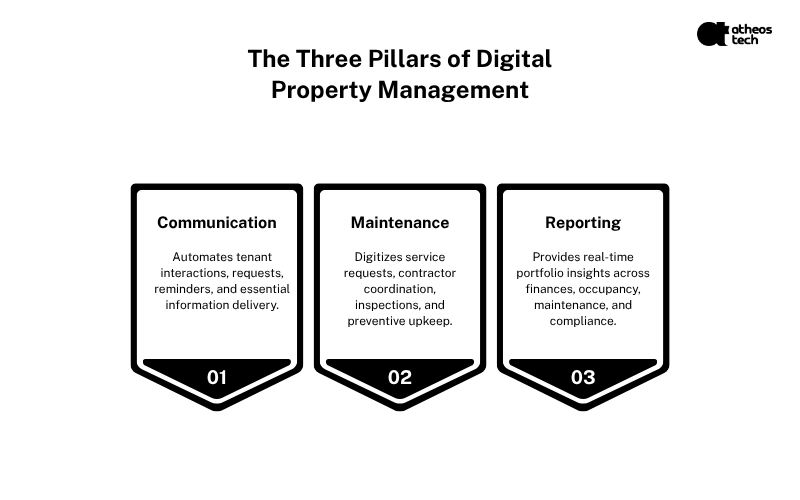
Pillar One: Automating Tenant Communication
Tenant communication is usually the first and highest-friction process property managers digitize, because it directly touches both compliance and tenant satisfaction.
What a modern, automated tenant communication system typically includes:
- A self-service tenant portal where tenants can view their contract, download documents, submit maintenance requests, and message the property manager directly, replacing scattered WhatsApp and email threads with a single documented channel
- Automated delivery of the legally required information sheet and anti-discrimination policy disclosures at the right point in the tenancy lifecycle
- Multilingual support, particularly relevant given the growing population of arbeidsmigranten (labor migrants) and international tenants who must legally be informed in a language they understand
- Chatbot or AI-assisted first response for routine questions (rent due dates, maintenance status, contract terms), reducing call volume for the property management team
- Automated rent reminders and payment confirmations, reducing manual chasing and improving cash flow predictability
In the Dutch market, several platforms already operate in this space, including Rems, Bloxs, BRIXXonline, Omniboxx, and GatePMS, alongside global enterprise-grade systems like Yardi Voyager and MRI Software for larger, multi-entity portfolios. AtheosTech does not resell or clone any of these platforms. Instead, we build custom tenant portals and communication systems tailored to a specific property manager’s workflow, branding, and compliance requirements, giving firms the functionality of these established platforms without being locked into a rigid, one-size-fits-all system.
The advantage of a custom-built portal over an off-the-shelf platform typically shows up in three places. First, branding and client experience, a portal that carries your firm’s identity rather than a third-party vendor reinforces trust with landlords and owners rather than diluting it. Second, workflow fit, off-the-shelf platforms are usually built around a generic property management process and require you to adapt your operations to the software, whereas a custom build is shaped around how your team, and your specific niche, actually works. Third, integration depth, a custom system can be built with API integration to your existing accounting, maintenance, and CRM tools from day one, rather than relying on limited or costly third-party connectors that a generic platform may or may not support.
None of this means off-the-shelf platforms are the wrong choice for every firm. For a very small portfolio just starting to digitize, a lighter existing platform can be a reasonable first step. The point at which a custom build becomes the stronger option is usually when a firm’s portfolio, compliance obligations, or reporting requirements have outgrown what a generic tool can flexibly support.
Pillar Two: Digitizing Maintenance Workflows
Maintenance is where inefficiency is most visible to tenants and most costly to property managers. A modern maintenance workflow typically includes:
- Digital ticketing that logs every maintenance request with timestamps, photos, and status tracking, creating the audit trail property managers need if a dispute ever reaches the Huurcommissie
- Automated contractor dispatch, routing requests to the right aannemer (contractor) based on issue type, location, and availability
- Meerjarenonderhoudsplan (MJOP) digitization, turning static multi-year maintenance and budget plans into living, trackable systems that update as work is completed and costs are incurred
- Preventive maintenance scheduling, using IoT sensors and building data where available to flag potential issues before they become expensive emergency repairs
- Real-time status updates for tenants, so tenants can track their request instead of calling to check progress, directly reducing inbound call volume
- Mobile inspection tools for field staff, allowing photo documentation, defect tracking, and 360° condition reports to be logged on-site rather than reconstructed later from memory or paper notes
For VvE-beheerders in particular, digitizing the MJOP is one of the highest-value moves available, since it turns a document that is often outdated the moment it is printed into a system that owners, boards, and beheerders can all see and trust in real time.
Maintenance automation also has a direct compliance dimension that is easy to overlook. Under the Wet goed verhuurderschap, tenants have a right to reasonable, timely maintenance response, and disputes over unresolved repairs are one of the more common reasons tenants escalate to the Huurcommissie or file a municipal complaint. A digital ticketing system with timestamps, contractor assignment records, and completion confirmations gives a property manager a factual, defensible record of exactly when a request was received, acted on, and resolved, which is often the difference between a quickly closed dispute and a drawn-out enforcement case.
There is also a cost-control angle. Preventive maintenance scheduling, informed by building data and historical repair patterns, consistently reduces emergency call-out costs compared to a purely reactive model, since minor issues get addressed before they escalate into urgent, after-hours repairs that carry a premium rate. For portfolios of any meaningful size, the difference between a reactive and a preventive maintenance posture shows up directly in the annual maintenance budget line.
Pillar Three: Portfolio Reporting and Data-Driven Decisions
Portfolio reporting is where digital transformation moves from operational efficiency into strategic value. Property managers, whether managing five units or five hundred, are increasingly expected to answer questions like: what is our occupancy rate this quarter, what is our maintenance spend trending toward, and are we compliant with WWS point requirements across the regulated portion of the portfolio.
A modern portfolio reporting system typically provides:
- Real-time dashboards consolidating occupancy, rent collection, maintenance spend, and compliance status across an entire portfolio, not just per property
- Automated service cost (servicekosten) reconciliation, calculating and reporting the annual settlement that Dutch law requires landlords to provide tenants
- API integration with existing accounting systems, so financial data does not need to be re-entered manually across platforms
- CSRD and ESG-aligned sustainability reporting, increasingly relevant as the Corporate Sustainability Reporting Directive pushes larger property portfolios to document energy performance and emissions data with the same rigor as financial statements
- WWS point calculation tools, helping property managers verify regulated rent compliance systematically rather than case by case
- Multi-entity and multi-currency reporting for portfolios that span multiple legal entities or international ownership structures
This is also where digitale infrastructuur (digital infrastructure) decisions matter most. A portfolio reporting system that pulls from disconnected spreadsheets will always lag behind reality. One built on proper API integration between the tenant portal, maintenance system, and accounting software gives property managers a live, trustworthy view of their entire operation.
Portfolio reporting done well also changes the nature of client conversations. Instead of a quarterly meeting built around explaining what happened last quarter, a property manager with live dashboards can walk an owner, board, or investor through what is happening right now and where trends are heading, occupancy risk, upcoming maintenance spend, compliance status, turning the relationship from reactive account management into proactive portfolio advisory. That shift is often what separates a property manager retained for years from one whose contract gets reviewed and re-tendered.
Ready to modernize how your firm communicates with tenants, manages maintenance, and reports on your portfolio?
Talk to AtheosTech about a digital transformation assessment tailored to your property management business.
How AtheosTech Approaches Digital Transformation for Property Manager
AtheosTech works as a 360° digital consultancy and IT solutions partner, not a single-product vendor. For property managers, that typically means a combination of:
- Custom IT consultant-led discovery, mapping your current tenant communication, maintenance, and reporting workflows before recommending any specific build
- Custom software and portal development, building tenant and owner portals tailored to your specific compliance obligations, niche (housing corporation, VvE, private landlord, commercial, or holiday rental), and branding
- API integration connecting your tenant portal, maintenance system, and accounting software into a single operational picture
- Web development solutions, including public-facing sites optimized for landlord and investor lead generation, alongside secure tenant and owner login areas
- Workflow automation, covering maintenance ticketing, compliance document delivery, and rent reminder sequences
- Reporting dashboard development, giving portfolio managers and boards real-time visibility without manual spreadsheet consolidation
Every solution we build is developed to be Wet goed verhuurderschap and AVG compliance-ready, with audit trails, role-based access, and data processing agreements structured into the system architecture from day one, not bolted on afterward.
Digital Marketing for Dutch Property Management Firms
Technology alone does not fill your pipeline of new landlords, investors, or VvE clients. Property management is still a relationship-driven, locally trusted business in the Netherlands, which makes digital marketing a critical complement to operational technology, not a separate concern.
For property managers specifically, this typically includes:
- Lokale SEO (local SEO), since most property management searches are hyper-local (“vastgoedbeheerder Utrecht,” “VvE beheer Rotterdam”), and ranking for these terms directly drives qualified inbound leads
- Content marketing built around the exact compliance questions landlords are searching for right now, such as Wet goed verhuurderschap obligations or WWS point calculations, positioning your firm as the authoritative local resource
- PPC marketing to capture high-intent searches from landlords actively comparing property management services, particularly effective in competitive metro markets like Amsterdam, Rotterdam, and The Hague
- Reputation and review management, since property management decisions are heavily influenced by trust signals, especially for housing corporations and VvE boards making group decisions
- Landing pages tailored by niche, since a private landlord with two units and a commercial vastgoedbelegger with a logistics portfolio respond to entirely different messaging and proof points
A property manager offering genuinely automated tenant communication, maintenance workflows, and portfolio reporting has a real differentiation story to tell, but only if that story reaches the landlords and investors actively searching for a new management partner. Digital marketing is how the operational transformation described above actually translates into new business.
Engagement Models: How We Work With Property Management Firms
Based on AtheosTech’s working dynamics, the right engagement model depends on where a property management firm is in its digital journey:
Project-based engagement, best suited for firms building a new tenant portal, maintenance system, or reporting dashboard from scratch, with a defined scope and delivery timeline
Retainer-based managed services, best suited for firms that need ongoing platform updates, compliance adjustments as regulation evolves (such as future changes to WWS or the Wet betaalbare huur), and continuous API integration support as new tools are added
Phased rollout engagement, recommended for larger portfolios or housing corporations, where tenant portal, maintenance automation, and reporting dashboards are deployed in sequence rather than all at once, reducing operational disruption
Consultancy-only engagement, for firms that want an independent digital infrastructure audit and roadmap before committing to a build, particularly useful for VvE boards or corporations that need to justify the investment to stakeholders
Because property management businesses vary so widely by niche and portfolio size, AtheosTech typically starts every relationship with a discovery conversation to determine which model fits before proposing a scope.
Conclusion
The Dutch property management sector is being reshaped by two forces at once: rising regulatory obligations under the Wet goed verhuurderschap, Wet betaalbare huur, and AVG, and rising tenant and investor expectations for real-time, digital-first service.
Property managers who continue relying on spreadsheets, scattered email threads, and manual compliance tracking are not just less efficient; they are exposed to real enforcement and reputational risk.
Those who invest in digital transformation, purpose-built tenant portals, automated maintenance workflows, and live portfolio reporting are building a structurally stronger, more defensible business, one that is easier to scale, easier to prove compliant, and easier to market to the next generation of landlords and investors.
If you manage residential, commercial, or mixed-use property in the Netherlands and want to see what a tailored digital transformation roadmap looks like for your portfolio.
Get in touch with AtheosTech for a discovery conversation.
FAQs
FAQs
It means replacing manual, disconnected processes, spreadsheets, email threads, paper maintenance logs with a connected system for tenant communication, maintenance ticketing, and portfolio reporting, typically built around a tenant portal, workflow automation, and integrated dashboards.
No specific law mandates a digital portal, but the West goed verhuurderschap does require landlords to deliver specific information to tenants in writing and, for certain groups such as international workers, in a language they understand. A portal makes this obligation far easier to fulfill consistently and to prove during a compliance check.
It is the Good Landlordship Act, in force since 1 July 2023, applying to landlords, property managers, and rental intermediaries of regular housing and labor migrant accommodation. It sets baseline standards around non-discrimination, deposit limits, service costs, and mandatory tenant information disclosures.
Yes. The AVG applies regardless of company size whenever personal data is processed. Even a small property manager handling a handful of units must have a legal basis for data processing, appropriate security measures, and, where a third-party vendor processes tenant data, a signed verwerkersovereenkomst (data processing agreement).
Yes, through API integration. Most modern accounting platforms and property management tools expose APIs that allow a custom tenant portal, maintenance system, or reporting dashboard to pull and push data automatically, avoiding duplicate manual entry.