- AtheosTech
Are Third-Party Delivery Apps Bleeding the Profit Margins of Dutch Restaurants and Cafés Dry?
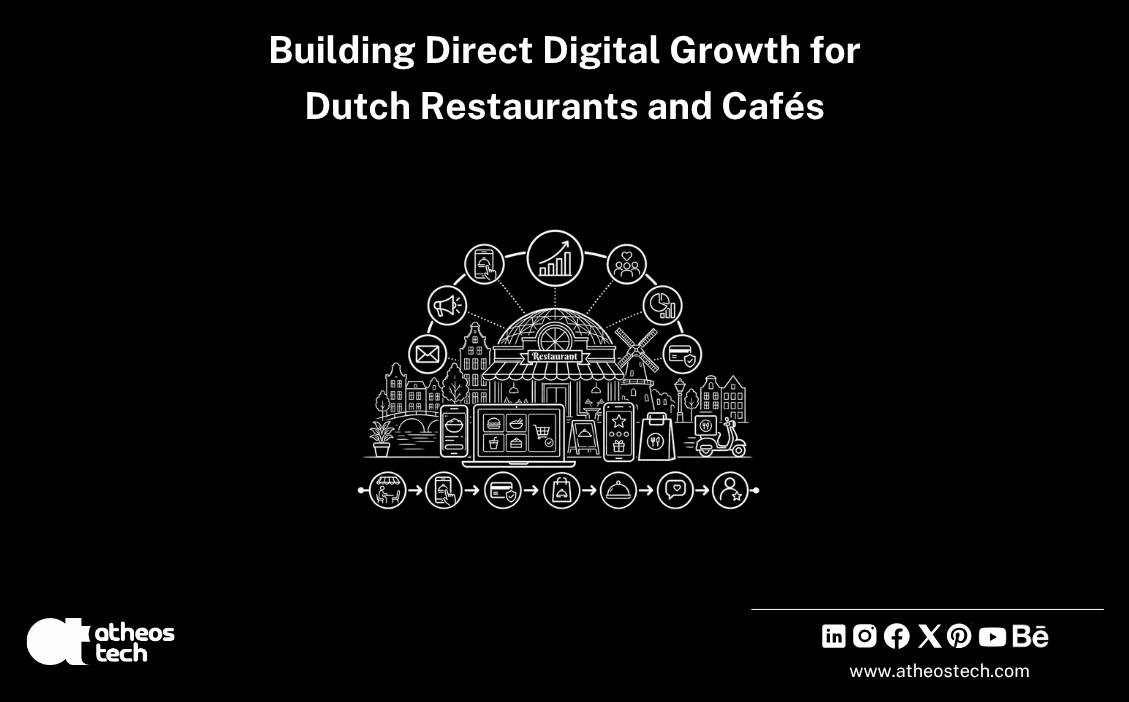
The digital transformation for Dutch restaurants and cafés has never been more consequential, and never more contested. Across Amsterdam, Rotterdam, Utrecht, Den Haag, and every gezellig buurtcafé in between, restaurateurs are waking up to a hard truth: the platforms they trusted to bring them customers have been quietly eating their margins for years.
Thuisbezorgd.nl, Uber Eats, and Deliveroo built empires on restaurant menus while operators watched their net profit disappear order by order. But something is changing. A growing number of Dutch horecaondernemers (hospitality entrepreneurs) are done playing by someone else’s rules. They are rebuilding their digital infrastructure, owning their customer relationships, and engineering sustainable revenue directly.
This blog is a deep-dive technical and strategic guide into exactly how that transformation happens, what it costs to ignore it, and how purpose-built IT solutions are making it possible for restaurants and cafés across the Netherlands to compete, retain, and grow on their own terms.
The Dutch Horeca Landscape: A Market Worth Fighting For
The Netherlands runs one of Europe’s most culturally embedded and economically significant foodservice sectors. Before diving into solutions, understanding the scale and structure of this market is essential.
The Cultural Foundation
- The term horeca (Hotel, Restaurant, Café) is not simply an industry classification in the Netherlands; it is woven into daily Dutch social life
- From the iconic bruine kroegen (brown cafés) of Amsterdam to modern all-day dining concepts in Rotterdam and Eindhoven, this sector serves as both a culinary and community infrastructure
- Dutch consumers eat out, order in, and gather in cafés with a frequency and loyalty that makes this market commercially high-stakes for any operator willing to compete digitally
Platform Dominance: The Numbers
- Thuisbezorgd.nl, owned by Amsterdam-founded Just Eat Takeaway, is the dominant force in Dutch food delivery
- Approximately 75% of Dutch consumers reported using Thuisbezorgd.nl in 2024 (Statista)
- The Thuisbezorgd.nl mobile app recorded over 500,000 downloads in the same period
- Just Eat Takeaway generated €5.2 billion in global revenue in 2023, built substantially on the commission structures charged to restaurant partners
- As of July 2024, Just Eat Takeaway had become the second most-funded food delivery company in the EU, having raised a total of €2.8 billion in funding
Global Market Growth Accelerating Digital Expectations
- The global food delivery market is projected to grow from $156.75 billion in 2024 to $173.57 billion in 2026, a compound annual growth rate (CAGR) of 10.7% (Source)
- This growth is driving consumer expectations upward across the Dutch horeca sector
- Dutch diners now expect a restaurant to be discoverable online, reviewable, bookable, and orderable from a single seamless digital experience, whether via mobile app, website, or social media
The Infrastructure Gap
- Despite accelerating digital demand, a significant majority of Dutch restaurants and cafés still lack independent digital infrastructure
- Most operators continue to route customers and revenue through third-party aggregators by default, not by strategy
- The gap between what Dutch consumers expect digitally and what most restaurants can independently deliver is the central business opportunity this blog addresses
The Commission Trap: What Delivery Apps Are Really Costing You
The financial mechanics of delivery platform dependency deserve precise, unambiguous analysis. The numbers are not abstract; they directly determine whether a Dutch restaurant is profitable or subsidizing someone else’s platform.
Platform Commission Rates in the Netherlands
- Thuisbezorgd.nl: approximately 13% to 14% commission per order, positioned as the most accessible option for smaller operators
- Uber Eats: 20% to 30% commission depending on the visibility plan selected (Lite, Plus, or Premium)
- Deliveroo: 25% to 35% commission per order, plus an onboarding fee covering photography and tablet equipment
- Bolt Food: 15% to 20% commission, a lower-cost alternative with more limited reach in the Netherlands
- According to Deliverect Netherlands, 72% of restaurants globally identify high commission fees as their most significant challenge with delivery platforms ( Source )
The Margin Mathematics
- Dutch restaurant net profit margins typically sit between 3% and 9%
- A restaurant operating at an 8% net margin, routing orders through a platform at 30% commission, is mathematically losing money on each transaction unless delivery menu prices are significantly inflated
- Inflating delivery menu prices carries its own penalty: customers notice the discrepancy, trust erodes, and repeat orders decline
- On a single €50 delivery order under a premium plan, a platform takes €15 in commission before any food cost, labour, or packaging expense is counted
The Customer Data Problem
- When a guest orders through Thuisbezorgd.nl or Uber Eats, the restaurant receives the fulfilled order, but zero customer relationship data
- No email address, no order history, no loyalty signal, no ability to retarget, re-engage, or upsell
- The platform retains the diner relationship; the restaurant retains the packaging cost
- This structural data exclusion is not an oversight; it is a deliberate feature of the platform business model
This Is a Dependency Model, Not a Service Model
- Dutch horecaondernemers who have recognized this pattern are actively investing in breaking it
- The correct strategic framing is to treat delivery platform commission as a customer acquisition cost, not a permanent operating expense
- Every repeat customer converted to a direct ordering channel is a margin recovery, not a platform loss
Critical Platform Development: The DoorDash-Deliveroo Acquisition
- In May 2026, DoorDash announced its agreement to acquire Deliveroo for approximately £2.9 billion
- The acquisition aims to consolidate DoorDash's European presence and compete directly with Just Eat Takeaway and Uber Eats
- The combined entity will operate across 40+ countries, serving approximately 50 million monthly active users
- This consolidation of major delivery platforms means even less negotiating leverage for individual Dutch restaurants
- The case for building independent direct-ordering infrastructure becomes more urgent, not less, as platform power concentrates
Further Reading
If this blog got you thinking about the broader digital transformation happening across the Netherlands, you will find our deep-dive into the Dutch logistics sector equally useful.
Pain Points Every Dutch Restaurant Owner Recognizes
The challenges facing Dutch restaurants and cafés in 2026 are not generic hospitality industry complaints. They are structural, operationally specific, and in many cases self-reinforcing. Each pain point below maps directly to a category of digital or IT solution.
Marge-erosie (Margin Erosion)
- Commission fees compound with rising ingredient costs, energy tariffs, and minimum wage increases across the Netherlands
- The margin that once made delivery a profitable revenue channel has largely eroded for most independent operators
- Restaurants are effectively subsidizing platform growth with the margin that should fund their own growth
Klantdata-eigendom (Customer Data Ownership)
- Restaurants generating the majority of their orders through third-party apps have no direct access to their own customer base
- Remarketing, loyalty programs, personalized communication, and repeat-purchase campaigns become structurally impossible without foundational customer data
- Operators are running high-volume businesses with zero intelligence about who their best customers are
Zichtbaarheid versus afhankelijkheid (Visibility vs. Dependency)
- Third-party platforms do provide genuine discovery value; a new restaurant listed on Thuisbezorgd.nl appears in front of millions of Dutch users immediately
- However, that visibility comes at the cost of structural dependency
- The moment a restaurant’s ranking slips, the platform changes its algorithm, or a competitor outbids for placement, revenue drops overnight with no independent digital channel to absorb the shock
- “Restaurant + [stad]” (restaurant + city) searches consistently rank in the top-5 local search queries across all major Dutch markets, yet most restaurants capture none of this intent organically
Gebrek aan een eigen digitaal kanaal (Lack of Own Digital Channel)
- Surveys consistently show that 65% of consumers prefer to order meals directly from a restaurant’s website or app when a functional one exists (Deliverect Netherlands, 2026)
- Despite this clear consumer preference, a significant portion of Dutch restaurants still lack a mobile-optimized, conversion-ready direct ordering solution
- The consumer intent for direct ordering exists; the infrastructure to capture it often does not
Operationele fragmentatie (Operational Fragmentation)
- Many Dutch restaurants operate simultaneously across multiple platforms (Thuisbezorgd.nl, Uber Eats, WhatsApp, telephone, and in-house POS) with no unified order management system
- Orders arrive through disconnected channels, requiring manual relay to the kitchen, increasing error rates, service delays, and staff pressure during peak periods
- The absence of POS koppeling (POS integration) across all ordering channels is one of the most immediately solvable and highest-impact operational problems in Dutch horeca
Beperkte digitale marketing capaciteit (Limited Digital Marketing Capacity)
- According to Searchlab’s 2026 horeca marketing statistics for the Netherlands, only 19% of hospitality businesses actively invest in SEO, and just 28% use Google Ads
- The overwhelming majority of Dutch restaurants are practically invisible in organic and paid search, leaving enormous local discovery potential completely untapped
- 93% of customers read online reviews before choosing a restaurant or café (EHL Hospitality Insights), yet most operators have no systematic approach to review generation or reputation management
AVG-naleving (GDPR/AVG Compliance Gaps)
- Many restaurant websites collect customer data through booking forms, newsletter sign-ups, or ordering widgets without proper consent mechanisms, cookiebeleid (cookie policy), or verwerkersovereenkomsten (data processing agreements)
- The Autoriteit Persoonsgegevens (AP), the Dutch Data Protection Authority, is actively enforcing compliance and has levied significant fines against organizations in violation
- Non-compliance is not a theoretical risk; it is a live enforcement exposure that grows proportionally with a restaurant’s digital footprint
Niches & Business Models in the Dutch Restaurant Ecosystem
The Dutch horeca sector is not monolithic, and neither are the digital solutions it requires. Different formats operate under fundamentally different economics, customer relationships, and digital strategies. Understanding the niche is prerequisite to designing the right solution.
Bruine Kroeg & Neighbourhood Café
- Community-anchored venues with revenue models built predominantly on dine-in and local repeat custom
- Delivery is rarely the primary revenue lever; lokale zichtbaarheid (local visibility) is
- Digital priorities: lokale SEO, Google Mijn Bedrijf (Google Business Profile) optimization, reputation management, and neighbourhood-level social media community building
- A fully completed Google Business Profile alone can increase Google engagement by up to 70% for these venues (Malou 2026)
- Revenue model: dine-in, beverage margin, occasional events and terrace trade
Fast-Casual & Quick Service Restaurant (QSR)
- High volume, lower ticket size, speed-dependent operations where marginal costs matter acutely
- Even a 13% commission on Thuisbezorgd.nl becomes painful at QSR order volumes
- Digital priorities: self-service kiosk systems, direct app ordering, digitized klantentrouwprogramma (loyalty program), and unified POS integration
- A custom white-label ordering app eliminates third-party commission and converts each repeat order into a fully margin-positive transaction
- Revenue model: volume throughput, upsell via digital menu engineering, loyalty-driven repeat frequency
Fine Dining & Gastronomie
- Premium Dutch restaurants compete on reputation, curation, and experience
- Digital priorities: high-quality website with editorial storytelling, chef and provenance content, online reservation system with proprietary customer data capture, and review management across Google, TripAdvisor, and Iens
- Digital priorities: self-service kiosk systems, direct app ordering, digitized klantentrouwprogramma (loyalty program), and unified POS integration
- A custom CRM storing diner preferences, dietary requirements, celebration occasions, and order history enables the kind of personalized hospitality that defines the segment
- Revenue model: high average cover, beverage pairing, private dining, and event revenue
Dark Kitchen / Ghost Kitchen
- A growing segment in Dutch urban centres (Amsterdam, Rotterdam, Utrecht), operating entirely without a public dining room
- Entirely dependent on digital discovery and direct ordering capability for every euro of revenue generated
- The structural irony: dark kitchens most need delivery platforms for initial discovery but are also most severely penalized by commission structures at scale
- Building proprietary ordering infrastructure is not optional for this model; it is existential
- Revenue model: delivery-only, margin recovery through direct channel migration as customer base grows
Specialty Café & Koffiezaak
- Dutch koffiecultuur is sophisticated and growing; specialty coffee operators compete on origin, roasting story, barista craft, and community atmosphere
- Digital priorities: Instagram and TikTok content strategy (the primary discovery channels for this demographic), loyalty app integration, QR-code digitaal menu, and click-and-collect functionality for high-traffic morning periods
- WhatsApp business integration is particularly relevant for Dutch koffiezaken managing pre-orders and local regulars
- Revenue model: beverage margin, retail bean sales, wholesale, and loyalty-driven frequency
Franchise & Multi-Location Restaurant Groups
- Multi-unit operators face a different order of technical complexity and require centralized digital management
- Digital priorities: unified POS koppeling across all locations, multi-location lokale SEO management, consolidated klantdata platform (customer data platform), and analytics dashboards tracking performance per vestiging (location)
- Each location requires its own Google Mijn Bedrijf profile, its own neighborhood-level SEO footprint, and its own localized content strategy while maintaining brand consistency
- The compounding effect of getting multi-location local SEO right is significant: a group with 10 locations each ranking well in their respective neighborhoods effectively controls local food discovery across a city
- Revenue model: dine-in, delivery, catering, franchise fee income, and centralized procurement savings
The Digital Shift: From Visibility to Ownership
The strategic reframing happening across Dutch horeca is a deliberate move from borrowed visibility to owned digital infrastructure. These are not variations of the same thing; they are structurally different business positions with profoundly different margins and risk profiles.
What Borrowed Visibility Looks Like
- Your restaurant appears on Thuisbezorgd.nl, Uber Eats, TripAdvisor, and Iens
- Customers find you through these platforms and generate orders
- Revenue flows in, commission flows out, customer data stays with the platform
- Your digital presence is entirely dependent on third-party algorithm decisions, ranking changes, and platform policy updates
- When the platform changes its rules, your business changes overnight, without your consent
What Owned Digital Infrastructure Looks Like
- A professionally built, SEO-geoptimaliseerde restaurantwebsite (SEO-optimized restaurant website) with direct ordering capability
- A proprietary customer database with order history, preferences, and contact data
- An email and WhatsApp marketing capability that communicates directly with your best customers
- A branded mobile app with push notifications and a digital klantentrouwprogramma
- A lokale SEO strategy that drives organic discovery without per-click or per-order cost
- Social media channels that function as continuous brand and discovery engines
The Hybrid Model That Works in 2026
- Abandoning delivery platforms entirely is the wrong call for most Dutch operators; their discovery reach is too significant to ignore
- The correct model is hybrid: use platforms for klantacquisitie (customer acquisition), accepting commission as an acquisition cost, while simultaneously investing in converting those customers into direct relationships
- Every customer who orders directly on a second or third occasion is generating fully margin-positive revenue
- Restaurants combining platform presence with a direct ordering channel consistently report higher overall margins because their repeat customer base increasingly orders direct (Deliverect Netherlands)
Why Lokale SEO Is the Cornerstone
- The search query “restaurant + [stad]” consistently ranks in the top-5 local search queries across all major Dutch cities including Amsterdam, Rotterdam, Utrecht, Den Haag, and Eindhoven
- A restaurant ranking organically for “beste Indonesisch restaurant Amsterdam Oost” or “gezellig terrasje Utrecht centrum” is generating qualified, commission-free customer intent at zero marginal cost per visit
- Yet according to Searchlab’s 2026 horeca marketing data for the Netherlands, only 19% of Dutch hospitality businesses actively invest in SEO, leaving this high-intent discovery channel almost entirely unclaimed by the majority of operators
- Local SEO compounds over time: an investment made today generates returns for months and years, unlike paid media which stops the moment the budget stops
Social Media as a Discovery and Revenue Engine
- Platforms like Instagram, TikTok, and Facebook have evolved from brand channels into genuine transactional marketplaces
- Dutch diners in the 18 to 35 demographic increasingly discover new restaurants through social content rather than search or platform browsing
- A consistent Instagram strategy with strong visual identity, behind-the-scenes Reels content, and user-generated content (UGC) amplification functions as a continuous, algorithm-amplified discovery engine
- 54% of Dutch hospitality businesses increased investment in digital tools in 2026 (Lightspeed), and the gap between digital leaders and laggards in the Dutch horeca market is accelerating measurably
The Competitive Intelligence Signal
- The restaurants and café groups in the Netherlands that are growing fastest right now are not the ones with the best food alone; they are the ones combining great product with sophisticated digitale aanwezigheid (digital presence)
- Owning your digital infrastructure is no longer a differentiator; it is becoming the baseline expectation for a sustainably operated Dutch horeca business
Is Your Restaurant Invisible on Google?
Only 19% of Dutch hospitality businesses actively invest in SEO. That means the first-mover advantage is still available in most Dutch cities.
Building Your Own Digital Engine: Solutions That Work
This is where architecture meets ambition. For Dutch restaurants and cafés serious about reclaiming their margins and owning their customer relationships, the following digital solutions form the operational backbone of an independent digital presence.
Custom Direct Ordering System
Platforms like Square Online, Lightspeed Order Anywhere, and Flipdish demonstrate what a branded direct ordering experience looks like. But generic SaaS tools come with their own dependency, limitations, and recurring costs that compound over time.
A custom direct ordering platform built specifically for a restaurant or café group delivers complete brand control, zero per-order commission, direct integration with existing POS systems, and full customer data ownership from day one. For multi-location operators, a custom platform can aggregate order management across all sites under a single dashboard, something generic tools rarely do elegantly.
AtheosTech develops custom ordering solutions similar in functionality to platforms like Flipdish or Owner.com, engineered specifically for the Dutch market with Dutch language support, iDEAL payment integration (the dominant Dutch payment method), and full AVG-compliance built into the architecture from the ground up.
Branded Mobile App (iOS & Android)
A proprietary restaurant app transforms a passive customer base into an engaged community. Features that drive direct orders and repeat visits include:
- Push notification campaigns for dagspecials (daily specials) and aanbiedingen (offers)
- Integrated loyalty and stamp card systems (digitizing the analogue koffiekaart)
- Table reservation with real-time availability
- In-app reorder functionality based on order history
- WhatsApp deep-link integration for Dutch customers who prefer a messaging-based service
Apps built on platforms like Olo or Bopple show the commercial model. A custom-built branded app removes platform dependency entirely and typically recoup their development investment within 12 to 18 months for restaurants processing sufficient order volume.
Restaurant Website with SEO Architecture
A restaurant website in 2026 is not a digital brochure. It is a conversion machine and an SEO asset. The technical requirements for a high-performing Dutch restaurant website include:
- Core Web Vitals optimization for Google ranking
- Schema markup for Restaurant, Menu, LocalBusiness, and Review entities
- Mobile-first responsive design (the majority of Dutch restaurant searches happen on mobile)
- Structured menu pages optimized for longtail Dutch search queries
- Integrated online reservation widget with Google Reserve connectivity
- Google Business Profile synchronization
- Cookie consent management (cookiebanner) compliant with Dutch Telecomwet and AVG
AtheosTech builds restaurant websites with this full technical stack, designed to rank, convert, and remain compliant
Digital Marketing: SEO, Social, and Paid Search
Digital marketing is not a luxury for Dutch restaurants in 2026; it is an operational infrastructure. The specific services with the highest ROI for horeca are:
Lokale SEO (Local SEO) Optimizing for location-based discovery is the single highest-leverage marketing investment for most restaurants. This includes Google Business Profile management (critical, as 93% of customers read reviews before choosing a restaurant according to EHL Hospitality Insights), citation building across Dutch directories like Iens.nl, NSMBL, and TripAdvisor, and on-page optimization targeting neighborhood-level Dutch search queries.
Through targeted local SEO, Dutch restaurants can achieve consistent first-page placement for high-intent local queries, driving reservation and walk-in traffic entirely organically.
Social Media Marketing & Content Strategy: Consistent presence on Instagram, Facebook, and TikTok drives awareness and direct reservation intent. AtheosTech's digital marketing team develops platform-native content strategies for Dutch horeca clients, including Reels production guidance, community management, and Instagram Direct ordering integration where applicable.
Google Ads & Meta Ads Paid search and social advertising can dramatically accelerate the impact of organic efforts, particularly for new openings, seasonal promotions, or special events. Geo-targeted campaigns in Dutch cities can deliver measurable reservation uplift within days of launch.
E-mail & WhatsApp Marketing Once a restaurant owns its customer data, email and WhatsApp become powerful, near-zero-cost retention channels. A well-segmented customer list is worth more, in recurring revenue terms, than any delivery platform ranking.
POS Integration & Unified Order Management
Operational fragmentation is solved at the integration layer. Modern restaurant operations require orders from direct web, app, delivery platforms, and in-house POS to flow into a single kitchen management system without manual relay. AtheosTech builds custom API integrations connecting direct ordering channels with leading POS systems, eliminating double entry, reducing errors, and enabling real-time inventory tracking across all revenue channels.
CRM & Loyalty Platform
Customer relationship management is where the margin gap between platform-dependent and platform-independent restaurants becomes most visible. A custom CRM enables:
- Automatic customer profiling from order history
- Segmented communication (vegan guests, birthday triggers, lapsed customers)
- Digital klantentrouwprogramma (loyalty program) with points, stamps, or tier-based rewards
- Net Promoter Score (NPS) tracking and automated review generation prompts
Systems like SevenRooms or Revel Systems demonstrate the commercial model. AtheosTech builds custom CRM solutions that integrate directly with a restaurant's ordering and POS infrastructure, giving operators the guest intelligence that platforms deliberately withhold.
QR Code Menus & Table Ordering
The post-pandemic acceleration of QR-code tafelbestelling (table ordering) has become a permanent fixture in Dutch horeca. Self-ordering systems reduce reliance on floor staff during peak service, decrease order errors, and typically increase average check size through algorithmically presented upsell suggestions. According to Deliverect Netherlands, table ordering systems that connect directly with a restaurant's POS can speed up table turnover times by up to 10 minutes per cover.
AtheosTech develops fully branded QR menu and table ordering systems that integrate with existing POS infrastructure and capture customer data with every transaction.
AVG & Digital Compliance for Dutch Horeca
This section is non-negotiable, and Dutch restaurateurs who skip it do so at genuine financial risk.
The AVG (Algemene Verordening Gegevensbescherming) is the Dutch name for the EU’s General Data Protection Regulation (GDPR). It is implemented locally through the Uitvoeringswet AVG (UAVG), which adds specific Dutch requirements on top of the GDPR baseline. Enforcement is handled by the Autoriteit Persoonsgegevens (AP), the Dutch Data Protection Authority, which has demonstrated increasing willingness to impose significant fines. Recent penalties include a €600,000 fine against a retailer for unauthorized tracking cookies.
For Dutch restaurants and cafés operating any digital channel, AVG compliance covers several specific areas:
Cookiebeleid (Cookie Policy & Consent) Any website collecting cookies for analytics, advertising, or personalization must display a clear cookie banner that gives users a genuine choice to accept or decline, with the reject option equally visible to the accept option. Under Dutch law, pre-ticked boxes and buried consent are not compliant.
Verwerkersovereenkomst (Data Processing Agreement) If a restaurant uses third-party tools (email marketing platforms, booking systems, CRM software), a verwerkersovereenkomst (DPA) must be in place between the restaurant and each processor. This is a specific UAVG requirement and is frequently overlooked.
Recht op inzage en verwijdering (Right to Access and Erasure) Customers who have provided personal data (email addresses, order history, reservation details) have enforceable rights to access, correct, or delete that data. Restaurant operators must have a process to respond to these requests within 30 days.
Leeftijdsverificatie (Age Verification) The UAVG sets the Dutch age of digital consent at 16, higher than some other EU member states. Any digital marketing targeting minors or collecting data from younger users requires specific safeguards.
AtheosTech’s digital solutions are AVG and UAVG compliance-ready by design. Every website, ordering system, CRM, and marketing tool developed by AtheosTech is architected with proper consent management, data minimization, processing agreements, and privacy-by-design principles, ensuring Dutch horeca clients are protected before they go live, not retroactively patched after an enforcement notice.
Engagement Model: How AtheosTech Works With You
Different restaurants have different readiness levels, budgets, and objectives. AtheosTech’s working model is structured to meet horecaondernemers where they are, not where a one-size-fits-all agency assumes they should be.
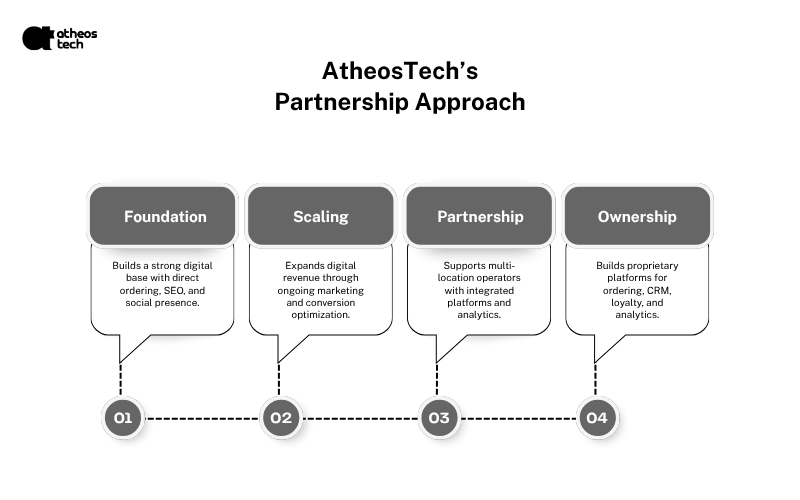
For restaurants starting from scratch (digitaal beginnen) If you currently rely almost entirely on Thuisbezorgd.nl or Uber Eats and have no proprietary digital presence, the recommended starting point is a foundational engagement: a professionally designed, SEO-architected website with direct ordering capability, Google Business Profile setup and optimization, and a baseline social media content framework. This is a defined-scope project with a clear deliverable and timeline.
For restaurants with existing digital presence looking to scale (digitale groei) If you have a website and some social media activity but are not generating meaningful direct revenue from digital channels, the recommended model is a retainer-based digital marketing engagement combining ongoing lokale SEO, paid search management, social content production, and conversion rate optimization on existing digital assets.
For multi-location or franchise operators (meerdere vestigingen) Complex operators with multiple locations, POS systems, and customer databases require a strategic IT partnership rather than a project-based approach. AtheosTech works with these clients on a dedicated partnership model, delivering custom platform development, integration architecture, centralized analytics, and ongoing technical support under a structured long-term agreement.
For technology-first operators building proprietary platforms (platformontwikkeling) Some restaurant groups want to own their entire digital stack: their ordering app, CRM, loyalty platform, and analytics engine. AtheosTech develops these end-to-end, from UX/UI design through backend development, API integrations, cloud hosting on Dutch or EU-based infrastructure, and ongoing maintenance.
In every engagement model, AtheosTech functions as a 360-degree digital consultancy, meaning the technical build, the marketing strategy, the compliance architecture, and the data intelligence are developed cohesively rather than in isolated silos that later fail to integrate.
The Platforms Worth Knowing (and What to Build Instead)
A technically literate restaurateur should understand the platforms shaping their industry, because knowing what the market leaders do reveals exactly what needs to be replicated independently.
Thuisbezorgd.nl dominates Dutch food delivery with 75% consumer reach. It provides discovery, but at 13 to 14% commission and without customer data sharing. What you need instead: a direct ordering website with SEO presence strong enough to capture branded search intent from repeat customers.
Uber Eats offers urban reach and marketing tools at 20 to 30% commission. What you need instead: a branded app with push notifications that converts Uber Eats customers into loyal direct orderers over time.
Deliveroo provides premium positioning at 25 to 35% commission. What you need instead: a high-quality restaurant website with premium visual design that communicates brand value without platform intermediation.
TheFork (IENS) is the dominant restaurant reservation platform in the Netherlands, well-known locally as Iens. It provides reservation management and discovery at a per-cover fee. What you need instead: an integrated reservation system on your own website that feeds directly into your POS and CRM.
TripAdvisor and Google Maps drive enormous discovery intent. These are not platforms to replace but to dominate: regular review responses, updated menus, accurate opening hours, and geo-tagged photos optimize your ranking on both. AtheosTech’s digital marketing service includes full management of these critical listings as part of a local SEO strategy.
Too Good To Go has significant Dutch penetration and represents a zero-waste revenue channel for surplus food. It is a niche but meaningful platform for cafés and bakeries, and its integration into a restaurant’s broader digital presence is straightforward.
The Data That Should Drive Your Decision
Let these numbers anchor the business case for independent digital investment:
- 72% of restaurants globally cite high commission fees as their biggest delivery platform challenge (Deliverect Netherlands, 2026)
- 65% of consumers prefer to order directly from a restaurant’s website or app when one exists (Deliverect Netherlands, 2026)
- 93% of customers read online reviews before choosing a restaurant or café (EHL Hospitality Insights / Searchlab 2026)
- 75% of Dutch consumers used Thuisbezorgd.nl in 2024, demonstrating both the platform’s reach and Dutch consumers’ comfort with digital food ordering (Statista 2024)
- Only 19% of Dutch hospitality businesses actively invest in SEO (Searchlab 2026), meaning local search rankings are there for the taking for restaurants willing to invest
- 54% of hospitality businesses invested in digital tools in 2026 (Lightspeed), demonstrating that the competitive gap between digital leaders and laggards is accelerating
- Restaurants that complete their Google Business Profile fully receive up to 70% more engagement on Google (Malou 2026 Restaurant SEO Study)
- Table ordering systems can improve table turnover by up to 10 minutes per cover, directly impacting covers-per-service and revenue per square metre (Deliverect NL)
Conclusion: Jouw Restaurant, Jouw Data, Jouw Marge
The delivery platforms are not the enemy. They are a distribution channel with a very high price tag. The strategic error is allowing them to be the entirety of your digital strategy.
Dutch restaurants and cafés that will thrive through the second half of this decade are those that treat digital infrastructure with the same seriousness as their kitchen equipment. A custom ordering platform, a well-architected website, a disciplined local SEO strategy, a CRM that knows your regulars by name, and an AVG-compliant data operation are not luxuries. They are the margin protection layer that delivery platforms will never provide.
AtheosTech works with Dutch horeca businesses, from independent cafés in Amsterdam’s Jordaan to multi-location restaurant groups across the Randstad, to design and build the digital infrastructure that converts platform dependency into direct revenue.
As a 360-degree digital consultancy and IT solutions partner, AtheosTech brings together web development, app development, digital marketing, CRM integration, compliance architecture, and data analytics under one roof, so that every element of your digital presence works together rather than in isolation.
How Digitally Ready Is Your Restaurant? A Quick Self-Assessment
AtheosTech offers a complimentary digital readiness consultation for Dutch horeca businesses.
FAQs
FAQs
Thuisbezorgd.nl charges Dutch restaurant partners approximately 13% to 14% commission per order. This makes it the lowest-commission major delivery platform in the Netherlands, though it still represents a significant margin reduction for restaurants operating on net profits of 3% to 9%.
Dutch restaurants can generate direct orders by building a branded website with an integrated ordering system, launching a proprietary mobile app, optimizing their Google Mijn Bedrijf listing for local discovery, and running lokale SEO campaigns targeting neighborhood-level Dutch search queries. Each of these channels delivers orders at zero commission cost.
Yes. Under the AVG (Algemene Verordening Gegevensbescherming) and the Uitvoeringswet AVG (UAVG), any Dutch restaurant website that collects customer data through booking forms, ordering systems, or newsletter sign-ups must display a compliant cookiebanner, maintain a cookiebeleid, and have verwerkersovereenkomsten in place with all third-party data processors. Enforcement is handled by the Autoriteit Persoonsgegevens.
The highest-ROI digital marketing strategy for Dutch restaurants combines lokale SEO (local SEO) to capture organic discovery, Google Mijn Bedrijf optimization to dominate the local map pack, Instagram and TikTok content for social discovery among 18 to 35-year-old diners, and email or WhatsApp marketing to drive repeat orders from owned customer data.
Most Dutch restaurants begin seeing measurable improvements in Google rankings and organic visibility within 60 to 90 days of a structured lokale SEO campaign, provided their Google Mijn Bedrijf profile is fully optimized and on-page technical foundations are in place. Significant traffic and reservation uplift typically builds between months 3 and 6. Unlike paid advertising, the compounding nature of SEO means results continue to grow after the initial investment, making it the highest long-term ROI digital channel for independent horeca operators in the Netherlands.