- AtheosTech
Can Makelaars Escape the Grip of Funda Through Dutch Real Estate Digital Transformation?
Introduction: The Funda Monopoly Everyone Accepted
Imagine a standard Monday morning at a mid-sized makelaardij (real estate agency) in Utrecht or Rotterdam. You press publish on a beautifully staged three-bedroom family home. Within forty-eight hours, the structural machinery of the Dutch property market kicks into overdrive. Your inbox floods with forty automated booking requests, and the phone rings continuously. Within a week, a crowded viewing schedule concludes. Bids fly above the asking price, and the koopakte (purchase agreement) is officially signed. On the surface, the entire process looks absolutely flawless. The property is sold, the commission is earned, and the client is highly satisfied.
But if you look closer at the operational aftermath of that transaction, a major vulnerability emerges. Once the digital dust settles, ask yourself what your real estate business actually owns. The reality is that the forty prospective buyers who reached out to view the property are gone. The critical data detailing their budgets, specific neighborhood preferences, and current housing situations remains securely locked behind a third-party portal. The seller moves on, and your team is forced to return to square one. You are completely reliant on the exact same external platform to trigger the next wave of business. You paid to list the property and did the heavy lifting on the ground, yet you walked away with zero owned data.
This is the invisible trade-off that the Dutch real estate sector has collectively accepted for over two decades. It is the classic conflict between a system that “works” and an asset that is genuinely “owned.” We accept this Funda monopoly because the platform undeniably works as a mass-exposure engine. It aggregates demand efficiently, but it creates a dangerous state of structural dependency. When every lead, every customer interaction, and every drop of digital market intelligence routes through a single external gatekeeper, you are not building a sustainable business. You are simply renting space on someone else’s platform.
The purpose of this deep dive is not to suggest that you should leave the portal tomorrow. In a hyper-competitive housing market, cutting off the primary aggregator would be highly counterproductive. It is not about desperately seeking a perfect Funda alternative that can magically replace that volume overnight. The core thesis is simple yet critical: you must stop being solely dependent on it.
True digital resilience requires establishing a robust direct real estate channel Netherlands platform that runs parallel to traditional property portals. This means building a digital infrastructure designed specifically to capture, nurture, and convert traffic on your own terms. When you control the ecosystem, you retain the behavioral insights, the long-term lead engagement, and the direct customer relationships. This shields your operations from sudden external algorithm updates or arbitrary increases in marketplace fees. You transition from hoping for traffic to owning an audience.
In this comprehensive breakdown, we will examine the macroeconomic realities defining the 2026 Dutch housing market and uncover the structural cracks showing within traditional aggregator models. More importantly, we will outline exactly how progressive makelaars, property developers, and property managers are actively reclaiming their data autonomy across different segments of the market.
We will not save our technical methodology for a generic pitch at the end of the article. Instead, we will weave AtheosTech’s specific architectural approach directly into each section. By integrating examples of custom software engineering, intelligent database structures, and targeted digital growth strategies, we will show you exactly how to transform your business from a temporary portal tenant into a permanent digital landlord.
What does the Dutch housing market look like in 2026?
Navigating the Dutch property landscape requires a cold look at the macroeconomic metrics rather than relying on generalized market sentiment. The market conditions of 2026 reveal a complex environment where transaction volumes remain resilient, but underlying buyer behavior is undergoing a profound structural shift. For real estate professionals, understanding these dynamics is critical to surviving the evolving digital landscape.
Transaction Volumes and Price Deceleration
The market has experienced a significant surge in transactional velocity. In 2025, the market recorded a total of 238,695 homes sold, representing a robust increase of 15.61% year-on-year. This momentum carried directly into the first quarter of 2026, with 55,949 homes changing hands, marking an 8.69% increase compared to the first quarter of the previous year.
However, this high volume of sales stands in stark contrast to a clear deceleration in price growth. The rapid, double-digit price spikes seen in previous years have moderated. Year-on-year price growth reached 8.57% across 2025, but dropped to a more measured 4.98% by March 2026. This deceleration is heavily driven by a flat hypotheekrente (mortgage interest rate), which has stabilized at a higher baseline. This stable but elevated interest rate environment places a strict ceiling on buyer borrowing capacity, compounding affordability pressures and forcing buyers to be significantly more selective before initiating contact.
The Structural Supply Deficit
Beneath these transactional figures lies a massive structural supply deficit that guarantees long-term market tension. The national housing target stands at 932,300 homes gepland (planned) for construction between 2025 and 2030. Yet, when you look at the municipal execution layer, only around 440,000 units have received formal municipal goedkeuring (approval). This massive supply gap means that demand will outstrip physical inventory for the foreseeable future, making the acquisition of new instructions and projects the primary battleground for agencies and developers alike.
The Load-Bearing Metric: Declining Listing Engagement
For a digital strategist, the most critical data point does not relate to prices or physical brick-and-mortar structures. It centers on user engagement. Both NVM and Funda data reveal a striking anomaly: even though overall transaction volumes are rising, the average number of property viewings and direct contact requests generated per individual listing has steadily declined.
Buyers are no longer blindly clicking every property that appears on their screens. Elevated borrowing costs and market maturity have made consumers highly deliberate. They spend far more time researching, filtering, and qualifying properties digitally before they ever submit their personal information.
| Market Metric | Full Year 2025 | Early 2026 |
|---|---|---|
| Total Homes Sold | 238,695 units | 55,949 units (Q1) |
| Year-on-Year Price Growth | 8.57% | 4.98% (As of March) |
| Average Listing Engagement | Baseline engagement | Declining viewings and inquiries per listing |
This specific engagement drop is the warning sign that legacy real estate models are losing their grip. When buyers become highly selective and restrict their inquiries, relying purely on a third-party portal to aggregate casual traffic is no longer a viable strategy. Winning in this market requires reaching buyers earlier in their research cycle, capturing their intent on a direct real estate channel Netherlands platform, and securing their loyalty long before they filter you out on a generic marketplace.
Is Funda reliable? What are the criticisms of Funda?
To understand why a direct real estate channel Netherlands model is becoming essential, we must look objectively at the platform that currently dominates the market. Funda is not merely a website; it is the structural backbone of Dutch property discovery. However, as the market matures, the foundational architecture of the platform is revealing significant operational friction points for the agencies and developers who rely on it.
The Structural Reality of Funda
Founded in 2001 and headquartered in Amsterdam, Funda was an early pioneer in digital real estate aggregation. Over two decades, it transformed how the Dutch public searches for homes. From a corporate perspective, its ownership structure is uniquely powerful. The platform operates with major backing from American private equity firm General Atlantic, while maintaining deep ties to the NVM (Nederlandse Vereniging van Makelaars), which retains a significant ownership stake.
This specific ownership structure creates a fundamental incentive conflict. The NVM operates as the premier trade association representing real estate agents, yet it holds a vested interest in the very platform that its members must aggressively pay to use. For a localized makelaar, this means your operational costs and visibility rules are dictated by a platform partly controlled by your own trade body. There is very little collective leverage to push back against rising listing fees, algorithm changes, or rigid template constraints.
The Credibility Cracks
While the platform boasts immense traffic, user trust is facing newfound scrutiny. A prominent investigation highlighted by RTL Nieuws exposed a controversial practice regarding how listings are refreshed. Data analysis revealed that a significant volume of homes labeled as nieuw (new) had actually been sitting on the market for months. Agencies were reportedly pulling older listings and relisting them to restart the algorithm, often at adjusted prices.
Funda defended the practice, stating that a new sales strategy or changed circumstances justified resetting a listing. However, to a highly analytical buyer base navigating a tight housing market, this creates deep skepticism. When the "new" label loses its structural integrity, buyers begin to doubt the transparency of the entire platform.
The Competitor Landscape
Funda is not the only player, but the alternative ecosystem is highly fragmented. A complete view of the named competitor landscape reveals a mixture of specialized rental platforms, independent listing sites, and regional tools:
- Pararius
- Jaap.nl
- Makelaarsland
- Huizenzoeker.nl
- VBO Makelaar
- Direct Wonen
- BOG.nl
- Zimmo
- Kamernet.nl
- Vastgoedpro
- Habyt
While platforms like Pararius command immense strength in the rental market, and Jaap.nl provides a viable alternative for buyers seeking broader aggregate data, none of these platforms completely break the underlying model. They are still third-party aggregators. Moving your budget from one portal to another does not solve the core issue of data ownership; it simply changes who collects the rent.
The Inevitable Objection
At this point, a seasoned agency owner will likely raise an obvious objection: "All of these criticisms might be technically true, and the courtage (commission) structures may be frustrating, but Funda is still where 90% of buyers look first. I cannot afford to turn it off.
That instinct is absolutely correct. Turning off the primary aggregator today would paralyze your lead flow. The objective is not to abandon the platform prematurely; the goal is to stop treating it as your exclusive digital strategy. As we will detail precisely in Section 5, the most profitable agencies are not fighting the portal. They are outmaneuvering it by intercepting buyers much earlier in their search journey.
What are the biggest problems with relying on Funda?
The surface-level frustration most real estate professionals express about the dominant real estate portal Netherlands ecosystem usually revolves around cost. However, the true danger to your business is not the monthly invoice; it is the structural extraction of your data and brand equity. Across the industry, whether you are a local broker, a large-scale developer, or a property manager, relying entirely on a third-party aggregator traps you in a restrictive operational box.
To understand why a massive Dutch real estate digital transformation is currently underway, we must break down exactly how this dependency throttles the three primary segments of the market.
For Makelaars: The Loss of Brand and Data Control
For the traditional residential broker, the portal model fundamentally flattens differentiation. When a buyer searches for a property, your meticulously crafted listing is forced into the exact same rigid visual template as every other agency. You cannot highlight your unique selling proposition, your deep neighborhood expertise, or your superior service model. You are reduced to a logo in the corner of a standardized page.
Worse still is the data drain. When a buyer submits an inquiry, the platform retains the overarching behavioral data while passing you a single, isolated lead. You have no ability to run retargeting campaigns on users who viewed the property multiple times but didn’t click “contact.” You cannot track which other neighborhoods they are exploring. Furthermore, with the fragmented nature of the current NVM digital strategy, individual agencies have zero collective leverage to push back against rising listing fees or algorithm updates that suddenly deprioritize their inventory.
How AtheosTech Addresses This:
Breaking this cycle requires moving beyond a standard digital brochure. Through our specialized makelaar website development services, we architect a complete Real Estate & PropTech solution directly under your own domain. We build advanced listing-search web apps equipped with custom map views and dynamic filters that rival portal UX. Crucially, this front-end ties directly into a robust real estate CRM Netherlands architecture. To capture off-hours intent, we integrate an AI chatbot for real estate leads Netherlands trained specifically on your agency’s inventory and localized Dutch terminology, ensuring every interaction feeds directly back into a database you exclusively own.
For Property Developers: The Resale Template Mismatch
Selling nieuwbouw (new build) projects on a portal designed for existing homes is structurally broken. A phased, multi-unit development requires a completely different digital journey than selling a single resale family home. Developers are forced to cram complex, multi-stage project data into a rigid single-property layout.
This mismatch creates severe pain points. Developers lose their pre-launch momentum because generic portals lack robust tooling for early interest registration or waitlist (wachtlijst) management. Furthermore, the absence of an integrated keuzemodule (configurator) means buyers cannot digitally explore finishes, floor plans, or lot orientations before contacting sales. You are paying premium visibility rates for a platform that actively degrades the buyer’s exploration experience.
How AtheosTech Addresses This:
We transition developers away from generic listings by building a custom real estate platform Netherlands tailored to the exact lifecycle of the development. We engineer dedicated project microsites featuring interactive 3D configurators, phased-release gating logic, and CRM-linked waitlist nurturing. By combining our web development capabilities with AI/ML consulting, we can analyze the engagement data on your microsite to generate predictive unit-demand signals, allowing your sales team to optimize pricing dynamically before the next phase goes live.
For Property Managers: The Post-Match Disconnect
For property managers, the relationship with a listing portal ends exactly when the hardest work begins: the moment a match is made and the tenant moves in. A standard aggregator provides zero operational utility for the lifecycle of the tenancy.
Property managers are left managing a fragmented mess of disconnected back-office systems. Handling onderhoudsverzoeken (maintenance requests), tracking lease renewals, and managing mandatory rent-point system disclosures become chaotic, manual tasks. Without unified property management software Netherlands, managers expose themselves to severe administrative bloat and regulatory risk, particularly concerning strict data handling laws.
How AtheosTech Addresses This:
We bridge the operational gap by engineering a puntensysteem compliant tenant portal Netherlands that layers seamlessly over your existing back-office systems. Utilizing advanced API and database engineering, we connect your tenant-facing dashboard directly to your maintenance and accounting software.
Because managing tenant data carries immense regulatory weight, our security & compliance consulting teams ensure your architecture strictly adheres to real estate compliance Netherlands AVG WWFT standards, addressing all compliance rules for Dutch real estate websites regarding data retention, identification, and consent logging.
The Shared Cross-Segment Pain Point: Platform Dependency Risk
Regardless of whether you sell single homes, build 200-unit towers, or manage a portfolio of 500 rentals, the core vulnerability remains identical: third-party platform dependency risk.
When your entire lead generation engine relies on an external gatekeeper, your business is inherently fragile. A sudden change in the portal’s ranking algorithm, a significant hike in courtage (commission) or listing fees, or a shift in how they monetize lead data can instantly devastate your margins. You have no recourse because you do not control the distribution channel. True resilience requires shifting your focus toward an owned digital channel real estate model where your primary digital asset acts as a reliable, independent revenue engine.
The Direct Channel Test
Are you running a resilient digital business, or are you just a highly successful portal tenant? Ask yourself these four questions:
Do you own your lead list?
When a buyer views your listing but doesn't immediately call, can you legally capture their data and retarget them with similar properties next week?
Can you differentiate your brand?
Does your digital presence allow you to highlight specific technical expertise, neighborhood authority, or unique service offerings, or are you forced into a standardized template?
Are you protected from CRM/data loss?
If your primary portal vanished tomorrow, would your business still generate qualified inbound leads?
Is your data legally compliant by design?
Is your current tech stack automatically logging AVG consent and WWFT identification requirements without manual spreadsheet tracking?
If you answered “no” to more than one of these questions, you are exposed. It is time to learn exactly how to build a direct channel beyond Funda and reclaim your digital autonomy.
Who This Digital Reinvention Serves: The Dutch Real Estate Landscape
The pressure to move beyond Funda and embrace a direct real estate channel Netherlands model is not limited to residential agents. Across the entire property lifecycle, stakeholders are finding that legacy, portal-first strategies are no longer sufficient to maintain operational efficiency or capture high-value market share.
At AtheosTech, we engineer tailored digital infrastructures that align with the specific operational demands of these distinct business categories:
Residential Property Agents (Makelaars): Moving from purely transactional brokerage to data-driven lead nurturing. Focus is on capturing intent early and owning the prospect's data journey within a bespoke CRM.
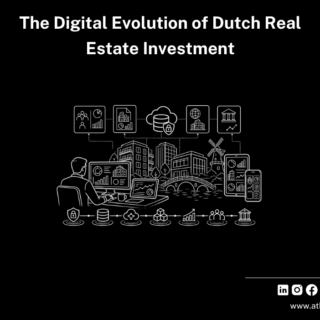
Commercial Real Estate: Positioning high-value assets for institutional investors and corporate tenants. Focus is on transparent asset performance data, secure digital document rooms, and professional-grade lead qualification.
Property Developers: Transitioning from simple resale listings to interactive, project-specific microsites. Focus is on phased project gating, 3D floor plan configurators, and CRM-linked waitlist management for nieuwbouw launches.
PropTech Startups: Creating lean, API-first architectures that allow for rapid product iteration. Focus is on backend reliability, secure data pipelines, and scalable cloud infrastructure ready for rapid user acquisition.
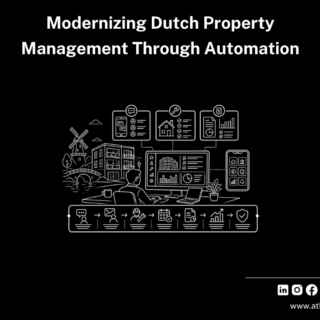
Housing Corporations (Woningcorporaties): Managing large-scale residential portfolios with extreme regulatory sensitivity. Focus is on compliant tenant communication, automated maintenance workflow integrations, and full transparency regarding the puntensysteem.
Property Management Firms: Transforming manual, email-heavy workflows into digital-first operational hubs. Focus is on lease renewals, automated document compliance, and real-time maintenance tracking.
Real Estate Investment (REITs): Managing fund transparency and asset lifecycle reporting. Focus is on high-security data management, automated reporting dashboards, and building digital trust with diverse stakeholder groups.
Regardless of your specific niche, the shared goal of this Dutch real estate digital transformation is the same: securing your digital independence so that you are no longer a tenant in someone else’s marketplace, but the landlord of your own high-performing platform.
How is the mindset of Dutch real estate agents changing about digital marketing?
Historically, the dominant mindset among makelaars and property developers was highly practical: your website was simply a digital business card. The rationale was entirely reasonable. If Funda was already generating more inbound inquiries than your agents could physically handle, why would you invest heavy capital into building your own independent search architecture? For over a decade, a basic contact page with a few team photos was completely sufficient.
But the underlying mechanics of the market have fractured, and relying on that legacy mindset is now actively costing agencies market share. The shift we are witnessing across the industry is not just a marketing pivot; it is a fundamental re-evaluation of digital architecture.
The Under-35 Squeeze and the Ex-Huurwoning Gap
The catalyst for this mindset shift is a drastic change in buyer behavior, driven directly by intense financial pressure. First-time buyers, particularly those under 35, are navigating an increasingly hostile affordability landscape. A recent market analysis by Rabobank highlighted a severe financing shortfall: prospective buyers under 35 who currently rent in the mid- or high-end segments often cannot finance the purchase of ex-huurwoningen (former rental homes) being sold off by landlords. On average, their dual or modaal inkomen (median income) leaves them falling short by roughly €120,000.
Because of this massive financial gap, these younger buyers are no longer casually browsing portals and requesting viewings on a whim. Their research process has become highly analytical and defensive. They are actively seeking out hyper-specific local data, financing workarounds, and neighborhood insights long before they ever submit a lead form on a third-party aggregator. If your agency is not capturing that early-stage research intent, you are completely invisible to a massive demographic until it is too late.
The AI-Search Shift
This deep-research phase is increasingly happening outside of traditional search engines and portals entirely. Buyers are turning to advanced AI models like ChatGPT and Gemini to answer complex logistical questions before they ever open Funda.
We are seeing a surge in highly specific, conversational queries typed directly into AI interfaces. Buyers are asking things like:
- "Wat zijn de verborgen kosten van de notaris en overdrachtsbelasting in Amsterdam?" [What are the hidden notary and property transfer tax costs in Amsterdam?]
- "Welke wijken in Utrecht hebben de beste kans op een ex-huurwoning onder de €400.000?" [Which neighborhoods in Utrecht have the best chance for a former rental home under €400,000?]
When these AI engines generate answers, they scrape the web for authoritative, structured data. If your digital presence consists solely of a generic "About Us" page, the AI has nothing to cite. You lose the opportunity to intercept that buyer. Agencies are realizing that to win in a generative AI landscape, they must architect their sites to answer these exact conversational queries directly.
From Portal Tenant to Digital Landlord
This realization is driving the core metaphor that defines modern Dutch real estate strategy: the transition from a "portal tenant" to a "digital landlord."
A portal tenant pays high monthly fees to rent visibility on a platform they do not control, capturing only the leads that the algorithm decides to pass down. A digital landlord, by contrast, builds and owns a proprietary digital asset. They attract traffic directly by publishing highly localized, structured content, such as granular wijkgidsen (neighborhood guides) and hyper-local marktrapporten (market reports). By establishing this deep local authority, they capture buyer intent months before that buyer is ready to click "contact agent" on a generic listing. They own the data, they own the relationship, and they own the distribution channel.
A Moment for Reflection
If your instinct right now is to think, "This sounds great for a massive national agency, but we are a local team of five, we do not have the time to become a media company," that is a completely fair objection.
However, building an owned digital channel real estate model does not mean writing endless blog posts. It means engineering your website so that the data you already possess, your sold prices, your neighborhood insights, your localized market knowledge, is structured in a way that modern search engines and AI can actually read.
(If you are curious about exactly what your buyers are seeing, or failing to see, when they search for properties in your specific region, we invite you to reach out via our contact page for a direct, technical visibility audit. No heavy sales pitch, just a clear look at your current digital architecture.)
What does a direct digital channel look like for a real estate business?
When industry leaders discuss building an owned digital channel real estate presence, there is often a fundamental misunderstanding of the scale involved. Escaping third-party dependency does not mean launching a basic corporate website with a list of properties and a standard contact form. If your website offers a worse search experience than the major aggregators, buyers will bounce immediately.
To actually intercept and retain market share, your infrastructure must replicate the technical utility of a major portal while maintaining the exclusivity of a private ecosystem. Based on our engineering audits across the sector, a high-converting direct channel is built on five distinct architectural pillars.
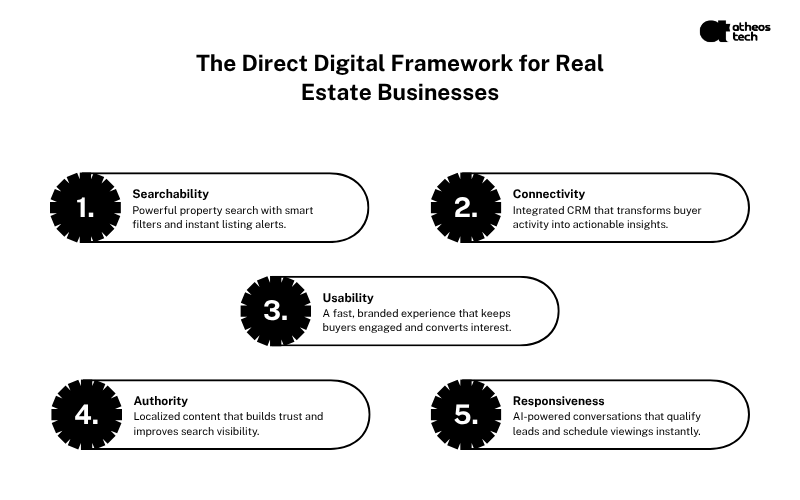
1. The Website as a True Search Hub
The core of a custom real estate platform Netherlands is a zero-latency, highly structured search engine. Buyers expect the exact same filtering speed they experience on major portals. Your interface must include deep, granular prijsklasse (price bracket) filters, interactive polygon map views to isolate specific neighborhoods, and most importantly, automated saved-search functionalities.
When a highly selective buyer cannot find a match today, they need the ability to save their exact parameters and opt-in to instant meldingen (alerts). The moment you list a property matching their criteria, your system must notify them directly, bypassing the public market entirely.
2. The Integrated CRM Backbone
A powerful front-end search hub is completely useless if the data leaks out the back. A structural flaw in many legacy agency setups is treating the website and the database as two separate entities.
A modern real estate CRM Netherlands architecture is hardwired directly into the search experience. When a user creates an account to save a favorite listing, their profile is instantly generated in your CRM. Your agents are not just receiving a static email notification; they are handed a dynamic profile detailing the buyer’s exact price ceiling, their most frequently viewed neighborhoods, and the specific property types they repeatedly click on. This is how you transition from hoping a buyer calls you, to knowing exactly when to call the buyer.
3. Replicating Portal Stickiness with Branded UX
To pull users away from established aggregators, your interface must rival their speed and usability, but carry the weight of your specific brand authority. This means engineering seamless mobile responsiveness, zero-latency image rendering, and intuitive navigation. The “stickiness” of your platform comes from providing a superior, distraction-free environment. Unlike a third-party marketplace where your listing sits adjacent to five competitors, your owned search environment guarantees that the only agent a buyer can contact is yours.
4. Content and Local SEO Infrastructure
Effective makelaar website development extends far beyond property listings; it requires building localized, technical authority that aggregators structurally ignore. Buyers entering the market spend weeks researching financial and regulatory nuances.
By building deep, localized content silos, such as detailed explainers on navigating the complexities of the puntensysteem for private investors, or calculators showing how upgrading a property’s energielabel impacts financing limits, you capture buyers in their earliest research phase. When you provide the structural answers they are searching for, you establish trust long before they are ready to bid.
5. AI-Ready Conversational Presence
Modern buyers conduct their property research at all hours, and they expect immediate responses. Forcing a highly qualified lead to wait until Monday morning for an email reply actively kills conversion rates.
The integration of an AI chatbot for real estate leads Netherlands directly into your site and WhatsApp Business channels solves this entirely. These are not basic FAQ scripts. By utilizing natural language processing trained specifically on your agency’s inventory, the bot can converse in fluent Dutch or English, qualify the buyer’s financial position, and execute a direct kijkafspraak (viewing appointment) by syncing seamlessly with your agents’ live calendars.
The Fragmented Vendor Trap (And How We Avoid It)
The fastest way to fail when building this infrastructure is to fall into the fragmented vendor trap. Agencies frequently buy a search template from one vendor, license a standalone CRM from a second, and attempt to bolt on a chatbot from a third. This creates massive technical debt, broken APIs, and constant data silos.
At AtheosTech, we explicitly engineer against this fragmentation. Through our specialized Real Estate IT Services & Consulting Solutions, we design your direct channel as a single, cohesive architecture. We combine front-end web engineering, secure cloud database integration, and proprietary AI NLP modeling into one unified build. You own the code, you own the data, and your systems talk to each other flawlessly without requiring three different support teams.
Furthermore, for large-scale property developers managing multi-phase nieuwbouw projects, we layer specialized AI/ML consulting on top of this architecture. By analyzing the deep search behavior and saved prijsklasse data captured on your microsites, we can deliver predictive demand modeling, allowing your team to optimize unit pricing dynamically before the next construction phase is even launched.
Should a real estate agency build its own portal or use a Funda-clone script?
When an agency finally decides to build an owned digital channel real estate presence, the immediate question shifts from strategy to execution. The market is flooded with software vendors offering what appears to be a rapid solution: pre-packaged marketplace themes designed to look and function like a major aggregator.
However, making a decision in the WPResidence Realtyna Flynax vs custom website debate requires a deep understanding of what you are actually buying. Are you acquiring a scalable digital asset, or are you simply paying for a fragile facade?
The Reality of Clone Scripts
If you search the market for a real estate clone script Netherlands, you will immediately encounter a specific tier of SaaS products and WordPress themes. These are not custom builds; they are mass-market products engineered to be sold globally. The most prominent include:
- WPResidence: A highly popular WordPress theme relying heavily on third-party plugins for CRM and map integrations.
- Realtyna / WPL: A WordPress framework that uses paid MLS feeds to populate property data.
- Flynax: A PHP-based classified script often used to quickly stand up rental or property directories.
- Estatik: A widely used WordPress IDX plugin.
- Open Real Estate CMS: A free, open-source Yii-based platform.
- Ready-Made Marketplace Scripts: Products like NCrypted’s “Realtor Clone Script” or Logicspice’s “Zillow Clone Script.”
- CodeCanyon Marketplace: Hundreds of generic PHP real estate scripts sold for under $100.
While these tools offer incredibly fast deployment, they suffer from predictable, structural limitations. Because they are designed for a global audience (primarily the US MLS system), they default to generic user experiences. They possess weak, plugin-dependent SEO architectures that struggle with modern AI search retrieval. Crucially, they are completely rigid when it comes to non-Dutch-market compliance defaults, they do not understand the puntensysteem, nor do they inherently protect against strict European data privacy laws. Any differentiation you achieve is purely cosmetic, usually just a change of brand colors.
The Three Architectural Paths
When evaluating a WPResidence vs custom real estate website build, agencies typically evaluate three distinct paths:
Path A: The Clone Script (The Me-Too Trap)
You purchase a pre-built theme like WPResidence or Flynax.
- Pros: Extremely low initial cost; you can launch a site in a matter of weeks.
- Cons: You fall into the “me-too” trap. Your site looks identical to thousands of others globally. When your agency attempts to integrate a highly specific local workflow, the rigid code breaks. We consistently see agencies outgrow these platforms within 18 months, forcing a total rebuild.
Path B: The Pure Custom Build
You engineer a custom real estate platform Netherlands entirely from scratch.
- Pros: Complete data ownership, zero technical debt from bloated plugins, and an architecture built specifically for Advanced Engine Optimization (AEO) and Generative Engine Optimization (GEO) from day one. It natively integrates Dutch-specific compliance.
- Cons: Higher initial capital expenditure and a longer development cycle.
Path C: The Hybrid Approach (The Recommended Default)
This is the strategic middle ground for most mid-sized agencies. You utilize a secure, headless CMS backend to manage your property data efficiently, but you engineer a completely custom, high-performance front-end interface and CRM integration. This delivers the speed and unique branding of a custom build without reinventing basic database structures.
The Direct Comparison Matrix
To clarify the operational impact of these choices, here is how the three approaches stack up:
| Evaluation Metric | Path A: Clone Script / Theme | Path B: Pure Custom Build | Path C: Hybrid Architecture |
|---|---|---|---|
| Initial Cost | Very Low | High | Medium |
| Launch Time | 2–4 Weeks | 4–6 Months | 2–3 Months |
| Data Ownership | Low (Trapped in third-party databases/plugins) | Complete | Complete |
| SEO / AEO Readiness | Weak (Relies on bloated, slow code) | Exceptional (Built for AI indexing) | Exceptional |
| Differentiation | Cosmetic only (Color changes) | Absolute structural control | High structural control |
| Compliance | Requires manual workarounds | Automated by design | Automated by design |
| Maintenance Burden | High (Constant plugin updates & conflicts) | Low (Stable architecture) | Low |
| Scalability | Breaks under heavy custom integrations | Limitless | High |
The Fourth Variant: Multi-Agent Marketplace Platforms
For large brokerage groups or developers managing multiple nieuwbouw projects simultaneously, a standard agency website is insufficient. These entities require full-scale marketplace platforms. This infrastructure must support multi-tenant architecture, allowing hundreds of individual agents to manage their own localized listings securely under one corporate digital roof. If you are operating at this scale, deploying a generic clone script is operational suicide; you require enterprise-grade marketplace engineering.
The Threat of Technical Debt
The hidden cost of the clone script route is the rapid accumulation of technical debt. When you rely on a patchwork of plugins to run your real estate portal Netherlands, you inherit massive security vulnerabilities. Constant patching is required just to keep the site online, and critical compliance protocols, such as logging AVG consent for every lead, are frequently missed because the base script wasn’t designed for European law.
At AtheosTech, we take a precise approach to this problem. When a client approaches us struggling with a rigid theme, we do not immediately demand a full, expensive rebuild. Our technology strategy consulting starts with an audit. We find the specific 20% of your architecture that is actively choking your growth, usually the broken CRM link or the slow front-end search, and we rebuild that specific layer. We modernize your infrastructure systematically, eliminating technical debt without halting your daily operations.
What compliance rules apply to Dutch real estate websites and platforms?
When evaluating a digital strategy, the conversation frequently gravitates toward lead generation and conversion metrics. However, in the Dutch market, the most significant threat to a real estate business is not a lack of traffic, it is a lack of strict regulatory compliance. The legal framework governing how property data and consumer information are handled is highly complex and fiercely enforced.
If you are using a generic real estate clone script Netherlands or a basic CRM that was built for the unregulated American market, you are likely operating in direct violation of European and Dutch law. A true custom real estate platform Netherlands must treat compliance not as an afterthought, but as a foundational architectural requirement.
Here are the six major regulatory frameworks your digital infrastructure must get right:
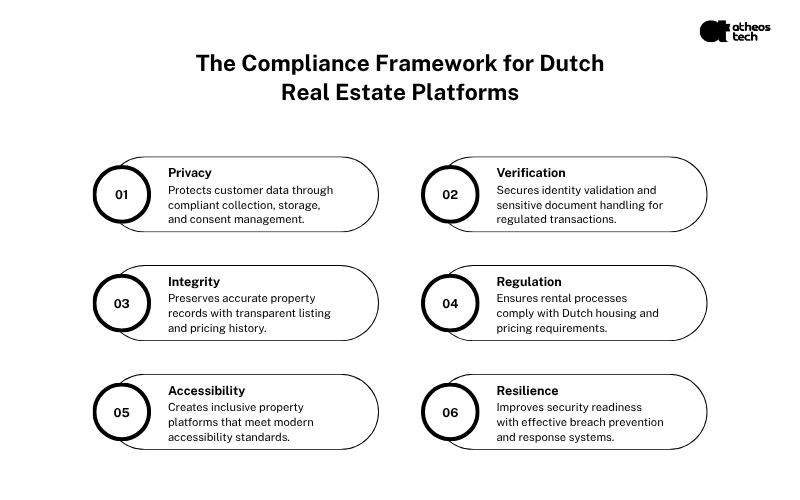
1. AVG (Algemene Verordening Gegevensbescherming)
The Dutch implementation of the GDPR dictates exactly how you capture and store buyer intent. You cannot simply scrape data or hold onto lead information indefinitely. Your CRM architecture must automatically log explicit user consent, enforce strict data retention timelines, and provide an automated mechanism for the recht op vergetelheid (right to be forgotten). If a user requests their data be deleted, your system must purge them across your entire database ecosystem instantly. Furthermore, you must maintain robust verwerkersovereenkomsten (data processing agreements) with any third-party software vendors touching your lead list.
2. WWFT and the Identificatieplicht
The Wet ter voorkoming van witwassen en financieren van terrorisme (WWFT) places a heavy burden on agents regarding anti-money laundering protocols. A core component of this is the identificatieplicht (identification obligation). If you are building a digital portal for high-end residential sales or commercial leases, your backend systems must securely handle and store encrypted identification documents, ensuring this sensitive data is walled off from general marketing databases.
3. NVM/VBO Listing Accuracy Standards
Tying directly back to the RTL Nieuws controversy highlighted in Section 3, industry bodies like the NVM and VBO enforce strict guidelines on listing accuracy and the manipulation of "new" statuses. If you are building your own real estate portal Netherlands, your database must maintain a clean, immutable audit trail of when a property was originally listed, when prices were adjusted, and how long it has been on the market. Manipulating this data on your own channel to artificially boost urgency can result in severe professional sanctions.
4. The Puntensysteem and Huurprijsplafonds
For property managers and rental agencies, the woningwaarderingsstelsel (commonly known as the puntensysteem) is the absolute law of the land. Following the aggressive expansion of the Wet betaalbare huur, your digital portals must accurately reflect these scoring mechanisms. A puntensysteem compliant tenant portal Netherlands must clearly display the exact point breakdown to huurders (tenants), ensuring the advertised rent strictly adheres to the legal huurprijsplafonds (rent caps). Failing to structure this data transparently invites immediate challenges via the Huurcommissie.
5. WCAG and Toegankelijkheidseisen
Digital accessibility is no longer optional. Public-facing real estate portals are increasingly scrutinized under strict Web Content Accessibility Guidelines (WCAG). Your platform must meet base toegankelijkheidseisen (accessibility requirements), ensuring that visually impaired users can navigate your listings, read contracts, and interact with your search filters using standard screen-reading software.
6. Datalekken and the 72-Hour Rule
Perhaps the most stringent operational requirement revolves around datalekken (data breaches). If your database is compromised, whether through a malicious hack or a simple employee error exposing a spreadsheet of buyer budgets, you are legally obligated to notify the Autoriteit Persoonsgegevens within exactly 72 hours of discovery. If your digital architecture relies on a messy web of outdated WordPress plugins, pinpointing the source of a breach within that timeframe is virtually impossible, exposing you to catastrophic fines.
The 2026 Compliance Checklist for Real Estate Tech
Before launching any new digital channel, verify these seven functional requirements:
- Does the system automatically purge lead data after a set retention period?
- Is there a one-click protocol to execute a user’s recht op vergetelheid?
- Are WWFT identification documents stored in a separate, encrypted environment?
- Do verwerkersovereenkomsten cover every API and third-party plugin on the site?
- Does the rental portal clearly display WWS point calculations to prospective huurders?
- Is the front-end code fully WCAG compliant for accessibility?
- Do you have an automated monitoring system in place to detect datalekken instantly?
How We Handle Real Estate Compliance
Attempting to retrofit a non-compliant, generic software platform to meet these strict Dutch standards is a massive drain on capital. At AtheosTech, we take a surgically precise approach to real estate compliance Netherlands AVG WWFT.
Through our specialized Security & Compliance Consulting, we do not default to tearing down your entire system. Instead, we use an audit-first methodology. We map your exact data flows from the front-end website all the way to your back-office CRM. We typically identify 3 to 6 concrete regulatory gaps, such as missing consent logs or unsecured ID storage, and we engineer specific, localized fixes to close those vulnerabilities.
(If you are unsure whether your current tech stack would survive an Autoriteit Persoonsgegevens audit, contact us today for a focused security and compliance review.)
What data supports the shift toward direct real estate channels in the Netherlands?
The transition from a portal-dependent model to an owned digital channel real estate strategy is not just a theoretical marketing concept; it is a structural shift validated by hard macroeconomic data. If you examine the numbers driving the Dutch housing market in 2026, the necessity of building an independent lead generation engine becomes undeniable.
Here is the consolidated data snapshot driving this digital pivot:
- Elevated Transaction Volume: The market demonstrated immense transactional heat, with 238,695 homes sold in 2025 (a 15.61% YoY increase) and an additional 55,949 units moving in Q1 2026 (an 8.69% YoY increase). The volume of available business is massive.
- Decelerating Price Growth: While volume is high, the era of unbridled bidding wars is softening. YoY price growth decelerated from 8.57% in 2025 to 4.98% by March 2026, heavily constrained by a stabilized, elevated hypotheekrente.
- The Structural Supply Deficit: The long-term pipeline is fundamentally constrained. While the government target sits at 932,300 gepland homes by 2030, only approximately 440,000 units currently have municipal goedkeuring, ensuring intense, long-term competition for instructions.
- The Rabobank Supply Surge: In a critical shift, Rabobank reported the addition of over 30,000 new listings in the first three quarters of 2025 alone, a 19% increase in active supply, partially driven by landlords liquidating ex-huurwoningen.
- The Engagement Drop: Most crucially, despite the 19% surge in supply and high transaction volumes, industry data reveals a steady decline in the average number of viewings and contact requests generated per individual listing on major portals.
Synthesizing the Data
When you combine these statistics, a very clear operational reality emerges. You have a market with high transaction volumes and a recent surge in inventory, yet price growth is slowing because buyers are constrained by higher borrowing costs. As a result, those buyers are becoming far more deliberate, leading to the crucial drop in per-listing engagement.
If buyers are viewing fewer homes and submitting fewer inquiries on Funda, it means they are doing heavier, more critical research before they decide to engage. They are qualifying properties, neighborhoods, and agencies long before they hit a portal’s contact button. If your agency does not have a robust direct real estate channel Netherlands presence designed to intercept that early-stage research, you are completely missing the most critical phase of the modern buyer journey. The data proves that relying solely on a portal is no longer enough to guarantee lead volume.
What a Direct-Channel Strategy Looks Like in Practice(Video)
Discussing APIs, databases, and compliance frameworks can quickly become abstract. To understand exactly how to build a direct channel beyond Funda, we must look at how these technologies are applied on the ground.
Below are three composite scenarios based directly on our engineering frameworks. While these are illustrative composites crafted to protect client confidentiality, they represent the exact operational transformations we execute for agencies, developers, and property managers operating in the Dutch market today.
Scenario 1: The Mid-Sized Makelaar (6 Agents)
This scenario is explicitly framed around AtheosTech’s typical starting engagement. A successful, six-agent makelaardij in the Randstad realizes they are spending heavily on portal fees but have zero retargeting data.
The Execution:
- The Audit: We begin by auditing their existing setup, identifying that their legacy WordPress site is bleeding leads because the search load times exceed four seconds on mobile.
- The CRM Bridge: Before building a new front-end, we structure their database. We implement a secure cloud architecture that centralizes their localized market data and active listings.
- Owned Search: We engineer a lightning-fast, custom search interface directly on their domain. It features polygon mapping and dynamic prijsklasse filters that replicate the speed of a major aggregator. Crucially, when a user sets up a saved search alert, that data flows instantly into the agency’s newly integrated real estate CRM Netherlands environment.
- Conversational AI: As the final layer, we deploy an AI chatbot for real estate leads Netherlands. Trained specifically on their local inventory, the bot captures 11:00 PM inquiries, qualifies the buyer’s financial readiness in natural Dutch, and schedules a preliminary call for the agents the following morning.
Scenario 2: The Large-Scale Property Developer (150-Unit Nieuwbouw)
A developer is launching a complex, phased new-build (nieuwbouw) project on the outskirts of Eindhoven. They know a standard portal listing will completely fail to communicate the scale and customization options of the project.
The Execution:
- The Microsite Hub: We engineer a dedicated project microsite optimized for early lead capture.
- The Keuzemodule: We build an interactive, 3D keuzemodule (configurator). Prospective buyers can explore floor plans, visualize sun orientation on specific lots, and select premium finishes directly within the browser.
- Phased Gating & The Wachtlijst: The backend is designed around strict fases (phases). As phase one sells out, the system automatically transitions users into a highly structured wachtlijst (waitlist) for phase two.
- Predictive Analytics: By running AI/ML models against the configuration data (e.g., tracking how many waitlist users are repeatedly configuring premium corner units), the developer gains predictive demand signals. This allows them to dynamically adjust the base pricing of phase two units before they are officially released to the market.
Scenario 3: The Institutional Property Manager
A beheerder (property management firm) overseeing a portfolio of 400 rental units is drowning in administrative chaos. Maintenance requests, lease renewals, and compliance updates are scattered across emails and isolated spreadsheets.
The Execution:
- The Tenant Portal: We build a highly secure, puntensysteem compliant tenant portal Netherlands that layers cleanly over their existing accounting software.
- Automated Compliance: Upon logging in, tenants can securely view their huurovereenkomst (lease agreement) and see a transparent breakdown of their WWS point allocation, ensuring the firm is instantly compliant with the latest huurprijsplafonds (rent caps).
- Streamlined Maintenance: When a boiler breaks, the tenant submits a localized request through the portal. The system automatically cross-references the unit’s maintenance warranty and pings the correct contracted plumber via an API connection, entirely bypassing the property manager’s inbox while logging the interaction for future AVG compliance audits.
Funda vs. your own website: which is better for Dutch real estate agents?
The debate over the optimal NVM digital strategy is frequently framed as a binary choice: you either surrender entirely to a third-party portal or you cut ties and build an isolated website. This is a false dichotomy. In a mature, highly competitive market, the most successful strategy does not involve choosing one over the other; it requires understanding the exact mechanical function of each channel and utilizing a hybrid architecture to maximize ROI.
To clarify exactly where your capital should be deployed, here is a direct comparison of the three primary approaches:
| Evaluation Metric | The Pure Portal Strategy (Funda/Pararius) | The Pure Owned Channel (Custom Build Only) | The Strategic Hybrid Architecture |
|---|---|---|---|
| Data Ownership | Zero. The portal owns the behavioral data and retargeting rights. | Complete. You own every click, saved search, and lead profile. | Complete. You capture portal traffic and funnel it into your owned CRM. |
| Lead Nurture | Reactive. You wait for an isolated email inquiry to arrive. | Proactive. You track deep user research and trigger automated alerts. | Proactive. Portal leads are instantly ingested and nurtured in your ecosystem. |
| Brand Differentiation | Minimal. You are constrained by rigid, standardized templates. | Limitless. You control the UX, the interactive maps, and the local branding. | High. You use the portal for initial reach, then redirect to your branded UX. |
| Speed-to-Reach | Instantaneous. You tap into an existing massive audience immediately. | Slow. Building organic authority and SEO momentum takes months. | Optimized. You leverage the portal's immediate reach while building long-term SEO. |
| SEO / AEO / GEO | Irrelevant. The portal captures the search traffic, not your brand. | Critical. Your site is engineered to capture AI and long-tail search queries. | Balanced. You dominate local long-tail searches while the portal handles broad terms. |
| Compliance Risk | Handled by the portal (but you still hold risk for local data storage). | High requirement. You must architect AVG and WWFT protocols yourself. | Managed via secure, custom database engineering tied to your CRM. |
| Long-Term Cost | Variable and rising. You are subject to continuous fee increases. | Fixed upfront CapEx, low ongoing operational costs. | Balanced. You maintain a baseline portal budget while investing in owned assets. |
| Brand Equity | You are building the portal's brand, not yours. | You are building a proprietary, sellable digital asset. | You are utilizing the portal to build your proprietary asset. |
The Verdict
If you rely entirely on a portal, you are running a highly vulnerable, transactional business that generates zero long-term digital equity. If you attempt to launch a pure owned channel and turn off the portals tomorrow, your lead flow will evaporate while you wait for SEO momentum to build.
Therefore, the only viable path for a modern Dutch real estate business is the Strategic Hybrid Architecture. You must continue to utilize the portals as a top-of-funnel mass-exposure engine. However, your ultimate goal must be to rapidly funnel that traffic off the aggregator and into your highly optimized, custom real estate platform Netherlands. Once they are in your ecosystem, your proprietary search tools, automated alerts, and compliant CRM ensure they never need to return to the portal. You use their reach to build your own digital landlord empire.
How can a Dutch real estate business build a direct digital channel?
Transitioning from a portal-dependent model to a robust owned digital channel real estate architecture can feel overwhelming. Many agencies freeze, fearing massive capital expenditure or severe disruption to their daily operations.
The key to a successful Dutch real estate digital transformation is methodical, phased execution. You do not need to tear down your entire business overnight. By following this eight-step roadmap, you can systematically reclaim your data autonomy without jeopardizing your current lead flow.
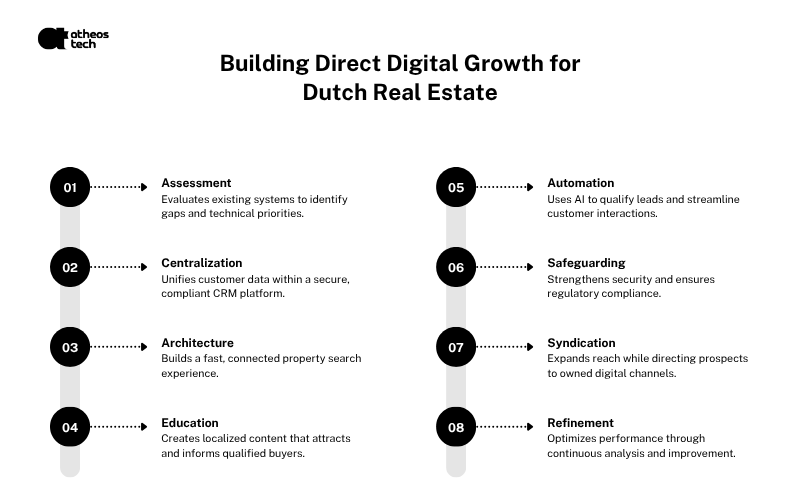
1. The Audit-First Methodology
Never commission a website rebuild or purchase a CRM without first auditing your existing data flows. Map out exactly where your leads originate, where they are stored, and where they leak out of your system. Identify your specific technical debt (e.g., outdated WordPress plugins, unencrypted WWFT data). This audit dictates your exact requirements, ensuring you only build what you actually need.
2. Establish the CRM Backbone
Before you build a front-end search experience, you must establish a secure, compliant database. Migrate your fragmented spreadsheets and legacy contacts into a unified real estate CRM Netherlands architecture. Ensure this environment natively handles AVG consent logging and secure document storage.
3. Engineer the Search Hub
With your database secure, architect the front-end user experience. This is not a standard corporate brochure; it must be a zero-latency web application. Implement dynamic map views, granular filters (e.g., prijsklasse, energielabel), and automated saved-search triggers that connect directly back to your new CRM.
4. Build Localized Content Silos
To capture buyers in their early research phase, generate highly structured content that aggregators ignore. Publish deep wijkgidsen (neighborhood guides), detailed explainers on local zoning laws, and calculators for navigating the puntensysteem. This is how you optimize for Generative Engine Optimization (GEO) and capture AI search traffic.
5. Deploy Conversational AI
Once traffic is flowing, ensure you capture off-hours intent. Integrate an AI chatbot for real estate leads Netherlands into your site and WhatsApp channels. Train the NLP model on your specific inventory and local market nuances so it can pre-qualify budgets and schedule kijkafspraken (viewings) automatically in fluent Dutch.
6. Lock Down Compliance Protocols
Before scaling your marketing, run a final security sweep. Ensure your new architecture strictly adheres to all compliance rules for Dutch real estate websites. Verify your 72-hour datalekken monitoring protocols, confirm your WCAG accessibility standards, and ensure your recht op vergetelheid mechanisms are fully automated.
7. Maintain Strategic Syndication
Do not turn off Funda. Transition your use of the portal from a dependency to a strategic tool. Syndicate your listings to the aggregators to capture mass reach, but use every interaction to pull those leads directly into your new, owned ecosystem where you can nurture them without competition.
8. Measure, Analyze, and Iterate
Treat your new platform as a living digital asset. Monitor which specific long-tail keywords are driving the highest-converting traffic. Analyze the drop-off points in your search UX and continually refine the architecture based on hard user data.
The AtheosTech Advantage: Unified Architecture
The fastest way to fail this roadmap is to hire four different vendors: a web designer for step 3, a software firm for step 2, an AI startup for step 5, and a legal consultant for step 6. This guarantees API failures and massive technical debt.
At AtheosTech, we execute this transition as a single, unified engagement. Our specialized teams seamlessly combine web & app engineering, cloud & DevOps infrastructure, advanced AI/NLP integration, and rigorous technology strategy consulting. We build your entire direct channel as one cohesive, secure architecture that you own completely. We start with the audit, and we engineer the solution.
FAQs
FAQs
When real estate professionals begin transitioning away from traditional portal dependency, several common operational and technical questions arise. Below, we address the most frequent inquiries regarding digital architecture, market positioning, and regulatory adherence.
No. Funda remains the undisputed mass-exposure engine in the Dutch housing market, and abandoning it entirely would severely paralyze your initial lead flow. However, your operational strategy must shift from absolute dependency to strategic syndication. Real estate agencies should use Funda purely for top-of-funnel reach, actively funneling those initial inquiries into their own direct digital channel. Once a buyer enters your proprietary CRM, you control the relationship, retargeting capabilities, and long-term nurture sequences without endlessly paying for repeated third-party portal exposure.
The cost of a custom real estate platform in the Netherlands varies significantly based on your underlying architecture. A fragile, off-the-shelf template might cost under €3,000 but immediately incurs massive technical debt and security risks. Conversely, a pure custom build from scratch can exceed €40,000. For most Dutch agencies, the optimal ROI lies in a strategic hybrid architecture, combining a custom front-end search hub with a scalable, headless CRM backend, typically ranging between €15,000 and €25,000, depending heavily on specific AI and AVG compliance integrations.
Funda is the market leader for residential sales, partially owned by the NVM, granting it unmatched inventory but enforcing high listing fees. Pararius dominates the Dutch rental market and expat housing sector, offering specialized tools specifically tailored for landlords and property managers. Jaap.nl operates as an independent aggregator, offering a broader, sometimes less regulated overview of the market, including FSBO (For Sale By Owner) properties. Ultimately, all three remain third-party marketplace platforms where agencies rent temporary visibility rather than owning the underlying audience data and CRM integration.
While clone scripts like WPResidence or Realtyna offer extremely fast, low-cost deployment, they represent a dangerous "me-too" trap. These generic products rely heavily on bloated plugins, struggle with modern AEO indexing, and critically lack native Dutch compliance features like encrypted WWFT identification storage or WWS puntensysteem integration. Most rapidly growing agencies outgrow these rigid templates within 12 to 18 months, forcing them to spend significantly more capital on a complete structural rebuild just to escape the accumulated technical debt, API conflicts, and severe security vulnerabilities.
A Dutch property management portal must strictly adhere to the AVG (GDPR) for tenant data retention, consent logging, and the WWFT for secure identification storage. Additionally, following the latest affordable housing regulations, portals must transparently integrate the WWS (puntensysteem) to prove strict adherence to huurprijsplafonds (rent caps). Finally, all digital platforms must meet WCAG accessibility standards and feature automated monitoring to instantly report any datalekken (data breaches) to the Autoriteit Persoonsgegevens within a rigid 72-hour window, avoiding massive regulatory fines.
Deploying a generic WordPress theme takes weeks, but engineering a robust, direct real estate channel takes meticulous planning. A strategic hybrid architecture, involving secure CRM data migration, custom search UX, dynamic map integrations, and automated compliance testing, typically requires two to three months from the initial technical audit to final deployment. For large-scale developers requiring phased 3D configurators (keuzemodules) and complex AI demand-prediction modeling for multi-unit nieuwbouw projects, development cycles generally span three to five months to ensure flawless backend logic and data synchronization.
Yes. Modern conversational AI has evolved far beyond basic, frustrating FAQ scripts. When an AI chatbot for real estate is properly integrated and trained on your specific agency’s proprietary inventory via advanced natural language processing (NLP), it can fluently and seamlessly alternate between Dutch and English. It can accurately pre-qualify a buyer’s budget, answer specific neighborhood zoning questions, and securely book a kijkafspraak (viewing appointment) directly into an agent's live calendar, effectively operating as a 24/7 digital sales assistant that never sleeps.
Conclusion: Reclaiming Your Digital Independence
The Dutch real estate market in 2026 is defined by elevated transaction volumes but constrained by stable, high interest rates and highly analytical buyers. In this hyper-competitive environment, your digital architecture dictates your market share.
Let us be absolutely clear about the core thesis of this transition: building your own digital infrastructure is not about declaring war on Funda, Pararius, or any other primary aggregator. It is about actively rejecting blind, single-channel dependency. It is about recognizing that relying on a fragile real estate clone script Netherlands or paying ever-increasing portal fees without simultaneously capturing your own proprietary data is a fundamentally flawed business model.
To thrive and secure long-term equity in this landscape, every sector of the market must take a specific, immediate action:
- For Makelaars: Stop renting your leads. Continue to syndicate to the major portals for top-of-funnel visibility, but ensure every click, every viewing request, and every saved search is funneled directly into your own proprietary search hub and CRM. You must capture and own your local audience.
- For Property Developers: Abandon the attempt to force complex, multi-phase nieuwbouw projects into rigid, single-property resale templates. Launch dedicated project microsites equipped with interactive 3D keuzemodules and AI-driven waitlist analytics to capture, nurture, and convert demand before the concrete is even poured.
- For Property Managers: Eliminate the severe operational and regulatory risks of disconnected spreadsheets. Consolidate your back-office operations into a secure, puntensysteem-compliant tenant portal that handles maintenance, lease renewals, and strict AVG adherence seamlessly in one unified environment.
The transition from a vulnerable portal tenant to a resilient digital landlord is the most significant operational upgrade your business will make this decade. However, this transformation should never begin with a rushed, expensive software purchase or a generic website theme. It requires a precise, architectural engineering mindset.
At AtheosTech, we specialize in building high-performance Real Estate & PropTech solutions. We do not blindly recommend tearing down your existing systems. We operate on a strict, audit-first methodology. We will systematically map your current data flows, identify the specific UX bottlenecks costing you leads, and uncover the hidden compliance gaps exposing you to regulatory fines. Only then do we engineer a tailored, scalable direct channel that you own completely.
Ready to reclaim your digital autonomy?
Contact our engineering and strategy team today to request a comprehensive technical visibility audit.
Let us show you exactly how your current architecture is performing and map out a precise roadmap to secure your digital independence.
(To understand how this shift fits into the broader European technological landscape, read our foundational overview on The Future of PropTech and Digital Real Estate Infrastructure.)