

- AtheosTech
Building High-Margin Direct B2B and Consumer Channels for Dutch Food and Beverage Manufacturers
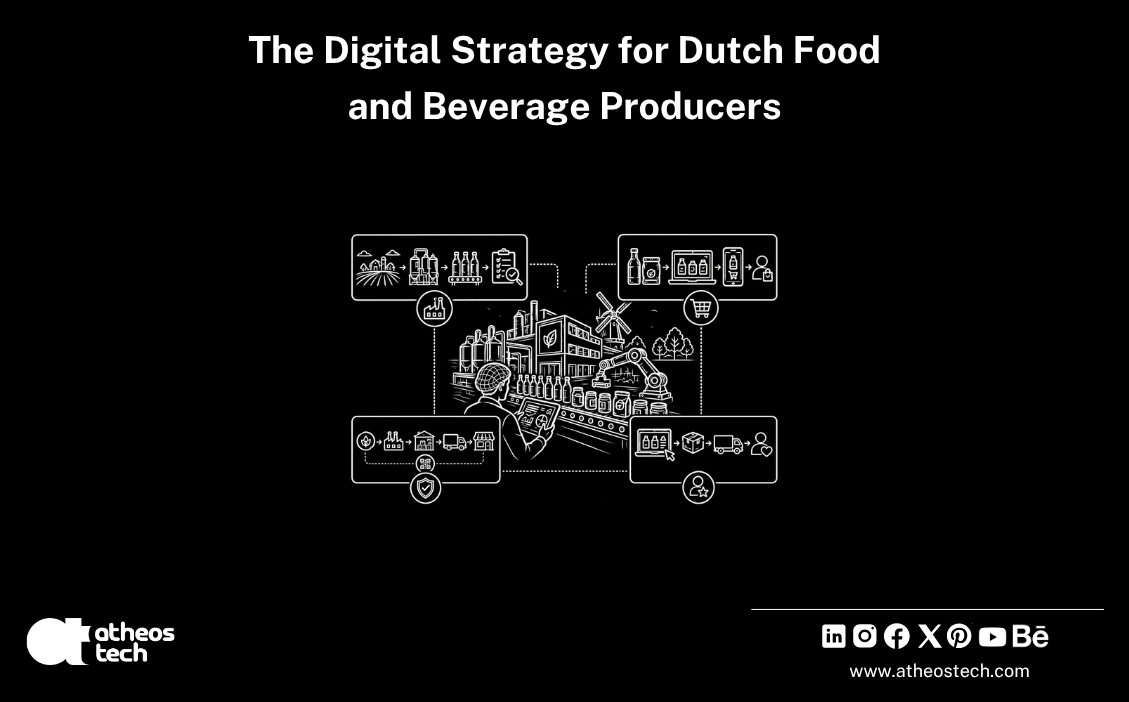
The Dutch food and beverage industry has always run on precision, from FrieslandCampina’s dairy logistics to family-run brewers and specialty producers across Gelderland, Noord-Brabant, and Zeeland. But precision on the factory floor no longer guarantees a direct relationship with the consumer, or proof that a product moved safely and legally from farm to fork.
Today, digital transformation is redrawing that path. A product no longer ends at the retailer’s shelf; it continues onto a “digital shelf” the manufacturer itself owns, tracks, and markets. This is why Dutch food and beverage manufacturers are investing in direct-to-consumer channels and traceable supply chains. Why the ones getting their digitale infrastructuur (digital infrastructure) right are pulling ahead.
This article, prepared by AtheosTech’s R&D team, breaks down what is driving this shift, the pain points forcing manufacturers to act, and how a 360° digital consultancy and IT solutions partner fits into that journey. Traceability and direct-to-consumer growth are not two separate projects; they are two outputs of the same digital solution.
The Dutch Food and Beverage Sector at a Digital Crossroads
The Netherlands is one of the world’s largest agrifood exporters, built on a mix of large-scale players and a dense network of specialized manufacturers. But digital maturity varies widely across the sector:
- A large dairy cooperative may already run sophisticated ERP and traceability systems.
- A regional brewer or artisan producer nearby may still be tracking batches on paper.
- Production and factory automation are often far ahead of the customer-facing and supply chain visibility side of the business.
This gap, strong factory automation paired with weak digital connection to the market, is exactly where the “production line to digital shelf” transition needs to happen. It is less about adding more automation on the floor, and more about connecting the data that automation already produces to compliance, direct sales, and marketing systems.
Three pressures are pushing this shift forward at the same time:
- Consumer expectations around transparency have moved from “nice to have” to a baseline requirement.
- Retailers are tightening their own supply chain documentation demands on manufacturers.
- Export markets increasingly expect digital, verifiable traceability records instead of paper certificates.
Manufacturers who treat digital transformation as one connected initiative, rather than separate upgrades, are best placed to meet all three demands at once.
The Digital Services Reshaping Dutch Food and Beverage Manufacturing
Not every IT service is relevant to a food or beverage producer, so this section focuses only on those that consistently emerge as priorities for this industry, based on category research and the sector’s direction.
- Custom web development solutions for direct-to-consumer webshops, wholesale portals, and hybrid B2B/B2C storefronts that can handle perishable inventory, batch numbers, and subscription-based ordering.
- API integration between production systems (ERP/MES), warehouse management, logistics partners, and the customer-facing storefront, so a batch produced on the line is visible in stock counts and traceability records in near real time.
- Traceability and compliance-ready platforms that log ingredient origin, batch numbers, and processing steps in a format aligned with HACCP (Hazard Analysis and Critical Control Points) and NVWA (Nederlandse Voedsel- en Warenautoriteit / Dutch Food and Consumer Product Safety Authority) expectations.
- Secure cloud hosting and data architecture for manufacturers connecting operational technology (OT) on the factory floor to customer-facing systems, an increasingly targeted attack surface in this sector.
- Digital marketing as a core, not optional, service. A traceable supply chain and a slick webshop achieve very little if consumers and B2B buyers never discover them. AtheosTech’s digital marketing scope for this sector typically covers:
- Content marketing is built around provenance storytelling: where ingredients come from, how the product is made, and what “farm to fork” actually looks like for that specific brand.
- lokale SEO (local SEO) so regional producers, farm shops, and taprooms show up when nearby consumers search for terms like “streekproducten” (regional products) or “biologische boerderijwinkel” (organic farm shop).
- PPC marketing for seasonal product launches, limited-edition runs, and B2B lead generation aimed at retailers or hospitality buyers.
- What a manufacturer achieves through this combination is direct access to consumer data (something retailers rarely share back), a repeat-purchase relationship instead of a one-off retail transaction, and a measurable, attributable return on marketing spend rather than a generic shelf placement fee.
Beyond the storefront and marketing layer, most manufacturers in this category eventually need a small cluster of supporting services to keep the digital shelf running smoothly:
- IT solution consulting for choosing between cloud-hosted, on-premise, or hybrid infrastructure, particularly relevant for manufacturers with cold-chain or production-floor systems that cannot tolerate downtime.
- Ongoing platform maintenance and support, so seasonal traffic spikes (a Sinterklaas-season webshop surge, for example) do not become a stability risk.
- Data reporting and dashboarding that pulls sales, inventory, and traceability data into one view for management, rather than three separate exports that someone has to reconcile by hand.
- Integration support for payment methods that Dutch consumers actually expect at checkout, most notably iDEAL, alongside the standard card and wallet options.
None of these are sold as a bundle by default. The point of a 360° digital consultancy approach is that a manufacturer gets only the pieces relevant to where they actually are, whether that is a first traceability system, a first webshop, or an established D2C operation that now needs better integration and marketing performance.
Further Reading
For manufacturers looking at the broader picture of Dutch industrial digitalization beyond food and beverage
Where Dutch Food and Beverage Manufacturers Are Losing Ground
Dutch food and beverage manufacturers, particularly the small and mid-sized producers that make up a large share of the sector, are running into a fairly consistent set of operational and digital obstacles.
Fragmented, multi-tier supply chains:
Ingredients, co-packing, cold storage, and last-mile logistics are frequently handled by different parties, and few manufacturers have a single system that gives them end-to-end visibility across all of it.
Manual or paper-based traceability:
Many smaller producers still track batch and lot information in spreadsheets or on paper, which is workable until a recall or audit forces them to reconstruct a product’s full journey under time pressure.
Retailer dependency:
Selling primarily through supermarkets and distributors means the manufacturer rarely owns the customer relationship, the purchase data, or the pricing power, and margins are squeezed by listing fees and promotional demands.
Legacy ERP and production systems that do not talk to e-commerce or CRM:
Production planning, inventory, and customer-facing systems often sit in silos, forcing manual reconciliation and creating stock or fulfillment errors when a manufacturer tries to launch a direct channel.
Cybersecurity exposure as OT and IT systems converge:
As factory floor systems get connected to networks for efficiency and traceability, food and beverage manufacturers have become a more visible target; the 2023 ransomware incident that disrupted operations at fresh produce group Dole is a widely cited example of how quickly a cyber event can halt production and shipping. (Source)
Rising consumer demand for transparency:
Consumers increasingly want to know origin, ingredients, sustainability credentials, and allergen information before they buy, and expect that information to be verifiable rather than just printed on packaging.
Seasonal and perishable inventory complexity:
Unlike many manufactured goods, food and beverage products carry shelf-life constraints that make inventory forecasting and fulfillment far less forgiving; a webshop or B2B portal that doesn’t account for expiry dates and first-expire-first-out logic creates waste and customer complaints.
Underused production and quality data:
Factory floor systems increasingly generate large amounts of data on temperature, batch timing, and quality control, but for many manufacturers that data stays siloed in operational technology and is never connected to the business systems that could use it for traceability, forecasting, or marketing storytelling.
Taken together, these pain points point to the same underlying issue: most manufacturers in this category did not build their original systems, whether ERP, production control, or basic e-commerce, with direct-to-consumer selling or full traceability in mind. Retrofitting both at once, without a clear technical plan, is where most digital transformation attempts in this sector stall out.
Turning Operational Gaps Into Digital Advantages
Each of the pain points above maps to a specific, achievable digital solution rather than a vague “go digital” recommendation. The sequencing matters here: traceability and integration work is generally built first, since a direct-to-consumer storefront built on top of unreliable inventory or compliance data will eventually create more problems than it solves. Digital marketing then sits on top of a foundation that can actually support the order volume and transparency claims it generates.
- For fragmented supply chains: a centralized digital infrastructure connecting suppliers, co-packers, and logistics partners through API integration, giving one dashboard view of where a batch physically is at any point.
- For manual traceability: digital batch-tracking and traceability platforms that automatically log critical control points, replacing spreadsheets with a system that can produce a full batch history in minutes rather than days.
- For retailer dependency: custom web development solutions for direct-to-consumer and hybrid B2B/B2C storefronts, so a manufacturer can sell directly to consumers, specialty retailers, or hospitality buyers without giving up all margin and data to a single supermarket chain.
- For legacy system silos: API integration between ERP/MES, warehouse management, and the storefront or CRM, so a single order or production update reflects everywhere it needs to, automatically.
- For cybersecurity exposure: secured cloud architecture, access controls, and monitoring built around the specific risk of OT/IT convergence in a manufacturing environment.
- For transparency demand: consumer-facing traceability features (QR codes linking to batch origin, ingredient sourcing, and sustainability data) built directly into the product page or packaging experience.
- For perishable inventory complexity: storefront and warehouse logic built around expiry dates and first-expire-first-out fulfillment, rather than generic e-commerce inventory rules built for non-perishable goods.
- For underused production data: a connected layer between operational technology on the factory floor and the business systems (ERP, storefront, marketing) that can actually use that data, turning quality and batch data into both compliance evidence and marketing content.
Digital marketing solutions specifically address the “nobody knows we exist online” problem that follows once the operational side is fixed:
- Lokale SEO to make sure regional and artisan producers rank for nearby, high-intent searches.
- PPC marketing for time-sensitive campaigns tied to seasonal products, festivals (denk aan Sinterklaas, Kerst, of Koningsdag-gerelateerde producten), of nieuwe product launches.
- Content marketing that turns traceability data into a story consumers actually want to read, rather than a compliance footnote.
Together, these solutions are what actually convert a “production line” into a “digital shelf”: a product doesn’t just get made well; it gets found, trusted, and bought directly.
Ready to see where your supply chain and digital storefront have the biggest gaps?
Talk to AtheosTech's team about a digital and traceability assessment for your production line.
Matching the Right Digital Model to Your Niche
The “Dutch food and beverage manufacturer” category isn’t one uniform business; the right digital approach and revenue model shift by niche. Understanding which niche a business falls into, before recommending a platform or engagement model, is what separates a genuinely useful digital strategy from a generic template applied to every food producer regardless of how they actually sell.

Dairy and agrifood cooperatives:
Typically B2B-heavy with cooperative ownership structures (FrieslandCampina being the best-known example). Traceability is mission-critical here because of both food safety regulation and export requirements. Revenue model: bulk B2B supply plus a growing D2C/specialty product line for premium positioning.
Craft brewers and distillers:
A fast-growing niche in the Netherlands, often combining a physical taproom with a webshop. Revenue model: subscription-style beer/spirits clubs, direct online sales, and wholesale to horeca (hotel, restaurant, and catering) accounts.
Artisan and regional/specialty producers:
Small-batch cheese makers, jam producers, regional bakeries, and similar "streekproduct" (regional product) businesses. Revenue model: marketplace-first (via platforms plus their own webshop) combined with direct storytelling-driven sales, often leaning heavily on content marketing and lokale SEO.
Private-label manufacturers and co-packers:
B2B-only businesses producing for retailer or brand-owner labels. Revenue model: contract manufacturing, where the priority digital investment is API-driven B2B ordering portals and traceability documentation rather than a consumer storefront.
Meal kit and ready-to-eat producers:
A newer niche built almost entirely around direct digital sales, where the business model depends on subscription logistics, delivery-window management, and tight integration between order volume and production planning.
Beverage brands beyond beer:
Kombucha, craft soft drinks, and non-alcoholic spirits producers, a growing category in the Netherlands, generally follow a marketplace-plus-webshop model similar to craft brewers, but with a heavier reliance on content marketing to explain a less familiar product category to first-time buyers.
Recognizing which niche a manufacturer sits in, and often a business straddles more than one, determines whether the priority investment is a D2C storefront, a B2B portal, or both running in parallel. A dairy cooperative and a five-person craft distillery need fundamentally different digital priorities in year one, even though both will eventually need the same underlying traceability discipline.
Building Compliance Into the Foundation, Not as an Afterthought
Compliance is not a side note in this sector; it is one of the primary drivers of digital investment, and any digital solution provider working with Dutch food and beverage manufacturers needs to design around these requirements rather than bolt them on afterward.
Each engagement begins with a joint scoping conversation to align on the firm’s existing tech stack, compliance obligations, and reporting expectations before any development work starts, ensuring the resulting digital solution fits directly into how the firm already works.
Familiar Platforms, Custom-Built for Food and Beverage
Rather than offering a copy of any single named platform, AtheosTech builds custom solutions inspired by the functionality of the leading platform manufacturers already recognize and trust, tailored to the specific compliance and traceability needs of Dutch food and beverage production.
Shopify-style direct-to-consumer storefronts, rebuilt as custom solutions with the batch-level traceability, subscription logic, and B2B/B2C hybrid checkout that a generic template usually can’t handle out of the box.
Lightspeed-style point-of-sale and retail management, worth noting specifically because Lightspeed itself was founded in Amsterdam, making it a genuinely local reference point for combining in-store, taproom, or farm-shop sales with online inventory.
WooCommerce-style flexible, modular webshops for producers who want an open, customizable base that can be extended as their product range or B2B requirements grow.
B2B ordering portal functionality similar to what large distributor and marketplace platforms offer, adapted for co-packers and private-label manufacturers who need buyers to place recurring, contract-based orders with full traceability documentation attached.
Klaviyo-style marketing automation, adapted so that subscription reminders, restock alerts for seasonal products, and loyalty communications are built around the realities of perishable inventory rather than generic retail campaign templates.
The goal in every case is the same: take the parts of these familiar platforms that manufacturers already trust and expect, and build a custom version around the specific batch-tracking, compliance, and hybrid B2B/B2C needs that off-the-shelf software typically doesn’t solve well for this sector. This approach also avoids a common trap: locking a growing manufacturer into a rigid, one-size-fits-all platform that cannot flex as product lines, export markets, or compliance requirements expand.
Choosing the Right Engagement Path for Your Business
Based on AtheosTech’s working dynamics, the right engagement model for a food or beverage manufacturer usually depends on how much of the compliance and integration work needs to happen before a storefront or marketing campaign can even launch.
- Phased/pilot engagement, recommended for manufacturers tackling compliance-heavy builds (traceability systems, ERP-to-storefront API integration) for the first time. This allows the production and compliance foundation to be validated in a controlled scope before scaling to the full digital shelf.
- Dedicated team model, suited to manufacturers running ongoing integration work across multiple systems (ERP, WMS, storefront, CRM) where requirements evolve as the business grows its product range or expands into new B2B or export relationships.
- Retainer-based engagement, appropriate once the platform and traceability infrastructure are live, shifting the focus to ongoing content marketing, lokale SEO, and PPC marketing to keep growing the direct channel.
Most manufacturers AtheosTech works with in this category move through more than one of these models over time: a pilot to prove the traceability and storefront foundation, a dedicated team as integration scope grows, then a retainer once digital marketing becomes the primary growth lever.
What stays consistent across all three models is transparency in how scope, timelines, and deliverables are tracked, so a manufacturer’s operations and compliance team always knows exactly what stage the build is at, which matters more in this sector than most, given how tightly digital delivery is tied to food safety obligations.
Conclusion
The path from production line to digital shelf isn’t a single project; it’s a sequence: get the traceability and compliance foundation right, connect it to a direct-to-consumer or B2B channel through solid API integration, and then make sure that channel is actually discoverable through digital marketing.
Dutch food and beverage manufacturers that treat these as one connected digital transformation effort, rather than three separate initiatives, are the ones building genuine independence from retailer dependency while staying fully compliant with NVWA, HACCP, and ISO 22000 expectations.
AtheosTech’s role as a custom IT consultant and 360° digital consultancy is to make sure that the foundation is built once, built correctly, and built to scale as the business grows.
Considering what a direct, traceable digital channel could look like for your production line?
FAQs
FAQs
Retailer-only sales limit access to customer data, cap margins through listing and promotional fees, and prevent manufacturers from building a direct, repeat-purchase relationship with buyers. A direct channel gives manufacturers ownership of that relationship and the data behind it.
It means being able to track a product's full journey, ingredients, batch and lot numbers, processing steps, and distribution, in a digital system that can reconstruct that history quickly for audits, recalls, or consumer transparency requests, rather than relying on manual or paper-based records.
Food businesses are required to register digitally with the NVWA and follow HACCP-based food safety management, both of which assume traceability documentation is maintained and available. Many manufacturers also pursue ISO 22000 certification, particularly if they export.
HACCP is a framework for identifying and controlling food safety hazards at critical points in production. ISO 22000 is a broader, certifiable food safety management system that incorporates HACCP principles along with wider management and documentation requirements, often pursued by manufacturers with export or larger B2B customers.
It connects production and inventory systems (ERP/MES) with the customer-facing storefront and logistics, so stock levels, batch data, and order fulfillment stay accurate and synced automatically, instead of being manually reconciled between disconnected systems.