- AtheosTech
From Brainport to the Global Market: How the Netherlands' High-Tech Manufacturing Sector Is Digitising Production, Supply Chains, and Customer Acquisition

The Hidden Engine of Dutch High-Tech
Read any international business coverage about the Netherlands high-tech manufacturing ecosystem and you will almost exclusively find stories about the “Big Five.” Industry giants like ASML, NXP, ASM, Nexperia, and Besi dominate the global conversation surrounding semiconductor and advanced equipment capability. It is incredibly easy to assume they represent the entirety of the market.
The reality on the ground tells a very different story. Those tier-one players actually account for only 41% of the regional semiconductor revenue. The remaining 59% of revenue and employment sits firmly in a sprawling long tail of highly specialised, frequently family-owned suppliers. If you look closely at this vital tier of high-tech manufacturers, you will find that 62% of these firms earn under €10M per year.
The multi-billion-dollar giants might secure the international headlines. However, the digitisation story that actually determines who wins global market share is playing out right now in that long tail. It is happening inside the facilities of 40-person precisiebedrijf (precision engineering) firms that are quietly machining sub-micron tolerance components for the world’s most advanced lithography machines.
The pressure on these suppliers to modernize is immense and strictly measurable. The broader digital transformation market in the region is projected to grow from $40.17B in 2026 to $74.06B by 2031, riding a steep 13.02% compound annual growth rate. This is not just abstract financial modeling or marketing hype. For a high-tech manufacturer today, embracing the core data principles of Smart Industry Netherlands is the only viable way to keep pace with OEM demands.
Consider a mid-sized machining supplier operating on the edges of Eindhoven. Ten years ago, their competitive edge was purely metallurgical and mechanical. Today, their ability to integrate flexible manufacturing automation or provide data from a digital twin production process alongside their physical components is exactly what keeps them on an international buyer’s shortlist.
This guide explores how this essential supplier network is aggressively restructuring its approach. We will examine exactly how high-tech manufacturing companies are digitising their production floors, integrating their supply chains, and completely reinventing their B2B digital customer acquisition strategies to survive and scale in a global market.
What is the structure of Brainport's semiconductor supply chain?
If you want to understand how Brainport Eindhoven is leading digital manufacturing, you have to look at how the region was built. This ecosystem did not emerge by accident or government decree. It is the result of a compounding, century-long evolution: starting with the founding of Philips in 1891, leading directly to the ASML spin-out in 1984, and crystallizing into today’s hyper-specialised cluster.
At the core of this modern cluster sits Brainport Industries, a dedicated supply network comprising roughly 125 companies and knowledge institutes. This is not a casual trade association. These firms are strictly organised around shared roadmaps for cooperation, sustainability, and digitalisation. The ecosystem operates on a distinct signal: the region itself treats digital maturity as a matter of collective competitiveness rather than just an individual firm’s concern. True value chain integration manufacturing dictates that if a single tier-two supplier cannot seamlessly share quality data, the entire assembly process slows down.
But the real driver forcing this digital shift is a brutal structural constraint. Recent regional research projects that Brainport Eindhoven will generate another 115,000 new jobs over the next 25 years. That staggering figure includes an anticipated 20,000 new jobs at ASML alone starting from 2028 as they expand their campus. However, the region has hit a hard ceiling regarding housing and labour availability. For most high-tech manufacturers in this corridor, demand is not the binding constraint. Physical space and available human capital are.
This inescapable labour ceiling is exactly why digital customer acquisition and digital production efficiency matter more here than almost anywhere else in the world. When a 50-person machine shop physically cannot hire ten more operators or sales engineers because the local market is tapped out, the traditional growth model breaks. You simply cannot out-hire your way to more capacity in the Netherlands right now. Digital efficiency, automating supply chain handoffs, extracting more yield from existing machines, and acquiring highly qualified OEM leads without adding administrative bloat, becomes the only scalable lever left.
The Pain Points: Where High-Tech Manufacturers Are Getting Stuck
While the overarching vision of a hyper-connected hightech maakindustrie (high-tech manufacturing industry) sounds promising, the day-to-day transition remains incredibly challenging. Many high-tech manufacturers in the Netherlands are running into a wall because they are trying to solve modern supply chain demands using legacy operational habits.
Through our engineering audits and technology consulting across the Brainport cluster, we see six distinct friction points where mid-market suppliers routinely get stuck, and more importantly, how a targeted digital approach resolves them.
Pain Point 1: The Labour and Housing Ceiling
Growth is aggressively outpacing the regional workforce. High-tech engineering firms cannot scale by simply adding more headcount because there is nowhere to house them and no unallocated talent pool left to hire. When human capital hits an absolute physical wall, digital efficiency becomes the only scalable lever available to protect margins and hit delivery deadlines.
The Solution: You cannot out-hire the housing crisis, but you can automate the administrative drag. Through our technology and IT strategy consulting, we help leaders re-architect their operations to do significantly more with their existing footprint. By migrating legacy on-premise constraints into agile cloud & DevOps environments, we remove the friction that burns thousands of expensive engineering hours every quarter.
Pain Point 2: Digital Presence Stuck in 2012
A vast number of world-class Dutch suppliers possess incredible, sub-micron engineering capabilities, yet their public-facing digital profile is a static web page that has not changed in over a decade. Relying entirely on a basic contact page and a generic "request a quote" form is no longer sustainable when international procurement teams are looking to rapidly qualify new capacity online.
The Solution: Overcoming Industry 4.0 challenges in manufacturing SMEs starts with visibility. Our approach to SEO and content strategy rebuilds these legacy sites into technical qualification engines. Instead of generic brochures, we structure your digital presence to instantly deliver the exact tolerances, certifications, and material capabilities that an OEM procurement engineer is actively searching for.
Pain Point 3: Fragmented OT and IT Data
Operational Technology (OT) on the production floor remains heavily isolated from Information Technology (IT) networks. Real-time machine data, cycle counts, and milling tolerances sit trapped inside isolated shop-floor silos, completely disconnected from central ERP, CRM, or customer-facing data portals. This structural gap completely blocks any meaningful data-driven manufacturing sales or automated capacity forecasting.
The Solution: We bridge this gap directly through precision API and database engineering. By building secure, real-time data pipelines between your shop floor equipment and your customer-facing portals, we transform isolated machine outputs into a transparent, searchable asset for both your sales team and your existing clients. This is the foundation of true Industrial IoT manufacturing and IoT/edge AI engineering.
Pain Point 4: Grid and Energy Constraints
The energy crisis has manifested locally as a severe infrastructure bottleneck. Across the Netherlands, well over 1,000 industrial companies are stuck on power grid waiting lists due to acute capacity constraints. This utility bottleneck forces factories to shift away from traditional fixed running hours toward dynamic, data-driven load scheduling. Companies must optimize machine uptime around localized grid allowances and fluctuating peak prices.
The Solution: You cannot control the grid, but you can strictly control your consumption modeling. Using AI/ML consulting and predictive analytics, we help facilities build dynamic production schedules. This allows you to automatically balance high-draw processes, like cleanroom startups or heavy CNC milling, against real-time grid capacity and pricing to turn an infrastructure crisis into an operational advantage.
Pain Point 5: Compliance Stacking
An unprecedented wave of structural European regulatory changes is hitting suppliers. Four major legal deadlines (the EU Data Act, NIS2, the EU AI Act, and CBAM) are landing within an incredibly tight 18-month window. Trying to handle these requirements manually as isolated administrative tasks creates a mountain of paperwork that strains small engineering teams to the breaking point.
The Solution: Treating compliance as an annual paperwork scramble is a losing strategy. Our security & compliance teams embed these regulatory frameworks directly into your digital architecture. We build compliance-by-design into your systems so the documentation OEMs now demand is generated automatically as a byproduct of your daily operations.
Pain Point 6: Invisible to International Buyers
A substantial portion of the long-tail supplier network produces highly technical web content exclusively in Dutch, packed with generic marketing phrases like precisiebedrijf (precision engineering firm). This language barrier and lack of technical depth make them functionally invisible to international aerospace, defense, or medical equipment engineers searching for very specific technical capabilities in English.
The Solution: If an international buyer cannot find you, your engineering capability simply does not matter. We deploy a targeted bilingual SEO and content strategy that splits your domestic relationship-building from your global acquisition efforts. If you want to know exactly what your buyers currently see when they search for your capabilities, our free digital and technical visibility audit (which you can request via our contact page) will map the exact gaps costing you RFQs today.
The Mindset Shift: Rethinking Digital Value
It is completely reasonable that many high-tech founders view digital strategy with a heavy dose of skepticism. When your entire business revolves around precisietechniek (precision engineering) and maintaining sub-micron tolerances, a website can easily feel like a superficial vanity project.
However, solving the pain points of the modern supply chain requires a fundamental shift in perspective. The problem is not that digital strategy does not work for high-tech quality manufacturing. The problem is that many suppliers are running a consumer marketing playbook in a highly technical B2B environment.
To bridge this gap, we must confront the most common objections we hear on the shop floor and reframe them to reflect how modern procurement actually works.
"But our buyers are engineers. They do not care about shiny websites."
The Reframe: This is entirely true, but it misses the point. Engineers absolutely despise fluffy marketing copy, yet they obsess over specifications and verified data. They do not want marketing. They want to see your machining tolerances, your active certifications, and your real-time capacity data.:
If your website fails to immediately surface this technical information, the procurement engineer will simply move to a competitor who provides it clearly. In this industry, a vague website is the exact equivalent of a broken consumer checkout flow. It actively prevents a willing buyer from taking the next step.
"We are a 20-person shop. We cannot afford a marketing department."
The Reframe: Effective B2B digital customer acquisition in this sector does not require you to become a media company producing daily content. RFQ wins do not come from content volume. They come from the absolute precision of your content.
You do not need a massive marketing team. A single, rigorously detailed technical capability page paired with three highly specific case studies will consistently outperform fifty generic blog posts. The goal is to build a digital asset that acts as your best technical sales engineer, available 24/7.
"Our machines are the best in the region. That is our competitive advantage."
The Reframe: A decade ago, pure machine capability was a defensible moat. Today, world-class physical capability is simply the baseline entry ticket to operate in the Brainport ecosystem.
Competitive advantage increasingly stems from ecosystem alignment and data infrastructure rather than standalone physical capability. OEM buyers assume you can cut the metal. What they actually want to know now is whether your data systems can integrate directly into their supply chain dashboards.
A Moment for Reflection
If these internal objections sound familiar to your leadership team, you are in good company. But holding onto them while the Brainport ecosystem digitises around you is a massive risk. We encourage founders to take a step back and view their current digital footprint exclusively through the eyes of an international OEM procurement lead. If a buyer cannot verify your technical capability within 60 seconds of landing on your site, it might be time to rethink your digital front door.
(If you are ready to see exactly where those visibility gaps exist, you can request a free technical visibility audit through our contact page to map out your next steps.)
Digitising Production: The Smart Factory Layer
To remain competitive within the Brainport network, a high-tech manufacturer must move beyond legacy, isolated production methods. True operational excellence now requires the deep integration of cyber-physical systems that unite physical equipment with smart software layers. Accelerating smart factory adoption is not an IT project. It is a core strategic initiative that directly impacts machine utilization, yield, and delivery margins.
The Components of a Connected Shop Floor
Modern production floors rely heavily on data-driven visibility. By implementing industrial IoT manufacturing frameworks, factories can pull real-time data directly from legacy CNC machines, cleanroom sensors, and PLC systems. This continuous data stream powers automated monitoring and predictive maintenance protocols, allowing operators to catch tool wear or calibration drift long before a mechanical breakdown occurs.
On top of this sensor layer, factories are deploying artificial intelligence in manufacturing to handle shop-floor scheduling. In high-mix, low-volume environments, a single unexpected delay can throw off an entire week’s production. AI-driven scheduling tools process live order queues, material availability, and machine status to constantly optimize the production path. This shifts the facility from reactive firefighting to proactive, data-driven decision making.
The most significant efficiency gains are coming from implementing digital twins in high-tech production. By pairing edge AI with a virtual mirror of your physical line, teams can run complex simulations of flexible manufacturing automation paths without stopping actual machines. This specialized Digital Twin and Edge-AI segment is experiencing massive growth, expanding at a projected 21.95% compound annual growth rate through 2031.
Supporting these advanced applications requires robust, scalable compute architecture. Cloud and edge infrastructure now forms the absolute backbone of modern production systems, representing the largest single tech segment at 28.4% of the digital transformation market. This infrastructure allows facilities to process time-sensitive data directly at the machine side while pushing long-term analytics to secure cloud repositories, paving the way for predictable, zero-defect production models. This data-driven framework is also highly relevant for advanced facilities integrating automated additive manufacturing cells alongside traditional subtractive milling systems.
Architecture Comparison: Where to Process Your Production Data
Choosing where to store and process your shop-floor data is a critical architectural decision. High-mix, low-volume environments have distinct security, latency, and flexibility requirements that make a one-size-fits-all IT setup impossible.
| Deployment Model | Primary Advantage | Primary Friction Point | Best Fit for High-Mix Manufacturing |
|---|---|---|---|
| On-Premise | Complete control over intellectual property. | High up-front cost and slow scaling. | High-security defense or ITAR-regulated production lines. |
| Pure Cloud | Rapid deployment and massive processing power. | Latency issues and dependency on web connection. | Long-term predictive analytics and global supply metrics. |
| Hybrid Edge-Cloud | Real-time local processing with cloud analytics. | Requires careful, structured API management. | Dynamic scheduling and real-time tool monitoring. |
The Integration Rule: A smart factory layer is only as valuable as its weakest integration link. If your edge data cannot talk to your customer portal, you have built an expensive information silo, not a modern digital factory.
At AtheosTech, we help engineering firms bridge these structural gaps. We design and implement tailored systems across the entire smart factory stack, offering specialized expertise in IoT engineering, AI/ML consulting, predictive analytics, edge AI, and cloud & DevOps deployment.
What compliance deadlines affect Dutch high-tech manufacturers in 2025–2026?
For years, regulatory compliance was largely treated as a legal or administrative issue. Today, it is fundamentally a data architecture problem. Suppliers across the Brainport region are currently facing an unprecedented stacking of European regulations that mandate how data is captured, secured, and shared.
These directives are not abstract legal concepts; they are strict engineering requirements. Missing these deadlines does not just risk a fine, it directly jeopardizes your ability to remain an approved vendor for major OEMs.
Here is the exact compliance window Dutch manufacturers are navigating right now:
| Regulation | Status | What It Forces Digitally |
|---|---|---|
| EU Data Act | Applying since Sept 2025 | Data access architecture for smart connected products; mandatory customer-facing data portals. |
| NIS2 (Cyberbeveiligingswet) | In force 1 July 2026 | Mandatory cyber resilience protocols for medium/large manufacturers and their critical supply-chain partners. |
| EU AI Act (high-risk) | Enforceable from 2 Aug 2026 | Strict data governance for AI used in quality control, predictive maintenance, and factory safety systems. |
| CBAM | Phasing in through 2026 | Granular emissions reporting for exporters of steel, aluminium, and related manufactured inputs. |
The Semiconductor-Specific Layer
Beyond the broad European mandates, Brainport suppliers face a hyper-specific, localized pressure: export control. Tied directly to the ongoing US–Netherlands Semiconductor Dialogue, the regulatory environment surrounding advanced lithography and microchip manufacturing has tightened dramatically.
Tier-one OEMs like ASML and NXP no longer treat export compliance as an exception-handling process. They now expect their supply chain to demonstrate complete export-compliance fluency as a standard qualification metric. Managing the cross-border data flows and documentation required for these restricted components must be seamless.
The Cost of Reactive Compliance
Firms that treat compliance as an annual scramble, pulling engineers off the floor for a week to manually audit spreadsheets, are burning through profit margins. Conversely, firms that build clean, exportable compliance documentation directly into their digital systems now spend a fraction of the time per quarter on reporting.
When you embed security and reporting into your foundational architecture, compliance becomes an automated byproduct of your daily operations rather than a massive administrative disruption. Our security & compliance consulting and quality assurance & testing services are specifically designed to help manufacturers achieve this “compliance-by-design” state before these deadlines lock in.
How We Solve It: Compliance-by-Design
The standard industry reaction to these deadlines is an annual paperwork scramble, pulling engineers off the floor for a week to audit spreadsheets manually. Firms that rely on this reactive model are burning through profit margins.
At AtheosTech, our approach flips this dynamic. We apply our consult-first engineering methodology to treat compliance as a structural data challenge, not a legal one. Before writing a single line of code, we run a deep consultation to map out exactly where your shop-floor data originates and where OEMs expect it to go.
Instead of adding another software tool for your team to manage, our security & compliance consulting teams embed these regulatory frameworks directly into your digital architecture. This is what we call “compliance-by-design.” We build the data pipelines so that NIS2 security logs, CBAM emissions data, and EU Data Act-compliant customer portals are generated automatically as a byproduct of your daily operations. By solving the structural data gap first, we turn compliance from an administrative nightmare into a seamless operational asset.
How do OEM buyers find and qualify Brainport suppliers today?
Relationships still close deals in the Brainport region, but the qualification process has gone entirely digital-first. Long before an OEM procurement engineer requests a sample part or schedules a site visit, they have already aggressively pre-qualified your facility. They are using your LinkedIn presence, your technical website content, and regional databases to determine if you are worth a conversation.
If we look at how search engines are evolving, this reality becomes even more stark. When international buyers search for a “precision CNC manufacturer Netherlands,” they are increasingly met with AI Overviews. These AI summaries do not pull data from the most polished brand copy or clever marketing slogans. They scrape the web for the clearest, most structured technical specifics, your exact machining tolerances, your material capabilities, and your active capacity. If your digital presence is vague, you simply do not appear in the AI-generated shortlist.
Trade platforms, directories, and networks like the European Digital Innovation Hubs (EDIH) or the Brainport Digital Factory now function primarily as discovery layers. They feed interested buyers directly into your website for the final evaluation.
This digital-first evaluation is exactly where we apply our methodology for how we work with compliances during the digital build phase. When we audit and rebuild a manufacturer’s digital architecture, we do not just redesign the interface. We structurally embed your compliance and certification data into the site’s DNA.
We ensure that your ISO 9001, IATF 16949, and export control documentation are not buried in a tiny footer badge or a hidden PDF. We make them prominent, interactive, and search-engine readable. In the eyes of a modern procurement engineer: a certification a buyer cannot find quickly is, for shortlisting purposes, a certification you do not have. By bringing your compliance fluency to the forefront, we turn your regulatory readiness into a massive competitive advantage for B2B digital customer acquisition.
To understand exactly how the acquisition landscape has changed, consider these fundamental shifts in buyer behavior:
Top-of-Funnel Content Has Changed: Buyers No Longer Want Generic Blog Posts. Technical whitepapers, specific capability matrices, and data on manufacturing servitization strategies are what actually capture engineering attention.
LinkedIn is the Dominant Channel: LinkedIn is no longer a networking add-on; it is the primary B2B validation channel. Procurement teams cross-reference your company website with your engineers’ LinkedIn profiles to verify technical depth.
Bilingual SEO is Mandatory: English-language technical SEO matters just as much as Dutch. International buyers use English search terms to find niche capabilities within the Netherlands.
Events Require Digital Follow-Up: Physical trade events like Hannover Messe and gatherings at the Brainport Industries Campus remain critical for handshakes, but the digital follow-up, how quickly you can route them to a specific, relevant data portal, is what actually determines the conversion.
Structured Databases Raise the Bar: Catalist-style smart targeting and structured supplier databases mean that OEMs can filter out non-compliant or digitally invisible suppliers with a single click.
If your digital presence cannot survive this strict, multi-channel qualification gauntlet, you are losing RFQs to competitors who are, quite literally, less capable on the shop floor but more visible on the screen.
Build vs. Buy: Custom Systems vs. Off-the-Shelf "Clone" Platforms
When a high-tech manufacturer decides to modernize their operation, they inevitably face a critical architectural fork in the road: should they build a tailored digital solution or buy an off-the-shelf software package?
In the software marketing world, off-the-shelf options are often presented as complete solutions. In practice, many of these systems, such as SAP MES, Epicor Kinetic, Infor MES, or DELMIAWorks, function as what we call “clone platforms.” These are templated Manufacturing Execution Systems (MES) or Enterprise Resource Planning (ERP) tools designed to serve the broadest possible market. While powerful, they offer minimal structural customisation, forcing your unique engineering workflows into rigid, pre-defined boxes.
For a standard high-volume, low-variety manufacturer, a clone platform might be perfectly adequate. However, the Brainport ecosystem is built entirely on high-mix, low-volume production with extreme tolerance requirements. This operational model makes software flexibility a core requirement for a high-tech manufacturer, not a luxury.
Architectural Breakdown: Custom vs. Off-the-Shelf
To make an informed strategic decision, leaders must evaluate how both approaches perform against the specific operational realities of precision manufacturing.
| Evaluation Metric | Off-the-Shelf "Clone" Platforms | Custom Engineered Systems |
|---|---|---|
| Speed to Deploy | Fast initial setup, typically requiring weeks to launch a basic version. | Longer initial development lifecycle, requiring months of precise engineering. |
| High-Mix / Low-Volume Fit | Poor. Rigid data structures struggle with frequent tooling resets and custom runs. | High. Built from the ground up to handle variable scheduling and unique part numbers. |
| IP Scalability | Low. Your operational data sits inside a third-party framework with no proprietary ownership. | Complete. Your proprietary manufacturing logic is baked into software assets you own entirely. |
| Compliance Customisation | Difficult. You are forced to wait for the vendor to release updates for NIS2 or the EU Data Act. | Direct. Compliance protocols are deeply embedded into your exact data architecture. |
| Long-Term Total Cost | Escalating. Monthly license fees per seat scale up aggressively as your technical team grows. | Front-loaded. Higher initial capital investment but minimal ongoing operational costs. |
The 18-Month Verdict
Our experience working with growing engineering firms shows a highly consistent trend. High-mix, intellectual-property-sensitive manufacturers typically outgrow clone platforms within 12 to 24 months.
What begins as a convenient, quick fix quickly becomes a severe operational bottleneck. When your engineers are forced to run manual workarounds in Excel just because your off-the-shelf MES cannot process a complex multi-stage custom part, the platform is no longer saving you money. It is actively restricting your growth.
Choosing between build and buy requires a clear understanding of your long-term operational roadmap. If your software infrastructure needs to protect your proprietary operational methods or handle complex, data-driven integrations, a custom system is a necessity. Through our specialized technology & IT strategy consulting, we help engineering teams evaluate their existing software stack to build scalable, high-performance architectures that actually grow with the business.
Should Dutch manufacturers write in Dutch or English?
When expanding a digital presence, one of the most common pitfalls we see among high-tech manufacturing companies is the awkward bilingual website compromise. In an attempt to save time, teams often build a single site and rely on a simple toggle switch to translate generic marketing copy word-for-word.
This approach fails in both markets. The answer to whether you should write in Dutch or English is both, but they must be architected as two entirely separate content strategies.
The Domestic vs. International Divide
Your Dutch content and your English content serve fundamentally different purposes.
Locally, the Brainport ecosystem is tightly knit. Your Dutch content is primarily for domestic relationship-building, local talent acquisition, and reinforcing credibility with regional OEMs you likely already know. It can rely on shared cultural context.
Internationally, your English content is a pure technical qualification tool. International engineering buyers do not care about your local history; they care about your exact machining capabilities. If you simply translate generic Dutch phrasing directly, you become invisible to global search engines.
Consider a concrete example. A homepage boldly claiming to be a leading precisiebedrijf (precision engineering firm) tells a search engine almost nothing about what you actually do. If you translate that directly to “precision company” in English, it is equally useless. However, architecting an English technical page around “CNC machined titanium components, +/-0.01mm tolerance” tells both an AI search engine and a procurement engineer everything they need to know in a single line.
Separation Drives Performance
Firms that treat these as distinct strategies consistently outperform their peers in both markets simultaneously. They use Dutch to foster local partnerships and engage with regional initiatives like the European Digital Innovation Hubs. Meanwhile, they structure their English content specifically for technical SEO and B2B digital customer acquisition, answering the exact long-tail queries international buyers use.
If your current website relies on a simple language toggle rather than a dedicated technical strategy, you are likely bleeding international pipelines. Through our SEO and content strategy services, we decouple these approaches, ensuring your technical specifications rank globally while your domestic messaging remains culturally resonant.
Digitising the Supply Chain: Beyond the Factory Walls
The operational gains achieved on the shop floor vanish if they are not seamlessly connected to the outside world. Modern value chain integration manufacturing requires suppliers to look beyond their own physical footprint. In the Brainport ecosystem, the supply chain is no longer just a physical movement of goods; it is a continuous, high-speed movement of data. True supply chain digitalization in the Dutch tech sector means that information must flow as reliably as the physical components themselves.
The API-First Ecosystem
Historically, supply chain communication relied heavily on manual emails, PDFs, and disconnected supplier portals. Today, the standard is an API-first integration model. High-tech manufacturers must establish direct, automated data pipelines between their own production systems, their sub-tier suppliers, and their logistics partners.
This deep integration enables real-time inventory visibility. Instead of a procurement manager calling a vendor to check if a critical titanium blank has arrived, the OEM’s systems query the supplier’s data layer directly. Building this level of transparency requires rigorous database engineering to ensure that disparate systems, often running on entirely different legacy platforms, can communicate securely and instantly. This data fluidity is the absolute backbone of smart supply networks Netherlands, allowing for rapid scaling and automated capacity planning without administrative bloat.
Data Portals and Predictive Integration
As detailed in Section 9, the EU Data Act forces manufacturers to completely rethink how they handle data generated by connected products. If your facility produces an IoT-enabled testing rig or a smart sub-assembly, you are legally required to provide the end-user with structured, real-time access to the data that equipment generates.
This requires building highly secure, customer-facing data portals. While initially a compliance burden, this architectural shift is actually a massive operational opportunity. By structuring this data effectively, suppliers can offer advanced servitization models, moving away from simply selling a physical machine to selling verified uptime guarantees driven by a predictive maintenance supply chain.
The Enexis Data Safe House Framework
The necessity for structured data exchange now extends beyond buyers and sellers to include regional infrastructure. A prime, live example within the Brainport region is the Enexis Data Safe House framework.
Facing severe power grid congestion that threatened to halt regional expansion, grid operator Enexis partnered with Brainport Development to launch a centralized data platform. Instead of hundreds of individual companies fighting blindly for limited grid capacity, the Data Safe House securely collects energy consumption profiles and sustainability plans from over 200 regional companies. This secure manufacturer-to-infrastructure data exchange allows the network operator to smooth out peak loads, for instance, by coordinating data so that neighboring facilities do not spin up heavy-draw cleanrooms simultaneously.
This initiative proves that participating in the modern Dutch manufacturing ecosystem requires robust, secure API development. If your facility cannot systematically and securely exchange data with partners, customers, and regional infrastructure, you are effectively operating in the dark.
(If you are running isolated ERP or MES systems that cannot talk to external partners, our API and database engineering teams can build the secure bridges necessary to plug your facility directly into the Brainport digital supply chain.)
The Widening Digital Divide: A Structural Qualification Gate
Across the Brainport region, a silent but definitive split is occurring. We are moving away from an industry where companies are categorized simply by their size or mechanical capabilities. Instead, the ecosystem is fracturing along a stark digital fault line. This structural shift is dividing the hightech maakindustrie into two distinct tiers: firms that treat digital maturity as an existential core asset, and those that still relegate it to an administrative IT cost.
This widening digital divide is no longer a theoretical trend or a topic reserved for industry panel discussions. It has transformed into a hard, non-negotiable qualification gate that directly determines which companies survive the decade.
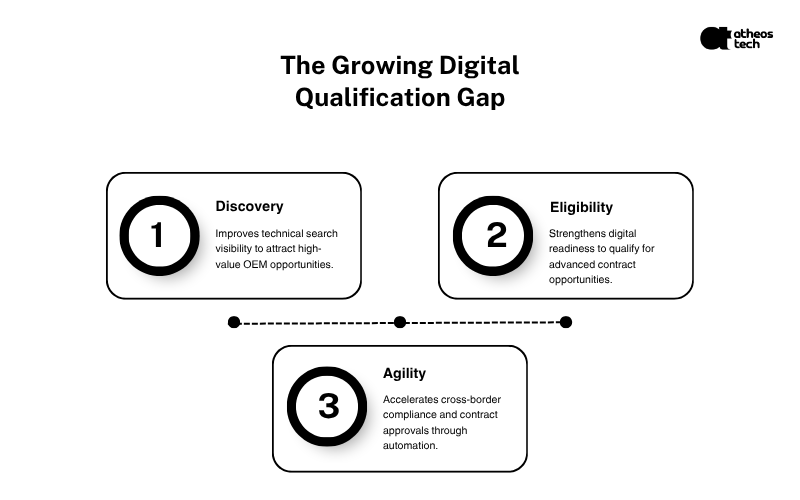
The consequences of this divide are visible in three critical areas:
Inbound OEM Sourcing:
Suppliers that have built detailed, searchable technical pages are routinely found directly by international OEM procurement engineers. These buyers use highly specific technical search queries and AI-driven sourcing engines to shortlist capacity. The digitally mature supplier bypasses traditional outbound sales outreach entirely, securing high-value RFQs passively. Meanwhile, data-blind competitors who rely on regional word-of-mouth are completely hidden from the initial discovery layer.
The Contract Bidding Arena:
Contract requirements have evolved. It is increasingly common for tier-one OEMs to require real-time data transparency as a prerequisite for bidding. Data Act-ready suppliers, capable of instantly spinning up automated customer portals and providing structured data handoffs, are easily winning smart-equipment contracts. Competitors operating with siloed, analog workflows are blocked from even submitting a bid, regardless of their physical machining skill.
Export and Compliance Speed:
Early movers who proactively integrated regulatory automation into their data architecture are closing cross-border contracts significantly faster. Because their systems generate clean, exportable compliance documentation (covering NIS2, CBAM, and export controls) as a standard operational byproduct, they handle qualification loops in hours. Firms stuck in a reactive setup end up bogged down in manual, multi-week administrative audits that stall delivery timelines and frustrate international buyers.
In a market defined by extreme precision and rapid scaling, your digital presence is no longer a marketing luxury. It is your ultimate technical qualification gate. If you fail to demonstrate digital maturity across your systems, the ecosystem will simply route around you.
Beyond Brainport:
The Breadth of the Dutch Manufacturing Ecosystem
While Brainport is the undisputed center of semiconductor capability, the push for digital transformation extends far beyond Eindhoven. The same pressures, such as labor ceilings, compliance deadlines, and the demand for supply chain integration, are forcing every industrial cluster in the Netherlands to modernize.
At AtheosTech, we build tailored digital architectures that align with the specific operational realities of these distinct business categories:
High-Tech Manufacturing (Brainport):
The tip of the spear. This ecosystem requires hyper-secure cross-border data flows, rigorous export compliance documentation, and digital twins for sub-micron precision engineering.
Food & Beverage Manufacturing:
Focused heavily on speed and safety. These facilities require predictive shelf-life analytics, automated GMP compliance, and uninterrupted cold-chain visibility from production to consumer.
Chemical Manufacturing (Chemelot):
Based in Limburg, this continuous-processing cluster demands robust predictive safety monitoring, automated ESG reporting (which is crucial for CBAM compliance), and real-time sensor analytics to prevent catastrophic downtime.
Metal Fabrication:
Transitioning from analog job shops to connected smart floors. The core focus here is integrating legacy CNC machinery with modern IoT sensors to optimize cycle times and dynamic scheduling.
Electronics & Precision Engineering:
Demanding automated traceability and strict quality control data portals. These systems ensure that every component can be digitally verified by OEM buyers instantly.
Cleantech and Energy Equipment:
A rapidly scaling sector reacting to the energy transition. Firms here need agile Product Lifecycle Management (PLM) and robust API pipelines to connect their hardware directly to dynamic grid management frameworks.
Agri-Processing:
Navigating biological variability through AI-driven demand sensing, smart sorting algorithms, and deep supply chain traceability from the farm directly to the factory floor.
The underlying technology of cloud infrastructure, API integration, and edge AI is universal, but the application is entirely bespoke. A digital strategy that works for Chemelot’s chemical flows will break inside a Brainport cleanroom. This is exactly why a consult-first engineering approach is non-negotiable.
A Practical Roadmap: Transitioning to a Digital Factory
To truly grasp the value of construction digital transformation, one must look beyond theory and examine how advanced software architectures operate in the field. In a market shaped by the Dutch housing construction decline and aggressive regulatory shifts, the physical construction process must be supported by equally robust digital engineering.
AtheosTech has deployed engineered interventions across various niches within the Netherlands building industry. Below are three detailed, direct success stories demonstrating how custom AI solutions, interconnected cloud portals, and precision digital marketing resolve deep operational friction and unlock trapped capital.
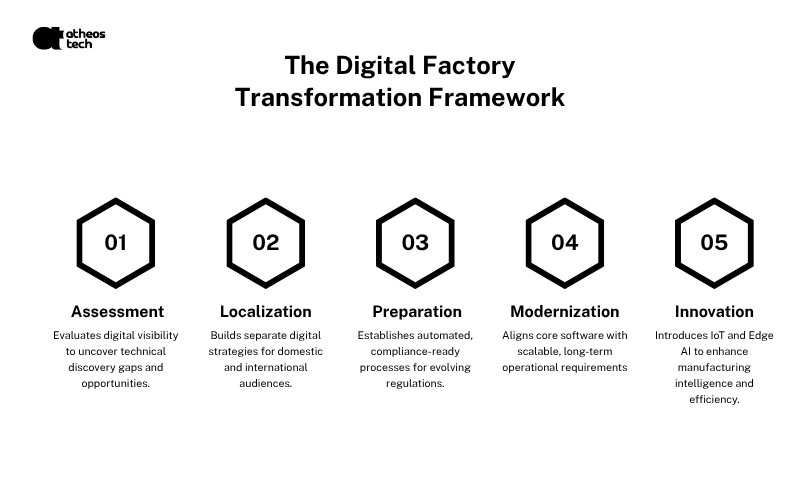
1. Conduct a Technical Visibility Audit:
- Prerequisite before any web or software development begins.
Start by evaluating your existing digital footprint exclusively through the lens of a procurement professional. Audit what an international engineering buyer actually sees, or fails to see, when actively searching for your exact machining capabilities, tolerances, and materials. Document your current discovery gaps and note where your site fails to provide immediate technical proof.
2. Separate Domestic and International Content:
- Decouple your target audiences completely.
Stop trying to make a single, translated website serve two entirely different markets. Keep your Dutch content focused on regional relationship building, local recruitment, and ecosystem credibility. Build an entirely separate, highly structured English technical strategy designed purely for global search visibility, optimization, and automated customer acquisition.
3. Embed Compliance-by-Design Protocols:
- Proactive protection against upcoming 2026 deadlines.
Review your data architecture against the strict requirements of NIS2, the EU Data Act, and CBAM. Instead of preparing for reactive, manual spreadsheet updates, design automated pipelines that capture required metrics directly from your daily workflow. Ensure your systems are structurally prepared to generate clean, exportable compliance data automatically.
4. Evaluate Your Core Software Strategy:
- Run a rigorous Build vs. Buy analysis per system.
Analyze your core software layer to determine if off-the-shelf platforms are restricting your workflows. If a critical system like your MES or customer portal handles proprietary intellectual property or high-mix scheduling, map out a transition plan to migrate away from rigid clone platforms and toward a custom, scalable data architecture that you own completely.
5. Deploy IoT and Edge AI Capabilities:
- Layer in advanced analytics once your data foundation is stable.
Once your underlying data infrastructure and APIs are reliable, begin connecting physical machines directly to your IT layer. Deploy localized sensors and edge AI tools where production data can create a clear, defensible advantage, such as real-time tool wear monitoring, predictive maintenance modeling, or dynamic factory scheduling.
The First Step is Consultation
Every successful digital factory transition begins with an accurate diagnosis of your current operational bottlenecks. In line with consultative, consult-first engineering psychology, you should never purchase a piece of software or rebuild a website without first running a comprehensive technical audit. Mapping the exact gap between your physical machine capability and your digital infrastructure ensures that every subsequent technology investment delivers a direct, measurable return on your operational efficiency.
How do OEM buyers find and qualify Brainport suppliers today?
The traditional B2B sales cycle in the Dutch high-tech sector has always relied heavily on personal networks, handshake agreements, and regional reputation. However, a structural shift has occurred within the procurement offices of major international OEMs. While the final contract negotiation remains deeply personal, the process of finding, vetting, and shortlisting new engineering partners has moved almost entirely online.
Today’s procurement engineers and supply-chain leads run a digital-first qualification process long before they ever reach out to your sales team. Your digital footprint is being picked apart and evaluated before a single sample part is ever requested.
The New Discovery Layer: AI Overviews and GEO
When an international procurement lead in Munich, Toulouse, or Boston needs a new manufacturing partner, they do not flip through a physical directory. They turn to advanced generative search engines.
An international buyer searching for a term like “precision CNC manufacturer Netherlands” no longer just sees a list of standard links. Instead, they get dense AI Overview summaries compiled directly from the web. These retrieval engines do not care about polished brand taglines or vague claims of “world-class quality.” They scrape supplier sites specifically looking for clear, structured technical parameters:
- Exact structural machining tolerances (e.g., sub-micron or $\pm0.01\text{ mm}$ limits)
- Cleanroom classifications (e.g., ISO Class 6 or Class 7 spaces)
- Specific material expertise (e.g., titanium grade 5, Inconel, or specialized ceramics)
- Available factory capacity and active machine listings
If your website lacks these explicit technical specs, the generative engines cannot index them. To the search engine, and consequently to the buyer, your capability simply does not exist. This is the core principle of Generative Engine Optimization (GEO): making your actual engineering facts completely transparent to machine readers.
Certifications as Searchable Trust Signals
In high-tech manufacturing, industry certifications are not decorative badges for a website footer. They are binary qualification gates. If a procurement lead is building a supplier shortlist for an automotive or medical project, they will search directly for required standards like ISO 9001 or IATF 16949.
A certification that a buyer cannot find within three seconds of landing on your site is, for shortlisting purposes, a certification you do not have. These trust signals must be prominently displayed alongside your technical capabilities, making it seamless for a buyer to verify your regulatory compliance instantly. B2B trade platforms and supplier directories still serve an important role in initial discovery, but they now function as an introductory layer that feeds directly back into your LinkedIn profile and primary website for deep technical evaluation.
Tracking the Shift in Buyer Behaviour
To effectively adapt your manufacturing servitization strategies and capture international pipeline, leadership teams must align their outreach with five major shifts in modern procurement habits:
Technical Whitepapers as Top-of-Funnel Assets: Engineering buyers avoid traditional marketing brochures. They want to download deep-dive technical case studies, structural tolerance analyses, and material stress-test documentations.
LinkedIn as the Primary B2B Growth Channel: Procurement leads actively use LinkedIn to evaluate a supplier’s leadership team, verify factory updates, and quietly assess operational maturity before initiating formal contact.
The Vital Need for Technical English SEO: Localized Dutch phrasing will keep you trapped in the domestic market. High-performing long-tail English optimization is what puts your facility on international shortlists.
Hybrid Event Conversion: Physical trade shows like Hannover Messe or events at the Brainport Industries Campus remain highly valuable for initial handshakes. However, the speed and precision of your digital follow-up, directing a contact to a hidden custom landing page matching their exact query, is what determines final RFQ conversion.
Structured Supplier Databases: The rise of smart, data-driven sourcing platforms (like Catalist-style target systems) means OEMs are programmatically filtering out suppliers who fail to maintain clean, searchable documentation.
Why AtheosTech: Bridging the Digital Engineering Gap
Successfully executing this digital transition requires an engineering partner that understands both the operational complexities of a precision shop floor and the global dynamics of digital B2B growth.
Founded in 2022 with a strict focus on marrying high-end minimalist design with robust technical execution, AtheosTech has quickly scaled to become a trusted global IT consulting and digital growth partner. Today, we manage an offshore technical team of over 150 highly specialized developers, data engineers, and security specialists, allowing us to deliver world-class infrastructure without the astronomical overhead costs of domestic IT agencies.
Having served more than 90 global clients across intricate B2B sectors, we specialize in overcoming the inherent trust gaps and technical friction points that hold manufacturing firms back. We do not look at your business through the lens of generic marketing metrics like clicks or traffic; we focus entirely on revenue engineering, business outcomes, and structural solutions to operational bottlenecks. Whether it is building secure, real-time API integrations for a high-mix, low-volume production environment or architecting an international technical SEO engine that captures high-value OEM RFQs, we build scalable software assets that you own completely.
Customer Acquisition and Servitization: The Final Step
If we pull back and look at the broader picture, the challenges of modernizing your production, integrating your supply chain, and acquiring new OEM customers are no longer separate departmental issues. They are all, fundamentally, data and digitization problems.
The divide in the Brainport manufacturing ecosystem is widening every quarter. Firms that treat digital maturity as an administrative afterthought are losing their visibility. In contrast, those that invest in robust data architecture are unlocking new models of Customer Acquisition and Servitization, moving beyond simply selling precision parts to selling verified capability, integrated compliance, and guaranteed uptime.
Transitioning a legacy machine shop into a connected digital factory is a complex engineering task, and it requires a consult-first approach. Before you invest heavily in a new software platform or commission a generic website redesign, you need to know exactly where your current digital infrastructure is leaking value.
We offer a free, comprehensive technical visibility audit for manufacturing founders. We will map out exactly what an international OEM buyer sees when they search for your capabilities and identify where siloed data is slowing your shop floor down.
Ready to rebuild your digital capability?
Explore our specialized high-tech services or reach out directly to start the conversation:
Contact us today to request your free digital visibility audit.