- AtheosTech
The Dutch Cleantech Manufacturer's Digital Growth Playbook: IoT Monitoring, Sustainability Reporting, and the Online Presence That Wins Energy Contracts

Dutch cleantech manufacturers are operating in one of the most demanding industrial environments in Europe right now. Digital transformation is no longer a competitive advantage for this sector; it is becoming the baseline requirement for staying in business, winning tenders, and keeping factory lines running when the electricity grid itself has become the bottleneck.
Between grid capacity shortages, tightening sustainability disclosure expectations, and procurement processes that increasingly score vendors on certified carbon performance, the Dutch cleantech manufacturer that treats its digital infrastructure (digitale infrastructuur) as an afterthought is the one that loses contracts to a competitor with better data, better reporting, and a stronger online presence.
This blog lays out a practical playbook: how IoT monitoring solves the grid and maintenance problem, how sustainability reporting systems turn compliance from a burden into a sales asset, and how the right digital marketing and web development solutions turn a manufacturer’s online presence into the thing that actually wins energy contracts.
The Dutch Cleantech Manufacturing Landscape: Niches and Business Models
The Netherlands has built a genuinely dense cleantech manufacturing base, and it is not one uniform industry. It breaks down into distinct micro-categories, each with its own operating logic and revenue model.
Solar and wind component manufacturers
produce inverters, mounting systems, and turbine parts, typically running B2B supply contracts with installers and utilities on a volume-and-contract-tender revenue model.
Battery and energy storage system makers,
a fast-growing niche given how central storage has become to solving grid capacity problems, often working on project-based and long-term service-contract models.
Industrial IoT and environmental monitoring hardware providers
building the sensors and platforms that other manufacturers depend on for water quality, emissions, and energy tracking, usually running SaaS-plus-hardware hybrid revenue models.
Circular economy and sustainable materials producers,
including recycled feedstock and waste-to-resource manufacturers, often structured around offtake agreements and municipal or corporate partnership contracts.
Hydrogen and alternative energy equipment manufacturers
a smaller but rapidly scaling niche tied closely to public subsidy cycles and pilot-project revenue.
What ties these niches together is that all of them now sell into a buyer base- utilities, installers, government tenders, and large industrial customers- that increasingly demands proof of digital maturity before it signs a contract. That proof shows up in three places: how well a manufacturer monitors and reports its own operations, how credibly it demonstrates sustainability performance, and how discoverable and trustworthy it looks online.
On the revenue model side, the split generally falls into a few recognizable patterns:
Volume and tender-based models
common among component manufacturers supplying installers and utilities, where pricing competitiveness and certification standing (particularly CO2-Prestatieladder level) directly affect win rates
Project and long-term service contracts,
typical of battery storage and hydrogen equipment makers, where the sale is less about unit price and more about proven reliability, monitoring capability, and after-installation support
SaaS-plus-hardware hybrid models
used by IoT and environmental monitoring providers who sell physical sensors alongside a recurring software subscription for the data platform itself
Offtake and partnership agreements
common in circular economy and materials recovery, where revenue is tied to long-term supply relationships with municipalities or large industrial buyers rather than one-off sales
Understanding which model a manufacturer operates under matters enormously for digital strategy, because a company selling on tender volume needs a fundamentally different content and SEO approach than one selling on long-term service relationships. This distinction shapes almost every recommendation in the sections that follow.
Pain Points Holding Dutch Cleantech Manufacturers Back
Before jumping to solutions, it is worth being precise about what is actually breaking down on the ground for this business category. These are not generic manufacturing problems; they are specific to the Dutch cleantech context right now.
Netcongestie (grid congestion) has become an acute, immediate constraint. As of mid-2026, even smaller electricity users have lost their previous exemption from congestion rules, and structural grid reinforcement is not expected to bring real relief until 2027 to 2028. For a manufacturer trying to electrify processes or expand capacity, this is a direct operational threat, not a background policy issue.
Sustainability reporting uncertainty. Full CSRD obligations have been delayed for most companies under the “stop-de-klok” (stop-the-clock) regulation, now applying mainly to enterprises above 1,000 employees and €450 million net turnover from financial year 2027 onward. But mid-sized cleantech manufacturers are still being pulled into reporting indirectly, because their larger customers need supply-chain sustainability data from them regardless of whether they are legally obligated themselves.
Fragmented, siloed operational data. Many manufacturers run separate systems for energy metering, production monitoring, and compliance recordkeeping, with no unified pipeline connecting sensor data to reportable sustainability metrics.
Legacy ERP systems that were never built with duurzaamheidsverslaglegging (sustainability record-keeping) in mind, forcing manual, error-prone data compilation at reporting time.
Complex, inflexible energy contracts. Standard flat-rate contracts leave manufacturers exposed to peak pricing and congestion penalties, when dynamic or capacity-limiting contracts could reduce both cost and grid strain.
Certification and tender requirements, particularly the CO2-Prestatieladder (CO2 Performance Ladder), which directly affects a manufacturer’s competitiveness in public and semi-public tenders but requires ongoing data discipline to maintain.
Weak or outdated online presence. A manufacturer can have excellent sustainability credentials and still lose a tender or a partnership inquiry because a buyer’s due diligence search turns up a thin, unclear, or poorly ranked website.
Each of these pain points has a digital solution, and most of them intersect; solving the data problem tends to solve the reporting problem, which tends to solve the tender-competitiveness problem. This is why a fragmented, one-off approach to digital investment rarely delivers the results manufacturers actually need.
What’s driving the urgency specifically in 2026:
- Energy prices remain volatile, adding cost pressure on top of grid constraints
- Netcongestie has moved from a background concern to an acute constraint, now affecting even smaller electricity users
- The European Commission’s push to simplify CSRD has created genuine confusion among mid-sized manufacturers about what they are and are not obligated to report
- Manufacturers assuming they have no reporting obligations often miss the informal, but commercially important, data requests coming from larger customers further up the supply chain
IoT Monitoring: Turning the Grid Problem Into a Managed Process
Netcongestie is not going away in the near term, so the manufacturers that are managing it well right now are not waiting for grid reinforcement; they are using IoT monitoring and data-driven contract optimization to work within current constraints. This is one of the clearest cases where a digital solution is not a nice-to-have but a direct operational necessity.
What effective IoT monitoring for cleantech manufacturers actually covers:
- Real-time energy consumption tracking at the machine and line level, not just the building meter, so peak load can be identified and managed precisely
- Predictive maintenance sensors on production equipment, flagging mechanical issues before they cause costly downtime, a pattern already well established among Dutch industrial IoT providers
- Peakshaving (peak load flattening) support, using consumption data to keep operations within existing grid connection limits rather than triggering costly upgrade requests
- Integration with dynamic and capacity-limiting energy contracts, so production scheduling can shift toward cheaper, lower-congestion hours automatically
- Data readiness for participation in energiehubs (energy hubs), the increasingly common model where neighboring businesses coordinate demand and supply on a shared grid connection
The technical backbone AtheosTech builds for this is centered on API integration, connecting sensor networks, existing SCADA or production systems, and energy contract platforms into a single monitoring layer rather than a patchwork of disconnected dashboards. This is also where custom IT consultant work matters most, since every manufacturer’s equipment stack is different and a generic off-the-shelf tool rarely integrates cleanly without custom development.
Platforms like Sensorfact and 30MHz are recognizable names in Dutch industrial IoT monitoring for exactly this reason, turning raw sensor data into usable operational intelligence, and AtheosTech builds custom solutions with comparable functionality, tailored to a manufacturer’s specific equipment and reporting needs rather than a fixed template.
Why custom development tends to outperform generic monitoring tools for manufacturers specifically:
- Most cleantech manufacturers run a mixed equipment stack, older machinery alongside newer, sensor-ready lines, which off-the-shelf platforms often struggle to unify without significant configuration work
- A generic dashboard rarely maps cleanly onto the specific reporting fields a manufacturer’s largest customers or CO2-Prestatieladder auditors actually request
- Energiehub participation requires sharing specific, structured data with neighboring businesses, something a custom-built data layer can be designed for from the start rather than retrofitted later
- Manufacturers already running an ERP system, particularly Microsoft Dynamics 365-based setups, generally get more long-term value from integrating IoT data directly into that existing system than from running a separate, disconnected monitoring tool
The practical starting point for most manufacturers is not a full IoT overhaul. It is usually a focused pilot on the highest-impact production line or energy connection point, proving out the data pipeline and reporting integration before scaling the same architecture across the rest of the facility. This phased approach also keeps the sustainability reporting and tender-readiness benefits arriving early, rather than waiting for a full-facility rollout to be complete.
Further Reading
For manufacturers looking at the broader Dutch high-tech manufacturing digitization picture beyond cleantech specifically, see our related article.
Sustainability Reporting and Compliance-Ready Digital Systems
This is the section where digital infrastructure and regulatory reality meet most directly, and it is also where manufacturers most often either overbuild for a requirement that has not actually kicked in yet, or underprepare for one that is arriving faster than expected through client pressure rather than law.
Where the regulatory picture actually stands:
- Full CSRD mandatory reporting for FY2025 and FY2026 has been postponed two years under the stop-de-klok regulation, taking effect from 2027 for companies exceeding 1,000 employees and €450 million net turnover.
- Companies already under the older NFRD rules, generally large, publicly listed enterprises, continue reporting under existing obligations regardless of the delay.
- For mid-sized cleantech manufacturers, the more relevant framework right now is the VSME (Voluntary Small and Medium Enterprises) standard, letting smaller suppliers respond to sustainability data requests without adopting the full CSRD burden.
- This matters commercially because CSRD-reporting companies must disclose supply-chain sustainability data, so their cleantech manufacturing suppliers get asked for it too, even without a legal obligation of their own.
Separately, and just as commercially relevant, is the CO2-Prestatieladder (CO2 Performance Ladder):
- A five-level certification system owned and managed by SKAO (Stichting Klimaatvriendelijk Aanbesteden en Ondernemen)
- Used specifically as a scoring tool in Dutch public and semi-public tenders (aanbestedingen)
- A higher certification level translates directly into pricing advantages during tender evaluation
- One of the few sustainability certifications with a direct, measurable commercial return for manufacturers competing for energy sector contracts
Where AtheosTech’s digital solutions fit into this compliance landscape:
- Building VSME-ready and CSRD-ready sustainability data structures into existing ERP and reporting systems, so manufacturers are not scrambling to compile data manually when a client or regulator asks for it
- Automating the data pipeline from IoT energy and emissions sensors directly into reportable sustainability formats, closing the gap between raw operational data and a usable duurzaamheidsrapportage (sustainability report)
- Structuring digital recordkeeping to support CO2-Prestatieladder audit requirements, including footprint tracking, ketenanalyses (chain analyses), and reduction program documentation
- Ensuring reporting dashboards are structured for the audiences that actually request this data: banks, investors, and large corporate clients under the VSME’s more detailed reporting module
AtheosTech positions every sustainability reporting solution it builds as compliance-ready for VSME and CSRD frameworks, and structured to support CO2-Prestatieladder documentation needs, rather than a generic dashboard bolted on after the fact.
A practical note on the VSME structure, since it’s the framework most relevant to most Dutch cleantech manufacturers right now:
- Built as a two-tier system: a basismodule (basic module) for companies starting to formalize their sustainability data, and a more detailed module covering what banks, investors, and larger corporate clients tend to request
- Structuring digital reporting around this two-tier model lets a manufacturer start with the basic module and expand later without rebuilding its data architecture
- Far more efficient than adopting a full CSRD-grade system prematurely, or doing nothing until a client demand forces a rushed manual response
- Also worth noting: Dutch guidance ties CSRD-style disclosure to step five of the OESO (OECD) six-step due diligence model, communicating transparently about policy, risks, actions, and results, so reporting systems built around that due diligence logic tend to hold up better to audit scrutiny and informal client data requests alike
Winning Energy Contracts Through Digital Presence
Here is the part of the playbook that gets underweighted the most often. A manufacturer can have strong IoT infrastructure and clean sustainability reporting and still lose contracts simply because its online presence does not hold up to a procurement team’s due diligence process.
Dutch energy sector procurement, especially public and semi-public aanbestedingen, increasingly involves a research phase before formal tender submission even begins. Buyers search for manufacturers, review their websites, check certifications, and form an impression of credibility long before a bid document is opened.
What this means in practice for a manufacturer’s digital presence:
- Service and capability pages that clearly state certification levels (including CO2-Prestatieladder standing) rather than burying them in a PDF
- Lokale SEO (local SEO) optimization so the manufacturer appears in searches tied to Dutch industrial regions and specific technical capabilities, not just generic international search terms
- Case study and project documentation pages that function as de facto proof points during a procurement team’s pre-tender research
- Fast, mobile-responsive, technically sound websites, since a slow or dated site actively undermines the credibility of a company claiming to be a technology-forward cleantech supplier
- Clear, structured information architecture that lets a procurement reviewer find compliance and sustainability information within a few clicks, not a general contact form
This is also where the niche-specific business model matters for content strategy. A battery storage manufacturer selling on long-term service contracts needs different online proof points than a solar component manufacturer selling on tender volume. AtheosTech builds web development solutions that reflect the actual sales motion of the manufacturer’s specific niche rather than a one-size-fits-all industrial template.
A few specific gaps worth checking on an existing manufacturer website:
- Is the CO2-Prestatieladder level stated clearly on the homepage or a dedicated certifications page, or is it only referenced in a downloadable PDF that a busy procurement reviewer is unlikely to open
- Does the site clearly separate content for different buyer types? A utility evaluating a supply contract has different questions than an installer sourcing components, and a single generic “About Us” page rarely serves both well
- Are technical specification sheets and compliance documentation easy to find without contacting sales first, since procurement teams often eliminate suppliers during early research precisely because this information was not readily accessible?
- Is the site built and hosted in a way that reflects well on a company positioning itself as forward-looking on technology, since a dated, slow-loading website undercuts every other credibility signal a manufacturer is trying to send
None of these are cosmetic concerns. In a sector where tender evaluation increasingly happens digitally before a single conversation takes place, the website functions as a pre-qualification document whether a manufacturer intends it to or not.
Ready to make your digital presence work as hard as your production line does.
Get in touch to talk through your specific niche and current setup.
Digital Marketing as the Growth Engine Behind Contract Wins
Everything above- IoT infrastructure, sustainability reporting, a strong website- only compounds into contract wins if the right buyers actually find the manufacturer in the first place. This is where digital marketing stops being a marketing department concern and becomes a direct revenue lever for cleantech manufacturers.
What a coordinated digital marketing approach covers for this sector:
- Content marketing built around the specific compliance and operational topics procurement teams and technical buyers actually search for, sustainability reporting standards, grid congestion solutions, certification requirements, rather than generic industry content
- PPC marketing (paid search) targeted at high-intent commercial searches tied to specific niches, tender categories, and regional buyer terms, useful for reaching procurement decision-makers actively evaluating suppliers
- Lokale SEO to build visibility within the specific Dutch industrial regions and clusters most relevant to a manufacturer’s supply relationships
- Search-optimized technical content that positions the manufacturer as a knowledgeable authority on the regulatory and operational issues its buyers are dealing with, which builds the kind of trust that shortens sales cycles in tender-driven markets
- A consistent content and SEO cadence, since sustainability regulation and grid policy are both actively shifting in 2026, and manufacturers that publish timely, accurate updates on these topics build durable search authority over competitors who do not
AtheosTech delivers this as part of its 360° digital consultancy and IT solutions approach, treating content marketing, PPC, and SEO as one coordinated system rather than disconnected services, because for a cleantech manufacturer competing on tenders, marketing and technical credibility need to tell the same story.
A point worth making explicitly here:
- Digital marketing for a cleantech manufacturer isn’t about generating high volumes of consumer-style leads
- It’s about making sure that when a procurement officer, installer partner, or utility buyer researches suppliers for a specific tender, the manufacturer’s name and content are what surfaces
- What that buyer finds should reinforce, not undermine, the credibility already built through certifications and operational data
- This is a narrower, higher-value kind of visibility that rewards precision and technical accuracy over volume
- Content strategy and sustainability reporting shouldn’t run as separate workstreams either: a manufacturer publishing accurate content on its CO2-Prestatieladder progress or VSME approach is, at the same time, building the search visibility that gets it found by the buyers evaluating exactly those criteria
Custom Platforms and Software Built for This Sector
Dutch cleantech manufacturers researching digital solutions will inevitably come across established platforms in this space, industrial IoT monitoring tools built around sensor networks and predictive maintenance, and ERP-integrated sustainability modules built into systems like Microsoft Dynamics 365 Business Central for manufacturing.
AtheosTech builds custom solutions with comparable functionality to these leading platforms, tailored specifically to a manufacturer’s existing equipment, ERP environment, and reporting obligations rather than requiring a full platform migration. This typically includes:
- Custom-built IoT monitoring dashboards designed around a manufacturer’s actual sensor and machinery stack
- API integration work connecting existing ERP, energy contract, and production systems into a single data layer
- Sustainability reporting modules structured for VSME and CSRD readiness, built to integrate with whatever core business system the manufacturer already runs
- Custom IT solution development for manufacturers whose equipment mix or reporting needs do not fit neatly into an off-the-shelf platform
The advantage of a custom approach over adopting an established platform outright is control and fit. A manufacturer does not need to reshape its production process or ERP structure around a vendor’s fixed data model. Instead, the reporting and monitoring system is built around how the manufacturer already operates, which tends to shorten the time it takes for staff to actually adopt and trust the new tools, and avoids the disruption of a full platform migration partway through an active sustainability reporting cycle or tender period.
Recommended Engagement Models for Cleantech Manufacturers
Not every manufacturer needs the same working relationship with a digital partner, and the right engagement model depends heavily on where a company sits in its digital maturity and project scope. Based on AtheosTech’s working dynamics, the models that tend to fit this sector best are:
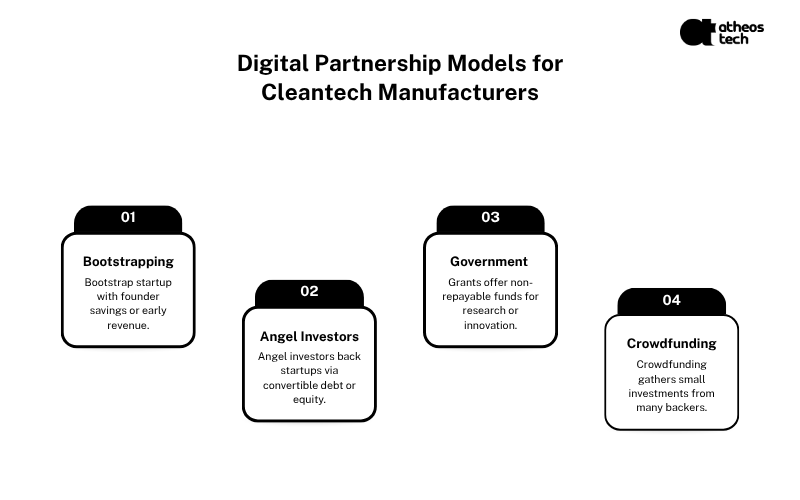
Project-based engagement
well suited to manufacturers building a defined deliverable, such as a compliance-ready reporting dashboard or a new corporate website ahead of a specific tender cycle
Dedicated team engagement
appropriate for manufacturers running ongoing digital transformation work across IoT integration, ERP customization, and continuous sustainability reporting needs
Staff augmentation,
useful for manufacturers with an internal technical team that needs specific expertise, such as API integration or CO2-Prestatieladder-aligned data structuring, without hiring full-time specialists
Retainer-based digital marketing engagement
the natural fit for the ongoing content marketing, PPC, and lokale SEO work needed to sustain search visibility as regulations and buyer search behavior continue to shift through 2026 and beyond
Manufacturers earlier in their digital maturity, still running fragmented systems and manual reporting, tend to benefit most from starting with a defined project engagement before moving into a dedicated or retainer model once the foundational systems are in place.
A useful way to sequence across these models, by urgency and dependency:
- IoT monitoring and data pipeline work comes first, since sustainability reporting and much of the tender-readiness content depend on clean, structured operational data
- Reporting system development follows closely, especially for manufacturers already fielding data requests from larger clients
- Digital marketing and website work can run in parallel rather than waiting, since building search authority takes time regardless of where technical systems stand
- The strongest results come once the operational and compliance story a manufacturer tells online is actually backed by the systems built earlier in this playbook
Conclusion
The Dutch cleantech manufacturing sector is being reshaped by forces that are not going to reverse: grid capacity constraints are a multi-year structural reality, sustainability data requests are flowing down from large corporate customers regardless of formal CSRD timelines, and tender evaluation increasingly rewards manufacturers who can prove both operational and digital maturity.
None of these pressures are solved by a single tool. They are solved by connecting IoT monitoring, compliance-ready sustainability reporting, and a genuinely strong online presence into one coherent digital growth strategy, which is exactly the kind of work a 360° digital consultancy is built to deliver.
If your manufacturing business is navigating netcongestie, preparing for sustainability data requests, or trying to strengthen your position in energy sector tenders.
AtheosTech can help you put the right digital foundation in place. Reach out to discuss where your business stands today and what the next step should look like.
FAQs
FAQs
Not for most mid-sized manufacturers. Mandatory CSRD reporting has been delayed under the stop-de-klok regulation and, from 2027, will apply mainly to companies with over 1,000 employees and more than €450 million in net turnover. Many smaller manufacturers still face informal reporting requests from larger clients and can use the voluntary VSME standard to respond.
Netcongestie refers to electricity grid capacity shortages that limit how much power businesses can draw or feed back into the grid. It has become an acute constraint for Dutch manufacturers in 2026, particularly those looking to electrify processes or expand capacity, with structural relief not expected until 2027 to 2028.
The CO2-Prestatieladder is a five-level certification system used as a scoring criterion in Dutch public and semi-public tenders. Higher certification levels earn pricing advantages during tender evaluation, making it a direct commercial factor rather than just a sustainability credential.
IoT monitoring enables manufacturers to track energy consumption at a granular level, support peakshaving, and integrate with dynamic or capacity-limiting energy contracts, helping them operate within existing grid connections while reducing exposure to peak pricing and congestion penalties.
VSME (Voluntary Small and Medium Enterprises) is a simplified, voluntary sustainability reporting standard for companies not legally required to report under CSRD. It is designed to help smaller suppliers respond efficiently to sustainability data requests from larger corporate customers.