- AtheosTech
Digitising the Chemelot Cluster: How Dutch Chemical Manufacturers Are Navigating Compliance, Safety Technology, and Digital Customer Engagement
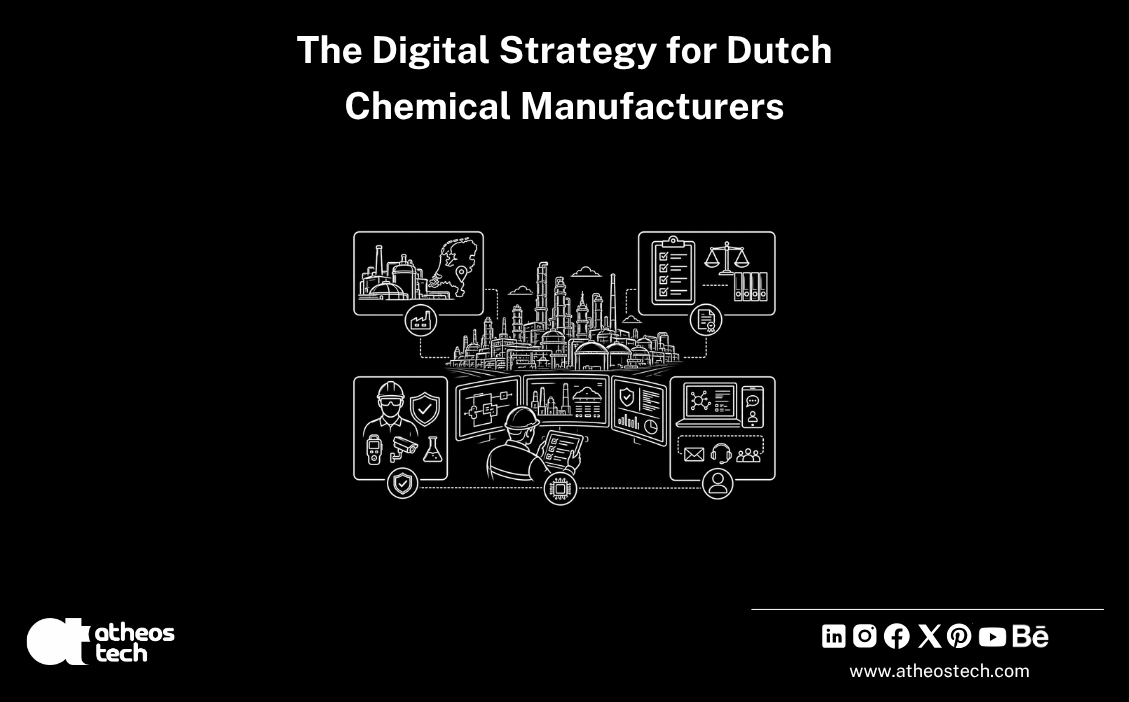
Digitising the Chemelot cluster is no longer a side project for Dutch chemical manufacturers; it is becoming the operating condition for staying in business. Chemelot, the 800-hectare chemical and materials site in Sittard-Geleen, is home to roughly 150 to 200 interconnected companies, from base-chemical producers like SABIC and OCI to specialty and materials businesses built around the former DSM footprint.
These companies share utilities, pipelines, and logistics, but increasingly they also need to share data, safety telemetry, and compliance evidence across the fence line. At the same time, national frameworks like the Omgevingswet (Environment and Planning Act), REACH, and Seveso III are tightening reporting expectations, energy costs are pushing plants toward electrification, and B2B buyers now expect the same digital self-service experience from a chemical supplier that they get from any modern SaaS vendor.
This blog looks at how digital transformation, safety technology, and digital customer engagement are converging at Chemelot and across the Netherlands’ other four chemical clusters, and where a 360° digital consultancy and IT solutions partner like AtheosTech fits into that journey.
The Chemelot Cluster at the Heart of Dutch Chemistry
The Netherlands is home to one of Europe’s most concentrated chemical manufacturing footprints, and Chemelot sits at the centre of it. It operates as a shared industrial park, with dozens of independent companies running their own operations on common infrastructure for utilities, logistics, and safety, which is why a single upgrade to a shared safety standard or digitale infrastructuur (digital infrastructure) can ripple across every tenant on the site.
- Chemelot sits in South Limburg, close to the German and Belgian borders, and is part of the wider ARRRA cluster (Antwerp-Rotterdam-Rhine-Ruhr-Area) that links Dutch chemistry to its neighbouring industrial regions.
- The site evolved from the former DSM complex into a shared industrial park with common infrastructure for utilities, energy, logistics, maintenance, and safety, so that individual tenant companies do not each have to build these functions from scratch.
- The Brightlands Chemelot Campus, located next to the industrial park, brings together start-ups, universities, and research institutes working on chemistry, materials, and digitalisation, including the Brightsite programme that studies enabling technologies for digital transformation in the chemical process industry.
- The Chemelot Circular Hub, a triple-helix partnership between industry, government, and knowledge institutions, has set a goal of making Chemelot Europe’s first climate-neutral and circular chemical site by 2050, backed by an investment of roughly €200 million from the Province of Limburg. (Source)
- Nationally, the chemical industry is the largest business sector in the Netherlands outside food and beverages, with the Royal VNCI (Vereniging van de Nederlandse Chemische Industrie) representing more than 390 companies and around 45,000 employees across five clusters: Chemelot, Rotterdam-Moerdijk, Noord-Nederland, Zeeland/West-Brabant, and the Noordzeekanaalgebied.
This density of interconnected, highly regulated, capital-intensive plants is exactly the environment where digitalisation delivers outsized returns, because a single improvement in a shared digitale infrastructuur (digital infrastructure) or a shared safety data standard benefits dozens of companies at once, not just one factory.
Where Dutch Chemical Manufacturers Are Losing Time, Money, and Compliance Confidence
Talking to operations, EHS, and commercial teams across Dutch chemical clusters surfaces a consistent set of pain points. Most of them are not chemistry problems, they are data, systems, and communication problems.
Operational and safety
- Legacy OT (operational technology) systems that were never designed to talk to modern IT systems, creating blind spots between the control room and the boardroom.
- Manual, paper-based or spreadsheet-based safety documentation for veiligheidsrapporten (safety reports) and internet noodplannen (internal emergency plans), which is slow to update and hard to audit.
- Reactive maintenance is driven by fixed schedules rather than real equipment condition, leading to either unplanned downtime or unnecessary maintenance spend.
- Difficulty proving, in real time, that a plant is operating within its permitted risk envelope under the Seveso III framework.
Compliance and administrative
- Since 1 January 2024, the former Brzo 2015 (Besluit risico’s zware ongevallen) has been absorbed into the Omgevingswet and the Besluit activiteiten leefomgeving (Bal), which means Seveso-classified companies (now officially called “Seveso-inrichtingen”) have had to re-map their compliance documentation to a new legal structure.
- Overlapping obligations across REACH, the ARIE-regeling (Aanvullende Risico-Inventarisatie en -Evaluatie), PGS 15 storage guidelines, and the Arbowet/Arbobesluit create duplicate reporting work if it is not centralised in one system.
- VCA* / VCA** / VCA-P contractor safety certifications need to be tracked, renewed, and verified across dozens or hundreds of third-party contractors working on-site at any given time.
Commercial and customer-facing
- Chemical buyers, from formulators to industrial distributors, increasingly expect online product data, safety data sheets (SDS), and order status to be available on demand rather than through email or phone.
- Many mid-sized Dutch chemical manufacturers still lack a searchable, SEO-optimised web presence, meaning technical buyers researching a spec or a CAS number cannot easily find them.
- Sales and technical service teams spend disproportionate time answering repetitive product and compliance questions that could be handled through a self-service digital solution or a well-structured knowledge base.
- Talent scarcity: the sector competes with tech and semiconductor employers (ASML and the wider Brainport ecosystem, for example) for the same pool of engineers who understand both chemistry and software.
Cross-cutting issues that touch every department
- Fragmented data ownership, where operations, EHS, quality, and commercial teams each maintain their own spreadsheets or point solutions, none of which talk to each other, making it hard to answer a simple question like “which customers are affected if we adjust output on this line” without a manual cross-check.
- Slow onboarding of new digital tools because plant IT environments are understandably conservative, given the safety stakes of anything connected to operational technology, which means any new digital solution has to be justified on both efficiency and risk-reduction grounds, not efficiency alone.
- Limited internal capacity to evaluate vendors or build custom integrations, since most in-house IT teams at mid-sized chemical manufacturers are sized for maintaining existing systems rather than running transformation projects.
- Pressure from larger customers and supply chain partners who now expect digital traceability, carbon reporting, and electronic data interchange (EDI) as a condition of doing business, effectively pushing digitalisation down the supply chain from large multinationals to smaller specialty producers.
None of these pain points sit in isolation. A compliance gap usually traces back to fragmented data. A slow sales cycle usually traces back to a missing digital front door. The section below maps each of these problems to a corresponding solution.
Turning Compliance, Safety, and Sales Bottlenecks Into Digital Wins
very pain point above has a matching digital solution, and the strongest results come from treating them as one connected programme rather than isolated fixes.
Solutions for operational and safety
- IIoT sensors and condition monitoring to replace fixed-interval inspection with real, continuous equipment data.
- Predictive maintenance models built on historian and sensor data, catching degradation before it causes downtime or a loss-of-containment event.
- Digital twins to simulate process changes and hazard scenarios before they touch a live asset.
Solutions for compliance and administration
- Centralised compliance dashboards that map every obligation, RI&E, veiligheidsrapport, VCA certificate, and permit back to a single source of truth, with automatic expiry and renewal alerts.
- Digital RI&E and Plan van Aanpak generation, turning weeks of manual documentation into a structured, auditable workflow.
- API integration between EHS software, ERP, and plant historian systems, so a change in a process parameter automatically flags whether a facility is still operating inside its permitted envelope.
- Real-time contractor management portals tracking VCA status, toolbox meeting records, and Last Minute Risk Analysis (LMRA) forms for every third party on-site.
Solutions for commercial and customer-facing
- Digital marketing as the foundation: content marketing built on genuine R&D and application expertise, PPC marketing targeted at specific technical search terms, and lokale SEO so regional distribution and service capability actually show up in local search results.
- Web development solutions for technically structured, SEO-friendly websites and B2B self-service portals where a formulator can find product data, SDS documents, and order status without picking up the phone.
- A self-service knowledge base that absorbs repetitive technical and compliance questions, freeing sales and technical service capacity for higher-value conversations.
- A measurable digital marketing funnel connecting website, PPC, and content activity back to sales-qualified leads, so marketing spend can be judged on commercial outcomes rather than traffic alone.
Solutions for cross-cutting
- A unified digitale infrastructuur (digital infrastructure) layer connecting EHS, ERP, historian, and CRM systems through API integration, so no department is working from a stale or incomplete picture.
- A custom IT consultant engagement to assess legacy systems and vendor options before committing to a build, reducing the risk of investing in the wrong platform.
Every solution above is designed to be delivered in a way that keeps a manufacturer’s Seveso III, REACH, and Arbowet obligations intact; more detail on that compliance layer follows below.
Navigating the Dutch Regulatory Maze From Seveso III to REACH
Compliance is arguably the single biggest driver of IT investment in Dutch chemical manufacturing, because non-compliance carries direct legal, financial, and reputational risk.
The regulatory stack Dutch chemical manufacturers must navigate
- Seveso III Directive (2012/18/EU), implemented in Dutch law through the Omgevingswet and Bal since 2024 (previously via Brzo 2015), which classifies sites as lower-tier or upper-tier “Seveso-inrichtingen” based on hazardous substance thresholds and requires a formal veiligheidsrapport and Veiligheids Beheer Systeem / VBS (Safety Management System). (Source)
- REACH (Registration, Evaluation, Authorisation and Restriction of Chemicals), the EU regulation requiring companies to assess and document the risks of the substances they manufacture, import, or use.
- ARIE-regeling, which applies a lighter-touch but still mandatory risk inventory and evaluation to companies handling hazardous substances below Seveso thresholds, roughly 30 percent of Seveso quantities.
- PGS 15, the Dutch publication series guideline governing the safe storage of packaged hazardous substances.
- Arbowet and Arbobesluit, the Dutch Working Conditions Act and Decree, enforced by the Nederlandse Arbeidsinspectie (Netherlands Labour Authority), which require a documented RI&E (Risico-Inventarisatie en -Evaluatie) with an accompanying Plan van Aanpak (action plan).
- VCA (Veiligheid, Gezondheid en Milieu Checklist Aannemers) certification for contractors working on Seveso sites, an important requirement given how many third-party engineering and maintenance firms operate inside a shared cluster like Chemelot.
- NEN-EN-ISO 45001 and related NEN standards for occupational health and safety management systems.
Why "compliance-ready by design" beats retrofitting
Many manufacturers first build a customer portal, a reporting tool, or an internal dashboard for operational convenience, then discover during an audit that the platform cannot produce the evidence trail an inspector expects. Retrofitting compliance into an existing platform is usually slower and more expensive than designing for it up front, because data models, access controls, and retention rules often need to be rebuilt rather than simply extended. In practice, compliance-ready design means:
- Data retention and access-control rules are defined during the discovery phase of a project, not added after go-live.
- Every integration between systems is documented in a way that itself becomes part of the audit trail.
- Reporting views are designed around the actual formats regulators and inspection bodies (the Arbeidsinspectie, the environmental authority, the security region) expect to see, rather than a generic dashboard layout.
AtheosTech builds every relevant solution to be Seveso III, REACH, ARIE, PGS 15, Arbowet, and NEN-standard compliance-ready from the outset. That distinction matters in a sector where a compliance gap is not just a UX flaw; it is a regulatory exposure.
From Reactive Documentation to Predictive Operations
Compliance is about proving safety on paper. Safety technology is about actually reducing the probability and impact of an incident, and increasingly the two are converging through the same digital infrastructure.
Key safety technology trends across Chemelot and comparable Dutch clusters
Digital twins, virtual replicas of a process unit or full plant used to simulate scenarios, test changes before they touch a live asset, and support the hazard studies (HAZID, HAZOP, LOPA) required under Seveso III. Companies like DSM and BASF have reported efficiency improvements in the range of 15 to 20 percent in pilot programmes using digital twin technology.
IIoT (Industrial Internet of Things) sensors for continuous monitoring of temperature, pressure, corrosion, and vibration, feeding data into predictive maintenance models rather than relying on fixed inspection intervals.
Predictive and condition-based maintenance, using machine learning on historian and sensor data to flag equipment degradation before it causes an unplanned shutdown or, worse, a loss-of-containment event.
SCADA/MES to IT integration, connecting shop-floor control systems with enterprise systems through secure API integration, so safety-relevant data reaches EHS, quality, and management dashboards without manual re-entry.
AI-assisted risk modelling, supporting Quantitative Risk Analysis (QRA) and Major Risk Analysis (MRA) work that upper-tier Seveso establishments must produce and periodically review.
Digital LMRA and toolbox tools on mobile devices, replacing paper permit-to-work and last-minute-risk-assessment forms with structured digital records that plug directly into the compliance dashboard.
What good OT-to-IT integration actually looks like
A well-designed integration layer does not touch the process control system directly. Instead, it typically works through a historian or a secured data diode that mirrors relevant tags, sensor readings, and alarm states into a separate reporting and analytics environment. This keeps the safety-critical control layer isolated while still giving EHS, maintenance planning, and management teams the visibility they need:
- A secure data layer that reads from plant historians without write-back access to control systems, protecting the integrity of the operational environment.
- API integration between this data layer and EHS, maintenance, and compliance software, so a single sensor reading can simultaneously trigger a maintenance work order and update a compliance dashboard.
- Role-based dashboards, so a control room operator, a maintenance planner, and a compliance manager each see the view relevant to their role, built from the same underlying data.
AtheosTech supports this shift by building the integration layer between OT systems, safety software, and reporting dashboards, rather than replacing the specialised process-safety engineering that plants already rely on. The goal is connective digital infrastructure, not a rip-and-replace of proven industrial control systems.
Further Reading
Digitalisation at Chemelot is one part of a wider Dutch story about high-tech manufacturing, supply chains, and digital customer acquisition. For a look at how another major Dutch industrial ecosystem is approaching the same shift, click the link below.
Not Every Chemical Manufacturer Runs the Same Playbook
“Chemical manufacturer” is not one business model. Digital strategy should be shaped by which niche a company actually operates in.
Base and bulk chemicals (fertilisers, polymers, elastomers): high-volume, commodity-driven, thin margins, where digitalisation focuses on process efficiency, energy optimisation, and predictive maintenance to protect margin.
Specialty and fine chemicals/intermediates: lower volume, higher margin, technically differentiated, where digital customer engagement, such as detailed technical content, application data, and self-service specification tools, becomes a genuine sales differentiator.
Bio-based and circular chemistry: an emerging niche closely tied to Chemelot’s 2050 climate-neutral ambitions, where digital traceability (tracking feedstock origin, carbon footprint, and circularity claims) is becoming a market requirement, not just a marketing angle.
Contract manufacturing and tolling: revenue tied to capacity utilisation and customer relationships, where digital order and production-status portals directly affect customer retention.
Chemical distribution and B2B trading: revenue models built on volume and service, where e-commerce-style web development solutions and digital catalogues increasingly determine which supplier gets the first call.
Recognising which of these models applies changes the revenue model implications too: base chemical producers typically compete on operational cost and reliability (favouring predictive maintenance and energy digitalisation investment), while specialty and distribution players compete on service and speed (favouring digital customer engagement investment).
How niche shapes the digital roadmap in practice
- A base chemicals producer will typically prioritise energy monitoring dashboards, predictive maintenance, and compliance automation, because margin protection depends on uptime and cost control rather than winning individual customer relationships.
- A specialty chemicals producer will typically prioritise a technically rich website, application-note content marketing, and a self-service technical data portal, because the sales cycle depends on being found and trusted by a specifying engineer or formulator long before a quote is requested.
- A bio-based or circular chemistry business will typically prioritise traceability and carbon-data systems alongside content marketing that explains its sustainability credentials in a way regulators, customers, and investors can all verify.
- A contract manufacturer or tiller will typically prioritise a customer-facing production-status portal, since retention in this niche depends heavily on transparency and responsiveness rather than product differentiation.
- A distributor or trading business will typically prioritise digital catalogue infrastructure, PPC marketing, and local SEO, since the buying decision is often won or lost at the research stage, before a sales conversation even happens.
A useful discovery step before any digital project is mapping which niche, and which revenue logic, a client actually sits in, rather than applying a generic manufacturing digitalisation template.
Digital Customer Engagement: Winning the Modern B2B Chemical Buyer
Chemical manufacturing has historically been a relationship-driven, trade-show-and-phone-call business. That is changing, and Dutch buyers researching technical suppliers now behave much like buyers in any other B2B sector.
What digital customer engagement looks like for a chemical manufacturer
- A technically credible website with searchable product data, safety data sheets, and application information, structured so that a formulator searching a specific molecule or CAS number can find the right page directly.
- Content marketing built around genuine R&D and application expertise: technical articles, application notes, and case studies rather than generic sales copy, which builds authority with a scientifically literate buyer.
- PPC marketing targeted at highly specific technical search terms, which tends to outperform broad brand campaigns in a niche B2B chemical audience.
- Lokale SEO (local SEO), important for manufacturers who also serve regional distribution, maintenance, or logistics needs tied to a specific cluster location such as Chemelot, Rotterdam-Moerdijk, or Zeeland/West-Brabant.
- Integrated digital marketing measurement, connecting website, PPC, and content performance back to actual sales-qualified leads rather than vanity traffic metrics.
Common gaps AtheosTech sees in Dutch chemical manufacturer websites
- Product and safety documentation locked behind a login or only available on request, when it could be indexed and searchable, subject to appropriate data-sensitivity review.
- No structured technical content strategy, so genuinely valuable in-house R&D and application knowledge never becomes public-facing content that ranks in search results.
- Contact and enquiry forms that funnel every visitor into a single generic sales inbox, rather than routing by product line, application, or region, which slows down response time and frustrates technical buyers.
- Minimal or no lokale SEO presence for manufacturers with regional distribution or service operations, meaning they are absent from local search results even for prospects located near their own facility.
- Little to no tracking connecting website and campaign activity back to actual commercial outcomes, which makes it difficult to justify further investment in digital marketing even when it is working.
Closing these gaps does not require a complete platform rebuild in most cases. It typically starts with a content and technical SEO audit, followed by targeted improvements to the highest-value product and application pages, before expanding into PPC marketing and a fuller self-service portal.
Ready to make your technical expertise easy to find and easy to buy from?
AtheosTech helps Dutch chemical manufacturers build the digital engagement infrastructure that turns technical credibility into qualified commercial leads.
Platforms Shaping B2B Chemical Buying Experiences, and What We Build Instead
Buyer expectations in industrial B2B are increasingly set by the largest, best-known digital commerce platforms, even though most chemical manufacturers will never operate at that scale. It is worth understanding what these platforms have normalised, because that is now the baseline a manufacturer’s own digital presence is judged against:
Large horizontal B2B marketplaces,
such as Alibaba.com's B2B marketplace, have normalised searchable product catalogues, transparent specification data, and direct online enquiry as standard buyer expectations, even outside their own platform.
Enterprise commerce platforms,
such as SAP Commerce Cloud and Salesforce B2B Commerce, have set the pattern for account-based ordering, reorder history, and self-service document retrieval that large industrial buyers now expect from any serious supplier.
Modern storefront platforms,
such as Shopify Plus for B2B, have shown that a clean, fast, mobile-friendly buying experience is achievable even for mid-sized manufacturers, not just large enterprises.
AtheosTech does not provide a copy of any single one of these platforms. Instead, the approach is to build a custom digital solution for each manufacturer, drawing on the account-based ordering, catalogue, and self-service patterns that these leading platforms have proven work, then adapting them to the client’s own product range, compliance documentation, and buyer base. This gives a Dutch chemical manufacturer a buying experience that feels current and familiar to its customers, without the cost or rigidity of adopting a large enterprise platform wholesale.
How We Support Dutch Chemical Manufacturers End to End
As a 360° digital consultancy and IT solutions provider, AtheosTech works across the parts of this puzzle that sit outside a plant’s core process engineering, focusing on the services most relevant to this sector based on the pain points above:
- Custom IT consultant services to assess where legacy systems, compliance workflows, and customer-facing platforms create risk or friction, before recommending a build.
- API integration between EHS, ERP, plant historian, and CRM systems, so compliance data, safety data, and customer data do not live in disconnected silos.
- Web development solutions for technical, SEO-structured websites and B2B portals built to reflect how buyers in this sector actually search and purchase.
- Digital marketing, a core and non-negotiable part of the offering, including content marketing, PPC marketing, and lokale SEO, designed around the specific technical vocabulary and regulatory language this audience searches for, and built to turn a manufacturer’s genuine technical credibility into a measurable pipeline of qualified leads.
- Digitale infrastructuur advisory: helping manufacturers plan the integration layer between OT and IT without disrupting proven industrial control systems.
- Compliance-aware digital builds: every relevant solution is designed to be Seveso III, REACH, Arbowet, and NEN-standard compliance-ready from the outset, reducing the risk that a customer-facing or reporting platform later needs to be reworked to satisfy an auditor or inspector.
AtheosTech deliberately does not attempt to replace specialised process-safety engineering, plant control systems, or regulatory consultancy. The focus is the digital and IT layer that connects compliance, operations, and commercial teams, which is where many mid-sized Dutch chemical manufacturers are currently underserved.
Choosing the Right Way to Work Together
Chemical manufacturing projects vary enormously in scope, from a single compliance dashboard to a full digital customer engagement rebuild, so the right working dynamics model depends on the nature of the work:
Dedicated team model: best suited to manufacturers running multiple parallel digital initiatives, such as a compliance platform, a customer portal, and ongoing digital marketing, where a consistent embedded team builds deep familiarity with the plant's regulatory and operational context over time.
Fixed-scope project model: appropriate for clearly defined, time-boxed deliverables, such as a new corporate website, a specific API integration or a compliance dashboard with a known feature set.
Staff augmentation / time-and-material model: useful when a manufacturer's internal IT or digital team needs specialised skills, for example API integration or SEO expertise, on a flexible, as-needed basis alongside existing staff.
Hybrid retainer model: common for ongoing digital marketing work such as content marketing, PPC management, and local SEO, where consistent monthly activity and reporting matter more than a single fixed deliverable.
Because compliance and safety-adjacent digital work often requires sustained institutional knowledge of a plant’s regulatory status, many Dutch chemical manufacturers find that a dedicated team or hybrid retainer model works better for compliance and infrastructure projects, while a fixed-scope model suits discrete, well-defined digital marketing or web development deliverables.
A Practical Roadmap for Getting Started
Digital transformation projects in a Seveso-regulated environment tend to succeed when they follow a structured, risk-aware sequence rather than a single big-bang rollout. A practical starting sequence looks like this:
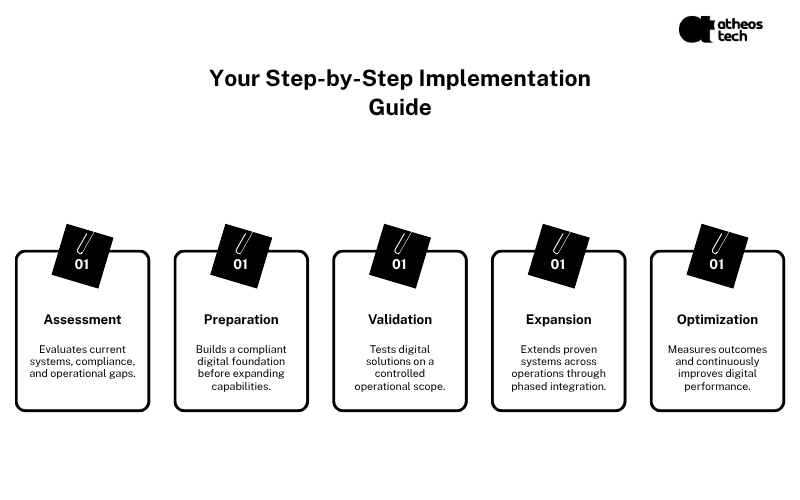
Discovery and mapping:
Audit existing compliance documentation, safety systems, customer touchpoints, and IT infrastructure to identify where the biggest gaps and risks actually sit, rather than starting from an assumed solution.
Compliance-ready foundations first:
Prioritise centralising compliance data and building the audit-trail layer before layering customer-facing or advanced analytics tools on top, since this reduces regulatory risk early and gives every later project a reliable data foundation.
Pilot on a contained scope:
Test new digital solution components, whether a dashboard, an integration, or a portal, on a single line, product group, or department before scaling cluster-wide, so that plant IT and operations teams can validate safety and reliability with limited exposure.
Integrate, then scale:
Once a pilot proves reliable, extend the API integration across additional systems and locations, and only then invest heavily in customer-facing digital marketing and portal features that depend on that underlying data being accurate.
Measure and iterate:
Track both compliance metrics (audit readiness, incident near-miss reporting speed) and commercial metrics (qualified leads, response time, portal adoption) so that the digital investment is evaluated on the same terms as any other capital project.
This sequencing reflects how conservative, safety-first industrial environments actually adopt new technology: trust is built incrementally, and each phase should make the next phase easier to justify internally.
Conclusion
Dutch chemical manufacturers at Chemelot and across the country’s other clusters are being pulled toward digitalisation from three directions at once: a regulatory framework that keeps consolidating and tightening under the Omgevingswet, Seveso III, and REACH; a safety agenda that increasingly depends on real-time data rather than periodic paperwork; and a commercial environment where technical buyers expect the same digital self-service experience they get everywhere else.
None of these pressures are going away, and companies that treat compliance, safety technology, and digital customer engagement as three separate problems will keep paying for that separation in duplicated work and missed opportunities.
Treating them as one connected digital infrastructure challenge, which is how AtheosTech approaches every engagement in this sector, is what turns digitalisation from a compliance cost into a genuine competitive advantage.
Not sure where to start with your own digital transformation roadmap?
AtheosTech offers a 360° digital consultancy and IT solutions approach built around the realities of Dutch chemical manufacturing.
FAQs
FAQs
It refers to the combined effort by companies operating at the Chemelot chemical and materials site to connect their compliance documentation, plant safety systems, and customer-facing digital channels through shared or interoperable digital infrastructure, rather than managing each in isolation.
The most relevant frameworks are the Seveso III Directive (implemented via the Omgevingswet and Besluit activiteiten leefomgeving since 2024), REACH, the ARIE-regeling, PGS 15 storage guidelines, the Arbowet/Arbobesluit, and VCA contractor certification.
A digital twin lets engineers simulate process changes, run hazard studies such as HAZOP or LOPA, and test scenarios virtually before applying them to a live asset, reducing the risk associated with trial-and-error changes on operating equipment.
Technical buyers now research suppliers online before making contact, so a manufacturer without searchable product data, technical content, and a clear digital presence is often excluded from consideration before a sales conversation even starts.
Projects that require ongoing regulatory knowledge, such as compliance dashboards or safety reporting integrations, tend to work best under a dedicated team or hybrid retainer model, while clearly scoped deliverables like a new website suit a fixed-scope project model.