- AtheosTech
The Digital Metal Fabricator: How Dutch Metalworking Firms Are Using Online Quoting, Portfolio Platforms, and Automation to Win Industrial Contracts
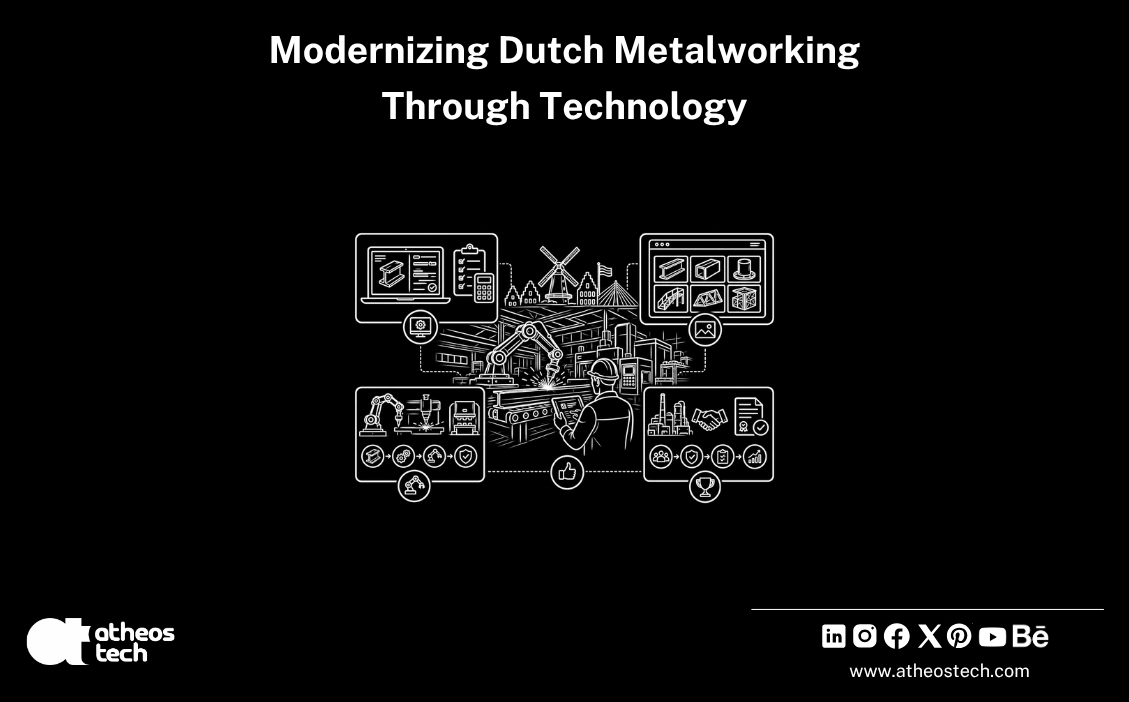
The Dutch maakindustrie (manufacturing industry) is going through its most important shift in a generation, and it is not just about faster machines. Metalworking firms across the Netherlands, from plaatwerk (sheet metal work) job shops in Brabant to precision verspaning (machining) suppliers near Twente, are discovering that winning industrial contracts today depends as much on digital transformation as it does on shop floor capability.
A buyer comparing three fabricators no longer picks up the phone first. They search online, they check a portfolio, they upload a drawing for an instant quote, and they move on to the next supplier if the response takes too long. This is the new reality of the digital metal fabricator, and it is reshaping how Dutch metalworking firms compete for contracts, tenders, and long-term OEM relationships.
In this piece, we unpack how online quoting, portfolio platforms, and automation are becoming the deciding factor in who wins industrial work in the Netherlands, and where a 360° digital consultancy and IT solutions partner like AtheosTech fits into that transformation.
The Dutch Metalworking Landscape Today: Why Digitalisation Is No Longer Optional
The Netherlands has long punched above its weight in precision manufacturing, and digitalization in metal fabrication is now the clearest sign of that shift. Regions like Brainport Eindhoven anchor a dense cluster of high-tech supply chains, and national programmes built around the Smart Industry agenda (the Dutch interpretation of Industry 4.0 and 5.0) are actively pushing metal manufacturing companies in the Netherlands toward digitalisation, connected factories, and data-driven production.
Here’s what is actually driving this shift:
Rising buyer expectations
Buyers now expect the same digital-first experience from a mid-sized fabricator in Overijssel that they get from a global online manufacturing marketplace, and that expectation is not going away.
A widening digital gap
Dutch SMEs, including many metalworking firms, are reported to lag behind larger enterprises in adopting advanced digital technologies, partly due to a persistent shortage of ICT specialists.
Energy and grid constraints
Industrial regions such as Brainport face capacity pressures that are pushing manufacturers toward smarter, data-driven production planning simply to keep output predictable.
Public investment
National digitalisation roadmaps and Digital Europe funding are lowering the cost and complexity of adopting tools once out of reach for small and mid-sized fabricators.
Tighter OEM qualification criteria
Larger OEMs increasingly favour suppliers who can demonstrate digital reliability alongside technical capability, making the digital transformation of metal fabrication a basic condition for staying in contention, not just a positioning exercise.
Together, these forces are reshaping the metalworking high-tech industry, and firms that move early on digitale infrastructuur (digital infrastructure), online quoting, and automation gain a durable edge over slower-moving competitors in metalworking Netherlands-wide.
Where Dutch Metalworking Firms Are Losing Industrial Contracts
Before looking at solutions, it is worth being precise about what is actually costing Dutch metalworking firms contracts today. Based on how the industry is evolving, these are the highest-impact, digitally solvable pain points:
Slow, manual quoting processes
A prospective buyer submits an offerteaanvraag (quote request) by email with a DXF or STEP file attached, and it sits in an inbox for days before someone manually reviews it, checks capacity, and replies. Trade press coverage of the fabrication industry has been direct about this: convenience creates demand, and firms still relying on manual, back-and-forth quoting are actively losing business to competitors who can return an instant, accurate price.
No credible online proof of capability
Industrial buyers now vet suppliers online before they ever send an RFQ. A fabricator without a searchable, well-structured portfolio of past projects, machine capacity, tolerances, and certifications effectively disappears from consideration during this pre-qualification stage.
Disconnected shop floor and customer-facing systems
Quotes, production schedules, and machine data often live in separate silos, so sales teams cannot see real capacity when promising a delivery date, and production teams cannot see incoming demand early enough to plan efficiently.
Heavy compliance and documentation overhead
Certifications such as NEN-EN 1090 (CE-marking for steel and aluminium structures) and welding quality standards generate significant paperwork that is still frequently managed manually, creating delays in quoting and contract confirmation.
Skilled labour shortages
A tightening market for qualified welders, CNC operators, and quality engineers means firms cannot simply "hire their way" out of inefficiency. Automation and digital tooling become necessary, not optional, to protect throughput.
Weak digital visibility
Even technically excellent fabricators are frequently invisible in search results when regional buyers or international OEMs are actively looking for a supplier, because they have never invested in lokale SEO (local SEO) or content marketing .
Each of these pain points compounds the others in practice. A firm with slow quoting is also usually the one without a searchable portfolio, because both stem from the same underlying gap: customer-facing digital infrastructure has simply never been built.
Meanwhile, the firms that have solved even one of these problems, most commonly instant online quoting, report a noticeable shift in the type and volume of enquiries they receive, often picking up buyers who would never have found them through word-of-mouth or trade directories alone. The lesson for Dutch metalworking firms is that these pain points are rarely isolated technical gaps. They are, collectively, the reason a technically capable fabricator can still lose contracts to a less experienced competitor that simply looks and behaves like a modern, digitally reliable supplier. (Source)
Further Reading
For a broader look at how the Netherlands’ high-tech manufacturing sector as a whole is digitising production and customer acquisition, click the link below and read the full guide.
Digital and IT Fixes That Turn Pain Points Into Contract Wins
Each of the pain points above maps to a concrete digital or IT solution, and this is where the real contract-winning advantage gets built.
- Online quoting portals with instant, DFM-aware pricing:
Replacing email-based RFQs with a web development solutions-built quoting engine lets buyers upload a CAD file and receive an accurate, manufacturability-checked price in minutes rather than days. This single change directly addresses the quoting-speed pain point that is now well documented as a competitive differentiator across the fabrication sector.
- Portfolio and case-study platforms
A structured, searchable digital portfolio (project galleries, tolerances achieved, materials handled, certifications held) turns a firm’s shop floor expertise into pre-qualification evidence a buyer can find and trust before first contact.
- API integration between quoting, ERP, and production scheduling
Connecting the customer-facing quoting tool to internal ERP/MRP systems through API integration means a quote reflects real capacity, and a confirmed order flows directly into production planning without manual re-entry.
- Compliance-ready digital documentation systems
Digitising certification records (NEN-EN 1090 executieklasse, ISO 3834 welding quality files, ISO 9606 welder qualifications) so they are attached automatically to relevant quotes and orders removes a major source of contract delay.
- Automation and Smart Industry-aligned tooling
Predictive maintenance dashboards, AI-assisted production scheduling, and connected machine data reduce the operational burden created by labour shortages, letting fewer people manage more throughput reliably.
- Digital Marketing as a growth solution
This is the piece too many metalworking firms still treat as optional, and it should not be. A combination of lokale SEO, PPC marketing, and ongoing content marketing is what makes a firm discoverable to the regional buyers and international OEMs who are actively searching for exactly the capability that firm offers.
Without this, even the best quoting portal and portfolio sit unseen. Digital marketing is the layer that turns a strong digital foundation into a steady pipeline of qualified industrial leads, and it is a service every Dutch metalworking firm serious about growth needs to invest in.
Importantly, these solutions are most effective when implemented together rather than in isolation. A quoting portal without a connected ERP still creates manual bottlenecks once an order is confirmed. A polished portfolio without digital marketing behind it may never be found by the buyers it was built to impress. The firms that see the clearest return are the ones that treat online quoting, portfolio visibility, system integration, compliance documentation, and digital marketing as one connected digital infrastructure, rather than a list of separate purchases to be made whenever budget allows.
360° Digital Consultancy and IT Solutions for Metalworking Firms
AtheosTech works with metalworking and industrial manufacturing clients as a 360° digital consultancy and IT solutions partner, and for this business category, a focused set of services consistently delivers the most value:
Web Development Solutions – Custom-built online quoting portals, portfolio and case-study platforms, and customer-facing project trackers, designed specifically around how industrial buyers actually evaluate and select suppliers.
API Integration – Connecting quoting tools, ERP/MRP systems, CRM platforms, and supplier portals so data moves automatically between customer-facing and shop-floor systems, eliminating manual re-entry and quoting delays.
Custom IT Consultant services – A tailored digital roadmap for firms at different stages of maturity, from a firm still running quotes through email to one ready to integrate AI-assisted scheduling and predictive maintenance.
360° Digital Consultancy – End-to-end guidance covering platform strategy, compliance-ready system design, and go-to-market digital presence, aligned to how the firm actually operates on the shop floor.
Digital Marketing – This is a core, non-negotiable part of AtheosTech’s offering for metalworking clients. Through lokale SEO, targeted PPC marketing, and ongoing content marketing, AtheosTech helps fabricators become the visible, trusted answer when a buyer in their region, or an OEM sourcing team abroad, searches for exactly the capability they provide.
A metalworking firm can achieve consistent inbound RFQ flow, stronger brand authority within its niche, and reduced dependency on slow, relationship-only sales cycles through a properly built digital marketing programme. What ties these services together is that none of them are offered as a generic package. A job shop chasing high-volume, low-value RFQs needs a very different quoting portal and marketing approach than a precision machining supplier serving two or three long-term OEM accounts.
AtheosTech’s role, in practice, is to assess where a metalworking firm’s real bottleneck sits (quoting speed, visibility, system integration, or compliance overhead) and build the specific combination of services that addresses that bottleneck first, rather than starting with a fixed list of deliverables.
Matching the Right Digital Strategy to Your Metalworking Segment
Not every metalworking business operates the same way, and the right digital investment depends heavily on which niche a firm sits in.
Micro-level niches within Dutch metalworking include:
- Job shops/contract fabricators – Firms taking on varied, often one-off or low-volume work (laser cutting, bending, welding) for a wide range of customers. These firms benefit most from instant online quoting, since volume and speed of RFQ turnaround directly drive revenue.
- Precision machining suppliers (verspaning specialists) – Firms serving tight-tolerance sectors like high-tech equipment or aerospace components, where a detailed digital portfolio demonstrating precision capability matters more than instant pricing alone.
- Structural steel and aluminium construction fabricators – Firms working under NEN-EN 1090 executieklasse requirements for construction and infrastructure projects, where compliance documentation and traceability are central to winning tenders.
- Tier-2/Tier-3 OEM component suppliers – Firms embedded in a larger manufacturing supply chain (automotive, machinery, industrial equipment), where API-integrated systems connecting directly into an OEM’s procurement platform matter more than public-facing marketing.
Applicable business and revenue models:
- Per-project quoting model – Revenue tied to individual RFQs and project wins, best suited to job shops and contract fabricators, where an online quoting portal directly increases conversion volume.
- Recurring/marketplace-style model – Revenue built around repeat buyers using a self-service portal for recurring orders, suited to firms handling standardised or semi-standardised parts.
- Retainer-based supply relationships – Revenue from long-term OEM or infrastructure contracts, where the priority shifts from lead generation to system integration, compliance documentation, and reliability of delivery data.
Choosing the right combination of digital tools depends entirely on which of these niches and models a firm operates in, which is why a generic, one-size-fits-all platform rarely works well in this sector.
It is also worth noting that many Dutch metalworking firms do not sit neatly inside a single niche. A firm might run a high-volume job shop operation for smaller customers while also holding a long-standing retainer relationship with one or two larger OEM accounts.
In these hybrid cases, the digital strategy usually needs to support both models at once, typically an instant, self-service quoting portal for the transactional side of the business, alongside a more integrated, API-connected system for the retainer relationships where reliability and traceability matter more than speed of first response.
NEN-EN 1090, ISO 3834, and VCA in a Digital-First Fabrication Business
Compliance is not a side note in Dutch metal fabrication. It is often the deciding factor in whether a firm is even eligible to bid on a contract, particularly for structural and construction-related work.
- NEN-EN 1090
The mandatory European standard (with its Dutch NEN implementation) governing CE-marking for load-bearing steel and aluminium structures. Since 2014, structural steel components sold within Europe must carry this CE-marking, and buyers routinely check for valid certification before confirming an order. (Source)
- NEN-EN-ISO 3834
The welding quality management standard, frequently required alongside NEN-EN 1090 certification to demonstrate controlled, traceable welding processes.
- ISO 9606
The welder qualification standard, confirming that personnel performing welding work meet the technical competency required under NEN-EN 1090.
- VCA (Veiligheid, Gezondheid en Milieu Checklist Aannemers)
The Dutch safety, health, and environment checklist widely required for contractors working on industrial and construction sites.
For a digital platform to genuinely serve this industry, it needs to be built with these realities in mind from day one. AtheosTech designs quoting portals, portfolio platforms, and documentation systems for metalworking clients so they are NEN-EN 1090, ISO 3834, and VCA compliance-ready, meaning certification data, executieklasse classifications, and traceability records can be attached, displayed, and verified directly within the digital workflow rather than chased down manually for every RFQ.
This matters commercially as much as it matters legally. Buyers and main contractors working under NEN-EN 1090 executieklasse requirements routinely ask suppliers to confirm their certification status and classification before a quote is even considered, and if that information is not easy to find or verify, some buyers will simply move on to a competitor whose compliance credentials are clearly and confidently presented.
Building compliance visibility directly into a firm’s online quoting and portfolio platform turns what is often treated as a back-office paperwork burden into a visible, contract-winning trust signal.
The Platforms Redefining Online Metal Fabrication
Dutch metalworking firms looking to modernise their customer-facing operations often point to a handful of global platforms as the benchmark for what “digital-first” fabrication should feel like. Platforms like Hubs (now part of Protolabs Network), Xometry, Fictiv, and RapidDirect have set the standard for instant online quoting, DFM feedback, and searchable manufacturing portfolios at scale.
AtheosTech does not build a copy of any single platform. Instead, we study what makes these category-defining platforms effective and build a custom solution inspired by that proven model, tailored to a firm’s actual capabilities, certifications, niche, and customer base:
- Instant, CAD-based quoting that mirrors the speed buyers already expect from global marketplaces
- Transparent manufacturability (DFM) feedback built into the upload process itself
- Structured, searchable project portfolios instead of a static “About Us” page
- Integrated order tracking so a buyer can follow a project from quote to delivery
Why this matters for positioning:
- Buyers comparing quotes across large online marketplaces still expect the same convenience from a smaller, regional fabricator
- Those same buyers often want the added confidence of a known, local, specialised partner rather than an anonymous marketplace listing
- A custom-built platform lets a Dutch metalworking business compete on convenience while keeping the relationship-driven trust a large marketplace cannot offer
Ready to make your quoting portal, portfolio, and digital presence work together to win more industrial contracts?
Automation & Smart Industry Alignment: From CNC Data to AI-Driven Production
Automation in Dutch metalworking is not an isolated technology upgrade. It is part of a coordinated national direction, most clearly expressed through the Smart Industry Wheel, the Dutch elaboration of Industry 4.0 and 5.0 developed with input from organisations like TNO. This framework organises transformation around themes including flexible manufacturing, digital and connected factories, and smart working, aiming to help Dutch manufacturing become a European leader in smart production.
For an individual metalworking firm, this translates into practical, achievable steps rather than abstract strategy:
AI-assisted quoting
Using historical project and resource data to generate faster, more consistent quotes, freeing sales staff from repetitive manual estimation work.
Predictive maintenance
Using machine data to anticipate failures before they cause downtime, protecting delivery reliability on contracted work.
Optimised production scheduling
Using real-time data to sequence jobs efficiently, directly addressing the throughput pressure created by skilled labour shortages.
Connected factory data
Feeding shop floor data back into customer-facing systems so quoted lead times reflect actual, current capacity rather than static estimates.
Firms that align their automation investments with this broader Smart Industry direction are better positioned not just operationally, but competitively, since buyers and larger OEM supply chains increasingly favour suppliers who can demonstrate this level of digital maturity.
On sequencing: most firms don’t need every step at once.
- Start with whichever capability removes the most immediate bottleneck, often AI-assisted quoting or connected scheduling data
- Expand into predictive maintenance and deeper Smart Industry integration once that first layer shows measurable value
- Treat automation as a staged journey, not a single large project, to keep it easy to justify internally and keep shop floor teams engaged
Winning Contracts Through Digital Marketing
Even the fastest quoting portal and the most impressive portfolio will not win contracts if the right buyers never find them. This is where a dedicated digital marketing strategy becomes essential, not supplementary, for a Dutch metalworking firm.
- Lokale SEO ensures that when a procurement manager in Rotterdam, Eindhoven, or Twente searches for a laser cutting or CNC machining partner in their region, the firm actually appears in those results, not just its larger, better-funded competitors.
- Content marketing builds long-term search visibility and buyer trust by publishing genuinely useful technical content (capability guides, material and tolerance explainers, case studies) that positions the firm as a credible authority rather than just another supplier listing.
- PPC marketing provides immediate, targeted visibility for high-value search terms and tender-related keywords, useful for firms entering a competitive niche or launching a new online quoting platform that needs traffic quickly.
Together, these three pillars turn a firm’s digital infrastructure investment into an actual pipeline of qualified industrial RFQs, rather than a well-built platform that quietly goes unnoticed.
These three pillars also work on different timeframes:
- PPC marketing delivers visibility almost immediately, useful for filling a gap in the order book or promoting a newly launched quoting portal
- Lokale SEO builds more gradually but produces durable, lower-cost visibility for regional searches like laser cutting or CNC machining
- Content marketing compounds over time, becoming one of the strongest authority signals a firm can build in its niche
A well-run programme blends all three: PPC for early momentum, SEO and content marketing for the long-term visibility that keeps qualified RFQs arriving consistently.
Choosing the Right Way to Work With a Digital Partner
Based on AtheosTech’s working dynamics, the right engagement model for a metalworking firm depends heavily on where it sits in its digital journey and which niche and revenue model it operates under:
Project-based engagement:
Best suited to firms building their first online quoting portal or portfolio platform, where the scope is well-defined (design, build, launch) and the priority is a clean, working deliverable within a fixed timeline.
Phased rollout engagement:
Recommended for firms integrating multiple systems together (quoting portal, ERP, compliance documentation, digital marketing) where a staged approach reduces operational risk and allows the shop floor team to adapt gradually.
Retainer-based engagement:
Best suited to firms prioritising ongoing digital marketing (lokale SEO, content marketing, PPC), continuous platform maintenance, or firms in retainer-based OEM supply relationships where consistent digital presence and system reliability matter more than a single deliverable.
Choosing between these depends on the firm’s niche, current digital maturity, and whether the immediate priority is building a new capability or maintaining and growing an existing one.
In practice, many clients move through all three over time rather than picking just one:
- Start with project-based to launch the first quoting portal
- Shift to phased rollout while connecting that portal to ERP and adding compliance documentation
- Settle into retainer-based once the priority becomes ongoing digital marketing and platform improvements
Thinking of the engagement model as something that evolves with the firm’s digital maturity tends to produce better long-term outcomes than committing to a rigid structure upfront.
Conclusion
Winning industrial contracts in the Dutch metalworking sector is no longer just a question of shop floor capability. It is increasingly decided by:
- How quickly a firm can quote
- How credibly it can showcase its work online
- How well its systems talk to each other
- How visible it is to buyers actively searching for exactly what it offers
Online quoting, portfolio platforms, automation, compliance-ready digital systems, and a genuine digital marketing strategy are no longer optional extras for a Dutch metal fabricator. They are the new baseline for staying competitive against both domestic rivals and global online manufacturing platforms, and the clearest expression yet of the digital transformation of metal fabrication across the metalworking high-tech industry.
The firms that struggle most in the coming years are unlikely to be the ones with weaker machinery or less skilled welders. They will be the ones that kept treating digital infrastructure as an optional marketing expense rather than a core part of how industrial contracts are actually won today.
The opportunity in front of metal manufacturing companies in the Netherlands right now is to close that gap deliberately, one connected piece at a time, before it becomes the deciding factor between the firms that grow and the firms that quietly lose ground to more visible, more responsive competitors.
Want to find out what a digital-first quoting portal, portfolio platform, and digital marketing strategy could look like for your metalworking business?
FAQs
FAQs
Digital marketing, particularly lokale SEO, content marketing, and PPC, makes a firm discoverable to buyers actively searching for its specific capability, turning an otherwise invisible shop floor strength into a steady pipeline of qualified inbound RFQs.
A project-based engagement is usually best for a first build, such as a quoting portal or portfolio platform, since the scope is well-defined. Firms integrating multiple systems typically benefit more from a phased rollout.
A job shop typically takes on varied, often lower-volume or one-off work across many customers, while a contract manufacturer or Tier-2/Tier-3 OEM supplier usually works within longer-term, higher-volume supply relationships tied to a specific customer's production needs.
Technical buyers now research suppliers online before making contact, so a manufacturer without searchable product data, technical content, and a clear digital presence is often excluded from consideration before a sales conversation even starts.
Because buyers increasingly choose suppliers based on quoting speed. Instant, CAD-based online quoting removes the multi-day delay of manual review and directly improves conversion on incoming RFQs.