- AtheosTech
Precision Engineering Meets Digital Precision: How Dutch Electronics and Precision Manufacturers Are Building Global Buyer Pipelines Online
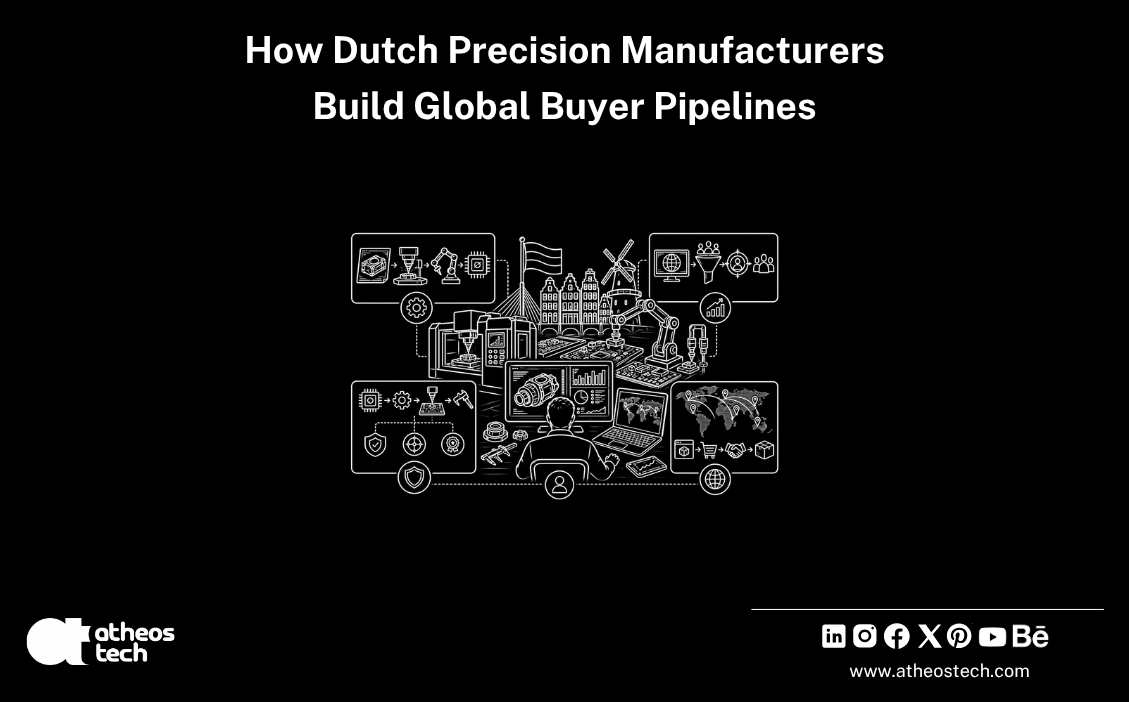
The Netherlands has quietly become one of the most technically dense manufacturing regions in the world. Around Brainport Eindhoven, Veldhoven and Helmond, a tight network of precision engineering firms, mechatronics specialists, photonics developers and electronics OEMs supply the systems behind global semiconductor, medical and aerospace industries.
Yet many of these same companies are still running their international sales pipeline the old way: trade shows, personal networks, and a website that reads like a product datasheet from 2012.
Research shows B2B buyers now complete roughly 57 to 70 percent of their purchase decision before ever contacting a supplier, which means a buyer’s first real interaction with a Dutch precision manufacturer is its website, not its sales team. Building digital buyer pipelines for Dutch precision manufacturers is no longer optional; it is the difference between being found by a procurement engineer in Munich or Michigan, and being invisible to them entirely.
This blog looks at where the sector stands today, the pain points holding back digital buyer acquisition, and how digital transformation and IT solution partners like AtheosTech help precision engineering and electronics manufacturers turn technical excellence into a predictable, global lead pipeline.
The Dutch Precision & Electronics Landscape: Why This Sector Is Different
Dutch precision manufacturing does not compete on volume. It competes on tolerance, reliability and systems integration. The maakindustrie (manufacturing industry) here is anchored by companies such as ASML, VDL ETG, NTS Group, Neways, Prodrive Technologies and Sioux Technologies, all clustered around the Brainport ecosystem where universities, suppliers and contract manufacturers sit within a short drive of each other.
This proximity shortens development cycles and makes tight collaboration between OEMs and their toeleverancier (supplier or subcontractor) network possible in a way few other regions can match.
What makes this sector different from mainstream B2B manufacturing is threefold:
Technical buyers, not casual browsers
The people evaluating a Dutch precision supplier are usually procurement engineers, R&D leads or system integrators who read datasheets, tolerances and certification documents before they ever pick up the phone.
Long consideration cycles
Decisions on mechatronic systems, PCBA contracts or metrology equipment can take months, moving through technical validation, quality audits and pilot runs before a purchase order is signed.
Global sourcing behaviour has shifted online
Buyers increasingly start their search on B2B directories, supplier databases and technical search queries rather than through referrals alone, which means a manufacturer's digital footprint now directly determines whether it even enters the shortlist.
The opportunity extends beyond lithography and chipmaking into adjacent fields like integrated photonics, advanced packaging, metrology and power electronics, where Dutch firms are already strong. For a mid-sized precision engineering firm, the addressable market online is larger than most owners assume, provided the digital groundwork is in place.
Most procurement decisions now begin with an unassisted online search rather than a direct call, and B2B marketplaces have become central to how sourcing teams build their shortlists. The first impression is rarely a handshake anymore; it is a Google search, a directory listing, or a LinkedIn post.
This is why investing in digitale infrastructuur (digital infrastructure) early is a structural advantage. A manufacturer competing purely on referrals is invisible to a buyer in Texas or Taiwan who has never heard of the company. The firms pulling ahead treat their online presence with the same precision as a five-micron tolerance: structured, documented, and verifiable at a glance.
Niches and Business Models in Dutch Precision Engineering
Not every precision manufacturer competes in the same way, and a digital strategy has to reflect the specific niche and revenue model a company operates in. Some of the clearest micro-categories in this space include:
- Electronics Manufacturing Services (EMS) and PCBA production, serving sectors like semiconductors, aerospace, and medical devices with printed circuit board assemblies.
- Mechatronic and motion systems, combining mechanical design, electronics, and embedded software for high-tech OEMs.
- Photonics and optical systems, an increasingly strategic niche adjacent to semiconductor equipment.
- Metrology, inspection and quality control systems, essential as chip and component tolerances tighten further.
- Cleanroom, vacuum and thermal management technology, supporting semiconductor fabrication environments.
- Contract manufacturing and first-tier OEM supply, where a company becomes an embedded long-term partner inside a larger manufacturer’s supply chain rather than a one-off vendor.
The revenue models attached to these niches also differ meaningfully:
- Project-based engineering contracts, where a client pays for design, prototyping and a defined production run.
- Long-term OEM supply agreements, often multi-year, with recurring volume commitments.
- Licensing plus manufacturing hybrids, where IP or proprietary design is licensed alongside physical production.
- Aftersales, spares and lifecycle support, which for capital equipment can generate revenue long after the original sale.
Each of these models needs a different kind of digital presence. A company built on long-term OEM contracts needs a website that builds long-cycle trust and technical credibility, while a company selling spares and aftersales support benefits more from searchable product catalogues and fast web development solutions that support self-service ordering.
It is worth being precise about why this niche-level thinking matters so much here. A generic “manufacturing website template” treats an EMS provider assembling high-volume PCBAs the same way it treats a photonics specialist producing single-unit optical assemblies for a research institute, and that is a mistake. The buyer journey, the technical proof points a visitor needs to see, and the length of the sales cycle are all different:
- An EMS or PCBA provider needs to show volume capacity, quality certifications, and turnaround speed prominently, since buyers are often comparing several suppliers on production capability alone.
- A mechatronics or motion systems integrator needs to demonstrate systems-level thinking through detailed case studies, since the sale is rarely a single component but a full engineered solution.
- A metrology or inspection technology company benefits from highly technical content, application notes, and white papers that speak directly to engineers evaluating measurement accuracy.
- A contract manufacturer or first-tier OEM supplier needs a digital presence built around long-term partnership signals: quality management documentation, supply chain resilience, and account-based content aimed at a small number of large buyers rather than broad lead volume.
This is also why AtheosTech starts every engagement in this sector with keyword and buyer research specific to the client’s niche, rather than applying a single manufacturing SEO or content playbook across every precision engineering client.
Further Reading
To see how this same digital shift is playing out across the wider Dutch high-tech manufacturing sector, read our related blog: From Brainport to the Global Market: How the Netherlands’ High-Tech Manufacturing Sector Is Digitising Production, Supply Chains, and Customer Acquisition.
High-Impact Pain Points Digital Solutions Can Solve
Based on how this sector currently operates, a recurring set of pain points shows up again and again, and almost all of them are solvable through the right combination of IT solution and digital marketing work rather than more trade show attendance.
Invisibility to international buyers – Many precision manufacturers have strong domestic reputations built over decades, but their websites are not built for how an American, German, or Asian buyer actually searches. Weak technical content marketing and thin English-language SEO means qualified buyers never find them.
Manual, email-based RFQ handling – Quote requests often still arrive by email or phone with no structured intake, which slows response time and makes it hard to track where a lead is in the pipeline.
No digital nurturing for long sales cycles – Because buying cycles stretch across months, a single missed follow-up can lose a deal. Without automated nurturing, sales teams rely entirely on memory and manual outreach.
Thin proof of technical credibility online – Certifications, case studies, tolerance capabilities, and quality processes exist, but they are rarely presented in a way that a first-time international buyer can quickly verify.
Disconnected CRM and ERP systems – Sales, quoting, and production planning often live in separate systems, which slows quote turnaround and creates friction exactly where speed builds buyer confidence.
Legacy websites not built for global, technical audiences – Many sites are slow, not mobile-optimised, and not structured for the kind of detailed technical search queries engineers actually use.
Fragmented ownership of the buyer’s digital journey – Marketing, sales, and technical teams often each control a different piece of the online presence: LinkedIn, the website, a separate quoting tool, with no single source of truth for where a lead actually stands.
Underused data on what buyers are actually searching for – Search volume and query data on specific tolerances, materials, or certifications often goes completely unused, meaning content and PPC budgets are spent on guesswork rather than evidence.
None of these are engineering problems. They are digital infrastructure and process problems, and they are exactly where a digital solution built around this sector’s specific sales cycle makes the difference between a website that exists and a website that actively generates qualified international enquiries.
Digital and IT Solutions Mapped to Those Pain Points
Each of these pain points maps to a specific, practical solution, and this is where a 360° digital consultancy partner like AtheosTech works alongside a manufacturer’s existing engineering strength rather than replacing it.
Technical content marketing and R&D-led storytelling – Whitepapers, technical case studies, and application notes written for engineers, not marketers, are what actually move a precision manufacturer up a buyer’s shortlist. This is content marketing built for a technical audience, not generic blog volume.
Web development solutions built for spec-driven buyers – A modern, fast, multi-language website that presents tolerances, certifications, and production capabilities clearly, structured so search engines and technical buyers can both find what they need quickly.
API integration between RFQ forms, CRM and ERP – Connecting the website’s quote request form directly into the sales CRM and production ERP through API integration removes manual data entry and cuts quote turnaround time significantly.
PPC marketing for high-intent global buyers – Targeted PPC marketing campaigns aimed at procurement engineers and technical decision-makers searching for specific capabilities (for example, precision CNC tolerances or PCBA volume capacity) bring in buyers who are already close to a purchase decision.
Lokale SEO combined with international technical SEO – Lokale SEO (local SEO) keeps a manufacturer visible for regional partnerships and Dutch-language searches, while a parallel international SEO strategy targets the English-language technical search terms global buyers actually use.
Custom IT consultant support for digital infrastructure – From hosting to cybersecurity to system integration, ongoing custom IT consultant support ensures the underlying digital solution stays reliable as the business scales its online presence.
Bringing these pieces together is what a genuine digital transformation looks like for this sector: not a single new tool, but a connected system where marketing, sales, and production data move together instead of sitting in silos.
A few practical examples of what this looks like once it is running:
- An engineer in Germany searches for a specific machining tolerance or PCBA capability, lands on a technical application note published as part of an ongoing content marketing programme, and downloads a related case study.
- That download triggers an automated, GDPR/AVG-compliant follow-up sequence rather than sitting in an inbox waiting for someone to notice it.
- A structured RFQ form, connected through API integration to the internal CRM and ERP, gives the sales team instant visibility into production capacity before they even reply to the buyer.
- PPC marketing campaigns are continuously refined based on which search terms actually convert into qualified RFQs, not just which ones generate traffic.
This is the practical, day-to-day version of 360° digital consultancy and IT solutions: connecting the tools a precision manufacturer already has, and filling the gaps, rather than replacing systems that already work well internally.
Ready to turn your engineering credibility into a global buyer pipeline??
Talk to AtheosTech about building a connected digital marketing and IT strategy for your business.
Compliance-Ready Digital Presence
Precision engineering and electronics manufacturers operate under some of the strictest product and data regulations in Europe, and a digital strategy has to be built with these in mind from day one rather than bolted on afterwards.
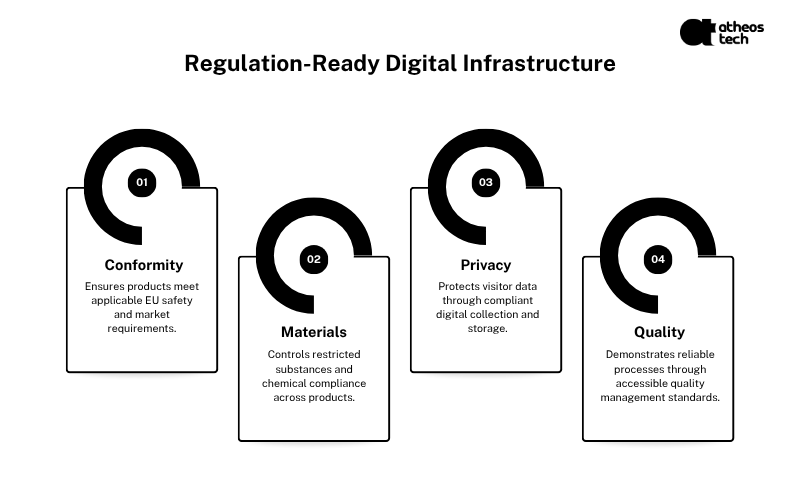
CE marking and underlying directives
Electrical and electronic products sold in the EU typically fall under the Low Voltage Directive, EMC Directive and RoHS Directive, and manufacturers are responsible for testing and documenting conformity before a product enters the market, according to guidance published on business.gov.nl.
RoHS and REACH
RoHS restricts hazardous substances such as lead, mercury and cadmium in electrical and electronic equipment, while REACH governs chemical substances more broadly across almost every industry, as outlined by euverify.com.
GDPR / AVG (Algemene Verordening Gegevensbescherming)
Any website collecting RFQ submissions, newsletter sign-ups or CRM data from EU visitors needs privacy-safe forms, proper cookie consent, and compliant data storage.
ISO 9001 and quality management documentation
While this certifies the organisation rather than the product, it is frequently what a first-time buyer checks before shortlisting a supplier, and it should be easy to find and verify on the company website.
AtheosTech’s digital infrastructure for this sector is always built to be GDPR/AVG-ready, with CE, RoHS and REACH documentation presented clearly on the site so that international buyers can self-verify compliance before ever contacting sales.
This matters because a CE marking works as a trade passport for entry into the EU market, and it is directly tied to RoHS and REACH compliance for electrical and electronic products. Presenting this documentation clearly online, rather than only on request, removes friction for buyers comparing several suppliers at once.
Where Global Buyers Actually Search: The Platform Landscape
Understanding where international buyers currently look for precision manufacturing partners helps shape both SEO strategy and where a manufacturer should maintain a presence.
- Europages, a European B2B directory covering millions of listed companies across more than 30 European countries, is frequently used by procurement teams researching regional and EU-based suppliers.
- Kompass, a long-standing global business directory with detailed firmographic data, is commonly used for supplier discovery and market research before outreach begins.
- ThomasNet, primarily strong in North America, remains a key discovery point for industrial buyers seeking verified suppliers with clear certifications and production capability.
- Global sourcing platforms such as Alibaba and Made-in-China are less central to high-precision, certification-heavy manufacturing, but they still shape buyer expectations around how quickly a supplier profile answers technical questions.
AtheosTech does not build a copy of any single platform. Instead, we design custom IT consultant-led buyer portals for manufacturers that mirror the discovery and RFQ logic buyers already expect from these platforms: structured search, clear technical filtering, and fast quote requests, but fully owned and branded on the manufacturer’s own digital infrastructure rather than rented space on a third-party directory.
Directory platforms are strong for initial discovery, but not for deep relationship-building or structured, product-specific quoting. That is the layer AtheosTech focuses on: making sure that once a buyer finds a manufacturer through a directory, search engine, or referral, the manufacturer’s own website is ready to convert that interest into a qualified, trackable enquiry.
Engagement Models Suited to This Sector
Given the long sales cycles and technical depth of this industry, the way a digital partner engages with a precision manufacturer matters as much as the solutions themselves. Based on AtheosTech’s working dynamics, a few engagement approaches consistently fit this sector best:
- Retainer-based digital marketing partnerships, suited to companies that need ongoing content marketing, PPC marketing and lokale SEO management as an extension of their internal team, rather than a one-off project.
- Project-based web and API builds, ideal when the immediate need is a new website, RFQ portal, or API integration between existing CRM and ERP systems with a clearly defined scope and delivery timeline.
- Dedicated pod model, where a small cross-functional team (strategist, developer, SEO specialist) works as an embedded extension of the manufacturer’s marketing or sales function, useful for companies scaling into multiple export markets at once.
Choosing between these depends largely on where a manufacturer is in its digital maturity: a company just beginning its digital transformation journey often starts with a project-based website and RFQ system rebuild, then moves into a retainer model once the foundation is in place.
A few practical questions help decide which model fits best:
- Is the immediate priority a one-time technical rebuild (new site, new RFQ system, new API integration), or ongoing lead generation that needs continuous management?
- Does the internal team have marketing capacity already, and simply need specialist execution on PPC marketing or lokale SEO, or is there no dedicated marketing function at all?
- Is the company expanding into a genuinely new export market, where a dedicated pod with market-specific research may be worth the investment, or optimising an existing, already-active market?
There is no single right answer here, and part of AtheosTech’s own working dynamics is scoping this honestly with a client before recommending a model, rather than defaulting to whichever engagement type is easiest to sell.
Measuring Whether the Digital Pipeline Is Actually Working
A digital buyer pipeline is only useful if a manufacturer can see whether it is actually producing qualified opportunities, not just traffic. A few measurement practices consistently matter in this sector:
- Track RFQs by source and niche, not just total form submissions, so it is clear whether PPC marketing, organic content marketing, or directory listings are producing the buyers most likely to close.
- Measure time-to-quote, since this is one of the clearest signals of whether API integration between the website, CRM and ERP is actually reducing friction for buyers.
- Track which technical content drives the most qualified downloads and enquiries, so future content marketing investment goes toward the topics, tolerances and certifications buyers are genuinely searching for rather than what internally seems important.
- Review lokale SEO and international SEO performance separately, since a strong ranking for Dutch-language regional terms says nothing about visibility for the English-language technical searches an overseas buyer is running.
This kind of measurement discipline is what turns a website from a static brochure into a genuine, trackable buyer pipeline, and it is a core part of how AtheosTech structures ongoing retainer engagements in this sector.
Conclusion
Dutch precision engineering and electronics manufacturers already have the hardest part solved: world-class engineering, tight tolerances, and decades of technical credibility built into companies clustered around Brainport Eindhoven and beyond.
What is often missing is a digital solution that carries that same precision into how the business is discovered, evaluated, and chosen by buyers who now start their search online, whether they are in Rotterdam or Ohio. Closing that gap does not mean abandoning the relationship-driven, technical way this industry sells.
It means building the digital infrastructure, content, and systems that let those relationships start earlier, move faster, and reach further, through 360° digital consultancy designed specifically around how precision manufacturers actually operate.
If you are ready to build a compliant, technically credible digital buyer pipeline for your precision engineering or electronics business
AtheosTech is ready to map out the right strategy with you
FAQs
FAQs
Lokale SEO focuses on visibility for Dutch-language searches and regional partnerships, while international SEO targets the English-language technical terms that global buyers use when searching for specific manufacturing capabilities.
Yes. Without API integration, RFQ submissions have to be manually re-entered into a CRM or ERP, which slows down quote turnaround exactly where buyers expect speed and precision.
Yes. Any website collecting contact details, RFQ submissions, or newsletter sign-ups from EU visitors is subject to GDPR/AVG requirements, regardless of whether the end buyer is a consumer or a business.
Both have a role. Directory listings help with initial discovery, but a manufacturer's own website is where technical credibility, certifications, and direct RFQ handling need to live, which is why AtheosTech focuses on building that owned digital infrastructure rather than relying solely on third-party directories.
Trade shows and referrals still matter, but most international procurement teams now research and shortlist suppliers online before ever attending an event or asking for an introduction. A manufacturer without a strong digital presence risks being left off that shortlist entirely.